
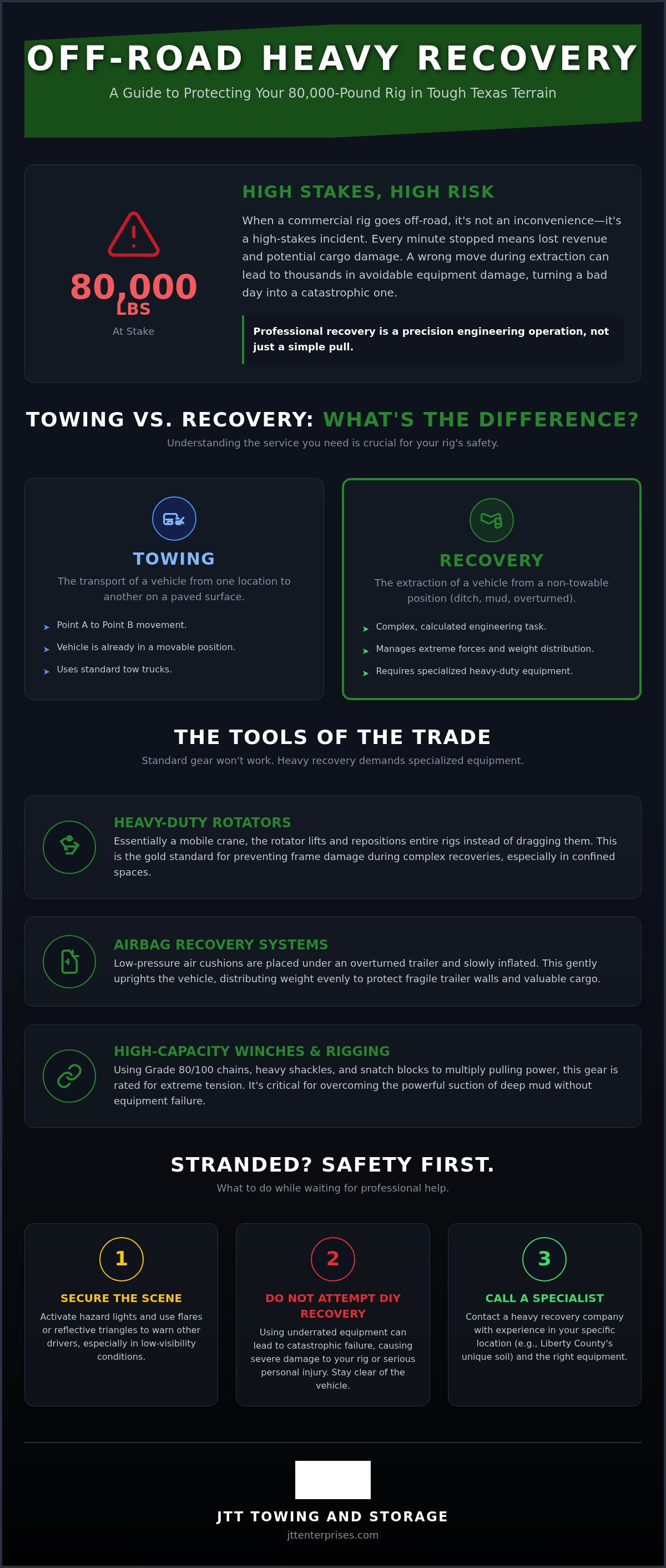
When your 80,000-pound rig slides off a rain-slicked shoulder in the remote backwoods of Liberty County, the silence that follows is often more deafening than the initial crash. You know that every minute your wheels are buried in the East Texas mud, your commercial operation is losing money and your cargo is at risk. It's a high-stakes situation where a single wrong move during extraction can lead to thousands of dollars in avoidable equipment damage. Professional Off-Road Recovery is a precision engineering operation, not just a simple pull.
We understand the anxiety of watching your livelihood sit precariously in a ditch. This article explains exactly how heavy-duty recovery works and how to protect your rig and cargo when stuck in the toughest Texas terrain. You'll learn about the specialized equipment required for safe extraction, the importance of maintaining load integrity, and how to manage a recovery when you're stranded in remote locations without a signal. Our goal is to provide the peace of mind that comes from knowing your equipment is in capable, local hands.
Key Takeaways
- Professional Off-Road Recovery utilizes heavy-duty rotators and airbag systems to upright overturned trailers while protecting the integrity of your cargo.
- Standard towing often fails in thick Texas mud because it doesn't account for the "suction" effect that traps heavy axles.
- Managing 40,000-pound load shifts during an extraction is essential to prevent trailer damage and minimize costly operational downtime.
- Secure your scene with flares and avoid DIY recovery attempts that can lead to catastrophic equipment failure or personal injury.
- Reliable recoveries in Dayton require a partner who understands Liberty County's unique soil conditions and maintains the readiness required for commercial fleets.
What is Off-Road Heavy Recovery and Why is it Unique?
Off-Road Recovery isn't just a larger version of pulling a passenger car out of a ditch. It is the specialized process of extracting heavy commercial vehicles from non-paved environments where standard equipment simply cannot reach or operate safely. When an 80,000-pound rig leaves the asphalt, the situation transforms from a simple mechanical failure into a high-stakes incident. Heavy recovery is a calculated engineering task involving complex physics and high-capacity machinery. It requires a deep understanding of weight distribution and ground pressure to ensure the vehicle is returned to the road without further damage.
Standard towing often fails in these scenarios because it doesn't account for the "suction" effect of Texas mud on heavy axles. In Liberty County, the soil can act like a vacuum, gripping the undercarriage and making the effective weight of the vehicle feel twice its actual size. If an operator tries a standard pull without breaking this vacuum, the result is often frame twisting or catastrophic trailer failure. Using the correct vehicle recovery methods is the only way to overcome these environmental forces while keeping the equipment intact.
Common Scenarios in Dayton and Liberty County
Our local terrain presents unique challenges for commercial drivers. We frequently see semi-trucks stuck on soft shoulders or construction site entrances where the ground wasn't as packed as it appeared. Log trucks often get bogged down in remote East Texas timber tracts, where the narrow trails offer zero room for error. Additionally, oil field equipment frequently gets trapped on unpaved lease roads after heavy rain, requiring a partner who knows how to navigate the backroads of the 77535 and 77336 zip codes.
The Difference Between a Tow and a Recovery
It's important to distinguish between these two services. Towing is the transport of a vehicle from point A to point B; recovery is the act of getting the vehicle into a towable position in the first place. During an Off-Road Recovery, winching requires specific, reinforced anchor points. If an operator hitches to a bumper or a steering component, they risk tearing the hardware right off the frame. For a detailed look at the technical process of a winch-out, you can read our Semi Truck Winch Out: Professional Recovery Guide. This distinction ensures that we prioritize the structural integrity of your rig before we ever begin the journey back to the shop.
Specialized Equipment for Large-Scale Off-Road Extractions
Successful Off-Road Recovery on a commercial scale relies on heavy-duty machinery designed for extreme tension and weight. Consumer-grade winches might work for a weekend trail rider, but they are dangerous when applied to a loaded tractor-trailer stuck in Liberty County clay. We use a combination of high-capacity winches and snatch blocks to double our pulling power. This mechanical advantage is critical for deep mud extractions where the resistance of the soil exceeds the vehicle's dead weight. We only utilize Grade 80 or Grade 100 chains and heavy-duty shackles to ensure every attachment point is secure and rated for the task.
Safety is the primary concern during these high-tension operations. Following official off-road safety guidelines helps prevent equipment failure that could lead to injury. Our operators are trained to calculate load limits before a single cable is tightened. This specialized Off-Road Recovery gear allows our team to manage even the most complex scenes. If you find yourself in a difficult situation, reaching out to a team with the right accident recovery equipment is the best way to protect your investment.
When to Call for a Rotator Service
A heavy-duty rotator is essentially a crane-style wrecker that can lift and rotate entire rigs. This equipment is indispensable for recovering overturned semis in confined spaces where traditional wreckers cannot position themselves. Instead of dragging a vehicle across the terrain, which causes extensive frame and body damage, the rotator lifts the unit vertically. This is the gold standard for complex recoveries on narrow Dayton roads or busy construction sites. It allows us to upright a trailer and place it directly onto a flatbed without further compromising the vehicle's structural integrity.
Airbag Recovery: Protecting the Cargo
Airbag recovery systems are the preferred method for uprighting overturned trailers safely. These low-pressure air cushions are placed under the trailer and inflated slowly to distribute weight evenly. This prevents the trailer walls from collapsing under the concentrated pressure of a traditional tow strap. It's the best solution for delicate or liquid loads that might shift and cause a secondary rollover during uprighting. Using airbags also minimizes the environmental impact during off-road spills by providing a stable, controlled lift that prevents further leakage from damaged tanks or containers.
Commercial Recovery vs. Standard Off-Roading
Standard off-roading isn't just a recreational hobby; for Dayton fleet owners, commercial Off-Road Recovery is a high-stakes business necessity. The most pressing concern is the "Downtime Factor." Every hour a truck sits in a ditch is an hour of lost revenue, missed delivery windows, and potential contract penalties. Commercial recovery involves managing complex logistics and liability, not just mechanical pulling. It requires a partner who follows the professional standards set by the Towing and Recovery Association of America to ensure the safety of the public and the preservation of the equipment.
Environmental and regulatory compliance also plays a major role in Liberty County. A commercial recovery often involves managing potential spills of fuel or hazardous cargo. Failing to address these issues during the extraction can lead to massive fines from state agencies. We prioritize a clean recovery that satisfies local regulations while getting your assets back on the road. We don't just pull the truck; we manage the scene to protect your company's reputation and bottom line.
Managing Load Shifts During Extraction
When a trailer is tilted or stuck at an angle, its 40,000-pound cargo becomes a significant liability. An off-road rig is more prone to a secondary rollover during winching if the load shifts inside the trailer. We utilize load shift correction services to stabilize the weight before the vehicle returns to the highway. If the primary rig is disabled, JTT handles load transfers to a different trailer so your cargo can keep moving toward its destination without waiting for repairs.
Industrial Equipment Recovery
Our work extends beyond tractor-trailers to include industrial Off-Road Recovery. We specialize in extracting a wide range of machinery from muddy job sites or unstable terrain, including:
- Excavators and backhoes
- Bulldozers and graders
- Oil field drill rigs and pumps
These machines have unique centers of gravity that differ significantly from standard road vehicles. Miscalculating these points during a lift can cause the machine to tip or the recovery equipment to fail. If you're interested in the technical side of industrial logistics, read our Off-Road Heavy Recovery in Dayton, TX: Your Comprehensive Guide. Understanding these complexities is why local construction and oil field operators trust us as their reliable guardian in the field.
Safety Protocol: What to Do While Waiting for Help
When your rig leaves the roadway, the first few minutes are critical for ensuring the safety of yourself and other drivers. Your immediate priority is to secure the scene. If you are on a shoulder, deploy reflective triangles or flares at the standard intervals to alert oncoming traffic. High-traffic corridors around Dayton, such as Highway 90, require maximum visibility to prevent secondary collisions. Once the area is marked, stay in your cab if it's safe to do so, or move well away from the roadway and the vehicle. Avoid standing directly in front of or behind the rig, especially on inclines where the ground might continue to shift.
Communication is the next step in a successful Off-Road Recovery. Modern logistics rely on precision, so provide your recovery specialist with exact GPS coordinates from your ELD or smartphone. If you don't have a signal, identify local landmarks, mile markers, or the nearest crossroad. Before help arrives, take a moment to assess the ground around your vehicle. Look for signs of underground utilities, such as markers for pipelines or fiber optic cables, and identify particularly soft pockets of soil that might complicate the extraction. Relaying this information early allows the team to bring the correct rigging for the specific terrain.
The Dangers of Snapped Cables and Improper Anchors
The most dangerous part of any recovery is the tension placed on cables and chains. Every professional operator understands the "kill zone," which is the area where a snapped cable could whip with enough force to be fatal. Never allow bystanders to remain near the equipment during a pull. It is also a common mistake to assume that standard tow hooks on big rigs are rated for heavy recovery. These hooks are often designed for straight-line towing on flat pavement and can shear off under the extreme angles required for an Off-Road Recovery. For a full breakdown of driver safety rules, refer to our Heavy Duty Roadside Assistance Checklist.
Preparing the Rig for the Recovery Team
You can reduce the time spent on-site by preparing your vehicle for the specialist. If the engine is disabled, you may need to disconnect drive shafts or air lines to prevent drivetrain damage during the pull. Clear any large debris or heavy brush from around the wheels to reduce resistance, but only if you can do so without putting yourself in a "pinch point" between the truck and the terrain. Finally, gather your paperwork, including the Bill of Lading and insurance information. Having these ready ensures a smooth transition once the rig is back on solid ground. If you are currently stranded, contact JTT for professional off-road recovery services that prioritize your safety and your cargo.
Choosing a Heavy Recovery Specialist in Dayton, TX
Selecting a partner for Off-Road Recovery requires more than just finding the nearest phone number. You need a team that understands the specific environmental challenges of Liberty County. The soil here, particularly after heavy East Texas rains, creates a vacuum-like suction on heavy axles that can snap standard equipment. A specialist with local knowledge anticipates these conditions and arrives with the appropriate rigging for our unique geography. This expertise prevents a difficult situation from turning into a total loss for your equipment.
Equipment diversity is another non-negotiable factor. While many companies operate standard wreckers, a true heavy recovery specialist maintains a high-capacity fleet that includes rotators and airbag systems. These tools allow for vertical lifts and controlled uprighting, which are essential for protecting both your rig and your cargo. If a company lacks these specialized assets, they may attempt a "drag-and-pull" recovery that causes extensive frame damage. Always verify that your chosen provider has the machinery required for the specific weight and position of your vehicle.
For commercial fleets, 24/7 availability is a standard requirement. Breakdowns and rollovers don't follow a schedule, and every hour of downtime represents a direct hit to your bottom line. Choosing a family-owned business often provides a level of accountability and neighborly service that larger, impersonal corporations cannot match. You aren't just a ticket number; you're a member of the community whose livelihood depends on a swift, successful extraction. This personal investment ensures that the job is done right the first time.
Why JTT Towing is the Dayton Standard
JTT Towing and Storage has been family-owned and operated for over 10 years. We have built our reputation as a "reliable guardian" for commercial fleets throughout the 77535, 77336, and 77327 zip codes. Our fleet is specifically designed to handle the most demanding oil field and construction site recoveries in the region. We maintain a "can-do" attitude, often taking on complex technical challenges that other companies turn down due to a lack of equipment or experience. Our team combines technical proficiency with the accountability of a local business.
Contacting JTT for Immediate Off-Road Support
When you call our dispatch, provide your exact location, vehicle type, and the nature of your cargo. This information allows us to deploy the right team and equipment for a fast response. We proudly serve Dayton, Huffman, Cleveland, and the surrounding Liberty County area. Our team remains ready to act as your trusted partner in any recovery situation, ensuring your assets are protected and your downtime is minimized.
Contact JTT Towing and Storage for Expert Off-Road Recovery.
Getting Your Commercial Fleet Back on Track
Managing a heavy-duty incident requires more than just raw power; it demands a strategic approach to engineering and safety. Protecting your rig and cargo depends on using specialized equipment like rotators and airbag systems to avoid the structural damage caused by traditional dragging. Understanding the unique soil conditions of Liberty County is equally vital for a successful extraction. By prioritizing professional standards and maintaining clear safety protocols while waiting for help, you can significantly reduce both operational downtime and expensive repair costs.
When the unexpected happens in the East Texas mud, you need a partner who acts as a reliable guardian for your business. JTT Towing and Storage provides 24/7 emergency dispatch and brings over a decade of experience to every scene. We are the family-owned Off-Road Recovery experts in Dayton, TX, committed to providing the stability and technical proficiency your fleet deserves. Our team is ready to tackle the most complex uprighting and extraction tasks with neighborly care and professional assurance.
Need Heavy Off-Road Recovery? Call JTT Towing and Storage Now. We are here to ensure your rig is recovered safely and your journey continues without delay.
Frequently Asked Questions
What is the difference between a winch-out and off-road recovery?
A winch-out typically involves a straight-line pull for vehicles stuck just off the pavement in mud or soft soil. In contrast, Off-Road Recovery is a more technical operation for vehicles far from the roadway or in complex positions. This often requires heavy-duty rotators, specialized rigging, and multiple anchor points to ensure a safe extraction. While a winch-out is a quick fix, recovery is a calculated engineering task designed to protect the rig's structural integrity.
Can you recover a fully loaded semi-truck without unloading it?
Yes, we can frequently recover fully loaded semi-trucks without the time-consuming process of unloading the cargo. By utilizing specialized equipment like heavy-duty rotators and airbag recovery systems, we distribute the weight evenly during the lift. This approach prevents the trailer walls from collapsing under the stress of the load. It minimizes downtime for your commercial operation and ensures that your delivery stays on schedule despite the incident in the field.
Does off-road recovery damage the truck's frame or suspension?
Professional recovery is designed specifically to prevent damage to the truck's frame or suspension. When untrained operators attempt a "drag-and-pull" extraction, they often cause frame twisting or suspension failure. Our team uses precision rigging and vertical lifting techniques to avoid these outcomes. By calculating the center of gravity and using rated anchor points, we ensure the vehicle returns to the road in the same mechanical condition it was in before the incident.
How long does a typical heavy-duty off-road recovery take?
The duration of a heavy-duty recovery varies based on the vehicle's weight, the terrain, and the complexity of its position. A straightforward winch-out might take one to two hours once the team arrives on-site. However, a complex Off-Road Recovery involving an overturned trailer or deep mud in Liberty County can take several hours to complete safely. Our priority is a methodical, secure extraction that prevents further equipment damage, rather than rushing and risking a failure.
What information do I need to provide when calling for a heavy recovery?
When calling our dispatch, please provide your exact GPS coordinates or the nearest mile marker. We also need to know the type of vehicle, whether it is loaded, and the nature of the terrain. Mentioning specific hazards like nearby power lines or steep embankments helps us deploy the correct machinery immediately. This information ensures our team arrives with the right capacity rotators or airbags to handle your specific situation in the Dayton area.
Is off-road recovery covered by commercial truck insurance?
Most commercial truck insurance policies cover professional recovery services, especially when they are necessary to prevent further loss or cargo damage. You should check your specific policy details for "towing and labor" or "on-hook" coverage. We provide the detailed documentation and itemized invoices required by insurance adjusters to help streamline your claim. Our team has over 10 years of experience working with various providers to ensure the recovery process meets industry standards.
Do you provide off-road recovery for construction and oil field equipment?
We provide specialized Off-Road Recovery for a wide range of industrial machinery, including excavators, dozers, and oil field drill rigs. These machines often get trapped in soft soil on unpaved lease roads or construction sites throughout Liberty County. Recovering this equipment requires an understanding of non-standard centers of gravity and high-capacity rigging. Our "can-do" attitude means we tackle the complex jobs that involve heavy machinery where standard towing companies might lack the necessary expertise.
What areas around Dayton do you serve for heavy recovery?
JTT Towing and Storage provides comprehensive recovery services across several key areas in and around Dayton. Our primary service range includes the zip codes 77535, 77336, 77327, and 77561. We also frequently respond to calls in 77357, 77532, and 77575. Whether you are stuck near Huffman, Cleveland, or on a remote timber tract in Liberty County, our 24/7 emergency dispatch is ready to send a team to your exact location.


