
When a heavy truck or a piece of expensive machinery slides off a rain-slicked road and into a Liberty County bayou, the silence that follows is often filled with a very specific kind of dread. You're likely staring at a submerged asset and wondering if it's even possible to save it without causing further structural damage. The fear of a total loss is real, and the added anxiety over potential environmental fines from fluid leaks can be overwhelming. It's a high-stakes situation that requires much more than a standard tow; it requires a specialized Water Recovery plan.
We understand that your equipment is your livelihood and seeing it underwater is a crisis. This article will help you discover the specialized engineering and heavy-duty equipment required to safely recover submerged heavy trucks and machinery from Texas waterways. You'll learn about the specific rigging techniques designed for underwater environments and how the right local specialist uses high-capacity rotators to minimize damage. We will walk through the difference between basic towing and the precision salvage operations needed to protect both your investment and our local ecosystem.
Key Takeaways
- Learn why specialized Water Recovery requires precision engineering to overcome the suction effects of mud and the massive weight of internal water.
- Understand the critical mechanical differences between a linear winch pull and the 360-degree vertical lifting power of a heavy-duty rotator.
- Identify immediate emergency actions to prioritize operator safety and mark vehicle locations in moving currents before professional help arrives.
- Discover how specialized rigging and high-capacity equipment can minimize structural damage to your submerged heavy trucks or machinery.
- Find out why local knowledge of the Huffman and Dayton bayou systems is essential for a safe, environmentally conscious salvage operation.
What is Water Recovery in the Heavy Towing Industry?
Water recovery is a specialized salvage operation involving underwater rigging and high-capacity lifting. While standard towing handles vehicles on solid pavement, this process deals with assets that are partially or completely submerged. It's a high-stakes task where the medium itself, water, changes every physical rule of the extraction. You aren't just pulling a weight; you're fighting fluid dynamics, visibility issues, and the massive weight of water trapped inside a cab or trailer.
There's a critical distinction between "wet" recovery and standard off-road recovery. Off-road jobs typically happen on dry land, even if the terrain is soft or uneven. In contrast, a wet recovery happens in a pond, bayou, or flooded ditch. Standard towing equipment often lacks the specialized reach and vertical lift capacity to handle these jobs. Professional teams rely on established underwater search and recovery techniques to ensure the rigging is secure before the lift begins. Without the right heavy-duty rotators and specialized dive support, a simple extraction can quickly turn into a catastrophic failure that destroys the vehicle's frame.
Common Scenarios for Water Recovery in Dayton
In the Dayton and Huffman areas, the local geography presents unique challenges. Heavy Texas rains can turn a standard drainage ditch into a deep channel in minutes. We frequently see heavy trucks slide into bayous or ponds when road shoulders give way under the weight of a loaded trailer. Construction equipment often becomes submerged in flooded excavation sites during the hurricane season, requiring immediate intervention to prevent the machinery from sinking into the deep silt and mud typical of our local river basins.
The Legal and Environmental Implications
Recovering a vehicle from a waterway isn't just a mechanical challenge; it's an environmental responsibility. When a semi-truck or bulldozer enters a creek, there's an immediate risk of fluid leaks. Diesel fuel, motor oil, and hydraulic fluids can contaminate local ecosystems rapidly. Professional recovery teams prioritize containment to minimize this impact. In Liberty County, major salvage operations often require coordination with local authorities to ensure all environmental protocols are followed. Rapid, professional Water Recovery is the best way to prevent a stressful accident from turning into a series of expensive environmental fines and long-term legal headaches.
The Unique Physics and Challenges of Submerged Recovery
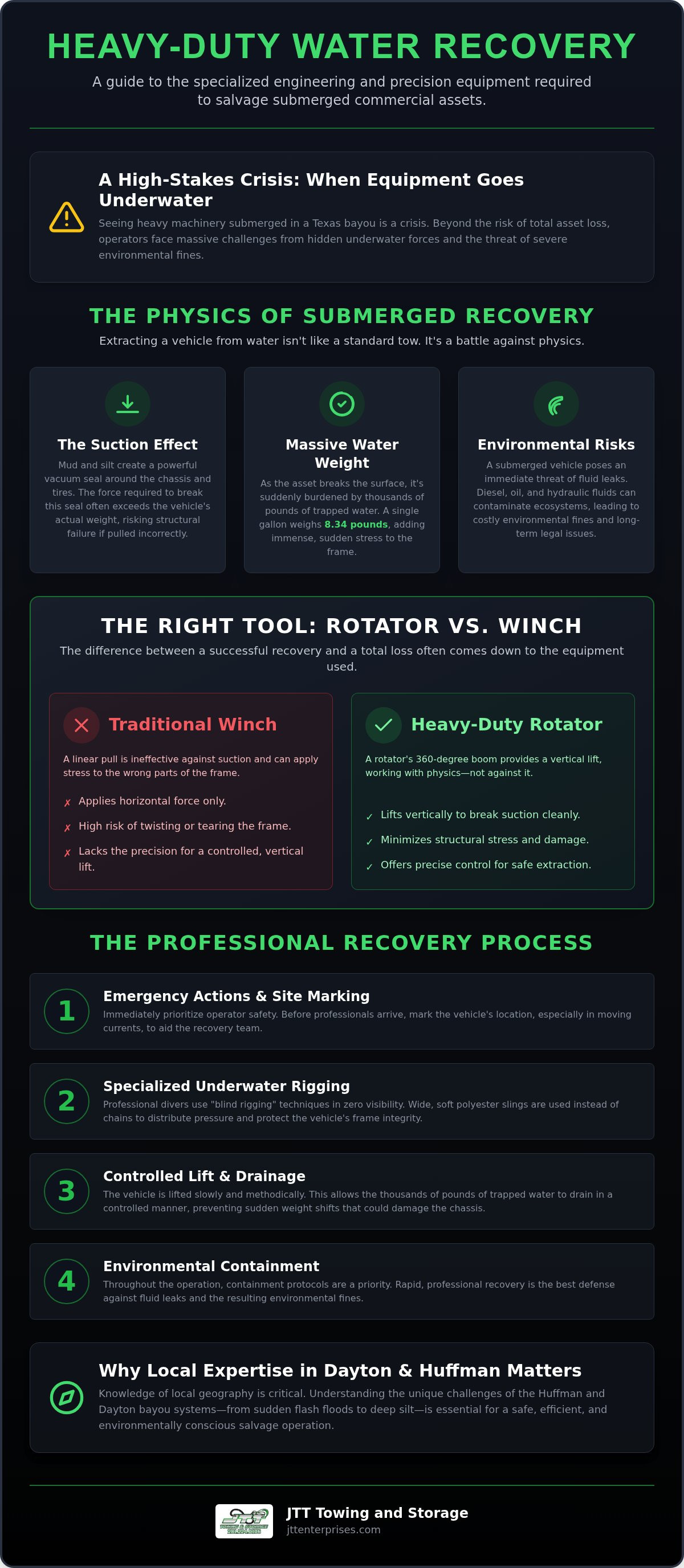
Submerged vehicles don't behave like vehicles on land. The moment a truck enters the water, it becomes subject to forces that can easily tear a frame apart if handled incorrectly. One of the most significant obstacles is the suction effect. Mud and silt at the bottom of a Texas bayou create a vacuum seal around the tires and chassis. Overcoming this requires calculating a specific break-out force that often exceeds the actual weight of the vehicle itself. Without the right engineering approach, a simple pull can result in catastrophic structural failure.
Buoyancy also plays a confusing role in these operations. While a vehicle is submerged, it may feel lighter, but its center of gravity shifts unpredictably as air pockets escape and water fills the voids. As you begin the Water Recovery, that temporary lightness disappears the moment the asset breaks the surface. Suddenly, the crane or rotator is hit with the full weight of the metal plus the thousands of pounds of water trapped inside. This is why slow, controlled movement is mandatory to prevent structural frame damage during the transition from water to air.
Underwater Rigging: The Critical First Step
Professional divers often face zero visibility in our local waterways. They must use blind rigging techniques to feel for structural anchor points on a submerged chassis that won’t snap under tension. It's a dangerous task. Understanding the dangers of underwater vehicle recovery, such as entanglement or shifting loads, is why we never recommend DIY attempts. We use soft-slings rather than traditional chains for these delicate lifts. Chains can bite into the frame or slip, whereas wide polyester slings distribute the pressure, protecting the vehicle’s integrity during the initial pull.
Managing Fluid Displacement and Weight
Water is incredibly heavy, weighing about 8.34 pounds per gallon. If a semi-trailer is half-full of water, that adds tens of thousands of pounds to the total load. Successful Water Recovery involves managing this weight through controlled drainage. As the vehicle is slowly lifted, we allow the water to escape in a way that doesn't create sudden weight shifts. If the water drains too fast from one side, the vehicle could roll. If it doesn't drain at all, the sheer weight could snap the rigging. If you find yourself facing a submerged asset, reaching out to a team with the right engineering knowledge at JTT Towing and Storage can save your equipment from becoming a total loss.
Rotators vs. Traditional Winches for Water Salvage
A standard winch is a powerful tool for a simple recovery, but it operates on a linear pull. This means it draws the object directly toward the tow truck in a straight line. In a complex Water Recovery, a horizontal pull is often your worst enemy. If a heavy truck is sitting ten feet below a steep embankment, a linear winch line will drag the chassis through the mud and slam it into the side of the bank. This "plowing" effect causes massive structural damage and often leads to the very total loss you're trying to avoid. It's the difference between dragging a weight and lifting a valuable asset.
In contrast, a rotator truck provides a vertical lift. It functions more like a mobile crane than a traditional wrecker. By using a 360-degree rotating boom, the operator can position the recovery vehicle on solid ground and reach over obstacles or sensitive embankments. This allows for a clean, vertical extraction that clears the bank entirely. For these high-stakes jobs, JTT utilizes specialized heavy duty rotator service Dayton to ensure the asset is handled with the precision it deserves. This equipment allows us to work in tight spaces where a traditional wrecker simply couldn't find the right angle.
When a Standard Winch-Out Fails
Using a standard wrecker for a submerged vehicle often creates more problems than it solves. Beyond the physical damage to the frame, dragging a vehicle across a rocky bayou bottom can rupture fuel tanks or hydraulic lines. These environmental spills are difficult to contain once the damage is done. While a winch out service for semi trucks is highly effective for dry land scenarios where the vehicle just needs a horizontal assist, water-based salvage requires a different mechanical approach. The resistance from water and silt makes a simple pull nearly impossible without breaking the rigging or the vehicle itself.
The Precision of Rotator Lifting
Stability is the foundation of a safe lift. In our local area, the soil near the water is rarely stable. Rotators are equipped with large outriggers that extend from the chassis to distribute the massive weight of the lift across a larger surface area. This prevents the recovery truck from sinking or tipping during the operation. By employing multiple winch lines from a single boom, the operator can stabilize a rolling load, ensuring the vehicle stays upright as it breaks the surface. This precision minimizes the recovery footprint, preventing further bank erosion and protecting the local Dayton and Huffman landscape while we work to secure your equipment.
Emergency Steps: What to Do if Your Vehicle Enters Water
The first few seconds after a vehicle enters the water are critical. Your absolute priority must be the safety of the operator and any passengers. Evacuate the cab immediately. Don't attempt to save personal belongings or documentation if the vehicle is actively sinking. Once everyone is on solid ground, move a safe distance away from the bank. If the vehicle is completely submerged and a current is present, try to mark the location with a clear landmark on the shore. This information is vital for the specialized team that will eventually perform the Water Recovery.
Immediate Safety Protocols
Before you focus on the vehicle, assess the surrounding environment for secondary hazards. Check for downed power lines that may have been pulled into the water during the accident. Unstable banks are also a major concern; the weight of a second vehicle or even a group of people can cause further collapses. You should refer to our heavy duty roadside assistance checklist to manage the initial scene safety effectively. Secure the perimeter to keep curious bystanders and other motorists away from the hazard zone. This protects lives while you wait for professional help to arrive.
Time is your enemy in these situations. The longer a vehicle sits on the bottom, the deeper it settles into the silt. This increased embedment makes the eventual lift much more difficult and expensive. Avoid the temptation to attempt a self-recovery using light-duty trucks or farm equipment. We often see double-submersion incidents where the recovery vehicle also becomes trapped or pulled into the water. This complicates the Water Recovery and increases the environmental risk. Contacting a specialized service immediately is the most reliable way to protect your asset from becoming a total loss.
Information to Provide the Recovery Team
When you call for assistance, providing specific details helps the team bring the right equipment the first time. Be prepared to discuss the following points with the dispatcher:
- Water Depth and Bottom Type: Is the vehicle in five feet of water or twenty? Is the bottom sandy, rocky, or deep mud?
- Cargo Details: Tell us what you're hauling. We need to know if the load is time-sensitive or if there are hazardous materials involved that require special containment.
- Vehicle Orientation: Is the truck upright, resting on its side, or completely inverted?
Having these facts ready allows the recovery operators to calculate the necessary lifting capacity and rigging requirements before they arrive on-site. If you're facing an emergency in the Dayton or Huffman area, reach out to the professional team at JTT Towing and Storage for a safe, methodical, and expert recovery.
Professional Water Recovery in Dayton and Huffman
Choosing a partner for a high-stakes Water Recovery operation requires more than just looking for the biggest truck in the directory. It requires a team that understands the local landscape. JTT Towing and Storage has spent over 10 years serving as a reliable guardian for the Dayton and Huffman communities. Our deep-rooted experience with Off-Road Recovery across the region’s challenging terrain gives us a unique advantage. We don't just see a submerged truck; we see a neighbor’s livelihood that needs protecting. Our team brings a neighborly reliability to every scene, combining technical proficiency with a calm competence that reassures you during a crisis.
We maintain a "can-do" attitude toward complex salvage jobs that other companies often decline. Whether it's a semi-truck deep in a bayou or heavy machinery stuck in a flooded construction site, we have the specialized hardware to manage the lift. Our commitment is twofold: we protect your high-value assets from further damage and safeguard the local environment from hazardous leaks. We treat every job with the same level of integrity and professional assurance, ensuring that the recovery is handled right the first time. We believe in being a dependable anchor for local businesses when they face their most difficult days.
Serving Liberty and Harris County Waterways
Our service area extends across the vital waterways of Liberty and Harris County. We provide specialized recovery capabilities near Dayton (77535), Huffman (77336), and Liberty (77327). This local presence is critical when time is of the essence. We have extensive experience working with local industrial sites and recovering specialized oil field equipment from marshy, water-logged environments. We maintain a constant state of readiness to respond to submerged commercial rigs across these sectors. When an accident happens on a rain-slicked road near the Trinity River or local drainage systems, you need a local responder who knows the ground and the current.
Why Dayton Fleet Managers Trust JTT
Fleet managers across the region rely on JTT because we prioritize reducing downtime. We know that every hour your equipment is underwater is an hour of lost revenue. Our focus on efficient, safe extraction ensures that your assets are returned to service as quickly as possible. We combine the power of heavy-duty rotators with the precision of experienced operators to deliver professional assurance on every job. We don't just pull vehicles; we engineer solutions that protect your bottom line. If you are facing a submerged vehicle crisis, don't settle for a standard tow. Contact JTT Towing and Storage for specialized water recovery and let our family-owned team handle the heavy lifting.
Protect Your Equipment with Precision Recovery
A submerged vehicle is a serious crisis, but it doesn't have to result in a total loss. Successful Water Recovery depends on understanding the complex physics of suction and fluid weight while utilizing the right high-capacity equipment. By choosing a team that prioritizes vertical lifting over horizontal dragging, you protect the structural integrity of your heavy trucks and machinery. You also ensure that environmental risks are managed with the care our local Texas waterways deserve.
JTT Towing and Storage brings over 10 years of local expertise to every salvage operation in Dayton, Huffman, and throughout Liberty County. As a family-owned business, we combine the specialized power of heavy-duty rotators with the neighborly reliability you expect from a local partner. We're committed to providing the professional assurance needed to stabilize high-stakes situations and get your operations back on track. If you find your assets in a difficult position, don't wait for the situation to worsen. Request Expert Water Recovery for Your Heavy Assets and let our seasoned team provide the stable, expert response you need. We're ready to help you move forward with confidence.
Frequently Asked Questions
Is water recovery covered by standard commercial truck insurance?
Most commercial policies cover the physical recovery of the vehicle under Inland Marine or Collision coverage; however, the specific limits for Water Recovery can vary significantly. You should review your policy for salvage and recovery clauses. These often cover the specialized equipment costs needed for a complex lift. We recommend contacting your provider immediately to confirm that environmental mitigation and specialized rigging are included in your specific plan.
How long does a typical heavy-duty water recovery take?
The duration of a recovery operation depends on the depth and the amount of silt surrounding the chassis. A standard job usually takes between four and eight hours once the specialized equipment arrives on-site. This time includes the initial dive or blind rigging, the break-out from the mud, and the slow, controlled lift to the surface. Complex scenarios involving moving currents or hazardous cargo in the Huffman area may require additional time for stabilization.
Can a vehicle be repaired after being fully submerged in fresh water?
Can a vehicle be repaired after being fully submerged in fresh water?
Freshwater submersion doesn't always mean a total loss if the asset is recovered quickly. Unlike saltwater, fresh water is less corrosive to the engine and frame. The key to a successful restoration is a rapid, professional extraction followed by immediate mechanical drying. Once we secure the vehicle in our storage facility, a qualified technician must flush all fluids and clean the electrical systems to prevent long-term oxidation and mold growth in the cab. For readers who want to explore professional maintenance and protection options for their restored assets, visit TIPS Automotive for expert automotive services.
The most common mistake is waiting too long to call for professional help or trying to use light-duty equipment. When a vehicle sits in the mud for an extended period, it settles deeper, making the eventual lift more difficult. Attempting a self-recovery with a standard truck often results in a second vehicle getting stuck. This increases the complexity of the Water Recovery and the risk of damaging the submerged frame beyond any possible repair.
Do I need to report a submerged vehicle to environmental agencies in Texas?
You must report the incident if there is any discharge of oil, diesel, or hydraulic fluid into a public waterway. The Texas Commission on Environmental Quality (TCEQ) sets specific guidelines for spill reporting and remediation. Our team focuses on minimizing this impact during the extraction process. If you are operating near local bayous or rivers in the 77535 area, professional containment is the best way to avoid heavy environmental fines.
How much weight can a heavy-duty rotator lift from a submerged position?
Our high-capacity rotators are designed to handle loads ranging from 50 to 75 tons, depending on the boom's extension and angle. However, the effective weight of a submerged vehicle increases due to water trapped inside and the suction force of the silt. We calculate the necessary break-out force before every lift to ensure our equipment stays within safe operating limits. This engineering-first approach protects your machinery and ensures the safety of everyone on the recovery scene.
Does JTT provide water recovery for construction equipment like excavators?
Yes, JTT Towing and Storage specializes in recovering heavy machinery, including excavators, bulldozers, and cranes. Construction equipment often presents unique challenges because the heavy tracks can sink deep into flooded excavation sites. We utilize specialized rigging and high-capacity rotators to lift these assets straight up, preventing further damage to the hydraulic systems. Our team serves industrial clients throughout the 77336 and 77327 zip codes with professional response for these high-value assets.
What happens if my truck is submerged in a moving current?
Moving water adds a massive amount of lateral pressure to the submerged vehicle, increasing the risk of it rolling or being swept downstream. In these cases, we prioritize immediate stabilization using multiple winch lines to anchor the truck to solid ground. This prevents the vehicle from shifting while our team prepares for the final lift. Current-based recoveries require precise coordination and high-tension rigging to ensure the asset doesn't break free and cause further damage.


