
A disabled bus on a busy Liberty County road or rural route needs a towing plan suited to the vehicle and the scene. If you’re searching for bus towing Liberty County TX, start by sharing clear details about where the bus is and what happened. That information helps coordinate the recovery around the bus’s condition and access.
It’s understandable to feel uncertain when a large passenger vehicle can’t move safely. The next step depends on details such as the bus’s size and weight, whether it’s simply inoperable or off the roadway, and where it needs to go. JTT Towing and Storage is a family-owned company based in Dayton, providing heavy-duty towing and accident recovery for complex situations.
This guide explains how to prepare for a bus tow, what information to have ready when you call, and what to expect as recovery is coordinated. You’ll also learn how the bus’s position and the surrounding conditions can shape the plan, helping you move from roadside uncertainty toward a clear next step.
Key Takeaways
- For bus towing Liberty County TX, a clear description of the bus and scene helps coordinate the next steps.
- Have the exact location, bus type, condition, access constraints, and immediate safety concerns ready for the first call.
- An upright, accessible bus may require a different plan from one involved in a collision or positioned off the roadway.
- Prioritize passenger and roadway safety while arranging help, and contact emergency services if there’s immediate danger.
- JTT’s heavy-duty towing and accident recovery services support bus recovery coordination in Liberty County and nearby areas.
Bus Towing in Liberty County, TX: When a Tow or Recovery Is Needed
Bus towing moves a disabled bus from its current location to a destination where it can be inspected, repaired, or stored. Recovery addresses situations where a bus can’t be safely moved as it sits, such as after a collision or when it’s positioned off the roadway. Start by describing the bus’s condition and location so the response can be coordinated around the actual situation.
For school, shuttle, and commercial bus operators, a breakdown can disrupt schedules and leave passengers or staff waiting. If the bus can’t be driven safely, attempting to move it may create added risk or damage. Focus first on people’s safety, then communicate what the bus is doing, where it is, and whether it’s obstructing traffic or sitting on unstable ground.
Which bus problems may require towing assistance?
A mechanical failure may leave a bus unable to start, steer, or move under its own power. Collision damage can also make driving unsafe, even if the bus still starts. A bus immobilized in a ditch, on a soft shoulder, or in another difficult position may need recovery coordination rather than a straightforward transport tow.
Condition and location matter together. A disabled bus in a wide, accessible parking area presents a different situation from one stopped near moving traffic or partly off the roadway. Share visible damage, warning signs, unusual sounds, and any change in the bus’s position. Don’t try to move it if doing so could put people at risk.
What makes a bus tow different from an ordinary roadside call?
A bus is a large vehicle, so details that might be secondary in an ordinary roadside call can shape coordination: the bus’s approximate size and weight, whether passengers are aboard, the room around it, and its position relative to traffic. Narrow entrances, overhead obstacles, soft ground, and limited room to maneuver may also affect access. A clear description gives the recovery team useful information about the scene.
Be specific about the incident and surroundings. Explain whether the bus is upright, damaged, blocking a lane, or off the pavement, and note any immediate hazards. If the bus carries passengers, say whether they’re safe and whether they need assistance. Don’t guess at a recovery method. The details help the team determine the appropriate next steps.
Different types of tow trucks are designed for different towing situations, but the right approach depends on the vehicle and scene. For bus towing Liberty County TX, JTT’s heavy-duty towing and accident recovery services provide local support for coordinating a response. A straightforward tow and a complex recovery aren’t the same job, so accurate details help shape the plan.
What Information Helps Coordinate Bus Towing Near Liberty?
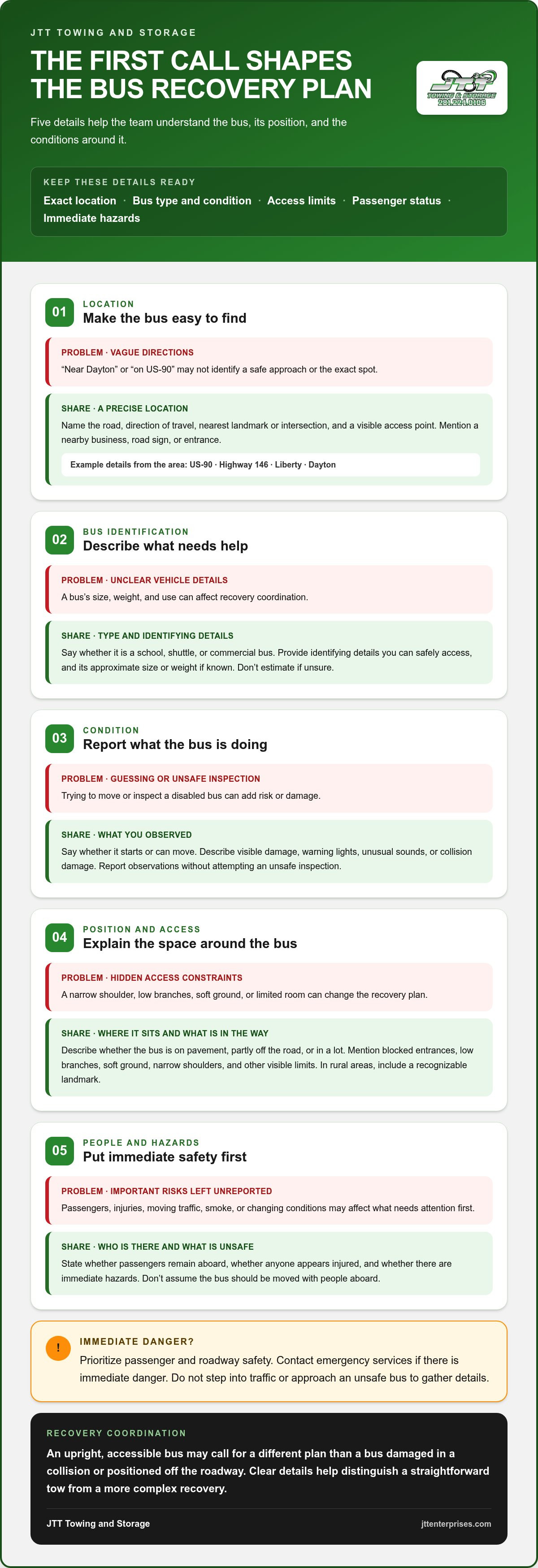
A clear first call gives the team a practical picture of the bus, its position, and the conditions around it. In Liberty County, a location described only as “near Dayton” or “on US-90” may not be enough to identify a safe approach. Share the most precise information you have, then add details about access, passengers, and hazards. If you’re arranging bus towing Liberty County TX, this checklist can help organize the call.
What should you tell dispatch first?
Work through these details in order. If you don’t know an exact measurement or mechanical term, give your best clear description rather than guessing.
- Pin down the location. Name the road, direction of travel, nearest landmark or intersection, and a visible access point. Say whether the bus is near US-90, Highway 146, in Liberty or Dayton, or on a local road. A nearby business, road sign, or entrance can help distinguish one location from another.
- Identify the bus. Describe its general use, such as school, shuttle, or commercial, and share any identifying details you can safely access. If you know its approximate size or weight, provide that information. Don’t estimate if you’re unsure.
- Explain its condition. Say whether it starts or can move, and describe visible damage or symptoms, such as a warning light, unusual noise, or collision damage. Report what you observed without attempting an unsafe inspection.
- Describe access and position. Is the bus on a paved surface, partly off the road, or in a lot? Mention a narrow shoulder, blocked entrance, low branches, soft ground, or another visible access constraint. In rural areas, a recognizable landmark can be especially useful.
- Report people and immediate concerns. State whether passengers remain aboard, whether anyone appears injured, and whether there are hazards such as moving traffic, smoke, or changing conditions. If there’s immediate danger, contact emergency services.
How can you make the location easier to find?
Give directions from a recognizable route or landmark, then describe where the bus sits in relation to it. For example, say “on Highway 146, northbound, just past the marked entrance,” rather than relying on a vague description. If you’re on a local road outside town, identify the nearest crossroad or visible sign. Don’t step into traffic or approach an unsafe bus to gather details.
Passenger status is important to communicate, but don’t assume a bus should be moved with people aboard. For a legal reference related to bus towing and occupants, consult the federal regulations for bus towing. Make sure the response team also knows the actual situation at the scene.
The most useful first-call details are the exact location, bus type and condition, access limits, passenger status, and immediate hazards. With those points ready, you can give a clear account and help start recovery coordination. For local heavy-duty towing and accident recovery support, connect with Liberty County towing support.
How the Bus Towing Approach Depends on Vehicle Condition and Access
Two buses stopped on the same road may need different plans. One may be upright, accessible, and ready for transport; another may be damaged, immobilized, or difficult to reach. The key distinction is between transport, moving a bus from an accessible position to a destination, and recovery, coordinating its movement from a position or condition that complicates access. Neither label alone determines the method.
The reported condition, position, and surroundings help recovery personnel assess the situation. The examples below show how those details can shape coordination, not a guaranteed method for any particular incident.
How do condition, position, and access affect the plan?
| Bus condition and position | Access considerations | Coordination focus |
|---|---|---|
| Inoperable but upright on an accessible paved area | Room to approach and maneuver; clear route out | Plan transport based on the bus’s condition and intended destination. |
| Disabled on a narrow shoulder or near moving traffic | Limited working space; traffic close to the bus | Communicate the precise position and surrounding risks so the scene can be assessed. |
| Collision-damaged or partly off the roadway | Possible obstacles, uneven ground, or restricted access | Describe visible damage and how the bus sits before deciding whether recovery coordination is needed. |
| Stopped inside a lot or behind a restricted entrance | Tight turns, blocked gates, low branches, or limited clearance | Explain the access route and constraints that may affect approach and exit. |
When may transport differ from recovery?
A bus that’s accessible and stable may present a more direct transport situation than one that’s immobilized or obstructing access. But a bus that appears upright isn’t automatically simple to move. Damage, the ground beneath it, nearby obstacles, and room to maneuver all matter. Don’t assume a particular towing method based on a brief description. The team assessing the scene determines the appropriate approach.
Accurate details help avoid assumptions. Explain what the bus can and can’t do, where it rests, and whether access is restricted. For broader context on commercial recovery planning, JTT’s heavy-duty towing guide describes considerations relevant to heavy-duty towing.
How do route and site access shape transport planning?
Planning involves more than the bus’s current position. The approach path, turning room, entrance width, overhead obstacles, and route out may affect how the job is coordinated. Share known restrictions at both the scene and destination. If you’re unsure about a measurement, describe what you can see rather than guessing.
For a bus involved in a crash, visible damage and its position can inform accident recovery coordination. JTT’s tractor-trailer accident recovery guidance offers related heavy-vehicle context, though each scene requires its own assessment. The Federal Motor Carrier Safety Administration guidelines are also a resource for commercial motor vehicle information. For bus towing Liberty County TX, a scene-specific assessment helps align the transport or recovery plan with the vehicle and access conditions.
What to Do While Arranging Bus Towing in Liberty County
A bus breakdown can create pressure to act quickly, especially on a busy road or rural stretch with limited space. Keep the priority simple: protect people, communicate the scene clearly, and avoid actions that could make conditions less safe. For bus towing Liberty County TX, these practical steps can help operators and fleet managers stay organized while recovery is arranged.
How can you keep people and the scene safer?
If there’s immediate danger or anyone is injured, contact emergency services first and follow their instructions. Move passengers and staff away from immediate hazards only when it’s safe to do so. Don’t direct anyone into traffic to flag down help, inspect the bus, or collect information. If a safe location isn’t obvious, wait for guidance from emergency responders.
Keep clear of an unstable or damaged vehicle. Don’t stand behind it, beneath it, or beside areas that could shift. Avoid trying to push, restart, or reposition the bus. If conditions change, such as smoke appearing or the vehicle shifting, report that promptly rather than approaching to investigate.
Choose a safe person to communicate with the recovery team, then keep that person reachable. Share a precise location and describe visible hazards or access limits from a safe position. If the bus is near a busy road, narrow shoulder, or rural access point, explain what makes the scene difficult. Don’t walk along a roadway to improve a view or find a landmark.
What can a fleet manager prepare for the tow?
Once immediate safety is addressed, a fleet manager can gather details that help coordinate the next stage. Keep the information together and pass it on without delaying emergency action:
- Bus identification, such as the fleet number, make, model, or other details readily available from records.
- The operator’s name and a reliable contact number for follow-up questions.
- Relevant fleet instructions, including who can approve transport and where the bus should be taken.
- Known access constraints at the bus’s location and destination, such as a restricted entrance or limited turning room.
- Any load-related details or post-recovery storage considerations that could affect the destination plan.
Keep one point of contact responsible for sharing updates. Multiple callers can create confusion if details differ. If a fleet manager isn’t at the scene, the person there can relay observations while the manager provides identification, destination instructions, and other records.
A bus off the roadway or on soft ground may need recovery coordination based on its position and the surrounding terrain. The off-road heavy recovery guide offers further context on factors that can matter in off-road situations. Don’t attempt to move the bus or clear obstacles yourself.
For a local point of contact, contact JTT about heavy-duty towing and recovery with the scene details and fleet instructions ready. Clear communication supports an orderly handoff from roadside uncertainty to the next step.
Arrange Bus Towing in Liberty County with JTT Towing and Storage
A bus that can’t continue safely needs a clear next step, whether it’s stopped after a mechanical problem or involved in a collision. JTT Towing and Storage provides heavy-duty towing and accident recovery from its base in Dayton, Texas. For operators arranging bus towing Liberty County TX, a direct description of the scene helps start recovery coordination with the relevant details in hand.
How does local heavy-duty towing support bus operators?
Local coordination matters when a disabled bus is affecting a route, passengers, or fleet operations. JTT is family-owned and has been in business for more than ten years. Its heavy-duty towing and accident recovery services provide a local point of contact for operators in Liberty County and nearby areas, including ZIP code areas 77535, 77336, 77327, 77561, 77357, 77532, and 77575. Each situation depends on the bus’s condition and position, so share what’s happening rather than assuming a particular towing or recovery method.
For your first call, be ready to provide:
- Location: The road or facility, direction of travel if relevant, and a nearby landmark or entrance.
- Vehicle condition: Whether the bus can move, what symptoms or visible damage you’ve noticed, and whether it was involved in a collision.
- Scene access: Any narrow shoulder, restricted entrance, limited turning room, or off-road position.
- Callback details: Your name, direct phone number, and the best contact person at the scene.
- Destination needs: Where the bus should go, if known, and any relevant fleet instructions.
Share observations from a safe place. If the situation presents immediate danger or someone is injured, contact emergency services first. For service coordination, contact JTT Towing and Storage with the location, vehicle condition, access details, and a reliable callback number.
What happens after a bus is recovered or transported?
The next step depends on the vehicle’s condition and the operator’s plans. A bus may need to go to a repair location or another destination selected by the fleet. If secure storage is needed after recovery, JTT also offers vehicle storage. Include the intended destination and any storage considerations in the coordination so the handoff reflects the operator’s needs.
Fleet managers may also need to update dispatch, arrange passenger or route changes, and coordinate who will receive the bus at its destination. Keep those responsibilities with the appropriate team members and provide clear instructions to the person communicating with the towing provider. This helps avoid confusion after the immediate roadside issue is addressed.
JTT’s commercial vehicle storage guide covers storage as a fleet-planning consideration. With a family-owned local provider and heavy-duty towing and accident recovery serving Liberty County and nearby ZIP code areas, JTT offers a practical point of contact when a bus needs coordinated assistance.
Make the Next Step Clear Before the Bus Moves
A roadside incident is easier to manage when one person is responsible for coordinating the response. For your next fleet briefing, consider keeping a simple bus incident card with the operator’s contact details, fleet identification, and the person authorized to arrange transport. That preparation gives staff a useful starting point when an unexpected stop interrupts a route.
If a bus is disabled now, focus on the immediate situation. Keep people clear of hazards, contact emergency services if there’s immediate danger, and share accurate details about the bus and its location. A clear first conversation can help turn uncertainty into an organized recovery plan.
For bus towing Liberty County TX, JTT Towing and Storage provides heavy-duty towing and accident recovery. Contact JTT Towing and Storage to arrange bus towing assistance and take the next step with a local team. With the right information ready, you can move forward calmly and keep your attention on the people and operations that need you.
Frequently Asked Questions
Can a bus be towed after a breakdown in Liberty County?
Yes. If a bus can’t continue safely, towing or recovery may be needed. For bus towing Liberty County TX, share whether the problem began while driving or after the bus was parked, and whether it’s carrying passengers or equipment. Those details help clarify what needs attention first. If anyone is injured or faces immediate danger, contact emergency services. Don’t attempt to move a disabled bus from an unsafe position.
What information should I give when requesting bus towing?
Along with the road, direction of travel, and nearest landmark, give the recovery team a reliable callback number and the name of the person who can make decisions for the bus. If you manage a fleet, have the fleet or unit identifier and intended destination available. This can help keep communication organized if the caller isn’t the operator. Describe what you can observe safely, and don’t guess at technical details you can’t verify.
Can a bus be towed from a rural road near Liberty, TX?
Yes, a rural location can be described for towing coordination. In addition to the road name, identify a junction, marked entrance, or recognizable feature that helps pinpoint the bus. If a map pin points to a long stretch of road, explain which side or access point leads to the vehicle. In Liberty County and surrounding areas, precise directions can be especially helpful when there are few visible landmarks.
What should passengers do while waiting for bus towing?
Passengers should follow the driver’s directions and instructions from emergency responders. If it’s safe to do so, keep the group away from traffic and other immediate hazards rather than gathering around the bus. The driver or trip lead can account for passengers and relay whether anyone needs urgent help. If someone is injured or danger is immediate, contact emergency services instead of waiting for towing assistance.
Does bus towing differ from heavy-duty truck towing?
Yes. Both involve large vehicles, but a bus may have passengers aboard, while a truck may be carrying freight or equipment. That difference can affect the information the recovery team needs and the coordination at the scene. Share the vehicle’s purpose, current condition, and whether people or cargo are involved. Don’t assume a bus and a tractor-trailer can be handled identically. The specific vehicle and situation guide planning.
Can a bus be stored after towing in Liberty County?
Yes. Storage can be a practical next step if a bus can’t go directly to its final destination. JTT Towing and Storage offers secure vehicle storage. Before transport, fleet staff can identify who will authorize access, receive the vehicle, and handle any records or keys. JTT serves local ZIP code areas 77535, 77336, 77327, 77561, 77357, 77532, and 77575, so include the bus’s actual location when arranging logistics.


