
Can a heavy wrecker handle your truck and the situation it’s in? The answer depends on more than vehicle size. Its condition, position, load, and surroundings help determine the right approach. If you’re looking for a heavy wrecker service Dayton TX drivers and commercial operators can turn to, clear details about the vehicle and scene help the team understand the call.
A breakdown or recovery can leave you uncertain about what happens next, especially when a commercial vehicle is blocking a route or carrying a load. JTT Towing and Storage is a family-owned Dayton business that provides heavy-duty towing and specialized recovery, along with truck repair and vehicle storage. This guide explains what heavy-duty equipment can address, what information to share, and how recovery and transport may proceed. It also covers possible next steps, from repair to secure storage, so you can make informed decisions during a stressful moment.
Key Takeaways
- A heavy wrecker service Dayton TX call may be appropriate when a large vehicle’s size, position, damage, or surroundings make standard towing unsuitable.
- Help dispatch understand the situation by sharing your location, vehicle type, condition, and any immediate hazards.
- Heavy-duty towing, accident recovery, off-road recovery, and truck repair address different needs, though one situation may involve more than one service.
- Stay clear of traffic and unstable vehicles while waiting, and follow emergency responders’ instructions at the scene.
- After recovery, towing may lead to truck repair or secure vehicle storage, depending on the vehicle’s condition and needs.
When does a heavy wrecker service in Dayton, TX make sense?
A heavy wrecker service provides specialized towing and recovery for large commercial vehicles or situations that demand more than ordinary roadside assistance.
A disabled tractor-trailer on a Dayton road is an obvious example, but the need isn’t determined by vehicle type alone. A truck’s size, whether a trailer is attached, its position, visible damage, and the space around it all affect what kind of help is appropriate. A vehicle that has slid off the road or is difficult to access may need a different response from one stopped on a level shoulder.
You don’t need to choose the truck or recovery approach before calling. Describe what you can see and where the vehicle is. Dispatch can use those details to understand the request and arrange appropriate assistance. If you’re unsure whether ordinary towing or a heavy wrecker service Dayton TX commercial operators can rely on is the right fit, explain the vehicle and scene instead of guessing its weight class.
Which situations may call for a heavy wrecker?
Common situations include a disabled tractor, a stopped trailer, or another heavy vehicle that can’t continue safely. Recovery can become more demanding if a vehicle is off-road, damaged in an accident, positioned awkwardly, or carrying a shifted load. These details help dispatch understand the circumstances. You don’t need to assess the recovery yourself.
Even when the vehicle appears intact, its surroundings matter. Narrow access, uneven ground, nearby traffic, or a trailer that’s difficult to separate from the tractor can affect how assistance is arranged. Share any immediate hazards and describe the vehicle’s position as clearly as you can. If you can’t safely get close enough to assess damage, say so rather than approaching it.
How is heavy wrecker service different from ordinary towing?
The main difference is the vehicle and the demands of the situation. Light-duty towing generally addresses smaller vehicles, while heavy-duty calls can involve commercial trucks, trailers, or challenging access. The right response depends on the full picture, not one detail such as the vehicle’s appearance or whether it can still move.
Heavy-duty towing may be appropriate when a commercial vehicle needs transport. A breakdown that leaves it in a difficult position may also require recovery, and a shifted load can add another consideration. Explain what happened and what the vehicle is carrying, if known. General background on tow truck types and operations can help explain why towing needs vary, but dispatch needs details about your specific scene.
JTT provides heavy-duty towing, off-road recovery, accident recovery, and load shifts and transfers around Dayton. You don’t have to diagnose the problem or name the equipment. Give a clear account of the vehicle, its location and condition, and any access or safety concerns. That gives the team a practical starting point for understanding what kind of assistance the situation calls for.
How JTT assesses a Dayton heavy-wrecker call
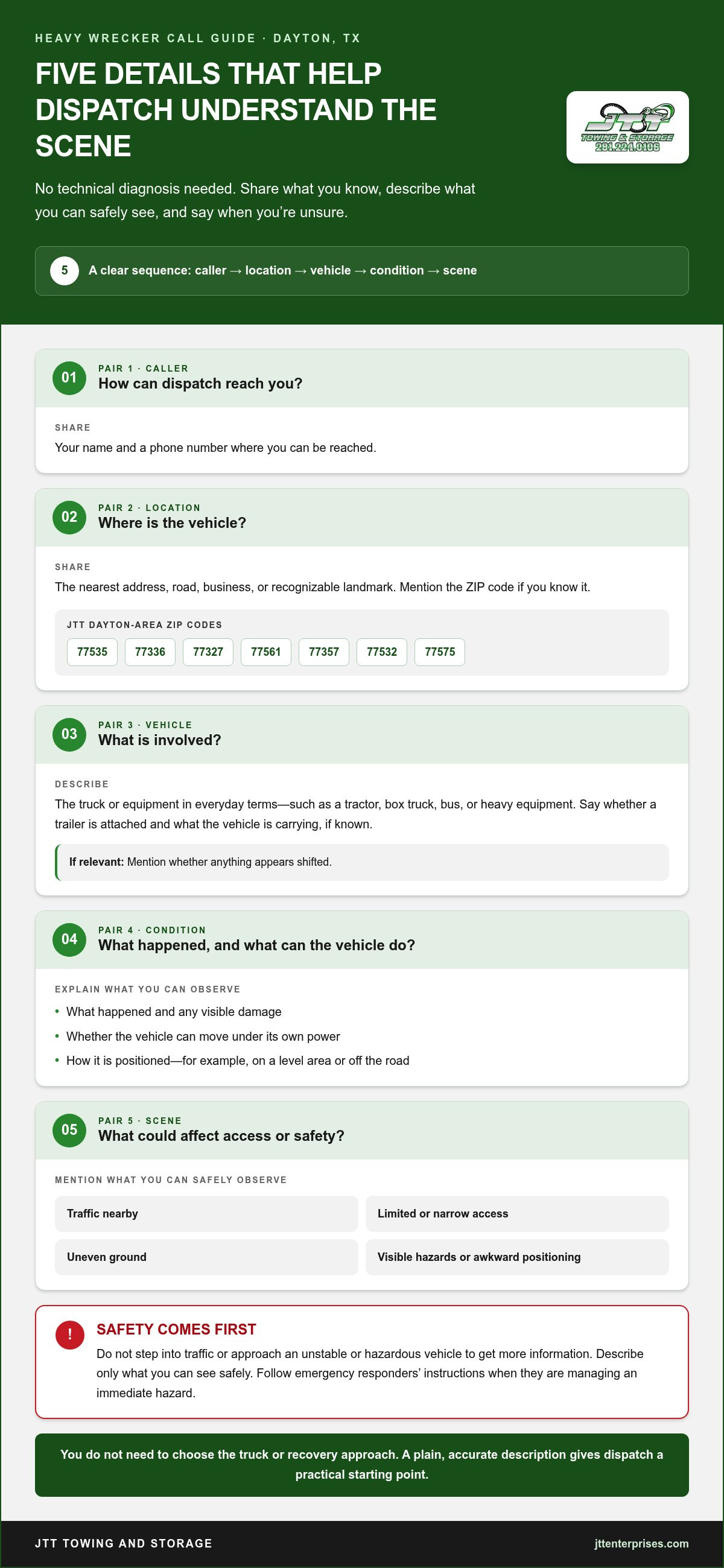
A clear call gives the team a useful picture of what’s happening before assistance is arranged. You don’t need technical terms or a complete diagnosis. Start with who’s calling and where the vehicle is, then describe the vehicle, its condition, and any immediate concerns around the scene. If you’re unsure of a detail, say so rather than guessing.
Use this simple sequence to organize the information:
- Caller: Share your name and a number where you can be reached.
- Location: Give the nearest address, road, business, or recognizable landmark.
- Vehicle: Describe the truck or equipment, whether a trailer is attached, and what it’s carrying if known.
- Condition: Explain what happened, any visible damage, whether the vehicle can move, and how it’s positioned.
- Scene: Mention traffic, limited access, or hazards you can observe safely.
Vehicle and scene details help dispatch understand what kind of assistance the situation calls for. A truck stopped on a wide, level area has different access considerations from one positioned off the road or near moving traffic. The goal isn’t to diagnose the problem. Give a plain, accurate description of what you can see.
What vehicle details should callers share?
Describe the vehicle in everyday terms: a tractor, box truck, bus, or piece of heavy equipment. Mention whether it has a trailer, what kind of load it carries if you know, and whether anything appears shifted. Report visible damage and whether the vehicle can move under its own power. Don’t approach a hazardous vehicle or try to obtain measurements you can’t safely access.
What location and scene details help in Dayton?
Give the closest address, road name, nearby business, or safe landmark you can identify. JTT serves the Dayton-area ZIP codes 77535, 77336, 77327, 77561, 77357, 77532, and 77575. Sharing the specific ZIP code or nearest landmark can help clarify where assistance is needed. Also describe access restrictions, traffic, and visible hazards from a safe position. Don’t step into traffic or move closer to an unstable vehicle to improve your description.
If you’re calling about a commercial vehicle around Dayton, gather only the details you can safely observe before speaking with dispatch. Information about JTT heavy-duty towing and recovery explains the services available for heavy vehicles. Clear, calm descriptions help the team understand the situation, while emergency responders’ directions should always take priority when they’re managing an immediate hazard.
Heavy wrecker service or another type of help: what fits the situation?
The right service depends on the problem to solve. A commercial vehicle that needs transport, a truck stuck in a difficult position, and a load that needs attention are different requests, even if they happen during the same incident. Use the comparison below as a starting point, then describe the full situation to dispatch. A heavy wrecker service Dayton TX call may involve more than one kind of assistance.
| Service | What it addresses | How it may fit |
|---|---|---|
| Heavy-duty towing | Moving a disabled heavy vehicle | A truck or tractor-trailer needs transport from its current location. |
| Accident recovery | Assistance after a collision | Damage or the vehicle’s position makes the situation more complex than a routine tow. |
| Off-road recovery | A vehicle positioned away from a regular roadway | The truck or equipment is stuck or difficult to access off-road. |
| Roadside repair | A mechanical issue affecting a truck | Truck repair may address the breakdown, depending on the vehicle’s condition and needs. |
These categories can overlap. A truck involved in an accident may need recovery before it can be transported. A vehicle stuck off-road may also be damaged. Describe what happened and the vehicle’s current condition instead of trying to choose a service based on a label alone.
When is towing different from recovery?
Towing moves a vehicle from one place to another. Recovery addresses a vehicle that’s immobilized or in a difficult position before or during that move. An accident, off-road location, or shifted load can add complications. For more detail on accident-related situations, refer to the dedicated accident-recovery guide on JTT’s site.
A load shift or transfer is a separate logistics need, not another name for towing. It concerns the cargo and may be relevant alongside a tow or recovery, but it doesn’t itself describe moving a disabled vehicle. Sharing whether the vehicle, its load, or both need attention helps clarify the request.
When might repair, hauling, or storage matter next?
If a breakdown involves a mechanical issue, truck repair may be part of the next step. Equipment and materials hauling serves a different purpose: transporting equipment or materials rather than recovering a disabled truck. Vehicle storage may be useful after a vehicle has been recovered or transported, depending on what needs to happen next.
JTT’s services include heavy-duty towing, accident and off-road recovery, load shifts and transfers, truck repair, equipment and materials hauling, and vehicle storage. The needs may change as the situation becomes clearer. Explain the immediate problem first, then discuss what the vehicle or load requires after it’s moved.
What to do while waiting for a Dayton heavy wrecker
Once you’ve requested a heavy wrecker service Dayton TX drivers can rely on, put safety ahead of updates or paperwork. If the scene presents immediate danger, follow instructions from emergency responders. Don’t stand in traffic, approach an unstable vehicle, or try to recover or move a damaged commercial vehicle yourself. A truck or trailer may shift unexpectedly, and being close to it can put you at risk.
If you can do so safely, wait away from moving traffic and leave room for responders to manage the scene. Don’t return to the vehicle to collect items or inspect damage if doing so would bring you near a hazard. If conditions change, share the update from a safe location instead of investigating. Your safety comes first.
How can drivers share useful updates safely?
Keep your phone accessible and describe your location using a road name, nearby business, or visible landmark. If the vehicle’s position, load, or access conditions change, pass along what you can observe from a safe place. Report new hazards or changing traffic conditions without approaching them. Don’t attempt to reposition a damaged or unstable truck, trailer, or load, even if that seems like it might make access easier.
Keep updates factual and brief. For instance, report that traffic has slowed near the vehicle or that the truck is no longer in the position you first described. If you can’t safely see what has changed, don’t guess. Wait for responders or the recovery team to assess the scene directly.
What information should fleet managers prepare?
A fleet manager can help by keeping basic details at hand and relaying them calmly. Gather the driver’s contact information, the vehicle’s identifying description, its location, and a short account of what happened. Add whether a trailer is attached and any known details about the load, but don’t ask the driver to approach the vehicle or cargo to find answers. Accurate information is more useful than a rushed estimate.
After the initial call, designate one person to share new information with dispatch. This can reduce confusion when several people are coordinating from different places. For a broader overview of commercial recovery, the heavy-duty towing guide for Dayton explains how towing support fits into these situations.
Share updates when they add useful information, such as a changed vehicle position, a load concern, or an access issue. JTT provides heavy-duty towing around Dayton, including the local ZIP codes 77535, 77336, 77327, 77561, 77357, 77532, and 77575. Keep the driver and fleet representative focused on safety while the team responds to the information provided.
Get heavy wrecker service in Dayton from JTT
A breakdown or incident involving a commercial vehicle can create several decisions at once: how to move the vehicle, whether recovery is needed, and what should happen afterward. JTT Towing and Storage supports heavy vehicles around Dayton with heavy-duty towing, accident recovery, and off-road recovery. Depending on the situation, truck repair or vehicle storage may also be relevant after the immediate recovery needs are addressed.
JTT is family-owned and serves the Dayton area. A heavy wrecker service Dayton TX call starts with the facts you can share, not a technical diagnosis or a guess about the equipment required. Give the team the vehicle’s location, condition, and any safety or access concerns to help clarify the request.
How JTT supports heavy vehicles after a breakdown or incident
Heavy-duty towing can move a disabled commercial vehicle, while accident or off-road recovery addresses situations where the vehicle’s condition or position makes the job more complex. If the issue involves mechanical trouble, truck repair may be part of the next step. For incident-specific information, see JTT’s tractor-trailer accident recovery guide.
Needs can change after a vehicle is recovered. It may require transport, repair attention, or a place to be stored. Sharing what happened and what the vehicle needs now helps clarify the request. If a load has shifted, mention that as well, since load shifts and transfers are a separate consideration from towing the truck.
What to include when requesting JTT’s help
Keep the first description straightforward. If you’re a driver, share what you can safely observe. If you’re coordinating for a fleet, pass along the driver’s account and a reliable way to reach them. Useful details include:
- Location: The nearest address, road, business, or identifiable landmark.
- Vehicle: The truck or equipment type, whether a trailer is attached, and basic identifying details.
- Condition: What happened, visible damage, and whether the vehicle can move.
- Scene concerns: Any known access limits, hazards, or load issues.
Don’t approach an unsafe vehicle to gather more information. Give the clearest account you can from a safe location, and follow emergency responders’ instructions if they’re managing an immediate hazard. Those practical details help JTT understand the call and discuss the appropriate support.
For heavy-duty towing or recovery around Dayton, JTT’s heavy-wrecker service supports drivers and fleets with the information they provide about the scene.
Build a clearer response for the next disruption
A commercial-vehicle incident can affect more than the truck. It may disrupt schedules, cargo plans, and communication across a fleet. A simple response plan can help: identify who will speak with dispatch, who will update operations, and where essential vehicle records are kept. This gives the person requesting a heavy wrecker service Dayton TX a clear point of support instead of leaving them to coordinate every decision alone.
If an incident is underway, focus first on people and follow emergency responders’ directions. Once the immediate scene is safe, keep updates organized through one point of contact. After recovery needs are addressed, record which operational decisions remain open, such as revising a delivery plan or coordinating the vehicle’s next steps. Keeping those tasks distinct makes it easier for everyone to focus on what needs attention next.
For heavy-duty help in Dayton and the surrounding ZIP codes 77535, 77336, 77327, 77561, 77357, 77532, and 77575, contact JTT Towing and Storage for heavy-wrecker service. Share your location, vehicle type, condition, and immediate concern.
Frequently Asked Questions
Can a heavy wrecker tow a semi-truck and trailer?
Yes. Heavy-duty towing is intended for large commercial vehicles, including semi-trucks and trailers. The appropriate response depends on the full combination and its situation, not just the tractor. Tell the team whether the trailer is attached, whether the vehicle is carrying a load, and if it can move. Mention visible damage or unusual positioning too. JTT provides heavy-duty towing and recovery around Dayton.
When should I call a heavy wrecker instead of a regular tow truck?
Call for heavy-duty assistance if a commercial truck, tractor-trailer, or other large vehicle is disabled, or if its condition or position makes an ordinary tow unsuitable. You don’t need to determine the technical requirements yourself. A fleet vehicle stopped at a loading area, for instance, may have different needs from one involved in an incident. Describe what happened so the team can assess the request.
What information should I give when requesting heavy wrecker service in Dayton?
Share a callback number, your location, the vehicle and trailer type, and a concise description of what happened. Note whether it can move, any visible damage, and known load or access concerns. JTT serves Dayton-area ZIP codes 77535, 77336, 77327, 77561, 77357, 77532, and 77575. Stay in a safe place while making the call.
Does heavy wrecker service include accident recovery?
Heavy-duty towing and accident recovery can both be relevant after a commercial-vehicle incident, depending on the vehicle’s condition and location. A collision may also involve a shifted load or airbag recovery needs, so mention those details if you know them. JTT provides heavy-duty towing and accident recovery. Describe only what you can safely observe, and follow emergency responders’ directions if they’re managing the scene.
Can a heavy wrecker help if a truck is stuck off-road?
Yes. JTT offers off-road recovery for situations involving a heavy vehicle immobilized away from a regular roadway. Describe the ground the vehicle is on, how it is positioned, and the closest safe landmark you can identify. If a road name or address is unavailable, explain the route or access point in plain language. Don’t try to drive or pull the vehicle out yourself.
What happens after a heavy truck is towed?
The next step depends on why the truck needed assistance and its condition after transport. If the issue is mechanical, truck repair may be appropriate. If the vehicle needs to be kept in a secure place, vehicle storage is another option. If you’re coordinating for a fleet, share known operational needs, such as whether the truck requires attention before it can return to work. JTT offers repair and storage alongside towing and recovery.


