
A semi that loses power on a busy route can disrupt traffic and put a delivery behind schedule. Searching for “semi truck towing Dayton Texas” is often the first step, but the right response depends on the truck’s condition, its location, and whether it needs a tow, roadside assistance, or recovery.
Details about the tractor, trailer, cargo, and access to the scene help the towing team plan. Sharing what you know can clarify the type of heavy-duty response needed and where the truck should go next.
This guide explains what to do when a semi needs help in Dayton, what information to provide when requesting service, and what to expect from the initial call through transport. JTT Towing and Storage is a family-owned local business with more than 10 years of experience. It provides heavy-duty towing and recovery, along with related services such as load shifts and secure vehicle storage.
Key Takeaways
- Choose a response based on the truck’s condition and position. A disabled rig, collision, or off-road situation may need different support.
- For semi truck towing Dayton Texas, share the truck and trailer details, cargo information, precise location, and access conditions.
- Prioritize safety and follow emergency instructions while waiting. Pass along updates if the vehicle’s condition or position changes.
- Know how heavy-duty towing, recovery, truck repair, and load shifts address different needs during a commercial vehicle incident.
- Understand how the service is planned and what information helps coordinate the truck’s next destination.
Semi Truck Towing in Dayton, TX: When Is a Tow the Right Call?
A disabled tractor-trailer can leave a driver in a difficult roadside position and disrupt a delivery schedule. First, determine whether the truck can continue safely, needs repair, or must be moved. Semi-truck towing transports a disabled commercial truck, with or without its trailer, to a suitable destination. Heavy-duty towing uses equipment suited to the vehicle and situation.
The tractor, trailer, and cargo all affect how a tow is planned. A semi-trailer truck combines connected components, so details such as whether the trailer is attached and whether cargo has shifted help describe the situation. For a driver or dispatcher seeking semi truck towing Dayton Texas, start by identifying the problem and the truck’s position.
Breakdown, collision, or recovery: identify the situation
A mechanical failure, collision damage, or a truck that has left the roadway can each require a different response. A breakdown may involve a disabled vehicle in a stable, accessible position. Recovery is more involved when the truck is off the road, obstructed, or difficult to approach and move like a standard tow. JTT provides accident recovery and off-road recovery for these situations.
- Mechanical failure: Describe what stopped working and whether the truck can move.
- Collision: Report visible damage and follow emergency instructions at the scene.
- Off-road position: Explain where the truck is and what may limit access.
These details help distinguish a tow from a recovery request. Don’t try to move a damaged or unstable vehicle yourself.
When a roadside repair may not be enough
Repair may be appropriate if the problem can be addressed while the truck remains safely in place. If the vehicle cannot continue safely, or moving it could cause further problems, towing may be the better next step. JTT provides truck repair as well as heavy-duty towing to move a disabled truck to a suitable destination. The right choice depends on the vehicle’s condition, not just the delivery deadline.
When describing the situation, share any warning lights, unusual sounds, visible damage, or changes in how the truck handles. Don’t drive it just to clear the route if doing so could create additional risk. For more on commercial recovery considerations, see the Dayton heavy-duty towing guide.
How Semi Truck Towing Is Planned Around Dayton
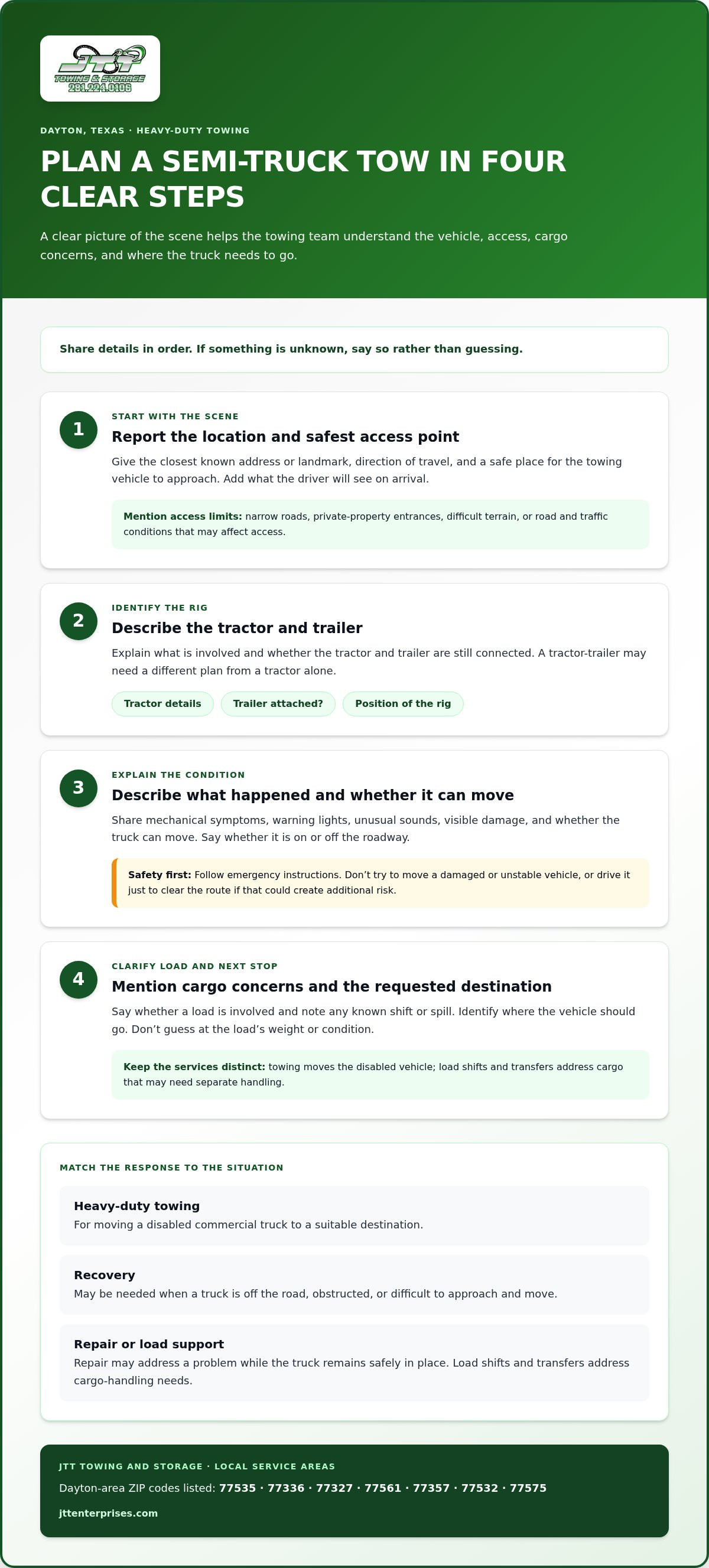
A well-planned tow starts with a clear picture of the scene. For semi truck towing Dayton Texas, the caller’s information helps the team understand where the vehicle is, what is attached, and what kind of help the situation calls for. Share details in a clear order, and say when something is unknown rather than guessing.
To plan a semi-truck tow, provide the exact location and safest access point, identify the tractor and trailer, describe the vehicle’s condition and any cargo concerns, and give the requested destination. Clear directions are especially useful if the truck is on a narrow road, private property, or difficult terrain. JTT serves local areas including ZIP codes 77535, 77336, 77327, 77561, 77357, 77532, and 77575.
What details should you share when requesting a tow?
Start with the location. Give a road name or address, nearby landmarks, direction of travel, and the safest place for a towing vehicle to approach. If the truck is on private property, describe the entrance and any access restrictions. A map pin is useful, but add details about what the driver will see when approaching.
- Report the location: Give the closest known address or landmark, direction of travel, and a safe access point.
- Identify the vehicle: Describe the tractor and trailer, including whether they remain connected.
- Explain the condition: Share mechanical symptoms, visible damage, whether the truck can move, and whether it is on or off the roadway.
- Describe cargo and destination: Say whether a load is involved, note any known shift or spill, and identify where the vehicle should go.
Include any road or traffic conditions that affect access. The Texas Department of Transportation (TxDOT) provides statewide transportation information that may help drivers and dispatchers stay informed about road conditions. Follow applicable emergency instructions at the scene.
Why the truck, trailer, and load matter
Not every tractor-trailer presents the same towing situation. A truck with an attached trailer may need a different plan from a tractor alone. Collision damage, a disabled wheel, or a position off the roadway can also affect how the rig is approached and moved. Cargo details help clarify whether the load is secure or may need separate handling. Don’t guess at the load’s weight or condition.
JTT provides heavy-duty towing and recovery, along with load shifts and transfers when cargo handling is needed. These are related but distinct services: towing moves the disabled vehicle, while load support addresses cargo that may need attention. Share what you can observe and leave handling to the service team.
Once you have the location, vehicle details, condition, cargo information, and destination ready, you can request Dayton heavy-duty towing support.
Which Semi Truck Service Fits: Towing, Recovery, Repair, or Load Support?
A disabled semi doesn’t always need the same response. A truck that can’t continue from a stable roadside position may need towing. A vehicle damaged in a collision or stuck off the roadway may require recovery. Mechanical repairs, cargo handling, and secure storage address other needs. For semi truck towing Dayton Texas, matching the service to the truck’s condition helps clarify what kind of help to request.
| Situation | Likely service category | What the service addresses |
|---|---|---|
| Truck can’t continue safely from its current position | Heavy-duty towing | Moving a disabled commercial vehicle to a suitable destination |
| Collision damage or a compromised position after an incident | Accident recovery | Recovery needs related to a crash, followed by moving the vehicle as appropriate |
| Truck is off the roadway or on difficult terrain | Off-road recovery | Recovering a vehicle that can’t be approached or moved like a routine roadside tow |
| A mechanical problem needs attention | Truck repair | Addressing a vehicle issue rather than transporting the truck |
| Cargo has shifted or needs to be moved | Load shifts and transfers | Handling the load, a separate need from towing the vehicle |
| A recovered vehicle needs a place to be kept | Vehicle storage | Providing secure storage as a possible next step |
When heavy-duty towing or accident recovery is relevant
Heavy-duty towing is the relevant service when a disabled truck needs transport from its current location. Recovery applies when the truck’s position or condition makes the situation more involved than a routine tow. After a collision, the damage and scene help determine the response. For collision-specific context, JTT’s Dayton tractor-trailer accident recovery guide covers that type of incident. The right service depends on the conditions at the scene.
When repair, load support, or storage may also matter
A mechanical issue may call for truck repair, but repair and towing serve different purposes. If the vehicle can’t safely continue, transport may still be needed. Load shifts and transfers address cargo handling, not routine movement of the truck. If a recovered vehicle needs safekeeping, secure vehicle storage may be a practical next step. These services can relate to one incident without being interchangeable.
Focus the request on what’s known: the truck’s condition, its position, and whether the cargo needs attention. For information about rules that may apply to a tow, review the consumer information on Texas towing laws. Clear details help distinguish the immediate need from any support that may follow.
What to Do Before the Semi Truck Tow Arrives in Dayton
Once a tow is arranged, focus on people first and clear communication second. Follow instructions from emergency personnel and local authorities, and avoid roadside activity that could put you or others at risk. Don’t try to move a damaged or unstable truck. If conditions make it unsafe to gather information, wait until you can do so safely.
For semi truck towing Dayton Texas, updates can help the team understand whether anything has changed since the initial request. A brief, accurate description is more useful than trying to assess or fix the vehicle yourself.
Protect people and communicate clearly
Stay in a safe place and follow applicable emergency guidance. If traffic exposure, a new hazard, or the truck’s position changes, pass that information along as soon as it’s safe. Be specific: say whether the vehicle remains in the same location, whether it is blocking access, and what you can observe about its condition. Don’t approach a damaged vehicle or cargo if doing so feels unsafe.
- Location: Confirm the road, nearby landmark, direction of travel, and safest access point.
- Scene changes: Report new traffic exposure, hazards, or access obstacles.
- Vehicle condition: Share visible changes or symptoms without attempting to diagnose the problem.
- Emergency direction: Follow instructions from responders and local authorities at the scene.
If another person is coordinating the tow, agree on who will provide updates. This keeps information consistent and reduces confusion if the scene changes.
Prepare details for dispatch and the receiving location
When it’s safe, gather information that can help coordinate the move. Have a company or fleet contact available, along with the truck’s identifying details and intended destination. Confirm whether the trailer is attached and note any cargo concern or restriction that could affect access. If you don’t know a detail, say so rather than guessing.
- Vehicle and trailer: Record available identifiers and whether the combination is connected.
- Cargo: Note whether cargo is involved and describe any visible shift or concern from a safe distance.
- Access: Mention gates, narrow entrances, private property, or other conditions that could affect the approach.
- Destination: Provide the planned receiving location and a contact person, if available.
Let the receiving location know the truck may be arriving and share any relevant access instructions. If the destination changes, update the towing team rather than relying on an earlier plan. Clear coordination connects the roadside situation with the next step.
For help with a commercial vehicle situation in Dayton, view JTT towing and recovery information.
Get Semi Truck Towing in Dayton, Texas with JTT
A disabled semi can interrupt a delivery, affect a worksite, or leave a driver waiting for a clear plan. JTT Towing and Storage is a family-owned provider based in Dayton, Texas, established over 10 years ago. For commercial operators looking for semi truck towing Dayton Texas, JTT provides heavy-duty towing and recovery alongside support for the truck and its load.
The right service depends on the situation. JTT’s relevant services include:
- Heavy-duty towing to move a disabled commercial vehicle to a suitable destination.
- Accident recovery for trucks involved in a collision.
- Off-road recovery when a vehicle is no longer in a routine roadside position.
- Truck repair for mechanical issues that need attention.
- Load shifts and transfers when cargo handling is needed separately from moving the truck.
These services address different parts of an incident. A tow may be the immediate need, while recovery, repair, or load support may also be relevant based on the truck’s condition and cargo. Not every call requires every service. Clear information about the scene helps identify the appropriate response.
Local commercial towing and recovery support
Based in Dayton, JTT serves commercial and industrial clients in local areas including ZIP codes 77535, 77336, 77327, 77561, 77357, 77532, and 77575. Its services include heavy-duty towing, accident and off-road recovery, and related support for commercial vehicles and equipment.
Request help for a semi truck in Dayton
When requesting help, provide the truck’s precise location, its current condition, whether the trailer is attached, any cargo concerns, and the intended destination. Note access restrictions, such as a gate or limited approach space, and share a company or fleet contact if someone else is coordinating the move. If details change after the request, pass along an update when it’s safe.
JTT Towing and Storage provides commercial vehicle towing and recovery, with related services for incidents that involve more than transport. Keep your description direct: what happened, where the vehicle is, what is attached, and where it needs to go. Those details help connect the roadside situation with the appropriate service.
For help with a disabled semi in Dayton, request semi truck towing from JTT and share the location, truck condition, trailer details, and requested destination.
Keep Your Fleet Moving After a Roadside Disruption
A breakdown can reveal where a fleet’s response plan needs to be clearer. After the immediate situation is handled, document who coordinates towing requests, who approves a destination, and how drivers should provide updates. A simple process can reduce confusion the next time a vehicle is sidelined and help your team focus on safe, timely decisions.
For owner-operators and fleet managers seeking semi truck towing Dayton Texas, keep the next step straightforward. Start a request with JTT and provide the details needed to understand the situation. JTT provides towing and recovery support for commercial vehicle incidents.
Request semi truck towing from JTT and take the next step with a local team. A clear plan and a dependable point of contact can help your operation move forward with greater confidence.
Frequently Asked Questions
Is semi truck towing available in Dayton, Texas?
Yes. JTT provides towing and recovery in Dayton and nearby local service areas, including ZIP codes 77535, 77336, 77327, 77561, 77357, 77532, and 77575. For semi truck towing Dayton Texas, share the truck’s location and condition, and say whether a trailer is attached. Provide a callback number so the team can coordinate the request.
Can a semi truck be towed with its trailer attached?
Whether the tractor and trailer can be moved together depends on their configuration, condition, location, and the circumstances. Damage affecting either part may change how the combination can be handled. Describe the full setup, any cargo concerns, and access restrictions when requesting help. Those details help shape an appropriate towing or recovery plan instead of assuming every combination can be moved as-is.
How long does semi truck towing take in Dayton?
There isn’t one reliable time estimate for every tow. Travel distance and traffic can affect the trip, while vehicle condition, site access, recovery needs, and cargo support can affect the work itself. If the truck’s location or condition changes after you request help, provide an update. Give the precise location and intended destination so the request can be planned around the actual situation.
What should I tell the towing company when a semi breaks down?
Give the caller a precise location, direction of travel, nearby landmark, and a clear description of what the truck is doing or not doing. Explain whether a trailer is attached, whether cargo is involved, and whether the rig is off-road or difficult to access. Provide a callback number and destination if available. Check vehicle details only if it’s safe, and don’t approach a hazardous scene to gather information.
Can JTT help if a semi truck is stuck off the road?
Yes. JTT provides off-road recovery, heavy-duty towing, and accident recovery. Explain how the vehicle left the roadway, describe the terrain and visible hazards, and give the most precise location you can. If you can see from a safe position, mention conditions such as soft ground or a nearby obstacle. Don’t try to move a truck that may be unstable. The details help guide the recovery response.
What happens if the semi truck has cargo that needs attention?
Tell the towing team whether the trailer is loaded and describe any visible cargo shift or need for a transfer. JTT provides load shifts and transfers for cargo handling alongside towing or recovery. Keep people clear of an unstable load and follow emergency instructions at the scene. If you don’t know whether cargo has moved, report what you can safely observe rather than checking the load yourself.
For semi truck towing in Dayton and nearby ZIP codes 77535, 77336, 77327, 77561, 77357, 77532, and 77575, contact JTT Towing and Storage with the truck’s location, condition, trailer details, and destination.


