
Imagine you're hauling eighty thousand pounds down Highway 90 near Dayton when the engine suddenly cuts out, forcing you onto a narrow, gravel shoulder. As traffic screams past at seventy miles per hour, you realize that every minute your wheels aren't turning, your profit margin is shrinking. This is the exact moment when professional heavy duty roadside assistance stops being a line item and becomes a critical lifeline for your safety and your livelihood.
We understand that a breakdown on a busy Texas highway is a high-stakes event that brings immediate stress and confusion. It's frustrating to worry about whether a standard wrecker can handle your load or if you'll be stuck waiting for hours because the wrong equipment was dispatched. You deserve a recovery process that is as disciplined and reliable as your own work ethic. Our goal is to provide the calm competence you need when things go wrong on the road.
This guide will help you master the critical steps to handle a heavy truck breakdown safely and efficiently. We'll cover essential roadside safety protocols, explain the technical difference between towing and recovery, and provide a checklist of the specific vehicle data you must provide to ensure an accurate dispatch. By following these expert-led steps, you'll protect your cargo, minimize downtime, and get back to work with confidence.
Key Takeaways
- Identify why vehicles exceeding 26,000 lbs GVWR require specialized heavy duty roadside assistance instead of standard towing to ensure equipment safety.
- Master immediate safety protocols, such as correct reflective triangle placement, to protect yourself and other drivers on high-speed highways.
- Learn to distinguish between a standard tow and a technical recovery operation to help dispatchers send the right equipment the first time.
- Create a pre-dispatch checklist including GPS coordinates and current load weight to minimize recovery time and prevent costly delays.
- Understand how specialized tools like airbag recovery systems protect your cargo during complex load shifts or off-road incidents.
What Defines Heavy Duty Roadside Assistance?
Heavy duty roadside assistance is a specialized field designed for vehicles with a Gross Vehicle Weight Rating (GVWR) exceeding 26,000 pounds. While standard assistance focuses on passenger cars, this service addresses the unique mechanical and structural needs of the largest machines on the road. It's a combination of heavy-duty towing, technical recovery, and on-site mechanical support. This isn't just a bigger version of a car tow; it's a high-stakes engineering task that requires specialized training and massive equipment.
The primary difference between standard and heavy operations lies in the physics of the recovery. A standard tow involves simple transport. In contrast, heavy-duty recovery often involves managing complex weight distribution and securing massive frames. Specialized heavy-duty tow trucks, such as rotators and heavy wreckers, utilize hydraulic booms and winches capable of lifting tens of thousands of pounds. These tools are essential when dealing with common high-stakes scenarios like mechanical failures, catastrophic tire blowouts, or load instability that threatens to tip a trailer. Without the right equipment, a simple breakdown can quickly turn into a permanent structural loss for the vehicle.
Vehicles Requiring Heavy-Duty Support
Not every vehicle can be serviced by a typical flatbed. Class 7 and 8 trucks, which include semi-tractors and their trailers, are the most frequent users of these services. Large-scale transport vehicles like buses, motorcoaches, and expansive RVs also fall into this category due to their length and weight. Additionally, construction equipment and industrial machinery often require specialized transport when they break down on-site or during transit between jobs. These vehicles have unique air brake systems and heavy axles that require expert handling to prevent damage during transit.
Core Services Included in Heavy Assistance
When you call for heavy duty roadside assistance, the service goes beyond a simple hook-and-go. The focus is on minimizing downtime while ensuring the safety of the driver and the cargo. We approach every call with the mindset of a reliable guardian, ensuring the scene is stabilized before any work begins.
- Emergency Support: This includes high-voltage jumpstarts and basic mechanical assistance to get a truck to the nearest service center.
- Accident Recovery: This involves extricating vehicles from ditches or righting rollovers using specialized winching and airbag recovery techniques.
- Fluid Delivery: Large diesel engines require significant volumes of fuel or specialized fluids to resume operation if they run dry.
- Heavy-Duty Towing: Transporting a disabled semi or heavy vehicle safely to a secure location or repair shop.
Our team operates with a sense of calm competence to handle these complex tasks. Whether it's a load shift on a busy highway or an off-road recovery in Liberty County, the right equipment makes the difference between a quick resolution and a costly disaster.
The Driver’s Immediate Safety Checklist
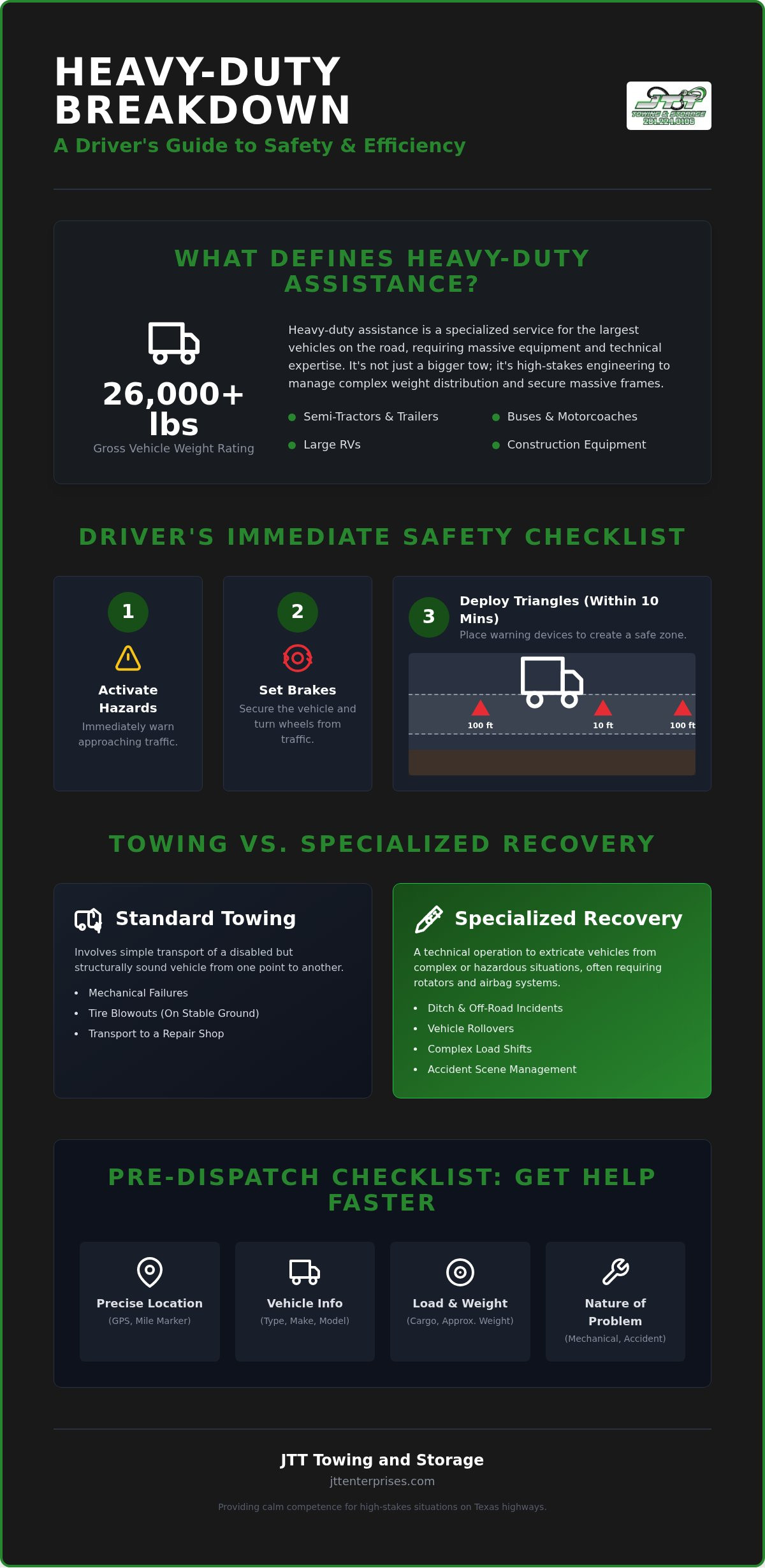
When your rig stops moving on a Texas highway, the shoulder becomes one of the most dangerous places you can be. Your first priority isn't the mechanical issue; it's the physical safety of yourself and your cargo. Activate your hazard lights immediately to provide an early warning to approaching traffic. Set your parking brakes and turn your steering wheel away from the travel lanes. This ensures that if another vehicle strikes your truck from behind, the impact pushes your rig into the ditch rather than into active traffic.
Texas presents unique environmental challenges that can complicate a breakdown. In Liberty County and Huffman, soft shoulders are common due to high humidity and soil composition. An 80,000-pound truck can easily sink or tilt if parked on unstable ground, leading to a much more expensive recovery. Additionally, high-heat conditions during most of the year can lead to rapid driver fatigue or heat exhaustion. Keep your cab as cool as possible while you prepare your roadside inspection report and wait for assistance.
Deploying Warning Signals
Visibility is your best defense against secondary accidents. Federal regulations require you to deploy warning devices within ten minutes of stopping. On a two-lane road, place one triangle 100 feet in front of the truck, one 10 feet behind the rear, and another 100 feet behind that. For divided highways, place the triangles at 10 feet, 100 feet, and 200 feet behind the vehicle to give high-speed traffic ample time to react. Texas "Move Over" laws require drivers to vacate the lane closest to a stopped vehicle with flashing lights, but you shouldn't rely on their compliance for your safety.
Managing Driver and Passenger Safety
The "Stay or Go" decision is often the hardest part of a breakdown. Generally, the cab of a heavy truck is the safest place to remain because it provides a protective steel cage against impacts. If you must exit the vehicle to place triangles or inspect damage, exit through the passenger side only. Never step out into the "kill zone" of active traffic. Once you've secured the scene, communicate your exact status to your fleet dispatch and your local heavy duty towing Dayton TX specialist.
While waiting for a professional recovery team to arrive, keep your seatbelt fastened if you remain in the cab. This provides extra protection in the event of a rear-end collision. Stay off your phone except for essential safety communications to ensure you remain alert to your surroundings. Your focus should remain entirely on maintaining a secure perimeter until help arrives on the scene.
Assessing the Situation: Towing vs. Specialized Recovery
Understanding the difference between a simple tow and a technical recovery is vital for any driver facing a breakdown. While both fall under the umbrella of heavy duty roadside assistance, they require vastly different equipment and skill sets. A standard tow involves moving a vehicle that is disabled but remains on a stable surface with its wheels capable of rolling. Recovery, however, is a technical rescue operation. This process is necessary when a vehicle is overturned, jackknifed, or stuck in a position where it cannot be moved by simple pulling force. When you request heavy duty roadside assistance, specifying whether you need a tow or a full recovery will save hours of downtime.
Drivers must accurately describe their situation to ensure the dispatcher sends the correct unit. If you've experienced a rollover or a significant collision, you'll specifically need tractor trailer accident recovery. This service uses specialized tools like rotators and heavy-duty winches to upright the vehicle safely without causing further structural damage. Following industry best practices ensures that both the driver and the surrounding environment remain protected during these high-intensity maneuvers. Our team approaches these tasks with the calm competence required to manage massive weights under pressure.
When You Need a Heavy Wrecker
A heavy wrecker is the standard tool for transporting large commercial vehicles that cannot move under their own power. You'll need this equipment if your Gross Combined Weight Rating (GCWR) exceeds the capacity of medium-duty trucks. Mechanical issues such as seized bearings, transmission failure, or drivetrain damage often require a heavy wrecker to lift the drive wheels and transport the unit to a repair facility. For comprehensive mechanical service and maintenance, relying on an automotive repair specialist such as E and J Garages & Auto Sales LLC helps ensure severe mechanical issues are properly resolved. Distance also plays a role. If you're far from a qualified shop, a heavy wrecker provides the stability needed for long-haul transport across Liberty County roads.
Signs You Need Specialized Recovery
Recovery services go beyond transport to solve physical placement problems. If your rig has left the pavement and is stuck in a ditch or deep mud, you need off-road recovery. This often involves winching from multiple angles to prevent the frame from twisting. Airbag recovery is another specialized technique used to upright overturned trailers. By using high-pressure air cushions, technicians can lift a loaded trailer gently, which protects the cargo from the crushing forces of traditional chains and cables. Finally, load shifts occur when cargo moves inside the trailer, making the vehicle dangerously off-balance. In these cases, the load must be stabilized or transferred before the vehicle can safely return to the road.
The Pre-Dispatch Checklist: Information for Faster Help
Accuracy in the first five minutes of a call determines the success of the next five hours. When you request heavy duty roadside assistance, your goal is to provide a complete picture of the scene. This prevents the costly mistake of a crew arriving with inadequate equipment. Provide your precise location using GPS coordinates whenever possible. If you're in a rural area like Liberty County, supplement this with mile markers or nearby landmarks. Mention any access restrictions immediately, such as low-clearance bridges or extremely narrow shoulders, so the recovery team can plan their approach route without getting stuck themselves.
Describing the Mechanical Issue
Be as specific as possible about the vehicle's symptoms. If your dashboard is displaying engine fault codes, relay them to the dispatcher. Look for active fluid leaks or listen for unusual noises that occurred right before the failure. Tire status is another critical data point; a single blowout on a dual-axle setup is handled differently than a catastrophic failure of both tires. Finally, check your brake system status. If your wheels are locked, the recovery team needs to know they'll be dragging dead weight. This requires specialized dollies or air-release tools to prevent destroying your tires during the tow. If the failure resulted from an accident, describe the orientation of the vehicle. Is it upright, on its side, or wedged against a guardrail? These details help determine if a rotator or a standard heavy wrecker is the right tool for the job.
Cargo and Trailer Information
The weight of your trailer dictates every aspect of the recovery plan. Clearly state whether your trailer is loaded or empty, as this directly impacts the winch ratings required for the job. If you're hauling hazardous materials (Hazmat), this must be the first thing you mention for legal and safety reasons. Providing an accurate gross vehicle weight is critical because it determines whether the situation requires a 35-ton wrecker or a more robust 50-ton unit for a safe lift. Don't guess on these numbers. Consult your bill of lading to give the dispatcher the most accurate data possible. This transparency ensures that the recovery crew brings the right rigging and support vehicles to protect your cargo from further damage.
Providing this information upfront allows us to act as your reliable guardian on the road. It ensures we arrive prepared for the specific challenges of your breakdown. If you find yourself stranded and need an expert team that values your time, reach out to our heavy duty roadside assistance specialists for immediate support.
Choosing a Reliable Guardian in Dayton, Texas
When your commercial vehicle is disabled, you aren't just looking for a tow truck; you're looking for a partner who understands the local geography and the pressure of your delivery schedule. Selecting the right provider for heavy duty roadside assistance in the Dayton and Huffman areas requires evaluating both technical capability and local accountability. National dispatch centers often lack the specific knowledge of Liberty County traffic patterns or the location of specialized repair shops that can handle a Class 8 truck. A community-rooted provider offers a level of personal investment that larger, faceless operations simply cannot match.
The quality of a recovery operation depends entirely on the equipment the company owns and maintains. It's essential to verify that your chosen provider operates high-capacity rotators and specialized airbag recovery systems before an emergency occurs. JTT Towing and Storage has operated as a family-owned business for over 10 years, combining the technical power of a large-scale fleet with the integrity of a neighborly service. This stability ensures that when you call for help, you're speaking with experts who are personally invested in the safety of your driver and the security of your cargo. We approach every call with the calm competence expected of a reliable guardian.
Local Knowledge and Response Times
Response speed is critical for minimizing the high cost of downtime on busy Texas highways. Our team's deep familiarity with Dayton, TX, and surrounding Huffman roads allows us to navigate around congestion and reach your location faster than out-of-town services. We provide quick responses for emergency jumpstarts and minor mechanical repairs to get you back on the road without a tow whenever possible. Because we operate 24/7, you never have to worry about whether a technician is available to handle your logistics emergency. This readiness is a core part of our commitment to the local trucking community.
Comprehensive Commercial Support
A breakdown doesn't always end at the roadside. Sometimes, you need secure vehicle storage for recovered assets or immediate assistance with load transfers to keep your delivery on schedule. We provide material hauling and load shift corrections to manage interrupted logistics efficiently. This comprehensive approach ensures that every aspect of the recovery is handled under one roof, reducing the complexity of your situation. We maintain high standards for every task, from simple flatbed towing to complex accident recovery. For professional support that prioritizes your safety and your bottom line, Contact JTT Towing and Storage for immediate heavy duty roadside assistance.
Secure Your Fleet with Professional Recovery Expertise
A breakdown doesn't have to be a disaster if you have a plan. By prioritizing immediate scene safety and providing precise vehicle data to dispatchers, you significantly reduce the risks of secondary accidents and equipment errors. Remember that specialized heavy duty roadside assistance is a technical operation. It requires the right tools, such as rotators and airbag systems, to protect your valuable cargo and frame. Choosing a local partner with deep roots in the community ensures you receive faster response times. You deserve accountable service when every minute counts.
JTT Towing and Storage brings over 10 years of specialized recovery experience to every call. Our expert airbag and off-road recovery team provides 24/7 emergency response throughout Liberty County, ensuring you're never stranded without a reliable guardian. We combine technical proficiency with the personal touch of a family-owned business to get your rig back in service safely and efficiently.
Need Heavy-Duty Roadside Help? Call JTT Towing and Storage for 24/7 Support in Dayton!
Stay alert, follow your safety protocols, and drive with the peace of mind that expert help is always just a phone call away.
Frequently Asked Questions
What is the difference between heavy-duty and medium-duty towing?
Heavy-duty towing is designed for vehicles exceeding 26,000 lbs GVWR, such as semi-trucks, buses, and large construction machinery. Medium-duty towing typically handles vehicles between 10,001 and 26,000 lbs, including box trucks or large dual-rear-wheel pickups. Heavy-duty operations require much larger wreckers or rotators with higher winch capacities to manage the massive weight and structural requirements of Class 7 and 8 commercial vehicles across Liberty County.
Can you provide roadside assistance for a loaded semi-trailer?
Yes, we provide comprehensive heavy duty roadside assistance for fully loaded semi-trailers. Handling a loaded trailer requires specialized knowledge of weight distribution and high-capacity recovery equipment. Our team manages accident recovery and load shifts to ensure your cargo remains secure during the process. We use specialized winching and lifting techniques to stabilize the vehicle, which prevents further damage to the trailer or the goods inside while on Texas highways.
How long does heavy-duty roadside assistance usually take to arrive?
Response times vary based on your specific location and current traffic patterns on major routes like Highway 90 or FM 1960. As a local Dayton-based business, we prioritize rapid emergency response for Huffman and Liberty County drivers. We operate 24/7 to ensure help is always available. While external factors like weather can influence travel time, our dispatchers provide real-time updates so you know exactly when our recovery team will arrive on the scene.
Do I need to call the police for a heavy truck breakdown in Texas?
You should call the police if your vehicle is blocking a travel lane or if you are involved in a collision. Law enforcement provides essential traffic control, which creates a safer environment for our recovery team to work. If you're safely on a wide shoulder in Dayton, you may not need an officer, but safety is the priority. Always check local Texas regulations to ensure you're compliant with reporting requirements for commercial incidents.
What is airbag recovery and when is it used for trucks?
Airbag recovery is a specialized technique used to upright overturned trailers or heavy equipment without causing the structural damage often associated with chains and cables. High-pressure air cushions are placed under the vehicle and inflated slowly to provide a gentle, controlled lift. This method is particularly useful for protecting fragile cargo or sensitive trailer bodies. JTT Towing and Storage utilizes this expert technology for complex accident recovery scenes throughout the Dayton and Huffman areas.
What information should I have ready when calling for heavy towing?
Please provide your precise GPS coordinates, the make and model of your vehicle, and your current load weight. Knowing if your trailer is loaded or empty is critical for dispatching the correct wrecker. Additionally, mention any mechanical symptoms, such as locked brakes or fluid leaks; specify if you're hauling hazardous materials. This data allows our team to arrive with the specific rigging and equipment needed for a successful heavy duty roadside assistance call.
Are load shifts covered under heavy-duty roadside assistance?
Yes, load shifts and transfers are a core part of our commercial support services. If your cargo moves during transit, it can make the vehicle dangerously unstable or cause it to exceed axle weight limits. We use specialized equipment to restabilize your load or transfer it to another trailer if necessary. This service is essential for maintaining safety and compliance on Texas roads, helping you avoid fines and preventing potential rollovers during transport.
Can you perform mechanical repairs on the side of the highway?
We offer professional truck repair services that include emergency jumpstarts and minor mechanical support to get you moving again. While major engine overhauls require a shop environment, our technicians can often address air system leaks or basic electrical issues on-site. If the vehicle cannot be safely repaired at the roadside, we provide heavy-duty towing to transport your rig to a secure facility or a qualified repair shop in the Dayton area.


