
A single miscalculation during a heavy-duty recovery can turn a simple stuck truck into a permanent loss for your fleet. It's a stressful moment when your rig leaves the pavement or sinks into the deep mud common in Liberty County. You're likely worried about frame twisting, axle stress, and the mounting costs of every hour your wheels aren't turning. Finding a professional winch out service for semi trucks is about more than just finding a big cable. It requires a team that understands the physics of an 80,000-pound load and the delicate balance of force needed to move it safely.
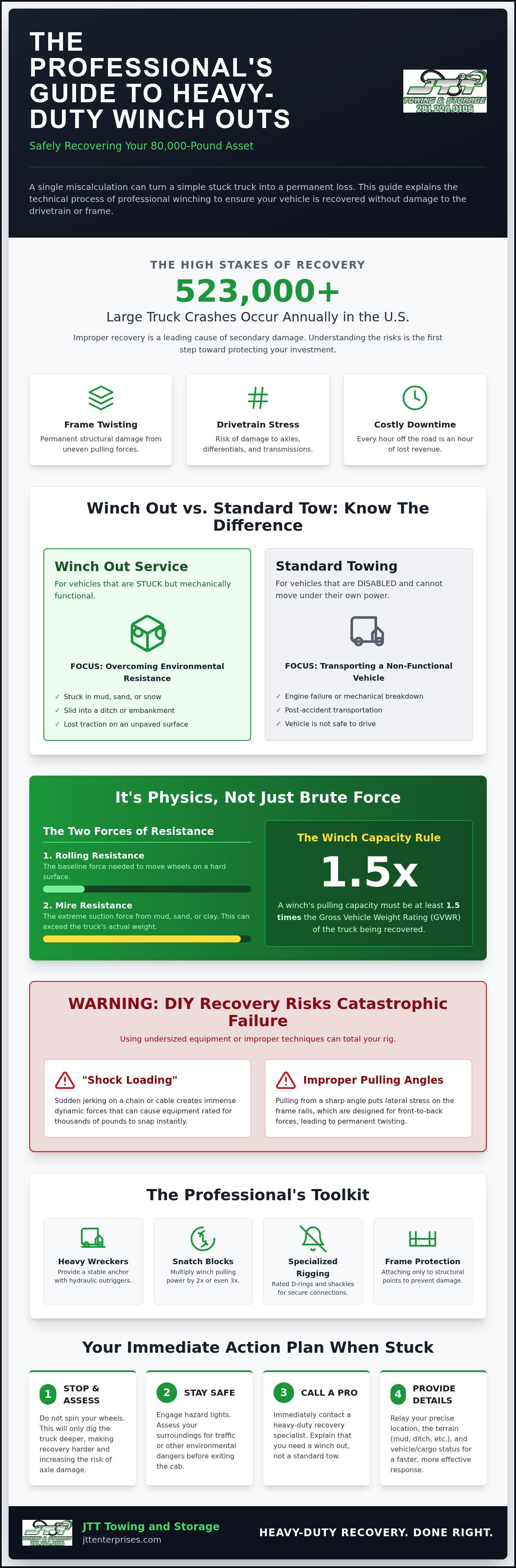
We know your livelihood depends on the structural integrity of your equipment. This guide will teach you the technical process of heavy-duty winching and how to ensure your vehicle is recovered without a single scratch to the drivetrain or frame. We'll explore the specialized equipment required for these massive loads, the step-by-step safety protocols used by experts, and how to get your driver back on the road with total peace of mind. With over 523,000 large truck crashes occurring annually in the United States, knowing the right way to handle a recovery is a vital part of your operational safety plan.
Key Takeaways
- Understand the critical differences between a standard tow and a complex heavy-duty recovery to ensure your vehicle receives the correct equipment for the situation.
- Discover how a professional winch out service for semi trucks applies calculated physics to protect your drivetrain and frame from permanent structural damage.
- Learn the hidden risks of DIY recovery attempts, including the dangers of "shock loading" chains and the catastrophic effects of improper pulling angles.
- Follow a step-by-step safety protocol for assessing environmental hazards and mire depth before any cables are attached to your rig.
- Gain insight into specialized off-road recovery techniques tailored for the unique soil conditions and challenging terrain of Liberty County and East Texas.
What is a Winch Out Service for Semi Trucks?
A winch out service for semi trucks is a specialized recovery operation designed to extract a commercial vehicle that's physically stuck but otherwise mechanically functional. It's different from a standard tow. While a tow involves transporting a disabled vehicle, a winch-out focuses on overcoming environmental resistance. When an 80,000-pound rig leaves the pavement, it isn't just sitting in the dirt; it's anchored by the immense weight of its cargo and the suction of the ground.
This process requires a professional recovery vehicle equipped with high-tension steel cables and hydraulic winches. In East Texas, specifically around Dayton and Liberty County, the terrain often dictates the complexity of the job. Our local soil transitions quickly from sandy loam to thick, heavy clay. These conditions create high mire resistance, meaning the ground literally holds onto the tires. Moving a loaded semi in these conditions requires precise calculations of weight distribution and center of gravity to prevent the truck from tipping or the frame from twisting under the pressure of the pull.
When Do You Need a Winch Out?
Drivers often face a "stuck" situation rather than a mechanical breakdown. This typically happens when a rig encounters soft shoulders on rural Texas roads or loses traction in mud and sand. You need a professional winch out service for semi trucks when your engine and drivetrain are working, but your tires can't find the grip necessary to move the mass of the trailer. This is a common issue at local construction sites and oil field access points where heavy equipment must navigate unpaved surfaces. Identifying the problem early prevents you from digging the truck deeper and causing axle damage.
The Role of the Heavy-Duty Wrecker
A standard tow truck doesn't have the mass or the winch capacity to safely recover a commercial vehicle. Effective recovery relies on the wrecker acting as a solid anchor point. If the recovery truck is too light, the winching process will simply pull the wrecker toward the stuck semi. Professional teams in Dayton use heavy wreckers and rotators that utilize hydraulic outriggers to "bite" into the ground. This stability allows the winch to exert the thousands of pounds of force needed to break the suction of the mud without risking the safety of the equipment or the operator.
The Technical Mechanics of Heavy-Duty Winching
A professional winch out service for semi trucks is a game of numbers and physics. When a rig is stuck, we calculate two primary forces: rolling resistance and mire resistance. Rolling resistance is the effort needed to get wheels moving on a hard surface. Mire resistance is the massive extra force required to pull a vehicle out of a deep sinkhole or thick mud. In the heavy clay common to East Texas, mire resistance can sometimes exceed the actual weight of the truck itself. This suction effect makes the rig feel twice as heavy as it is on the scale.
Providing a reliable winch out service for semi trucks begins with a precise calculation of the required pull. Industry standards, such as those taught by the Towing and Recovery Association of America (TRAA), recommend that a winch should have a capacity of at least 1.5 times the gross vehicle weight rating (GVWR) of the vehicle. While winches in the 12,000 to 20,000 lb. capacity range are common for smaller vehicles, recovering a loaded commercial rig requires high-tensile steel cables and industrial-grade hooks that can withstand tens of thousands of pounds of tension without snapping.
Essential Equipment: Beyond the Cable
Brute strength isn't always the answer. Professional operators use snatch blocks to create mechanical advantage. By looping the cable through a block, we can double or even triple the pulling power of a single winch. We also use heavy-duty D-rings and specialized shackles to ensure every connection is rated for the load. In situations where a truck is stuck down a steep embankment, a rotator is often brought in to provide vertical lift while winching. This specialized off-road recovery equipment ensures the truck doesn't drag against the ground during extraction.
Rigging for Structural Integrity
Protecting the truck's skeleton is our top priority. We identify structural attachment points on the chassis rather than hooking onto convenient but weak components. Attaching to an axle, fuel tank, or fairing can lead to thousands of dollars in damage. Rigging angles must be carefully managed to prevent frame twist. If the pull is too sharp, the force can permanently warp the truck's frame. We use soft straps and edge protectors to distribute pressure evenly, ensuring your rig returns to the road in the same structural condition it was in before getting stuck.
Why DIY Semi Recovery Risks Totaling Your Big Rig
It is tempting to call a buddy with another rig when you're stuck in the dirt. You might think a heavy duty chain and a bit of momentum are all you need to get moving. However, this DIY approach is exactly how small problems turn into catastrophic losses. Without the specialized equipment provided by a professional winch out service for semi trucks, you risk "shock loading" your recovery gear. This occurs when a slack chain is suddenly jerked tight. The force generated in that split second can easily exceed the breaking strength of the metal, leading to snapped links and flying debris.
Improper pulling angles are another silent killer of commercial vehicles. If the recovery force isn't applied correctly to the chassis, the frame can "diamond" or twist. A twisted frame often means the truck is a total loss. It will never track straight on the highway again, leading to constant tire wear and handling issues. Fleet managers also face significant liability when using uncertified equipment. If a chain snaps and causes an injury, the lack of professional oversight can lead to denied insurance claims. Investing in a professional winch out service for semi trucks is always more cost-effective than replacing a totaled rig or paying for major frame realignment.
The Dangers of Chain Snapping
A snapped steel chain isn't just a broken tool; it's a lethal projectile. When a high-tension line fails, the energy release sends hooks and links flying at hundreds of miles per hour. This "line of fire" is why the team at JTT Towing and Storage establishes strict safety zones before any tension is applied. We prioritize site safety by clearing the area and using cable dampeners to ensure that if a failure occurs, the equipment drops safely to the ground. We don't take chances with the lives of bystanders or your drivers.
Protecting the Drivetrain and Transmission
Your truck's drivetrain is incredibly vulnerable during a recovery. Pulling a semi while it's in gear or with the parking brake engaged can shred the transmission's internal components. In many complex off-road recovery situations, it's necessary to disconnect the driveline entirely to protect the gears. Professional operators perform a full mechanical assessment before the first inch of cable is pulled. We check the state of the vehicle to ensure the extraction doesn't create a new set of expensive mechanical failures.
Step-by-Step Guide: What to Do When Your Semi is Stuck
When your rig leaves the asphalt, your first priority is securing the scene. Turn on your hazard lights immediately and place your warning triangles at the required intervals to alert oncoming traffic. This is especially critical on narrow rural roads in Liberty County where visibility may be limited. Once the scene is safe, take a moment to look at the ground around your tires. Determining whether you're dealing with deep East Texas clay or a simple soft shoulder helps us bring the correct equipment the first time. If you find yourself bogged down, call for a professional winch out service for semi trucks to ensure a damage-free recovery.
- Step 1: Secure the perimeter. Use your triangles and flares. Ensure you're visible to other motorists, especially at night or in heavy rain.
- Step 2: Assess the mire. Walk around the vehicle if it's safe. Note how deep the tires have sunk and if the chassis is resting on the ground.
- Step 3: Call for help. Contact a specialized recovery team. Provide your exact location and the specific conditions of the terrain.
- Step 4: Prepare the vehicle. Secure any loose cargo. Ensure the cab is clear of items that could shift during the pull, and wait for the recovery specialist to arrive.
Information Your Recovery Specialist Needs
Providing the right details to the dispatcher can save hours of billable time. We need to know the type of surface you're on, such as wet clay, loose sand, or a steep grassy embankment. Be ready to share your total gross weight and how that weight is distributed across the trailer. This information allows the operator to determine if a heavy wrecker or a rotator is necessary. Finally, look for overhead hazards. Mentioning nearby power lines, low-hanging branches, or underground culverts prevents onsite accidents and equipment damage.
Driver Safety During the Extraction
Safety doesn't end once the recovery team arrives. You must stay well outside the "line of fire" we established in previous sections. Usually, this means standing at least twice the length of the extended winch cable away from the operation. Follow the operator's instructions regarding hand signals or radio communication if you're asked to assist from the cab. Once the truck is back on solid ground, perform a thorough post-extraction inspection. Check your air lines, look for mud packed into the wheels which can cause vibrations, and ensure no debris is caught in the braking system before you head back out on the road.
Specialized Winch Out Services in Dayton and Liberty County
JTT Towing and Storage understands that Liberty County terrain presents unique challenges for commercial drivers. Our region is known for its "black gumbo" clay and sandy loam, which can swallow a loaded trailer in minutes after a heavy rain. We've spent over 10 years mastering these local conditions. Providing a professional winch out service for semi trucks in East Texas requires more than just high-capacity equipment; it requires an intimate knowledge of how our soil behaves under pressure. Whether you're stuck on a soft shoulder in Huffman or bogged down at a job site in Cleveland, our team approaches every recovery with a "can-do" attitude and a commitment to preserving your equipment.
When a simple extraction evolves into a more complex incident, our services integrate seamlessly with tractor trailer accident recovery. This ensures that even if a vehicle has left the roadway entirely or suffered structural damage, the transition from winching to full recovery is handled by the same seasoned experts at JTT Towing and Storage. We serve the entire 77535 area and surrounding communities with a fleet that includes heavy-duty wreckers and rotators capable of managing the most demanding commercial extractions. Our goal is always a safe return to the pavement with zero structural damage to your rig.
Off-Road and Airbag Recovery Solutions
Recovering an overturned trailer or a rig stuck in deep, uneven terrain requires a delicate touch. We often encounter cargo shifts that threaten the stability of the entire vehicle. To mitigate these risks, we utilize specialized off-road recovery techniques and high-capacity winching equipment. Our team is proficient in airbag recovery, which allows us to upright overturned trailers by distributing lifting force across a large surface area. This method is essential for protecting sensitive loads and preventing further damage to the trailer's skin. You can learn more about our comprehensive capabilities in heavy duty towing Dayton TX to see how we manage these high-stakes scenarios.
24/7 Readiness for Commercial Fleets
Local owner-operators and logistics managers trust JTT Towing and Storage because they know we prioritize their bottom line. A stuck truck represents lost billable time and potential delivery penalties. We maintain constant readiness to provide a fast winch out service for semi trucks, ensuring that your downtime is kept to an absolute minimum. Our status as a family-owned, community-focused business means we treat your fleet with the same care we would our own. When you face a recovery challenge in Dayton or the surrounding areas, you're partnering with a reliable guardian who possesses the technical proficiency and local expertise to get you back on the road safely.
Protect Your Investment with Professional Recovery
Successful recovery of a commercial vehicle requires a precise balance of heavy-duty equipment and technical expertise. We've explored how professional rigging protects your truck's structural integrity and why avoiding DIY attempts prevents catastrophic frame damage. In the challenging terrain of East Texas, having a partner who understands local soil conditions is the difference between a quick extraction and a totaled rig. JTT Towing and Storage is your dependable anchor in Liberty County, providing the stability and calm competence needed to manage stressful roadside situations.
Our team utilizes specialized off-road recovery equipment to ensure your vehicle is handled with the highest standards of care. Whether you're an owner-operator or a fleet manager, we're committed to minimizing your downtime. If you're currently facing a difficult extraction, don't risk your equipment with uncertified methods. Our 24/7 heavy-duty dispatch is ready to assist drivers in Dayton, Huffman, and Cleveland, TX. Request Immediate Winch Out Service from JTT Towing and Storage to secure the professional winch out service for semi trucks your business deserves. Safe travels are just a phone call away.
Frequently Asked Questions
What is the difference between towing and a winch out?
Towing involves the transport of a vehicle from one location to another, while a winch out service for semi trucks is strictly an extraction process. You need a tow when your truck has suffered a mechanical failure and cannot drive. You need a winch out when your rig is mechanically sound but trapped by environmental factors like mud or steep embankments. Our team focuses on returning your vehicle to a drivable surface so you can continue your route.
How much does a semi-truck winch out service cost?
The cost of a heavy-duty recovery depends on several technical factors rather than a single flat rate. We consider the type of equipment required, such as a standard heavy wrecker or a specialized rotator, and the level of mire resistance involved. Complexity increases if we must recover a vehicle from deep East Texas clay or a steep slope. For an accurate assessment, providing our dispatch team with detailed information about your specific situation is the best approach.
Can a winch out damage my truck’s frame?
Professional winching is designed to prevent structural damage, though improper DIY attempts carry a high risk of "frame twist." We identify specific, high-strength attachment points on the chassis rather than hooking onto axles or bumpers. By calculating the correct pulling angles and using soft rigging where necessary, we ensure the force is distributed evenly. This methodical approach protects your drivetrain and frame, ensuring your rig remains safe for high-speed highway travel after the extraction.
Does insurance cover winch out services for commercial vehicles?
Most commercial insurance policies provide coverage for recovery and winching services, but you should verify your specific policy details. Coverage often falls under roadside assistance, collision, or comprehensive clauses depending on the cause of the incident. Fleet managers and owner-operators in the 77535 area generally find that professional recovery costs are a reimbursable expense. We recommend keeping detailed documentation of the scene and the recovery process to assist with any subsequent insurance claims.
How long does a professional semi-truck winch out take?
A standard winch out typically takes between 30 and 60 minutes once our recovery specialist arrives on the scene. However, the duration varies significantly based on the severity of the mire and the stability of the ground. Complex extractions involving overturned trailers or deep mud in Liberty County can extend the process to several hours. Our priority is always a safe and methodical extraction that prioritizes the structural integrity of your vehicle over speed.
What information should I provide when calling for a winch out?
When calling our dispatch team, please provide your exact location and a description of the terrain, such as mud, sand, or a steep embankment. We also need to know your total gross vehicle weight and the type of cargo you're hauling. Identifying nearby hazards like power lines, underground utilities, or water is also essential. This data allows us to send the right high-capacity equipment to Dayton or Cleveland the first time.
Can you perform a winch out if my trailer is fully loaded?
Yes, we can perform a winch out service for semi trucks even if the trailer is fully loaded. Our fleet includes high-capacity wreckers and rotators specifically engineered to handle 80,000-pound commercial loads. If the cargo has shifted or the trailer is at risk of tipping, we may utilize airbag recovery to stabilize the weight during the pull. This ensures the extraction is completed safely without requiring you to offload your freight in the field.
Do you provide winch out services for construction equipment?
We provide professional off-road recovery for a wide range of construction and industrial equipment. Our team is experienced in extracting bulldozers, excavators, and specialized oil field machinery from challenging job sites across East Texas. Whether your equipment is stuck in a drainage ditch or bogged down in a construction zone, we have the heavy-duty winches and rigging necessary to perform a safe extraction without damaging the machine's tracks or hydraulic systems.


