
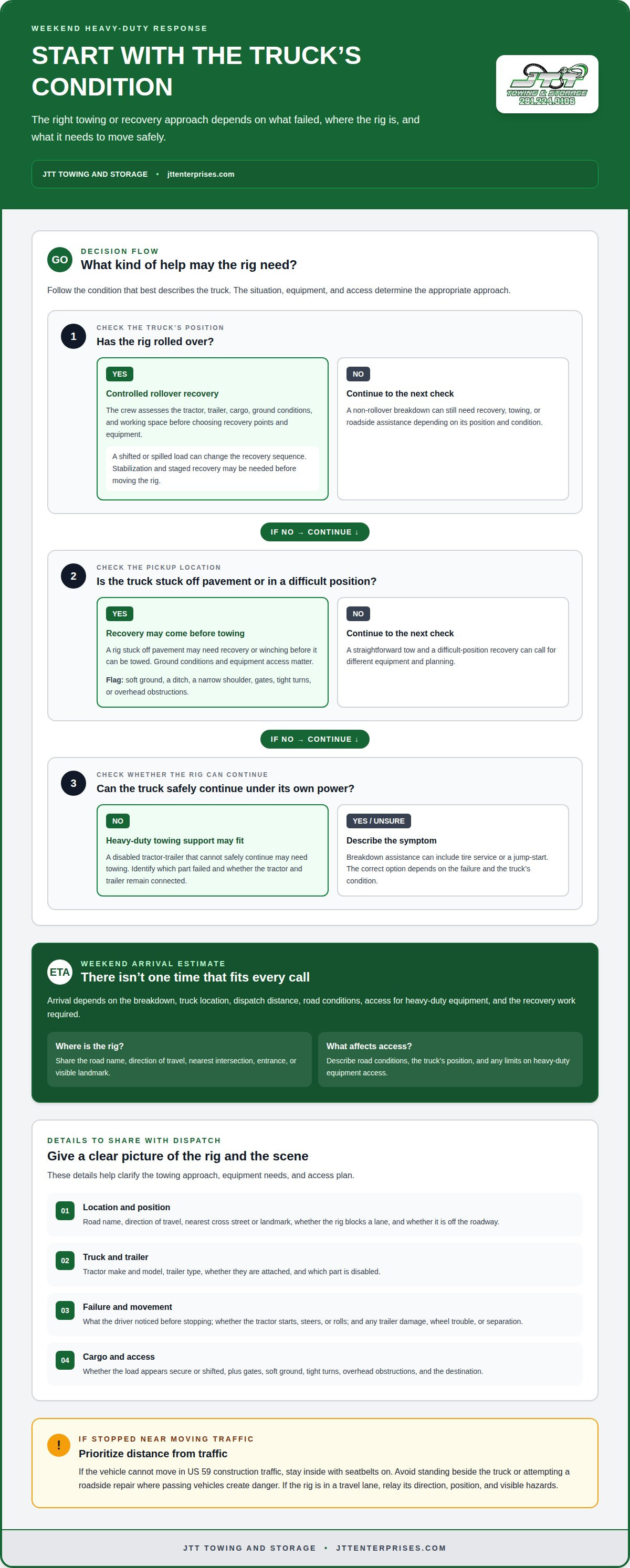
For weekend semi truck towing in Cleveland, TX, arrival time depends on dispatch distance, road conditions, and the equipment and recovery work the truck requires. A tractor-trailer that needs a straightforward tow may call for a different response than a big rig that’s disabled in a difficult position or carrying a shifted load.
When a truck is stopped and traffic is moving around it, an accurate arrival estimate matters. The estimate depends on the breakdown, the truck’s location, road conditions, and access for heavy-duty equipment, rather than one time that applies to every call.
This article explains what can affect weekend response times around Cleveland, what semi-truck and big-rig towing can involve, and how mileage relates to a tow. It also covers the main factors that shape a quote and what to share when arranging heavy-duty recovery.
Key Takeaways
- Understand why a weekend arrival estimate depends on the truck’s location, road conditions, access, and the recovery equipment required.
- Learn how rollover recovery differs from a straightforward tow and what details help clarify the situation.
- See what information about a semi or tractor-trailer can help determine the appropriate towing approach.
- Find out how hookup charges and mileage can affect a tow quote, without assuming one rate applies to every job.
- Identify when heavy-duty towing, accident recovery, or off-road recovery may fit the situation.
Heavy-duty recovery and rollover response
Heavy-duty recovery takes more planning than a routine tow because the truck’s position, damage, and load shape the approach. A disabled tractor-trailer on a narrow shoulder near Cleveland presents a different challenge from one stopped in an open lot. Give dispatch the road name, direction of travel, truck position, visible damage, and whether the load has shifted. These details help the team plan for the equipment and access required.
Texas commercial towing involves two separate considerations: operating requirements and insurance coverage. Requirements depend on the operation and circumstances, while coverage depends on the policy and the parties’ agreement. For a specific tow, identify the truck, trailer, cargo condition, and destination so the relevant coverage and responsibilities can be addressed clearly.
A rollover requires a controlled recovery, not simply pulling the rig upright. The crew needs to assess the tractor, trailer, cargo, ground conditions, and working space before choosing recovery points and equipment. A shifted or spilled load can change the recovery sequence. For example, a trailer resting on its side near a ditch may need stabilization and a staged recovery before it can be moved.
Road access around Cleveland can affect where a heavy-duty truck can position. Colony Ridge and Plum Grove developments along FM 1010 and FM 2025 added thousands of homes, increasing the importance of giving precise location details. Identify the nearest cross street, entrance, or visible landmark, then describe whether the rig blocks a lane or sits off the roadway.
Breakdown assistance can involve towing, winching a vehicle from a difficult position, tire service, or a jump-start. The correct option depends on the failure and the truck’s condition. A truck with a mechanical fault may need transport, while a rig stuck off pavement may require recovery before towing. Describe the symptom and whether the tractor or trailer can move.
Which local companies provide 24/7 heavy-duty towing and roadside assistance? A local address alone doesn’t establish round-the-clock dispatch. Treat 24/7 coverage as a specific schedule claim, and distinguish it from weekend availability when arranging help for a Cleveland breakdown.
While waiting on a Texas highway, prioritize distance from moving traffic. Drivers whose vehicles cannot move in US 59 construction traffic should stay inside with their seatbelts on. Avoid standing beside the truck or attempting a roadside repair where passing vehicles create danger. If the rig is in a travel lane, relay its direction, position, and visible hazards so responders can locate it efficiently.
Semi truck and Class 8 tractor-trailer towing
A Class 8 tractor-trailer may need a different towing approach from a single straight truck. The tractor-trailer’s components and cargo can affect the towing approach, so identify which part is disabled. A tractor that can roll but cannot steer presents a different task from a trailer with damaged wheels. Explain which part failed and whether the tractor and trailer remain connected.
When comparing towing services, focus on equipment, availability, service coverage, and relevant customer feedback. Match the heavy-duty service to the truck’s configuration and location in Cleveland, then consider whether the provider is available when you need help.
Give dispatch the details needed to identify the truck and destination. Include the tractor’s make and model, trailer type, whether it is attached, and what the driver noticed before stopping. Describe the cargo and whether it appears secure. Share the destination and any access limits, such as a low entrance or narrow private drive.
- Tractor issue: Explain whether it starts, steers, or rolls.
- Trailer issue: Identify damage, wheel trouble, or separation from the tractor.
- Load condition: Note visible shifting or cargo that may affect movement.
- Pickup access: Describe gates, soft ground, tight turns, or overhead obstructions.
Those distinctions matter for a Class 8 rig because a tow plan must account for both tractor and trailer. For example, if the tractor is disabled but the trailer is intact, the requested movement may differ from a combination with damage at the trailer axle. Don’t assume the load can be moved separately. Its condition and the available space influence how the recovery is handled.
Farm equipment also needs a clear description. A small tractor on a roadside shoulder differs from one stuck in a field, and an attached implement can affect access. Describe the equipment type, whether it can roll, and whether an implement remains connected. Mention a mower or trailer attachment so dispatch knows what accompanies the tractor.
Route details help with equipment planning around Cleveland. Identify the road surface and the approach from the nearest accessible entrance. A tractor-trailer stopped on pavement may have different access needs from farm equipment beside an unpaved field lane. Mention soft ground, drainage ditches, gates, or tight turns before dispatch.
For a disabled tractor-trailer, heavy-duty towing support is relevant when the vehicle cannot safely continue under its own power. Clear details about the combination, cargo, and access help frame the required tow.
Semi-duty and big-rig towing in Cleveland
For heavy-duty towing near Cleveland, the pickup point and destination shape the route and access plan. A location in Cleveland and a remote worksite outside town can involve different travel considerations. Give the road name, nearest intersection, and destination rather than just saying “near Cleveland.” That way, dispatch can consider the full route, not only the truck’s current position.
Which areas near Cleveland, TX do heavy-duty towing companies serve? JTT Towing and Storage serves the local area, covering designated ZIP codes including 77535, 77336, 77327, 77561, 77357, 77532, and 77575. For a specific pickup, provide the exact location and destination so the route and access can be assessed.
“Semi” and “big rig” can refer to vehicles with different towing needs. A loaded tractor-trailer, straight truck, and work truck may each require a different recovery plan. Share the vehicle type, whether it has a trailer, and whether it can roll or steer. A disabled truck that still rolls, for example, presents different movement needs from one with locked wheels.
Access matters at both ends of a Cleveland tow. A wide highway shoulder may leave room to position equipment, while a narrow driveway, gated yard, or soft field entrance can restrict the approach. Describe the entrance, surface, overhead obstructions, and turning space. Mention any restricted entrance at the destination before the tow begins.
Traffic and route conditions can also affect an arrival estimate. A call at a business entrance beside an active roadway differs from one at an isolated worksite. Share the direction of travel, visible landmarks, and whether the truck blocks a lane. If roadwork has changed the usual approach, describe the current access point rather than giving only a familiar address.
- Pickup location: Give the road, direction, nearest intersection, and landmark.
- Vehicle details: Identify the truck, trailer, and whether the combination remains connected.
- Access limits: Note gates, narrow turns, low clearances, or soft ground.
- Destination: Provide the planned drop-off point and any entry restrictions.
These details help determine whether the job is a direct tow or a recovery requiring extra positioning or a different route. A big rig beside a narrow access road, for instance, may need a careful approach before it can be moved. A truck going to a repair yard also needs an accessible drop-off point. Clear directions help prevent delays from searching for the vehicle or reaching an unsuitable entrance.
For weekend semi truck towing Cleveland TX, describe the vehicle and both ends of the route in one clear call. A precise location, road-access description, and destination give the towing team practical information to plan the job.
Service may involve locations within Cleveland or remote worksites outside town, depending on the pickup and destination. Provide both exact locations so the route and access can be assessed.
Towing prices and mileage charges
A towing quote for a Cleveland truck generally separates the initial hookup from travel and job-specific work. The price depends on the case and is given after a quote request; key factors include vehicle type, distance, access, and recovery complexity. A semi that can be connected on open pavement presents a different job from a rig that needs winching before towing.
Weekend, after-hours, and holiday charges don’t follow one universal Cleveland rate. The quote for a particular job should make clear how the requested timing and work relate to the total. Review those details before arranging the tow.
Mileage charges are tied to the distance used in the quote, but the route and mileage method matter. For example, a tow from a Cleveland roadside location to a repair destination involves a different distance from a move to a farther yard. Clarify the starting point, destination, and mileage basis shown in the quote. Don’t assume every company measures distance the same way.
The hookup involves connecting the vehicle for towing, while additional recovery work can expand the job. A truck already positioned for loading differs from one in a ditch or blocked by an inaccessible entrance. Describe whether it rolls, whether the trailer is attached, and whether cargo has shifted. These details explain why a straightforward tow and a recovery are different jobs.
- Vehicle: Identify whether it’s a tractor-trailer, straight truck, or other commercial vehicle.
- Location: Give the Cleveland pickup point and any limits on reaching it.
- Destination: Name the intended drop-off point and its access conditions.
- Condition: Describe damage, wheel issues, load concerns, or recovery needs.
- Timing: State whether the requested tow falls on a weekend, after-hours, or holiday period.
Compare quotes by confirming they describe the same job. One may cover a direct tow, while another includes recovery or difficult access. Check the hookup, mileage basis, destination, and any additional work. If the scope differs, the totals may not represent equivalent services.
Before accepting a quote, read the stated scope and make sure the vehicle and route details match the situation. For example, describe a tractor with an attached trailer accurately if that affects the work being quoted. Clear information keeps the estimate tied to the Cleveland tow you need.
Which towing companies offer weekend semi-truck towing in Cleveland, Texas?
Choosing a provider starts with matching the service to the job. A Cleveland semi-truck breakdown calls for a team that handles heavy commercial vehicles and the specific work required. A tractor-trailer needing a roadside tow differs from one requiring recovery from soft ground. Consider the truck’s condition and location when describing the situation to JTT Towing and Storage.
Weekend availability is a separate detail from general towing capability. A company may handle heavy vehicles without operating on the schedule you need. For Saturday or Sunday help, establish whether dispatch is taking calls during that period and whether the requested work fits the situation. Don’t infer weekend coverage from an advertisement that only says “heavy-duty towing.”
Equipment suitability matters, too. Describe the tractor, trailer, and load, then explain whether the vehicle can roll, steer, and remain connected. A loaded combination with a damaged wheel may need a different approach from an empty trailer with a disabled tractor. A clear description helps the team understand the job.
For a practical comparison, use the same details each time. Cleveland callers can organize the information this way:
- Location: Provide the road, direction, nearest intersection, and a visible landmark.
- Vehicle: Identify the tractor, trailer, and whether they remain connected.
- Condition: Describe damage, load concerns, and whether the rig moves.
- Access: Mention narrow entrances, soft ground, gates, or blocked lanes.
- Destination: Give the drop-off location and any access restrictions.
Use those details to understand the arrival estimate. It depends on dispatch distance, road conditions, access, and the equipment and recovery work required. A truck near a Cleveland entrance may have different access conditions from one stopped along a construction route. The location and current road situation help explain the estimate.
Reviews can add context when they describe similar commercial jobs. Look for comments about tractor-trailers, difficult access, or recovery work rather than relying only on general roadside experiences. A review about a passenger vehicle doesn’t show how a provider handles a loaded rig. Compare feedback that relates to the vehicle and work involved.
Before deciding, summarize the Cleveland pickup point, truck configuration, condition, and destination in one call. That focused description helps distinguish a suitable heavy-vehicle response from a general towing inquiry. Share your Cleveland tow details to take the next step.
JTT Towing and Storage: Accident Recovery
JTT Towing and Storage provides Accident Recovery for commercial vehicles involved in collisions, including situations where a rig needs careful removal from the scene. Heavy-Duty Towing can move a disabled semi-truck, while Off-Road Recovery helps when a vehicle leaves the roadway or gets stuck beyond paved access.
After recovery, Vehicle Storage can keep the truck secure while you arrange next steps. JTT Towing and Storage offers secure, monitored storage for short-term or long-term needs. When describing the incident, share the vehicle’s location and condition, and whether the tractor and trailer remain connected.
For a collision, roadside breakdown, or truck stuck off pavement near Cleveland, contact JTT Towing and Storage to discuss the situation.
Choose a clear next step for your truck
A disabled commercial vehicle can disrupt a delivery, work schedule, or planned route. Once you know the truck’s condition and destination, choose a response suited to the situation rather than treating every call as a routine tow. For weekend semi-truck towing in Cleveland, TX, a concise description of the incident helps the team understand what you need.
JTT Towing and Storage handles Accident Recovery, Heavy-Duty Towing, and Off-Road Recovery. These services address different needs, from a commercial vehicle involved in a collision to a disabled rig or truck that has left the roadway. Share the location, vehicle condition, and immediate concern so the team understands the situation from the start.
The next step is simply to explain what happened and what assistance you’re seeking. Contact JTT Towing and Storage for towing help, and move forward with a clear plan for your vehicle.
Frequently Asked Questions
How long does it take a tow truck to reach Cleveland, TX?
Arrival time depends on the truck’s location, road conditions, and the equipment and recovery work required. A disabled rig near a clear entrance may be easier to reach than one blocked by construction traffic or positioned off the roadway. For a Cleveland call, give the road, direction, nearest landmark, and vehicle condition. These details help dispatch understand the location and provide a more useful arrival estimate.
Are you available 24/7 in Cleveland, including nights and weekends?
Yes, JTT Towing and Storage is available 24 hours a day, 7 days a week, including nights and weekends. For a Cleveland-area breakdown, explain whether the truck is disabled, involved in a collision, or off the road. Include its location and whether it blocks traffic. This helps clarify the situation when requesting Heavy-Duty Towing or Accident Recovery outside regular business hours.
Do you handle Class 8 wrecks and rollovers on US-59 / I-69 near Cleveland?
JTT Towing and Storage provides Heavy-Duty Towing and Accident Recovery for large vehicles, including commercial truck incidents near Cleveland. For a Class 8 wreck or rollover near US-59 / I-69, describe the truck’s position, visible damage, and whether the trailer or load has shifted. Share the direction of travel and a nearby landmark so responders can identify the scene and understand the recovery conditions.
What is the typical cost of weekend semi-truck towing near Cleveland, TX?
The cost depends on the specific job, including the truck’s condition, distance, access, and whether recovery work is needed before towing. A roadworthy rig that can be connected directly differs from a rollover or truck stuck off pavement. For a useful quote, provide the Cleveland pickup location, destination, tractor-trailer details, and any access or load concerns. No single estimate applies to every weekend tow.
How quickly can a heavy-duty tow truck reach Cleveland, TX on a weekend?
Weekend arrival depends on dispatch location, traffic, road access, and the equipment needed for the truck. A rig near Cleveland’s 77327 area may have different route conditions from one farther away, such as near Dayton’s 77535 area. Describe the precise location, direction, and nearest landmark, then explain whether the truck can move. These specifics help the team assess the call and provide an arrival estimate.


