
A roadside tow is for a vehicle disabled by a breakdown or another non-collision problem. A collision tow follows a crash and may involve recovering a damaged vehicle. Emergency roadside assistance can include towing, jump-starts, lockout help, fuel delivery, and flat-tire assistance. The right response depends on what happened and where the vehicle is.
A breakdown or lockout is stressful enough without wondering what help covers or how long a response may take. Roadside service availability varies by state, and arrival times depend on factors such as your location, road conditions, and the help required.
This guide explains what roadside assistance may include, how requests and dispatch work, and what affects response times. It also clarifies how roadside and collision towing differ, so you can describe the situation clearly and understand what kind of recovery is needed.
Key Takeaways
- Roadside plans may include jump-starts, towing, lockout help, fuel delivery, and flat-tire assistance; coverage varies by plan and location.
- For an immediate emergency while stranded, call 911, according to the National 911 Program.
- Response times depend on factors such as your location, road conditions, and the type of help needed.
- A roadside tow addresses a breakdown or other non-collision problem; a collision tow involves recovery after a crash.
- Clear details about your location, vehicle, and problem can help dispatch identify the right response.
Jump-start service and on-site battery testing
A weak battery can leave a vehicle unable to start, even after a brief stop. A jump start supplies temporary power so the engine can turn over, but it doesn’t explain why the battery failed. On-site battery testing can help distinguish a discharged battery from a deeper charging problem.
A technician can inspect the battery, its connections, and the charging system. Loose or corroded connections may interrupt power. If the engine starts, testing can help determine whether the vehicle is likely to keep running. If it won’t start, or testing points to another fault, towing may be the practical next step.
Before requesting help, note the vehicle’s make, model, and exact location. Tell dispatch whether the dashboard lights come on, whether you hear clicking, and whether the vehicle has needed previous jump starts. These details help identify the likely issue and prepare for the right roadside response.
Which roadside assistance plans are best in the United States? The best fit is a plan whose towing terms, covered vehicles, and included help match your driving habits. Manufacturer plans may tow only to an authorized dealership, so consider that restriction alongside coverage for jump-starts, lockouts, fuel delivery, and flat tires.
Membership fees depend on the plan’s included services, towing limits, and whether coverage applies to a person or a vehicle. Compare those terms with the help you’re most likely to need. Same-day service depends on factors such as the dispatch queue, your location, road access, and the type of assistance requested.
On-site help can address some problems without moving the vehicle. A jump start may restore enough power to start the engine. A locksmith call may help with a lockout, while a flat tire may require roadside tire-changing assistance. These are different tasks, so describe the exact problem when requesting help.
In the target areas of 77535, 77336, 77327, 77561, 77357, 77532, and 77575, provide dispatch with a precise location. Give a road name, direction of travel, nearby exit, or visible landmark. A location pin can help, but confirm the road and direction verbally.
Safety comes first if a breakdown leaves you exposed to immediate danger. People in the United States should call 911 for emergencies, including when stranded and needing emergency help, according to the National 911 Program. For a non-emergency battery problem, share your location and symptoms, then follow dispatcher instructions.
Roadside assistance availability by location
Roadside assistance features and availability vary by state. A plan that works for a driver in one state may have different terms elsewhere. Coverage can also depend on the road, the vehicle’s location, and the help requested. A dead battery near a town may present different dispatch conditions than one on a remote road during severe weather.
State availability and policy exclusions are separate questions. A plan may be sold in a state but still exclude certain roads, vehicle uses, or service situations. Read the covered-service language, geographic limits, and exclusions together. For example, towing may have a distance limit, while a lockout or flat tire may be covered under different terms.
Does car insurance include roadside assistance, and what are the coverage limits? Some auto policies offer roadside assistance as an optional benefit, while others don’t include it. The policy sets the covered services and limits, such as towing distance or the number of service calls.
Availability also depends on the meaning of “24/7.” That label may describe when requests can be submitted, but it doesn’t explain every dispatch condition or service restriction. Read whether the plan describes round-the-clock request intake, roadside dispatch, or both. Weather, road closures, and safe access can affect whether a service vehicle can reach a driver.
What should I do to stay safe while waiting for roadside assistance? Move away from moving traffic if you can do so safely, and make your vehicle visible to approaching drivers. Share your precise location and follow instructions from emergency responders or dispatch.
For clearer service coordination, provide:
- The state, road name, and direction of travel.
- A nearby exit, intersection, or visible landmark.
- The vehicle type and the problem, such as a dead battery.
- Any road closure, weather hazard, or access barrier.
Are roadside assistance services available for motorcycles, RVs, and electric vehicles? Coverage depends on the plan and vehicle category, so motorcycle and RV owners should review vehicle eligibility and towing terms. Some plans offer mobile charging for electric vehicles that run out of charge on the road.
Can I use roadside assistance for a rental car or someone else’s vehicle? Eligibility depends on whether the plan covers a named driver, a specific vehicle, or both. Before requesting service, compare the policy’s eligibility rules with the rental agreement or vehicle owner’s details.
Keep the plan information accessible, especially when traveling across state lines. A policy card or saved document can help you find its service number and exclusions. If a breakdown happens, state your location first, then explain the vehicle issue and access conditions.
Roadside assistance response times
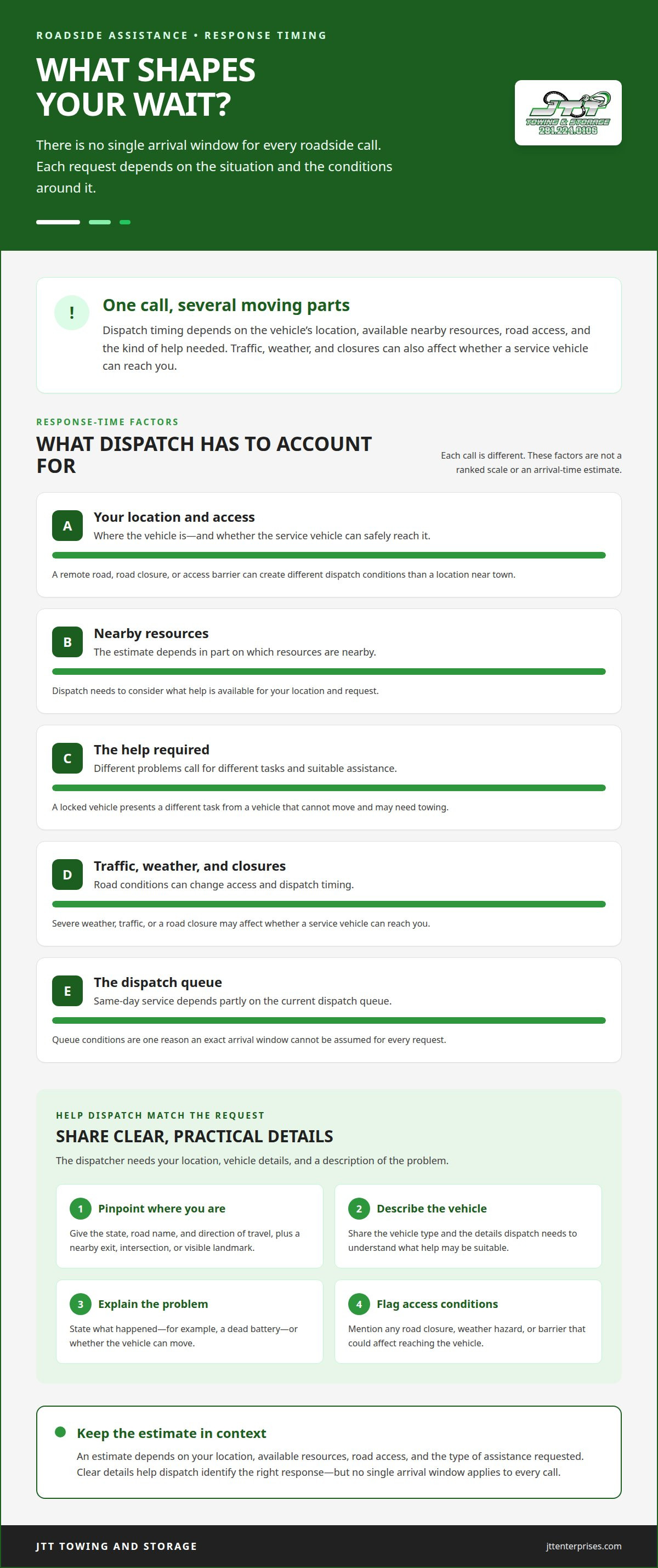
Dispatch timing can depend on the information available when you make the request. The dispatcher needs your location, vehicle details, and a description of the problem. A tow truck assigned to a locked vehicle faces a different task than one sent for a vehicle that cannot move. Clear information helps dispatch match the request with suitable help.
No single arrival window applies to every roadside call. The estimate depends on where the vehicle is, which resources are nearby, and current road access. Traffic, weather, closures, and competing service calls affect how quickly a driver can reach you. A vehicle beside an open city street presents different access conditions than one on a narrow shoulder.
Ask for the current estimated arrival time when you place the request. Also ask how dispatch will share updates, and keep your phone available. If the vehicle is difficult to spot, describe a nearby exit, intersection, landmark, or direction of travel. For example, “northbound near the last exit” is more useful than a town name alone.
The type of service also shapes timing. A jump start or lockout requires different equipment and steps than a tow. If a vehicle has collision damage, is stuck off-road, or carries a shifted load, explain that before dispatch. This helps identify the right equipment and avoid sending a truck that cannot complete the work.
Before ending the call, confirm these details:
- Your exact location, including road direction and nearby landmarks.
- The vehicle’s make, model, and whether it can move safely.
- The problem, such as a dead battery, flat tire, or collision damage.
- Any access issue, including a garage, narrow road, or blocked entrance.
Coverage terms and dispatch timing are related, but they are not identical. A service can be covered under a plan while local conditions still affect arrival. Review the plan’s covered services and limits, then give dispatch the information needed to route the call.
During a delay, update dispatch if your location changes or conditions worsen. Don’t leave the vehicle to meet a tow truck somewhere else unless dispatch directs you. If your phone battery is low, send your location and essential details first. Keep the vehicle’s hazard lights on when appropriate for the conditions.
For emergency roadside assistance, focus first on accurate location details and a clear description of the vehicle’s condition. Those facts help dispatch assess the job, select appropriate equipment, and provide a useful arrival estimate. Treat each update as part of coordination, not as a new request.
Towing coordination when on-site repairs are not possible
Some breakdowns need more than roadside troubleshooting. If a vehicle still won’t run after a jump start, or a warning light returns, towing may be the safer next step. Tell dispatch what was attempted and what changed. For example, report whether the engine started briefly, whether a tire is damaged, or whether the vehicle cannot shift into gear.
Minor roadside repairs can sometimes get a vehicle moving again. A technician may address a simple issue, such as a discharged battery or flat tire, depending on the problem and equipment available. More involved mechanical faults need diagnosis in a repair shop. Don’t keep driving if the vehicle makes unusual noises, leaks fluid, or shows signs of unsafe operation.
Before dispatch, decide where you want the vehicle taken. A nearby repair shop may be convenient, but confirm it can receive the vehicle and handle the issue. If you don’t have a destination, ask dispatch about available towing destinations. Share the shop’s name, address, and any access instructions to help the driver route the tow correctly.
Use these steps to coordinate the move:
- Describe the vehicle’s condition and any roadside repair attempt.
- Give dispatch the exact pickup location and destination address.
- Explain whether the vehicle rolls, steers, and can be placed in neutral.
- Remove personal items you’ll need before the vehicle is loaded.
- Confirm where the vehicle will be left at the repair shop.
Vehicle condition affects the towing method. A car that rolls and steers may be loaded differently from one with collision damage or locked wheels. Tell dispatch about low clearance, a blocked wheel, or a vehicle in a tight parking space. These details help match the tow truck and loading approach to the recovery.
Vehicle size matters, too. Light-duty towing suits many passenger vehicles, while larger vehicles may require medium-duty or heavy-duty equipment. Flatbed towing can be appropriate when the vehicle’s condition makes rolling it unsuitable. Describe the vehicle and damage clearly rather than choosing equipment yourself.
If a vehicle cannot be repaired roadside, towing connects the breakdown location with a repair destination. The tow operator handles transport; the repair shop diagnoses and fixes mechanical faults. Keeping those roles clear helps you know what to expect at pickup and after arrival.
For example, if a vehicle starts after a jump but stalls again, share both facts. If it remains locked in a garage, explain the clearance and access limits. Accurate details support suitable dispatch, a practical destination, and a safer handoff to the repair shop.
Customer experiences with towing, lockouts, and app requests
A roadside request often begins with a specific problem: a vehicle won’t start, keys are locked inside, or a tire is damaged. Describe what happened in plain terms. “The engine clicks but won’t turn over” gives dispatch more useful context than “the car is broken.” Clear details help distinguish a lockout from a mechanical issue requiring a tow.
How do I request roadside assistance and what information should I provide? Use the plan’s phone number or mobile app, then provide your exact location, vehicle details, and the problem. Mention the road direction, a nearby exit or landmark, and whether the vehicle can move safely.
A mobile app can make it easier to submit a request when you’re stranded, especially if you can share a location pin. Still, check that the pin matches your actual position. A pin placed on a frontage road instead of the highway may send help to the wrong access point. Include a road name or landmark as a second location clue.
For a lockout, state whether the keys are inside the vehicle, the trunk, or another locked area. Don’t leave out details such as a child or pet inside, because that changes the urgency of the situation. If anyone faces immediate danger, call 911 rather than relying only on an app request.
Towing requests benefit from a clear destination. Give the repair shop’s name and address if you have chosen one. Explain whether the vehicle has collision damage, a blocked wheel, or limited access. For example, a car in a narrow parking garage may need different coordination than one beside an open road.
Before sending an app request, gather these details:
- Your location, travel direction, and a nearby road marker.
- The vehicle’s make, model, color, and license plate.
- The issue, such as a lockout, flat tire, or no-start condition.
- A contact number and any destination details for a tow.
After submitting, keep your phone available and review the request summary. Correct a wrong location or vehicle description promptly. If the problem changes, such as the vehicle becoming unsafe to move, update dispatch through the same request channel when possible. This helps keep the reported situation aligned with what the driver will find.
For a vehicle that needs transport rather than an on-site fix, request towing assistance with the pickup location and destination ready. A concise, accurate request helps make the handoff clearer, whether you called or used a mobile app.
JTT Towing and Storage: Accident Recovery
JTT Towing and Storage provides Accident Recovery when a collision leaves a vehicle damaged or unable to travel safely. If the vehicle is off-road, Heavy-Duty Towing or Off-Road Recovery may fit the situation, depending on its condition and location. Vehicle Storage can help when the vehicle needs to be held after recovery.
Share the collision location, vehicle type, visible damage, and any access challenges when arranging recovery. Details such as a blocked lane, a vehicle off the roadway, or a large truck help clarify the recovery needs. For a roadside breakdown without collision damage, explain the issue so the required towing approach is clear.
For collision recovery or vehicle storage, contact JTT Towing and Storage to discuss your situation and next steps.
Choose the right recovery for what comes next
A vehicle that can’t continue its trip may need more than a roadside fix. The next decision is whether the situation involves a collision, a heavy vehicle, or recovery away from a road. Matching the request to the problem helps start a clear conversation about the vehicle’s condition and required transport.
JTT Towing and Storage offers Accident Recovery, Heavy-Duty Towing, and Off-Road Recovery for these situations. If a crash has left your vehicle unable to travel, explain the damage and its location. For a heavy vehicle or one stuck off-road, describe access conditions and any obstacles around it. Those details help shape the recovery request.
Keep the next step straightforward: share what happened and where the vehicle is. For recovery needs that go beyond routine emergency roadside assistance, contact JTT Towing and Storage to discuss the situation. A clear request can help you move forward with greater confidence.
Frequently Asked Questions
What's the difference between a roadside and collision tow?
A roadside tow moves a vehicle disabled by a breakdown or non-collision problem. A collision tow involves a vehicle damaged in a crash and may require recovery before transport. For example, a car with engine trouble may need a standard tow, while a vehicle stuck beside the roadway after a collision may need recovery equipment. Tell dispatch what happened and describe visible damage.
What services are included in emergency roadside assistance?
Plans commonly include towing, jump-starting, locksmith services, fuel delivery, and flat-tire help. Specific coverage varies, so compare the plan’s service descriptions with your needs. For instance, a driver with an electric vehicle should look for mobile charging coverage if running out of charge is a concern. A plan may also set limits on which vehicles or situations qualify for service.
How much does emergency roadside assistance cost without a membership?
The cost depends on the situation and the help required. A tow’s distance, vehicle condition, location, and equipment needs can affect the quote; a lockout or jump-start is a different service request. Ask for a quote before authorizing work, and clarify what the quoted service includes. Don’t assume a membership benefit applies to a call made without an active plan.
How long does roadside assistance usually take to arrive?
Arrival time depends on the pickup location, road access, traffic, weather, nearby resources, and the type of service needed. A tow truck may need different equipment than a technician handling a lockout. Give dispatch a precise location, including road direction and a landmark, then ask for the current estimate. If your position or conditions change, update dispatch through the same request channel.
What are common exclusions and limits in roadside assistance plans?
Plans may limit towing distance, eligible vehicles, service-call frequency, or where help can be provided. Coverage also varies by state. Manufacturer-provided plans typically tow vehicles only to an authorized dealership, so that destination restriction can matter. Read exclusions alongside included services, and note whether a situation, such as commercial vehicle use, falls within the policy’s stated terms.
How do I find emergency roadside assistance near me?
Use your plan’s phone number or app and share your exact location, vehicle, and problem. For local help, drivers in postal areas 77535, 77336, 77327, 77561, 77357, 77532, and 77575 can consider JTT Towing and Storage, based in Dayton, Texas. Describe whether the vehicle needs a roadside response, towing, or recovery so dispatch can understand the request.


