
A cement truck recovery service must account for the load’s movement as well as the truck’s position, because both affect stability and rollover risk.
If a truck is stuck, leaning, or involved in a collision, getting it moved safely is the immediate concern. With a heavy vehicle carrying wet concrete, however, the recovery approach matters: abrupt movement or an unstable setup can add risk.
This article explains how the truck’s weight and shifting concrete affect stability, what recovery teams consider when planning an operation, and how recovery typically proceeds. It also covers when heavy-duty towing, accident recovery, or load transfer may be appropriate, so you can understand the steps involved.
Key Takeaways
- Learn how recovery needs differ when a truck is stuck, damaged in a collision, or needs to be moved with its load.
- Understand which job conditions affect recovery pricing, including the truck’s position, load, and access to the scene.
- See why arrival time depends on the location, recovery conditions, and the equipment needed for the situation.
- Prepare useful details for a recovery call, such as the truck’s position, load status, and any immediate hazards.
Shifting wet concrete and truck stability
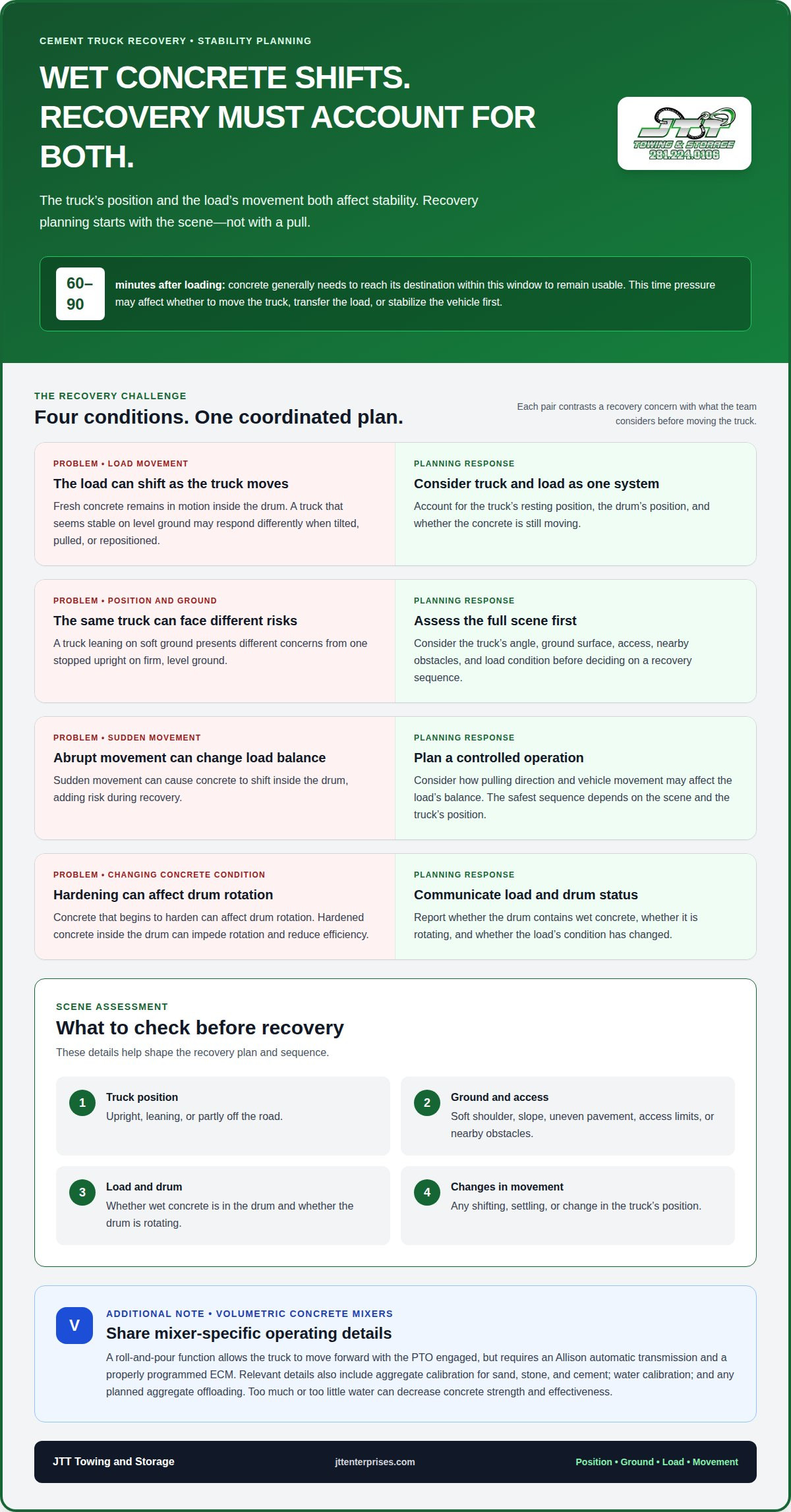
That movement changes how weight is distributed across the truck. A cement truck recovery service must consider both the truck’s resting position and how its load may move during recovery. A vehicle that appears stable on level ground can respond differently when tilted, pulled, or repositioned.
The concrete’s condition also matters. Fresh concrete remains in motion inside the drum, while material that begins to harden can affect drum rotation. Concrete generally needs to reach its destination within 60 to 90 minutes of loading to remain usable. That time pressure may influence decisions about whether to move the truck, transfer the load, or prioritize stabilizing the vehicle first.
Recovery planning starts with assessing the scene, not with a pull. The operator considers the truck’s angle, ground surface, available access, and load condition. A truck leaning on soft ground presents different concerns from one stopped upright on firm, level ground. The drum’s position and whether the concrete is still moving also matter.
- Truck position: Note whether the vehicle is upright, leaning, or partly off the road.
- Ground conditions: Identify soft shoulders, slopes, uneven pavement, or nearby obstacles.
- Load condition: Report whether the drum contains wet concrete and whether it is rotating.
- Movement: Describe any shifting, settling, or change in the truck’s position.
These observations shape the recovery plan. A controlled operation accounts for how the pulling direction and vehicle movement may affect the load’s balance. Sudden movement can cause concrete to shift inside the drum, so the team considers the truck and its load as one system. The safest sequence depends on the scene and the vehicle’s position.
Recovery costs vary with distance, location, and access, while the cement truck’s load can affect the equipment and work required. The price depends on the specific situation and is provided after a quote request.
When reporting a stranded truck, provide its location, whether it is tilted, and whether the drum contains wet concrete. Mention any slope, soft shoulder, or other access issue. These details help the recovery team understand the conditions before starting the operation.
Recovery considerations can differ for a volumetric concrete mixer. Its roll-and-pour function allows the truck to move forward with the PTO engaged, but requires an Allison automatic transmission and a properly programmed ECM. The mixer’s aggregate calibration process covers sand, stone, and cement. Water calibration also matters, because too much or too little water can decrease concrete’s strength and effectiveness.
Hardened concrete inside a cement-truck drum can impede rotation and reduce efficiency. Aggregate offloading from a volumetric concrete mixer requires precautions to prevent equipment damage. The mixer’s roll-and-pour capability, transmission and ECM requirements, material calibration, and any planned aggregate offloading are relevant operating details to communicate. These factors complement information about the truck’s position and load condition.
What services does a cement truck recovery company provide?
A cement truck recovery operation may involve more than towing. The right response depends on whether the truck is disabled on a roadway, stuck off-road, damaged in a collision, or carrying a load that needs separate handling. A cement truck recovery service can involve scene assessment, vehicle recovery, towing, and coordination around the concrete load. These details help determine the equipment and sequence required.
For a truck stuck on a soft shoulder, Off-Road Recovery may focus on safely repositioning the vehicle before it can travel. The operator assesses the truck’s location, ground conditions, and obstacles, then plans a controlled recovery. A truck lodged beside a narrow access road, for example, presents different space constraints from one stopped in an open worksite. The recovery method must suit the actual position.
After a collision, Accident Recovery can address the disabled vehicle and scene conditions that affect its movement. The recovery team needs to understand visible damage, the truck’s position, and whether access is restricted. Airbag Recovery is another specialized need after airbags deploy. Sharing these details early helps tailor the response to the incident rather than treating every disabled truck as a routine tow.
- Scene assessment: Establish the truck’s position, access route, and visible hazards.
- Off-road recovery: Plan how to recover a truck that has left the road or become stuck.
- Accident recovery: Address a disabled truck involved in a collision.
- Load coordination: Determine whether the concrete load needs separate handling or transfer.
Load handling can shape the operation. If the truck cannot continue safely, the team may need to coordinate a load shift or transfer before moving it. The concrete’s condition, drum operation, and access for receiving equipment all affect the plan. For example, a truck blocking a worksite entrance may require a different sequence from one secured in an open area.
Towing or storage may follow recovery when the truck cannot continue to its destination. The appropriate next step depends on its condition and where it can be moved safely. Give the dispatcher the truck’s location, incident type, visible damage, and load status. A clear description helps identify whether the situation involves Off-Road Recovery, a collision, or additional load coordination.
If a collision has disabled a truck, explore recovery support for collision-damaged vehicles as a next step. Describe the scene and vehicle condition so the response can be matched to the recovery need.
How much does cement truck recovery cost in the United States?
There isn’t one fixed price for cement truck recovery across the United States. Each job involves different distances, scene conditions, vehicle positions, and recovery plans. A straightforward tow from a firm, accessible surface differs from extracting a disabled truck from a ditch. The price depends on the specific situation and is provided after a quote request.
Distance is one factor. The truck’s location affects how far recovery equipment must travel and how far the vehicle needs to be moved afterward. A truck blocking a worksite entrance may need to be repositioned nearby, while one stranded far from a suitable destination may require a longer tow. Share the exact location and intended destination when requesting a quote.
Access and ground conditions also shape the work. A truck on stable pavement requires a different operation from one on a soft shoulder or uneven ground. Tight access, nearby obstacles, or a steep approach can change equipment positioning and recovery steps. Describe the scene clearly, including whether the truck is upright, leaning, or stuck off-road.
The truck’s load matters because it can affect the recovery plan and equipment required. Report whether the drum contains concrete, whether it is still rotating, and whether the load may need a separate transfer. For example, a disabled truck with a full drum may need coordinated load handling before towing. The load condition can therefore change the scope of the job.
- Distance: Give the truck’s location and where it needs to go.
- Scene access: Describe road width, ground surface, slope, and nearby obstacles.
- Vehicle condition: Explain whether it is damaged, immobilized, or off-road.
- Load details: State whether concrete remains in the drum and whether transfer may be needed.
- Recovery scope: Clarify whether the request involves repositioning, towing, or additional handling.
Before approving work, ask for a quote that reflects the known details: travel, access, truck position, load handling, and destination. If the situation changes after the initial description, such as the truck turning out to be leaning or the access route being blocked, the required work may change too. Accurate details help align the quote with the actual recovery operation.
For a useful request, provide the location, truck condition, load status, and desired destination together. These details connect the main cost factors to the recovery plan and help avoid an estimate based only on distance. A cement truck recovery service is priced around the work required at the scene, not simply the truck type.
How quickly can a heavy-duty tow truck reach a stranded cement truck?
Arrival time depends on the truck’s location, the route to the scene, and the recovery equipment required. A heavy-duty tow truck already near an accessible roadway may reach a stranded vehicle sooner than equipment traveling farther to a remote worksite. Distance alone doesn’t determine timing. Road access, traffic, and the truck’s position also shape the response.
The recovery team needs to match equipment to the situation. A cement truck stopped upright on a paved shoulder may need a different setup from one leaning off-road or trapped in soft ground. Dispatch details help identify the difference. If the scene requires specialized recovery equipment rather than a straightforward tow, preparing the right response can affect dispatch and arrival planning.
Give a precise location when requesting a cement truck recovery service. A road name, direction of travel, nearby landmark, and worksite entrance can help pinpoint the scene. For example, “northbound near the plant entrance” is more useful than “outside town.” On a private site, identify the gate and the route suitable for a heavy-duty truck.
Report conditions that may affect access or the recovery plan. Mention a blocked lane, narrow driveway, steep approach, soft shoulder, or vehicle leaning at an angle. A truck in a ditch may require a different dispatch decision from one stopped on flat pavement. Load status matters too, because wet concrete and a moving drum can affect the sequence of work.
- Pinpoint the scene: Provide the road, direction, entrance, and a nearby landmark.
- Describe the truck: State whether it is upright, damaged, stuck, or leaning.
- Explain access: Identify obstacles, restricted approaches, and usable staging space.
- Report load details: Say whether the drum contains concrete and whether it is operating.
- Share immediate hazards: Describe traffic exposure or anything blocking safe access.
After dispatch, keep the route clear where it is safe to do so, and share any change in the truck’s position. Don’t attempt to move a leaning or stuck cement truck yourself. The recovery operator needs the vehicle’s current condition, not an earlier description, to plan the approach on arrival.
For the clearest arrival estimate, provide the location and scene details together, then ask for the expected arrival window based on that information. A precise answer depends on the truck’s position, equipment needs, route, and access conditions. Report new obstacles or a worsening lean promptly, since these changes can affect the required equipment and approach.
What information should I provide when calling for cement truck recovery
Start with the truck’s exact location. Give the road name, direction of travel, nearest exit, or worksite entrance. On a large construction site, identify the gate and describe the route to the vehicle. A nearby landmark or clear location pin can help distinguish the truck’s position from the site’s main address.
Next, explain what happened and how the truck is positioned. Say whether it stopped because of a mechanical problem, collision, or difficult ground. Describe whether it remains upright, is leaning, or has left the roadway. For example, “off the right shoulder and leaning toward the ditch” is more useful than simply saying the truck is stuck.
Share load and drum details, too. State whether concrete remains in the drum and whether it is turning. If you know the load condition, report it without guessing. Mention visible damage to the cab, wheels, or drum. These details help the recovery team understand the vehicle’s condition and whether the operation may involve load handling.
- Location: Road, direction, nearby landmark, site entrance, or location pin.
- Position: Upright, leaning, off-road, or blocking an access route.
- Incident: Breakdown, collision, ground conditions, or other cause.
- Load: Whether concrete remains in the drum and whether it is rotating.
- Access: Narrow approaches, locked gates, slopes, or blocked paths.
- Destination: Where the truck needs to go, if that is already known.
Then describe access constraints that could affect a heavy-duty vehicle. Report a narrow entrance, low obstruction, soft shoulder, steep approach, or blocked lane. If the truck is at a worksite, explain which route is open and whether another vehicle or piece of equipment blocks access. Don’t move the truck or attempt a self-recovery to improve access.
Keep the call focused on observable facts. If you’re unsure whether the truck is leaning or whether the drum is operating, describe what you can see rather than estimating. Give a callback number and stay available for questions about the entrance, load, or vehicle position. If conditions change, such as the truck settling further, provide an update.
Use this checklist during the call: location, truck position, incident, load status, access conditions, and destination. Clear details help communicate the recovery need and support planning for the right equipment. Share your recovery details to arrange assistance for a stranded cement truck.
After recovery, pass on any equipment concerns you observed so they can be considered during inspection and repair. Cement-truck inspections should assess the drum, hydraulics, and structural elements. Repairs should include checks that the drum rotation and hydraulic systems function properly. If you noticed a change in drum movement, hydraulic operation, or visible structural damage during the incident, describe what you saw without guessing at the cause.
For a volumetric mixer, include any concerns about its fiber chopper in the service handover. The fiber chopper should be calibrated to distribute fiber evenly and accurately in the concrete. Sharing these observations with the recovery details can help direct attention to the relevant equipment and reported condition.
JTT Towing and Storage: Accident Recovery
JTT Towing and Storage provides Accident Recovery for cement trucks disabled in a collision. When a truck is stuck off-road, Off-Road Recovery can address its position. Heavy-Duty Towing can move a disabled truck, while Vehicle Storage is an option when it needs to be held after recovery.
Share the truck’s location, damage, position, and load status when arranging assistance. For example, report whether it is blocking a road, leaning off the shoulder, or unable to move after impact. These details clarify the recovery need and next step.
Contact JTT Towing and Storage to discuss recovery for your situation.
Make the next move with a clear recovery plan
A disabled cement truck can create pressure to act quickly, but the next step should reflect the vehicle’s condition and location. Choose a recovery response based on whether the truck was involved in a collision, is stuck off-road, or needs Heavy-Duty Towing. Clear, accurate details help the team understand the situation and plan the appropriate assistance.
JTT Towing and Storage provides Accident Recovery, Heavy-Duty Towing, and Off-Road Recovery. If you need a cement truck recovery service, share the truck’s location, position, visible damage, and load status when you get in touch. That gives the conversation a practical starting point and helps clarify the recovery need.
Contact JTT Towing and Storage to discuss the situation and take the next step toward recovery. A calm, precise description of the scene can help move the process forward.
Frequently Asked Questions
How is a loaded cement truck recovered from mud, a ditch, or a rollover?
Recovery starts with assessing the truck’s position, the ground, and the load before selecting equipment or a recovery direction. In mud or a ditch, the plan must account for the surface and the truck’s stability. After a rollover, the vehicle needs careful assessment before repositioning. Wet concrete can shift as the truck moves, so operators may need to consider load handling before towing. Don’t attempt to pull or reposition the truck yourself.
What are the safety risks during cement truck recovery?
The main risks include vehicle instability, changing weight distribution, and nearby traffic. A truck leaning on a shoulder or resting in a ditch may shift further during an attempted pull. Keep clear of the vehicle and recovery area. JTT Towing and Storage provides 24/7 service in ZIP codes 77535, 77336, 77327, 77561, 77357, 77532, and 77575, with locations at 8290 FM 1960, Dayton, TX 77535 and 21 Private Road #34901, Cleveland, TX 77327.
What equipment is needed to tow or recover a cement mixer truck?
A heavy-duty tow truck may be needed, along with recovery equipment suited to the truck’s position, ground conditions, access, and load. If the concrete needs to be transferred, receiving equipment may also be required.


