
An electrical fault can be as disruptive as an engine or brake problem. Heavy-duty truck repair in Dayton, TX may involve engine performance, braking, electrical faults, lighting, or damaged wiring. Identifying the affected system helps determine whether the truck needs repair or recovery.
When a truck won’t run or stop as it should, clear information helps. Understand which systems may be involved and whether the situation calls for repair or recovery support.
This article explains common engine and brake repair needs, how electrical, lighting, and wiring issues can affect a truck, and what to consider when choosing support. It also outlines how JTT Towing and Storage fits into the next step when a heavy-duty truck needs repair or recovery in Dayton.
Key Takeaways
- Use review details to assess whether a shop understands heavy-duty vehicles and communicates clearly about diagnosis and repair work.
- When looking for help right away, describe the truck’s location, symptoms, and whether it can be moved safely so the next step is clear.
- Engine, brake, electrical, lighting, and wiring problems can call for different diagnostic and repair approaches.
- When a breakdown or collision leaves a truck unable to continue, recovery support can help move it from the scene.
- JTT Towing and Storage provides accident recovery, heavy-duty towing, off-road recovery, and vehicle storage for situations that call for those services.
Truck repair shop reviews Dayton TX
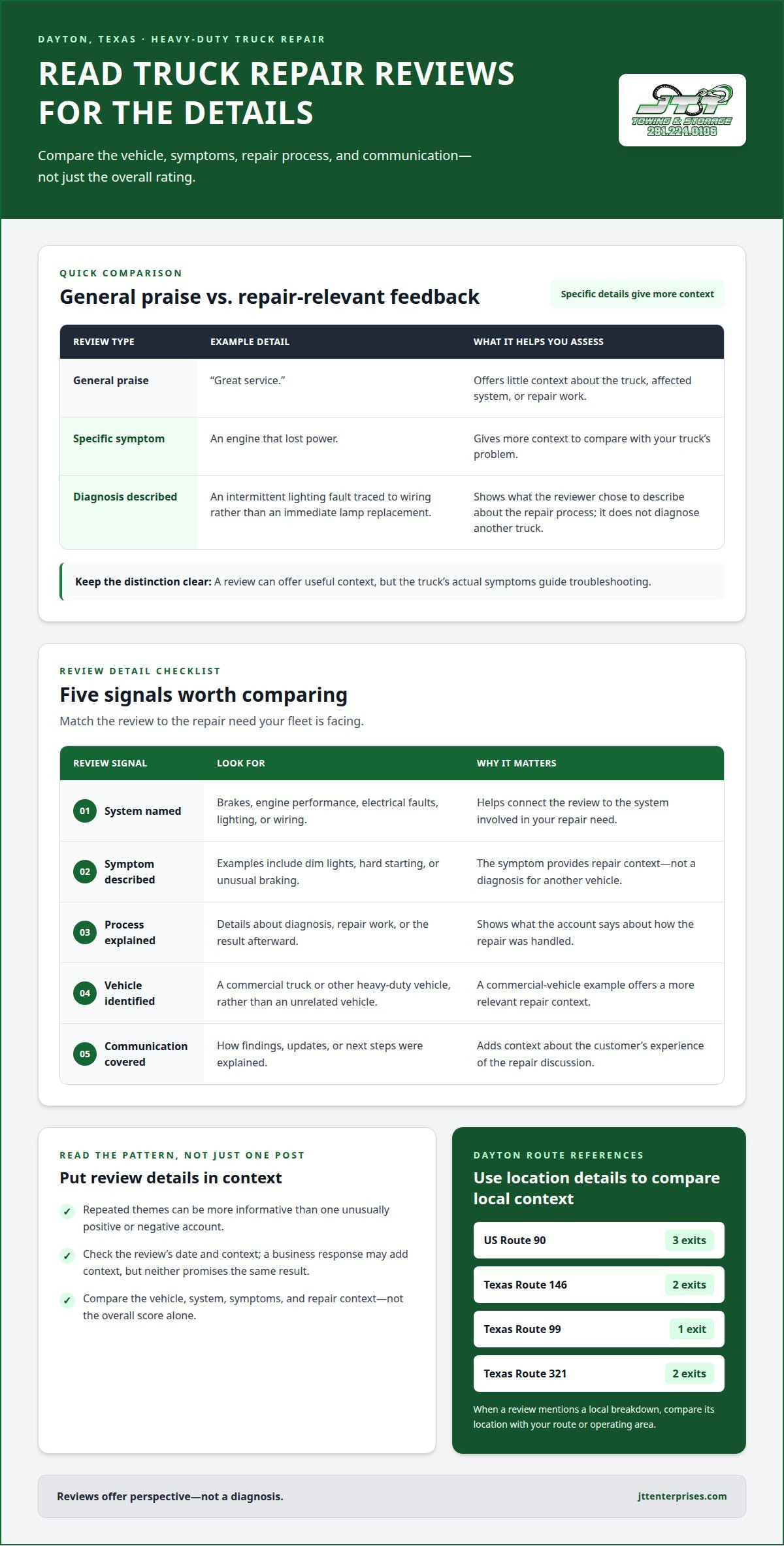
Reviews can help Dayton fleet managers separate useful repair feedback from general praise. For heavy-duty truck repair in Dayton, TX, look for comments that identify the vehicle system, symptoms, and outcome. A review describing an engine that lost power gives more context than “great service.” Specific details help you compare the reviewer’s experience with your truck’s problem.
Check whether a review describes commercial equipment rather than a passenger vehicle. A tractor-trailer with a brake concern presents a different repair context from a sedan with a warning light. Reviews that name a commercial vehicle and repair category offer more relevant clues. A high overall rating alone doesn’t show whether the truck had engine, brake, or electrical work.
Look for a clear description of the diagnosis. A useful example might explain that a technician traced an intermittent lighting fault to wiring rather than replacing a lamp immediately. That detail shows what the reviewer chose to describe. It doesn’t prove the same diagnosis applies to another truck, but it can help you judge whether the review offers meaningful information about the repair process.
Dayton’s road network can help you judge whether a review relates to local operations. US Route 90 has 3 exits in Dayton, and Texas Route 146 has 2. Texas Route 99 has 1 exit, while Texas Route 321 has 2. When a review mentions a local breakdown, compare its location details with your own route or operating area.
Read reviews for useful repair details
Use these clues to distinguish detailed feedback from general impressions. They help connect a reviewer’s account to a repair decision your fleet may face.
- System named: Check whether the review identifies brakes, engine performance, electrical faults, lighting, or wiring.
- Symptom described: A report of dim lights, hard starting, or unusual braking gives the repair context.
- Process explained: Note whether the account covers diagnosis, repair work, or the result afterward.
- Vehicle identified: A commercial truck example is more relevant than feedback about an unrelated vehicle.
- Communication covered: Look for details about how findings, updates, or next steps were explained.
Repeated themes can be more informative than one unusually positive or negative account. If several Dayton reviews describe clear explanations during electrical troubleshooting, that pattern may be relevant to a fleet dealing with a wiring fault. Comments about unrelated vehicle types or services offer less insight into heavy-truck repair. Read the details, not just the overall score.
Check each review’s date and context. A dated account shows when the customer described the experience, while a business response may clarify the issue. Treat both as context, not a promise of the same result. A review about brake repair, for example, can suggest useful questions but can’t diagnose another truck’s braking symptoms.
Connect a review’s details to your repair need before drawing a conclusion. Note the truck’s symptoms, affected system, and when the issue appears. Then compare those details with specific examples, such as intermittent starting trouble or a trailer light that repeatedly fails. This keeps your search focused on relevant experiences rather than ratings alone.
Reviews offer one perspective, not a diagnosis. A post about wiring can show what useful detail looks like, but the truck’s actual symptoms guide troubleshooting. In Dayton, comparing the vehicle, system, and repair context makes online feedback more useful when assessing which experience resembles your fleet’s issue.
Truck repair shops near Dayton TX open now
An “open now” label is a starting point, not a repair plan. For heavy-duty truck repair in Dayton, TX, first determine whether the truck can move safely or needs help where it stopped. A tractor that won’t start needs a different next step from a truck with a brake concern or trailer lighting fault. Note the exact location, symptoms, and vehicle type before reviewing listings.
Dayton’s roads offer useful location references for dispatchers. Give the road, direction of travel, nearest exit, and a visible landmark. “Eastbound near the Dayton fuel station,” for example, is more useful than “outside town.” Say whether the truck is in a parking area, roadside, or another accessible location. Clear directions help avoid confusion during the initial conversation.
Search results may show business hours, but hours alone don’t tell you which repairs a business handles. A listing marked open may not explain whether it addresses commercial truck engine diagnostics, brake concerns, electrical faults, lighting, or wiring. Read the service descriptions alongside the hours. A general repair listing, for example, may not explain whether it covers the heavy-truck system your fleet needs.
Make an open-now search useful
Use a simple sequence to match a search result to the truck’s condition. Keep the vehicle, system, and location details together as you review the information.
- Enter “Dayton, TX” with the affected system, such as engine or brake repair.
- Compare listed hours with the repair categories described for commercial trucks.
- Prepare the truck’s make, model, symptoms, and precise location.
- Describe whether it starts, moves, or displays a warning light.
- Explain what changed and when the symptom first appeared.
Specific symptoms make the initial discussion more useful. A driver might report that the engine cranks but won’t start, or that braking feels different than usual. For an electrical problem, note whether the headlights, marker lights, or several circuits are affected. Describe what you observe without guessing which component has failed.
If a truck has stopped near a busy access point, give a location another person can identify. Name the nearest road or intersection, direction of travel, and a visible landmark. If the truck is behind a business or inside a yard, describe the entrance and any access restrictions. These details help clarify where the truck is positioned.
The Dayton metro coverage map lists 3 on-call responders. That figure provides local coverage context, but it doesn’t identify a particular shop’s hours or work capacity. For a dispatcher, the essential details remain the truck’s location, symptoms, and ability to move. Keep them in one concise description while reviewing open listings and repair categories.
Distinguish a repair need from a recovery need. A truck that remains mobile despite a warning light may need diagnostic attention, while a disabled vehicle may first need help leaving its location. A trailer lighting fault also differs from an engine that won’t start. Describing the immediate condition helps define the next step instead of treating every breakdown alike.
Before calling, keep the vehicle information and symptom notes in front of you. Include the truck’s make and model, affected system, visible damage, and exact location in Dayton. Say whether the driver can move it. This preparation makes it easier to explain the problem and the type of assistance needed.
For a disabled truck that needs recovery rather than a repair discussion at its current location, consider the truck assistance options available for the situation.
For an urgent truck problem, first determine whether the vehicle can move safely or needs help where it stopped. Share its precise location, vehicle type, and symptoms, then check the listing’s hours and confirm that its services cover the affected heavy-truck system.
Treat an “open now” listing as a starting point: compare its hours with the commercial truck repair services it describes. Before contacting a shop, prepare the truck’s make, model, symptoms, and precise location, and explain whether it starts or moves safely.
JTT Towing and Storage: Accident Recovery
JTT Towing and Storage provides Accident Recovery when a collision leaves a commercial truck unable to continue safely. Heavy-Duty Towing can move a disabled truck, while Off-Road Recovery can help when it has left the roadway. Vehicle Storage provides a place for the vehicle after recovery as your fleet determines its repair plan.
When requesting help, share the truck’s location and condition, and say whether it is blocking the roadway or has left it. Mention visible damage and whether the vehicle can move under its own power. These details help clarify the recovery need and next step.
For assistance with a disabled truck after a collision or roadway incident, contact JTT Towing and Storage.
Keep Your Fleet’s Next Move Clear
A truck problem can disrupt a route, but a clear handoff keeps decisions organized. Record the symptoms, location, and whether the vehicle can move. Share those details with the people coordinating the next steps so repair planning reflects the truck’s actual condition, not assumptions.
For heavy-duty truck repair in Dayton, TX, the right next step depends on whether the truck needs diagnosis at a repair facility or recovery from its current location. When a collision, roadside breakdown, or off-road incident prevents travel, JTT Towing and Storage offers Accident Recovery, Heavy-Duty Towing, and Off-Road Recovery. These services can address the vehicle’s movement needs while your team plans what follows.
Keep the truck’s location and condition ready when arranging assistance. A precise description helps communicate the situation without guessing at the underlying mechanical problem. Contact JTT Towing and Storage to discuss recovery needs and take the next step with a clear plan for your truck.


