
The miles on a commercial tow can shape the bill as much as the breakdown itself. Cleveland is identified by ZIP codes 77327 and 77328, and emergency commercial truck towing in Cleveland, TX depends on matching the truck’s needs with the required recovery and travel distance.
A disabled semi can put a driver and an operation under pressure, especially at night or on a weekend. For emergency commercial truck towing in Cleveland, TX, explain the truck’s location and condition, the service it needs, and its destination. These details help clarify the recovery plan and the factors that shape a quote.
This guide explains what 24/7 coverage means for a tow request in Cleveland and Liberty County, what commercial truck towing may involve, and why distance matters when a truck must be transported. It also outlines the details that help clarify a towing quote, so you can understand the cost factors and the next steps during a stressful roadside situation.
Key Takeaways
- Match the tow service to the truck, its condition, and the recovery situation to help clarify what assistance is needed.
- Understand what 24/7 coverage means for emergency requests in Cleveland and Liberty County, including nighttime and weekend situations.
- Learn how travel distance and the tow details influence a quote, without relying on a one-size-fits-all price.
- Prepare the truck’s location, vehicle type, and breakdown details to make a towing request clearer and more efficient.
- See when heavy-duty towing, accident recovery, off-road recovery, or vehicle storage can help move the situation forward.
Commercial and heavy-duty towing in Cleveland
Commercial towing matches the recovery method to the vehicle, its condition, and the roadside setting. In Cleveland, first identify whether the disabled vehicle is a tractor-trailer, a loaded box truck, or another commercial vehicle.
Rotator and heavy-wrecker recovery capacity
A rotator uses a rotating boom to position lifting and pulling equipment around a disabled vehicle. Heavy wreckers offer substantial towing and recovery capability, but the right setup depends on the truck, its load and damage, and access to the scene. A tractor-trailer off the roadway, for example, may need a different recovery plan from a disabled box truck on a paved shoulder.
Focus on whether the equipment suits the specific recovery, not on its name alone. Share the vehicle configuration, whether a trailer is attached, and any visible damage so the recovery plan can account for them.
Choosing a licensed and insured towing company
For a commercial tow in Texas, choose a company whose licensing and insurance apply to the work involved. Review the relevant credentials and coverage, then consider whether the proposed equipment and recovery approach suit your vehicle. A tractor-trailer recovery, for example, needs a plan for that combination, not a generic roadside tow.
The company should also be able to explain the tow plan clearly. Confirm the pickup location, destination, vehicle condition, and any load concerns before work begins. This gives you a clear understanding of the planned service and the assignment.
Commercial and heavy-duty towing involves more than moving a vehicle from one point to another. A disabled truck may need a straightforward tow, while damage or difficult access may require recovery before transport. The truck’s configuration and condition determine what the work involves.
Consider a loaded tractor-trailer stopped beside a narrow access road. The trailer, cargo, and room to maneuver all affect the recovery approach. An empty commercial truck with a mechanical failure in a wide, paved area presents different access conditions, even if both vehicles need transport.
Before arranging a tow, note whether the vehicle is upright, off the roadway, or blocking access. Describe the tractor and trailer separately if both are involved. Mention shifted cargo or collision damage, as either can affect the recovery sequence.
- Identify the commercial vehicle type and whether a trailer is attached.
- Describe its position, visible damage, and access around the vehicle.
- Explain whether the load is present or appears to have shifted.
These details help distinguish a towing assignment from a recovery situation and give the team a clearer basis for planning equipment and access in Cleveland. Note whether the truck is in a parking area, beside a road, or off the roadway.
Emergency towing and 24/7 Liberty County coverage
For a commercial truck in Cleveland, emergency towing is for a vehicle that cannot safely continue, while roadside assistance addresses a limited problem at the scene. Cleveland is identified primarily by ZIP code 77327, a useful location detail when arranging help with JTT Towing and Storage.
Cleveland-area coverage and routes
Cleveland-area service depends on the truck’s exact location within our specific service ZIP codes, not just the city name. Give the ZIP code, road name, direction of travel, and nearest visible landmark. If the truck is near Cleveland’s edge or along covered local routes, these details help JTT Towing and Storage pinpoint the pickup and clarify the route to the destination.
The route and roadside setting affect the practical tow plan. A truck on a narrow shoulder, for example, presents different access needs from one in a wide parking area. Describe the roadway and say whether the vehicle blocks traffic. Specific directions are more useful than simply saying it is “near Cleveland.”
Information for an emergency towing request
For a Cleveland tow, prepare the truck’s location, type, and condition. Say whether it is a tractor-trailer, whether a trailer is attached, and whether the vehicle is upright or off the roadway. Include the destination and any access limits, such as a tight entrance or restricted space.
Describe the problem in plain terms. A truck that will not start is different from one involved in a collision or unable to roll. Mention visible damage, cargo concerns, and hazards around the vehicle. These details help JTT Towing and Storage clarify whether you need roadside assistance or a tow.
At night or on a weekend, clear location details remain important for a commercial truck in Cleveland. The phrase “24/7 coverage” means service access at any hour, within our designated service area, including nights and weekends. For your request, identify the truck’s location first, then describe the fault and the assistance required.
Roadside assistance may address a problem that leaves the truck safely in place and able to continue after help. Emergency towing is appropriate when the truck cannot continue safely or needs transport. A minor issue that can be resolved roadside, for example, is different from collision damage that prevents the vehicle from moving.
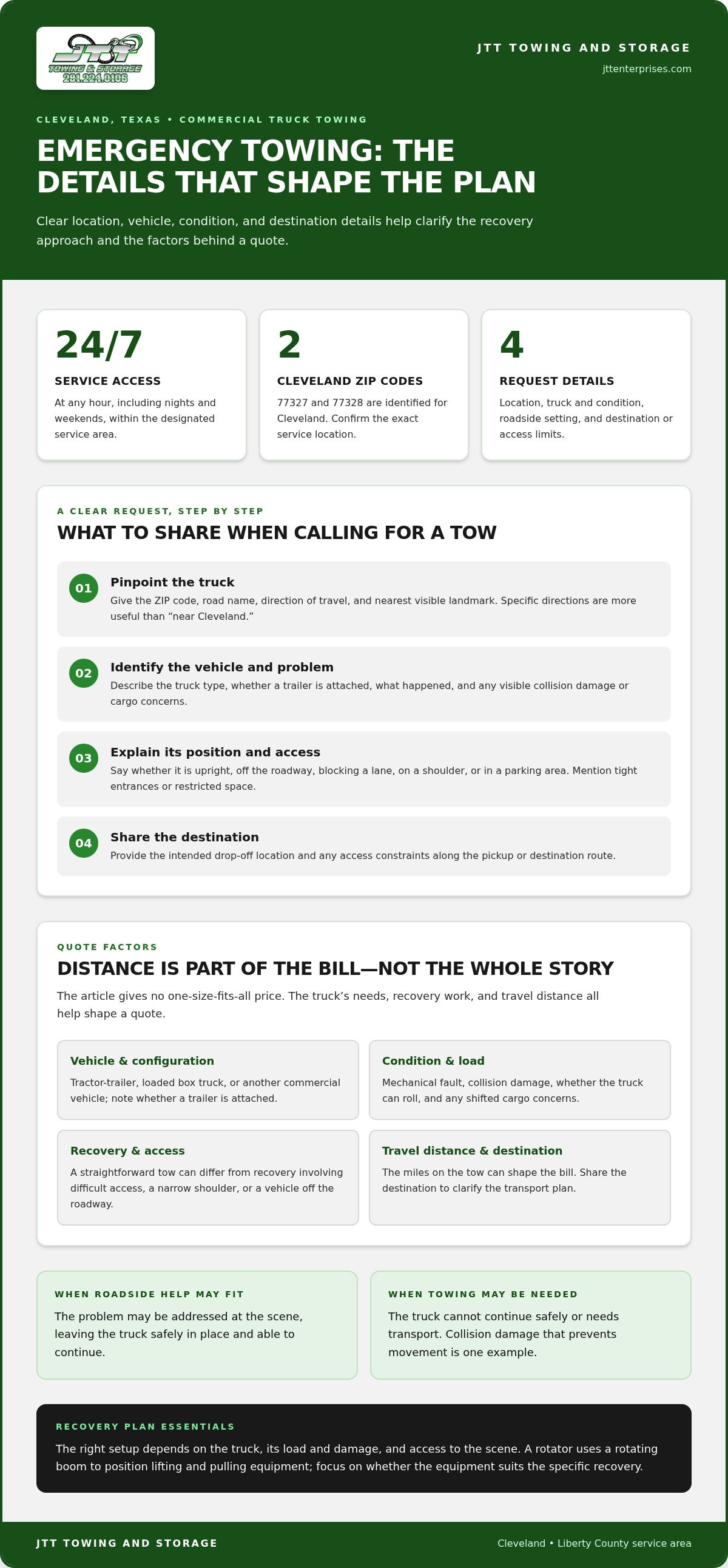
Use these steps to make the request clear:
- Provide the Cleveland-area ZIP code, road name, direction, and nearest landmark.
- Identify the truck and trailer configuration, then describe the problem and visible damage.
- Explain whether the truck is blocking a lane, on a shoulder, or in a parking area.
- Share the intended destination and any access constraints along the pickup or drop-off route.
ZIP code 77327 can help pinpoint a Cleveland address serviced by JTT Towing and Storage, but a roadway name or landmark narrows the location further. For a request within our service boundaries, state the specific community or road directly rather than assuming a broad regional name identifies the exact pickup point.
Describe the immediate situation before the mechanical issue. For example, say that a commercial truck is stopped on a shoulder and will not move, then explain whether it has a trailer. This gives the dispatcher a practical picture and helps distinguish a roadside issue from a towing need.
Tow pricing and mileage charges
A commercial tow quote reflects the work required for the truck and trip. Mileage matters, but distance alone does not describe the assignment. A disabled tractor-trailer needing recovery differs from a mobile truck requiring a straightforward tow, even if both travel the same route from Cleveland.
The price depends on the circumstances and is provided after a quote request. Key factors include mileage, vehicle type and condition, recovery complexity, and destination. Ask how the mileage basis is calculated, such as whether it covers the route from pickup to drop-off or other travel included in the quote. Clear terms show what distance the quote represents.
Distance can affect the total because a farther destination generally involves more travel. A tow from a Cleveland roadside location to a nearby destination, for example, follows a different route from one to a facility farther away. Provide the exact pickup point and destination so the mileage estimate reflects the trip.
Vehicle and recovery details also shape the quote. A truck that can be connected and moved directly may need a different plan from one that is damaged, off the roadway, or difficult to access. A trailer, cargo, or restricted approach can affect the recovery work, so describe these factors before requesting a quote.
- Pickup and destination: Give precise locations, not only “Cleveland” or “nearby.”
- Vehicle configuration: Identify the truck and whether a trailer is attached.
- Condition: Explain whether it rolls, starts, or has visible damage.
- Recovery conditions: Describe off-road positioning, limited access, or cargo concerns.
Insurance and payment are separate considerations. The terms of a commercial vehicle policy determine whether towing or recovery costs are covered, while payment arrangements depend on the service transaction. Keep policy information and incident details available if you plan to seek reimbursement.
Before agreeing to a tow, review the quote’s mileage basis, destination, and described work. If the destination changes after the truck is loaded, the route and distance may change too. State the intended drop-off point at the outset and explain any later changes so the trip details stay accurate.
For a Cleveland tow, follow a simple sequence: give the pickup location, describe the truck and its condition, provide the destination, then review how mileage and recovery work affect the quote. This creates a shared understanding before dispatch and distinguishes transport distance from the work needed to prepare the vehicle for towing.
Towing for semis, big rigs, and commercial vehicles
A semi, straight truck, and loaded tractor-trailer have different towing needs. In Cleveland, describe the complete vehicle combination so the recovery plan accounts for the truck, trailer, and condition.
Describe the tractor and trailer separately. Explain whether the tractor can roll, whether the trailer remains attached, and where the disabled unit is positioned. A tractor with a failed drivetrain and an attached trailer, for example, may need a different approach from a straight truck that rolls freely. These distinctions clarify the equipment and handling required.
Load status matters too. Tell the towing team whether the trailer is loaded, empty, or carrying cargo that may have shifted. A loaded trailer can affect how the combination is approached and moved. If cargo has shifted or the trailer is leaning, describe what you can see rather than trying to adjust it roadside.
Share the vehicle’s condition before discussing transport. Collision damage, a locked wheel, or a steering issue may require recovery considerations beyond a routine tow. If you know which axle or area is affected, say so. Avoid guessing at the mechanical cause: clear observations are more useful than an uncertain diagnosis.
- Vehicle combination: Identify the tractor, trailer, or straight truck.
- Movement: Explain whether it starts, rolls, and steers.
- Position: Describe whether it is upright, off the roadway, or in a confined area.
- Load: State whether cargo is present and note visible shifting.
Access can shape the recovery plan as much as the truck itself. A big rig in an open lot has more room to maneuver than one beside a narrow entrance or among other vehicles. In Cleveland, mention nearby obstacles, overhead clearance concerns, soft ground, and limited turning space. These details help the team plan its approach.
For a commercial fleet, identify who is authorized to coordinate the tow and give the intended destination. If the truck and trailer need separate handling, say so clearly. For example, the tractor may need transport while its trailer stays at the scene. Clear directions help prevent confusion about what is moving and where it should go.
Before the tow begins, review the planned handling with the operator. Confirm which unit is moving, whether the trailer stays attached, and where the vehicle is going. This gives the driver, dispatcher, and towing operator a shared plan for the semi or commercial truck.
What information to provide when requesting emergency truck towing
A clear request gives the dispatcher the details needed to understand the truck, its location, and the assistance required. For a commercial vehicle near Cleveland, organize the information in a practical order: exact location, vehicle configuration, condition, access, and destination.
Start with the pickup point. Give the road name, direction of travel, nearby landmark, and Cleveland ZIP code, if known. “Eastbound near the entrance to a warehouse,” for example, is more useful than “outside Cleveland.” If the truck is in a lot, name the entrance and closest access point.
- Location: Road or facility name, direction, landmark, and access entrance.
- Vehicle: Truck type, tractor and trailer configuration, and visible identifying details.
- Condition: Whether it starts, rolls, steers, or has collision damage.
- Scene: Shoulder, parking area, restricted access, or nearby obstacles.
- Destination: Intended drop-off location and any entry restrictions.
Describe symptoms rather than guessing at the mechanical cause. “The engine turns over, but the truck won’t move” is more specific than “transmission failure” when the diagnosis is uncertain. Note whether a wheel appears locked or the vehicle leans. These observations help distinguish a tow from a recovery involving damage or difficult positioning.
For a tractor-trailer, identify the tractor and trailer separately. Say whether the trailer is attached, loaded, or showing visible cargo movement. If the truck is a straight vehicle, name that configuration. This helps the dispatcher understand which unit needs transport and whether the trailer is part of the move.
Describe the surroundings using observable details. Mention a narrow entrance, low overhead structure, soft ground, or another vehicle blocking access. A truck inside a fenced loading yard, for example, may require directions to the correct gate. Do not enter traffic or approach a damaged vehicle to gather information; report only what you can safely observe.
Give the name and callback number of the person coordinating the tow, along with the destination contact if someone will receive the vehicle. If a fleet manager or dispatcher is making the request, identify their role. Promptly share location changes, such as moving the drop-off point from a repair facility to a secured yard.
Before the call, gather the details you already have, then explain the most urgent issue first. To arrange emergency truck towing, provide the vehicle, location, condition, and destination information clearly. A concise example is: “A loaded tractor-trailer is stopped near a Cleveland warehouse entrance, won’t roll, and needs transport to the named facility.”
JTT Towing and Storage: Accident Recovery
JTT Towing and Storage provides Accident Recovery for commercial vehicles involved in collisions. If a truck is damaged, disabled, or needs to be recovered from its position, this service can help move it toward the next step. Heavy-Duty Towing serves commercial vehicles that need transport, while Off-Road Recovery is for vehicles stuck away from a typical roadway. Vehicle Storage provides a place for a vehicle after recovery.
When arranging assistance, share the truck’s condition, location, and intended destination. Explain, for example, whether collision damage prevents movement or whether the vehicle is off-road. These details help identify the recovery need and clarify what happens next.
Contact JTT Towing and Storage to discuss Accident Recovery or related commercial vehicle assistance.
Put a clear recovery plan in motion
A roadside breakdown can disrupt more than one delivery. Make the next decision clear: identify who will coordinate the response, keep the vehicle and destination details ready, and choose recovery support that fits the situation. For emergency commercial truck towing in Cleveland, TX, a clear request helps turn uncertainty into an organized next step.
JTT Towing and Storage offers Accident Recovery, Heavy-Duty Towing, and Off-Road Recovery for collision damage, disabled commercial vehicles, and trucks stuck off-road. Describe the circumstances and assistance needed so the conversation can focus on the right recovery path.
Contact JTT Towing and Storage to discuss your commercial truck recovery needs. A steady plan starts with one clear next step.
Frequently Asked Questions
Are you available 24/7 in Cleveland, including nights and weekends?
Yes. JTT Towing and Storage is available 24 hours a day, 7 days a week, including nights and weekends. If a truck breaks down after dark, share its exact position and whether it blocks a lane or sits safely off the road. For a Cleveland-area pickup, include the road name, travel direction, and a nearby landmark to help identify the scene.
Can you recover a vehicle stuck on the unpaved roads around Colony Ridge or Plum Grove?
JTT offers Off-Road Recovery for vehicles stuck away from paved roads. For a truck near Colony Ridge or Plum Grove, describe the surface, access route, and distance from the nearest paved road. Include whether the vehicle is loaded, upright, and able to move. These details clarify the recovery conditions and equipment needs at the location.
Do you handle Class 8 wrecks and rollovers on US-59 / I-69 near Cleveland?
JTT offers Heavy-Duty Towing and Accident Recovery for commercial vehicle incidents. For a Class 8 wreck or rollover on US-59 or I-69, report the direction of travel, nearest exit or landmark, and the truck’s position. State whether a trailer is attached and describe visible damage or cargo movement. Those scene details help clarify the recovery requirements.
How long does it take a tow truck to reach Cleveland, TX?
Arrival time varies with the dispatch point, route, traffic, and the truck’s exact location. A pickup near a clear highway exit has different access needs from one deep inside a facility or on a narrow access road. Give the road name, direction, and a nearby landmark, then mention access restrictions. Precise location details help establish the route and response plan.
Is 24/7 emergency commercial truck towing available near Cleveland, TX?
JTT Towing and Storage provides towing and recovery for commercial vehicles, including Heavy-Duty Towing. For an urgent breakdown near Cleveland, describe the truck type and whether it can move under its own power. Say upfront if a collision or off-road position is involved. This helps identify whether towing, accident recovery, or off-road recovery fits the situation.
Which heavy-duty towing companies serve Cleveland, TX?
JTT Towing and Storage offers Heavy-Duty Towing for commercial vehicles in its local service area. Its targeted ZIP codes include 77535, 77336, 77327, 77561, 77357, 77532, and 77575. If your truck is near a boundary or at a facility with several entrances, provide the exact address or access gate. That helps identify the pickup point clearly.
What affects commercial truck towing response times in Cleveland, TX?
Response time depends on the truck’s precise location, the route, traffic, and access conditions. A tractor-trailer on a roadside shoulder may present different access needs from one inside a loading yard. Share the nearest landmark, direction of travel, vehicle configuration, and any restricted entrance. These details clarify the location and work involved.
How are heavy-duty towing rates and mileage fees determined near Cleveland, TX?
The price depends on the circumstances and is provided after a quote request. Mileage, pickup and destination, vehicle condition, and recovery complexity all affect the quote. A direct tow, for example, differs from a truck that needs recovery before transport. Provide the intended drop-off point and describe the truck’s condition so the quote reflects the route and work required.


