
What if the safest response to a semi-truck breakdown isn’t to troubleshoot the problem, but to secure the scene first? If you’re unsure where to stop, whether it’s safe to wait, or how to explain the issue, knowing what to do when a semi truck breaks down can help you make clear decisions under pressure.
A mechanical problem can quickly become a roadside hazard when a truck is stopped near moving traffic or carrying a shifted load. Protecting the driver and others comes first. Then, clear details about the truck’s condition and exact location can help responders determine what equipment and assistance are needed.
This guide covers practical steps for securing the scene, documenting the breakdown, and choosing between repair, towing, and recovery. For commercial drivers near Dayton, Texas, JTT Towing and Storage provides truck repair, heavy-duty towing, and recovery. The right response depends on the truck’s position, condition, and load, so a calm, safety-first approach helps set the next steps.
Key Takeaways
- Knowing what to do when a semi truck breaks down starts with prioritizing safety over diagnosing the mechanical problem.
- Watch for warning signs involving steering, braking, vehicle control, smoke, or fire, and stop operating the truck if conditions feel unsafe.
- Choose between repair, heavy-duty towing, and recovery based on the truck’s mobility, position, roadside risks, and cargo condition.
- When requesting help, share the highway, direction of travel, nearest exit or landmark, truck symptoms, and any immediate hazards.
- JTT Towing and Storage provides truck repair, heavy-duty towing, and recovery in the Dayton, Texas area, with the response suited to the breakdown circumstances.
What to do first when a semi truck breaks down on the road
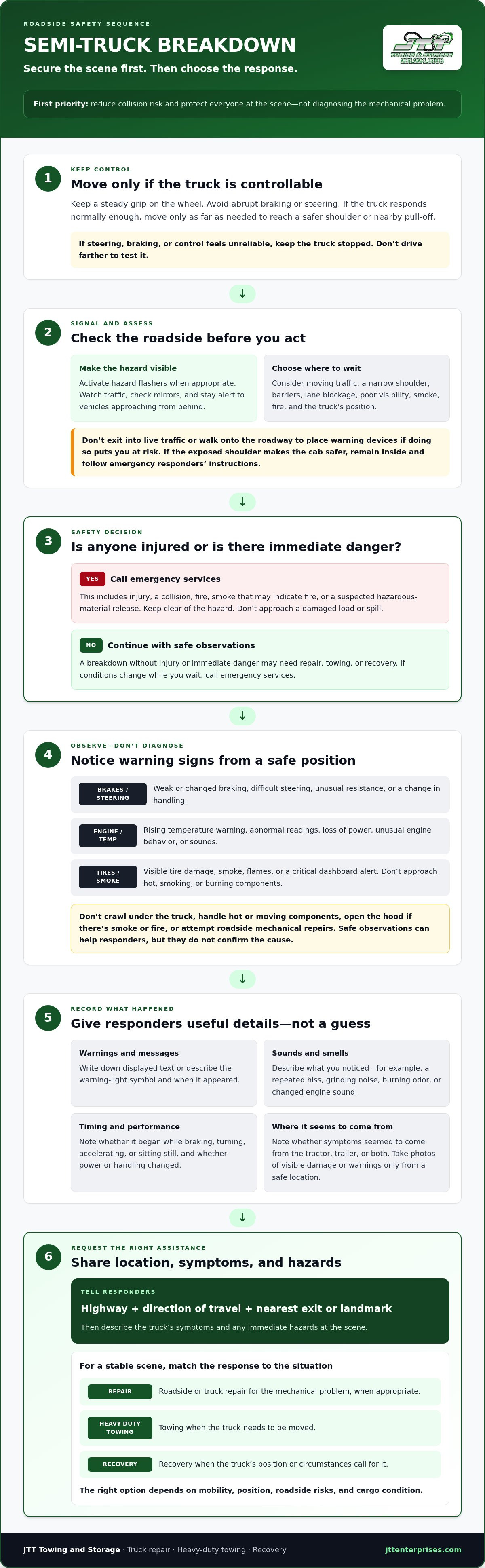
Stay calm and work in order: keep control of the truck, move to a safer position if it remains controllable, then alert other road users. Don’t try to diagnose a mechanical fault while the vehicle is moving or put yourself in danger to reach a shoulder. The first goal is to reduce collision risk and protect everyone at the scene.
Use this sequence, adapting it to traffic, visibility, and the truck’s condition:
- Maintain control. Keep a steady grip on the wheel and avoid abrupt braking or steering. If the truck responds normally enough to move, guide it only as far as needed to reach a safer place.
- Signal the hazard. Activate the hazard warning flashers when appropriate. Watch traffic, check mirrors, and stay alert to vehicles approaching from behind.
- Choose where to wait. Consider whether the truck is exposed to moving traffic, near a barrier, blocking a lane, or close to smoke, fire, or another hazard.
- Stay out of danger. Don’t exit into live traffic or attempt a roadside repair in an unsafe location. If the shoulder is exposed, remain in the cab if it’s safer there and follow emergency responders’ instructions.
- Call for the right help. Contact emergency services for injuries or immediate danger. If the scene is stable, arrange help for the mechanical problem.
How to secure the truck and assess the roadside
Move only if the truck can be controlled. A short distance to a safer shoulder or nearby pull-off may reduce exposure, but continuing to drive with unreliable steering or brakes can make the situation worse. Semi-trailer truck braking systems can involve components across the combination, so don’t assume a warning or change in braking means the truck is safe to operate. See this overview of semi-trailer truck braking systems, but leave diagnosis to qualified personnel.
Once stopped, assess the surroundings before opening a door. Traffic speed, a narrow shoulder, a barrier, poor visibility, and the truck’s position all affect where it’s safest to wait. Warning devices can alert approaching drivers, but don’t walk into traffic or deploy them if reaching the roadway would put you at risk. Follow applicable requirements and emergency instructions.
When to call emergency services instead of roadside assistance
Call emergency services if anyone is injured or there’s an immediate threat to people or traffic. A collision, fire, smoke that may indicate a fire, or a suspected hazardous-material release needs an emergency response, not just a mechanical repair call. Keep clear of the hazard and don’t approach a damaged load or spill. A breakdown without injury or immediate danger may call for repair, towing, or recovery instead. If conditions change while you wait, call emergency services.
How to assess a semi-truck breakdown without making it worse
Once the truck is stopped in a safer position, focus on what you can observe without approaching traffic or attempting a repair. A dashboard message, new sound, or visible change can help a technician understand what happened, but it can’t confirm the cause. Guessing may lead to a risky decision. If the truck’s control, braking, or steering feels unreliable, keep it stopped rather than testing it on the road.
Safe observations help responders; roadside mechanical repairs belong to qualified personnel in a suitable work area. Don’t crawl under the truck, handle hot or moving components, or open the hood if there’s smoke or fire. If there’s an immediate threat, move away only if it’s safe and contact emergency services. For applicable commercial vehicle safety information, consult the FMCSA’s trucking safety resources.
Which warning signs mean the truck should stay stopped?
Stop operating the truck if its response changes in a way that makes it feel unsafe. Warning signs include braking that feels weak or different, difficult steering, a rising temperature warning, or a tire that appears damaged. Smoke, flames, unusual engine behavior, or a critical dashboard alert also call for caution. Don’t try to verify a suspected problem by driving farther or attempting a roadside repair.
- Braking or steering: Note any loss of response, unusual resistance, or change in how the truck handles.
- Temperature or engine behavior: Record warning messages, abnormal readings, loss of power, or unusual sounds.
- Tires, smoke, or fire: Report visible damage or smoke from a safe position. Don’t approach a hot, smoking, or burning component.
What details should the driver record?
Write down what you noticed and when it began. Share the exact dashboard message or warning-light symbol if you can see it from a safe position, along with any sound, smell, or performance change. Note whether the symptoms seemed to come from the tractor, trailer, or both. These observations help responders prepare, but they aren’t a diagnosis.
- Messages and warnings: Record the displayed text or describe the symbol and when it appeared.
- Sounds and smells: Use plain descriptions, such as a repeated hiss, grinding noise, burning odor, or sudden change in engine sound.
- Timing and performance: Note whether the issue began while braking, turning, accelerating, or sitting still, and whether power or handling changed.
- Photos: Take pictures of visible damage or dashboard warnings only from a safe location. Don’t step into traffic or approach smoke, fire, or an unstable vehicle to get a better view.
These details help distinguish what the driver observed from what still needs professional inspection. If the truck needs mechanical attention, JTT’s truck repair support can address the problem after the scene is safe. Share the symptoms without trying to name a failed component, and leave the next operating decision to qualified personnel.
Should you request roadside repair, heavy-duty towing, or recovery?
The right response depends on whether the truck can move safely, where it’s stopped, and whether the trailer or cargo is affected. Repair may suit a truck that’s safely positioned and can be assessed onsite. If it can’t move safely, heavy-duty towing may be appropriate. A crash, rollover, off-road position, or shifted load can call for specialized recovery planning. For an overview of commercial towing considerations, see this heavy-duty towing guide.
| Response | Truck mobility | Roadside safety and position | Cargo considerations |
|---|---|---|---|
| Roadside repair | The truck may be operable, or the issue may be assessable while stationary. | Best considered when the truck is in a safe place for onsite assessment. | May be suitable if the load remains stable and unaffected. |
| Heavy-duty towing | The truck can’t continue safely or needs transport for service. | Used when the truck is disabled but can be approached and moved using a towing response. | Load condition and transport needs should be communicated. |
| Specialized recovery | The vehicle is immobilized or difficult to access. | May be needed after a collision, rollover, or off-road incident, or when position complicates removal. | A shifted or unstable load may require coordinated recovery and load handling. |
This comparison is a starting point, not a diagnosis. When requesting help, describe the truck’s condition, location, and load. Those details help match the response to the situation, rather than treating every disabled semi as a routine tow.
When might roadside repair be appropriate?
Repair may be considered when the truck is safely positioned and a technician can assess the reported problem onsite. A jumpstart or other mechanical support could be relevant, but neither is a guaranteed fix. The technician should determine whether work can be completed safely and whether the truck is fit to operate afterward. If the roadside location is exposed or symptoms suggest a serious fault, towing may be the safer course.
When does a disabled truck need towing or recovery?
A truck that can’t move safely, has collision damage, or is stopped in a hazardous position may need heavy-duty towing. Recovery is a more specialized response for difficult vehicle positions, such as off-road incidents or rollovers. Cargo matters too: a shifted load can affect stability and complicate movement. Accident scenes may require coordinated planning; this tractor-trailer accident recovery guide covers those situations.
As you decide what to do when a semi truck breaks down, don’t attempt to move a truck that feels unsafe simply to avoid a tow. Share whether it rolls, whether the trailer remains aligned, and whether cargo has shifted. JTT Towing and Storage provides heavy-duty towing and recovery, with the response shaped by the vehicle’s condition, position, and load.
How to request help and stay safer while waiting in the Dayton area
A clear report helps responders understand where the truck is and what assistance the scene may require. Around Dayton, Texas, a highway name alone may not pinpoint a safe approach, so include the direction of travel and a nearby exit, intersection, or landmark. If you can safely share a map pin, include it too. Keep the description factual: report what you see rather than guessing at a mechanical cause.
What information helps responders prepare?
Before calling for roadside assistance, gather the details you can safely confirm. If anyone is injured, or there’s fire, a spill, immediate traffic danger, or an unstable load, contact emergency services first. Otherwise, use this checklist:
- Exact location: Give the highway or road name, direction of travel, nearest exit or landmark, and a map pin if available.
- Truck and trailer: Identify the tractor and trailer type, and share details that help distinguish the vehicle.
- Symptoms: Describe warning lights or messages, unusual sounds, smoke, changes in performance, or visible damage. Avoid naming a failed part unless it has been professionally diagnosed.
- Mobility and position: Say whether the truck can move, whether it’s blocking a lane or on a shoulder, and whether it’s level, off-road, or otherwise difficult to access.
- People, traffic, and cargo: Report injuries, exposure to passing traffic, fire or spills, and whether cargo appears shifted, unstable, or affected.
These details help distinguish a truck that may be assessed roadside from one that needs towing or recovery planning. If conditions change after the call, update the responder or emergency services with the new hazard.
How to wait with less roadside risk
After reporting the breakdown, follow instructions from emergency personnel and responders. Stay alert to passing traffic, and don’t stand between vehicles or beside a traffic-exposed part of the truck. Whether it’s safer to remain in the cab or move away depends on immediate hazards, the truck’s position, and responder directions. Don’t approach a spill, smoke, unstable cargo, or damaged equipment to inspect it.
Keep your phone accessible and be ready to clarify your location or describe a change in the scene. If you’re unsure whether the situation has become an emergency, prioritize immediate safety and contact emergency services. Once the scene is stable, JTT Towing and Storage, based in Dayton, Texas, can provide a heavy-duty response suited to the truck’s condition, position, and load. For assistance, contact JTT for heavy-duty assistance.
How JTT Towing and Storage can help after a semi-truck breakdown
Once the scene is safe, the next step is matching the response to the truck’s condition. JTT Towing and Storage is a family-owned provider based in Dayton, Texas, established over 10 years ago. Its truck repair, heavy-duty towing, and recovery services address different situations, from a mechanical problem that can be assessed to a disabled vehicle that needs transport or a more complex recovery.
A truck that won’t start may need a jumpstart or mechanical support. A truck that can’t move safely may need heavy-duty towing. A collision, off-road position, or other difficult vehicle position can call for accident or off-road recovery. If cargo has shifted, load shifts and transfers may also be relevant. Secure vehicle storage is available for vehicles after recovery or transport.
Matching the response to the truck's condition
Describe what the truck can and can’t do, where it’s positioned, and whether the trailer or load is affected. JTT provides truck repair and mechanical support for repairable issues, while an immobile vehicle may require heavy-duty towing or recovery. Cargo concerns matter too. A shifted load may need attention as part of the response, and secure storage may be appropriate after the vehicle is recovered.
These options aren’t interchangeable. A truck that can be assessed safely in place presents a different situation from one blocking traffic, damaged in a collision, or stuck off-road. Clear information helps JTT understand whether the request involves repair, towing, recovery, load transfer, or storage. Don’t try to move an unsafe vehicle or adjust an unstable load yourself to make the response simpler.
What to have ready when you call JTT
Share facts that help describe both the vehicle and the scene. Give the location as precisely as possible, then explain the truck’s condition and any immediate concerns. If there are injuries or an urgent hazard, contact emergency services first.
- Location: Provide the road or highway, direction of travel, nearest exit or landmark, and a map pin if available.
- Vehicle configuration: Identify the tractor and trailer and note whether the truck is loaded.
- Observed symptoms: Describe dashboard warnings, sounds, visible damage, or changes in performance without guessing at the cause.
- Ability to move: Say whether the truck can move safely and where it is positioned.
- Safety and cargo: Report injuries, traffic exposure, smoke, spills, or cargo that appears shifted or unstable.
These details help keep the request clear and support a response suited to the circumstances. For truck repair, heavy-duty towing, or recovery from a breakdown, request help from JTT.
Make your next step clear and steady
A breakdown can disrupt a delivery and put pressure on the driver to get moving again. Resist the urge to rush that decision. A clear record of the situation and a calm conversation with your dispatcher can help everyone coordinate next steps, including cargo and schedule considerations. Keep the focus on a safe plan, not simply the fastest way back on the road.
If you’re deciding what to do when a semi truck breaks down, remember that arranging the right support is part of protecting the driver, the load, and other road users. Share what you know, be direct about hazards, and let the truck’s condition guide whether repair, towing, or recovery is appropriate.
For help with a disabled commercial truck in the Dayton area, contact JTT for heavy-duty towing, repair, or recovery assistance. Share the truck’s location and condition to get the next step underway.
Frequently Asked Questions
Can I move a semi truck after it breaks down?
Move it only if it remains controllable and reaching a nearby safer place won’t create more danger. If you’re deciding what to do when a semi truck breaks down, don’t treat the ability to start the engine as proof that it’s safe to drive. A truck with unpredictable handling or a serious warning should stay stopped. Tell the responder whether it can roll or steer, but don’t test it in traffic.
Should I stay inside the truck while waiting for help?
It depends on the truck’s position and nearby hazards, so there isn’t one safe choice for every scene. If you’re away from traffic and there’s no smoke, fire, or other immediate danger, the cab may offer protection from passing vehicles. If the cab itself is threatened, move away only if you can do so safely. Follow directions from emergency personnel and responders, and avoid standing between the truck and another vehicle.
What information should I give when calling for semi-truck breakdown assistance?
Give a precise location and a brief, factual description of what happened. On a divided highway, specify your direction of travel and the nearest exit, mile marker, or landmark so help doesn’t approach the wrong side. Add a map pin if available, plus the tractor-trailer configuration, whether it can move, and any cargo concern. Provide a callback number and update the location if the truck is moved.
Can a semi-truck breakdown turn into an accident recovery?
Yes. A breakdown may become an accident recovery situation if the truck is involved in a collision or ends up in a position that requires specialized removal. For example, a disabled truck struck by another vehicle may have damage that affects how it can be moved. Report any collision, injuries, vehicle instability, or displaced cargo promptly. JTT Towing and Storage provides accident recovery and heavy-duty towing for commercial vehicles.
What should I do if the semi-truck is blocking traffic?
If the truck is creating an immediate traffic danger, call emergency services and give the road name, travel direction, and nearest landmark. Don’t attempt to direct traffic, push the truck, or walk into a live lane. Use the truck’s warning systems if appropriate, but don’t leave a safer position to place devices in an unsafe area. Tell responders which lanes are blocked and whether the truck or load appears unstable.
Can I try to repair a semi truck on the roadside?
Don’t attempt a roadside repair if the truck is exposed to traffic, the ground is unstable, or the problem involves a safety-critical system. Avoid going beneath the vehicle or handling hot, moving, or damaged components. You can share visible symptoms and dashboard alerts with a technician, who can assess the issue and determine whether repair is appropriate. JTT serves commercial vehicles around Dayton, including ZIP codes 77535, 77336, 77327, 77561, 77357, 77532, and 77575.


