
The repair invoice is only the starting point when a commercial vehicle breaks down. The full cost can also include lost work, driver time, rescheduling, and missed customer commitments. Managing commercial vehicle breakdown costs means tracking the whole incident, not just the repair bill.
Unexpected recovery and repair expenses are difficult to forecast, and every hour a vehicle is out of service can affect schedules and fleet capacity. A low-cost response may create more downtime if it does not address the vehicle’s condition or safety needs.
This guide shows how to calculate a breakdown’s operational impact, compare roadside repair, towing, and recovery, and record incidents consistently. It also explains how to coordinate recovery, repair, cargo handling, and storage as part of a return-to-service plan. A repeatable process helps fleet managers make clearer decisions when a vehicle stops working.
Key Takeaways
- Count repair, recovery, downtime, and disruption to understand the full impact of a breakdown, not just the invoice.
- Use a consistent formula to track direct expenses, downtime impact, and documented secondary costs for each incident.
- Choose roadside repair, towing, or recovery according to safety, vehicle condition, and repair feasibility, rather than immediate expense alone.
- Build a practical response sequence that prioritizes people and captures essential incident details without delaying safety actions.
- Managing commercial vehicle breakdown costs is easier with clear records and a return-to-service plan that coordinates repair, towing, and recovery.
What Does a Commercial Vehicle Breakdown Really Cost?
A commercial vehicle breakdown costs more than the work needed to get it moving again. The full impact can include diagnosis, repair, roadside assistance, towing or recovery, time out of service, and the operational disruption that follows. Even a modest repair can cause a costly outage if a vehicle misses dispatches, its load needs attention, or schedules must be rebuilt around its return.
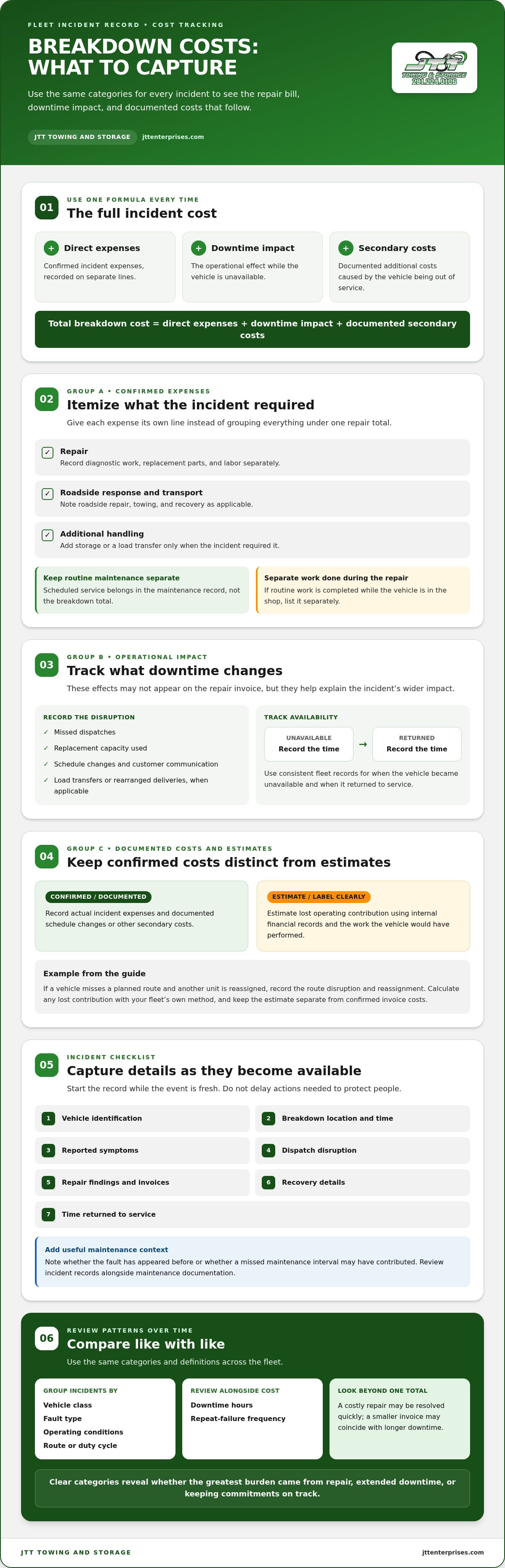
Total breakdown cost is the sum of direct incident expenses, downtime impact, and documented secondary costs caused by the vehicle being out of service. Use this definition for every incident so you can compare events consistently and distinguish a repair invoice from the wider effect on operations. Clear cost categories also support sound fleet management principles, including maintenance planning and vehicle availability.
Which direct costs belong in a breakdown record?
Record each expense on its own line instead of grouping the incident under a single repair total. Include diagnosis, parts, labor, roadside repair, towing, and recovery as applicable. Separate entries show whether an incident’s cost came mainly from the mechanical fault, transporting the vehicle, or several stages of response.
- Repair: Record diagnostic work, replacement parts, and labor separately.
- Roadside response: Note roadside repair and any towing or recovery used to move the vehicle.
- Additional handling: Add storage or a load transfer only when the incident required it.
Keep one-time breakdown expenses distinct from routine maintenance. Scheduled service belongs in the maintenance record; an unplanned repair following a failure belongs in the incident record. If routine work is completed while a vehicle is already in the shop, list it separately so it does not inflate the breakdown total or skew comparisons.
How does downtime affect fleet operations?
Downtime has operational effects that may not appear on a repair invoice. Track missed dispatches, replacement capacity used, schedule changes, and customer communication. When driver or staff transport is required following an incident, coordinating reliable passenger transport through regional services like Drivvu Taxi in the UK helps keep personnel mobile while vehicles are assessed. If a load must be transferred or a delivery rearranged, record what changed and why. Use consistent fleet records for the time the vehicle became unavailable and the time it returned to service.
To estimate lost operating contribution, use internal financial records and the work the vehicle would have performed. Keep that estimate separate from documented expenses such as repair labor or recovery. For example, if a vehicle misses a planned route and another unit is reassigned, record the route disruption and reassignment. Calculate any estimated lost contribution using your fleet’s own method rather than treating it as a confirmed invoice cost.
Managing commercial vehicle breakdown costs depends on keeping these categories distinct. Maintain separate fields for confirmed expenses, operational impacts, and estimates. That makes comparisons more reliable and helps managers see whether the greatest burden came from the repair, extended downtime, or work required to keep commitments on track.
How to Calculate and Track Commercial Vehicle Breakdown Costs
Use the same calculation for every incident: direct expenses + downtime impact + documented secondary costs. Keep each component visible instead of recording only a final total. This makes it easier to see what drove the cost and compare similar events without confusing a repair invoice with an estimate of lost operating contribution.
Track recovery separately from diagnosis, parts, labor, and other incident-related work. The recovery needed depends on the vehicle’s condition and circumstances. A heavy-duty towing guide can help managers understand the recovery process they’re documenting.
What information should managers capture during an incident?
Start a record while the event is fresh, but never delay actions needed to protect people. Capture the vehicle identification, breakdown location and time, reported symptoms, and dispatch disruption. Add repair findings, invoices, recovery details, and the time the vehicle returned to service as those details become available.
Note whether the fault has appeared before or whether a missed maintenance interval may have contributed. The FMCSA maintenance regulations provide a reference for commercial vehicle inspection, repair, and maintenance requirements. Review incident records alongside maintenance documentation to distinguish a one-off failure from a pattern that needs attention.
How can fleets compare breakdown costs over time?
Compare like with like. Group incidents by vehicle class, fault type, and operating conditions, such as route or duty cycle. Review cost per incident alongside downtime hours and repeat-failure frequency. A single total can hide useful differences: one fault may be expensive to repair but resolved quickly, while another may have a smaller invoice and leave the vehicle unavailable longer.
Hypothetical example: A delivery vehicle develops a recurring mechanical fault during a scheduled route. The manager records diagnosis, parts, labor, and recovery as direct expenses, estimates downtime impact from the fleet’s operating records, and adds documented schedule changes as secondary costs. The final record separates confirmed expenses from estimates, so the event can be compared with similar faults later.
Consistent breakdown records improve cost decisions by showing which expenses, downtime patterns, and recurring faults drive the greatest operational impact. Use the same categories and definitions across the fleet. Label estimates clearly rather than comparing them with confirmed invoices as if they were the same type of cost.
For fleets operating around Dayton, JTT Towing and Storage provides heavy-duty towing and commercial recovery. Record the recovery as part of the incident costs and connect it to the vehicle’s return-to-service plan.
Roadside Repair, Towing, or Recovery: Which Response Controls Cost?
Choose a response based first on safety, then on the vehicle’s condition and whether a practical repair can restore it to safe operation. A low immediate expense may not be the least costly outcome if the vehicle remains out of service, the load needs attention, or the same fault returns. Managing commercial vehicle breakdown costs means weighing the likely operational impact, not choosing by the first invoice alone.
| Situation | Practical response | Cost factors to track |
|---|---|---|
| Vehicle is safely accessible and the fault appears repairable on site | Consider roadside diagnosis or repair | Diagnosis, parts, labor, repair feasibility, and time until safe operation |
| Vehicle is disabled or cannot safely continue | Arrange towing to support repair or return-to-service planning | Towing, destination, repair needs, and added downtime |
| Collision, off-road position, or load issue complicates the scene | Assess whether specialized recovery or load handling is needed | Recovery requirements, vehicle condition, load implications, and schedule disruption |
When might roadside repair be a practical option?
On-site diagnosis or repair may be practical when the vehicle is in a safe, accessible location and the fault can be addressed there. For localized issues such as commercial tyre damage, coordinating with rapid roadside specialists like Mobile Tyre Fitting Essex demonstrates how on-the-spot repairs can resolve downtime without requiring transport. The driver’s description helps, but the vehicle’s actual condition determines what is feasible. A repair that does not resolve the cause, or leaves the vehicle unsafe to operate, can prolong the outage. Do not assume a roadside option will always be faster or less expensive.
When do towing or specialized recovery needs change the calculation?
Towing may be appropriate when a vehicle is disabled, unsafe to drive, or needs to reach a repair location. It is not automatically an unnecessary expense. Transport can be the sensible choice when continued operation could worsen the situation or delay a sound repair. Collision scenes, off-road positions, and load-related incidents can require a recovery plan beyond ordinary towing. For collision-related situations, tractor trailer accident recovery in Dayton addresses the recovery considerations involved.
Before choosing a response, establish whether people are safe, share the vehicle’s location and symptoms, and assess whether it can be moved safely. Then consider the repair location, load, dispatch commitments, and expected return-to-service path. This sequence helps keep the decision focused on more than the immediate invoice.
Record the response and the reason for choosing it, along with repair feasibility and resulting downtime. Comparing those details across incidents can show whether roadside repair, towing, or specialized recovery best fits recurring situations. For commercial breakdowns that call for transport, JTT’s heavy-duty towing service is part of the fleet’s response options.
A Practical Breakdown Cost-Control Plan for Dayton-Area Fleets
A clear breakdown playbook helps dispatchers act in a steady order, even when a vehicle stops mid-route. For Dayton-area fleets, use the same core steps whether a truck is near its depot or elsewhere on a local route: protect people first, establish the vehicle’s location, understand what happened, then coordinate the next move. Do not let recordkeeping delay immediate safety actions.
- Protect people. Confirm the driver and others are safe, and follow company procedures for managing the scene.
- Share the location. Capture a precise location and a reliable way to identify the vehicle and its surroundings.
- Document symptoms. Record the warning signs, what the driver observed, and whether the vehicle can move safely.
- Assess the operation. Note the route, cargo implications, dispatch commitments, and schedule changes. Then coordinate the response and any customer updates.
JTT provides commercial recovery and repair support for fleet operations in and around Dayton, Texas.
What should a fleet breakdown playbook include?
Specify who receives the driver’s report and who makes dispatch decisions, including who can approve recovery, repair, or other incident expenses. Use one incident form for vehicle details, location, symptoms, route, approvals, and supporting documents. Include a reassessment step: record what has changed, whether the vehicle is safe to move, and what must happen before it returns to service.
Keep the process usable under pressure. Drivers should know what information to send; dispatchers should know who owns each decision and where to save invoices, repair findings, and updates. A consistent handoff prevents gaps when responsibility shifts from the driver to dispatch, repair coordination, or recovery planning.
How should fleets account for cargo and vehicle holding?
Consider cargo protection and delivery commitments alongside the vehicle’s condition. A load transfer may be appropriate if the cargo or route plan requires it. Vehicle storage may be part of the plan if the vehicle needs to be held during repair or recovery coordination. Record the reason for each action, who authorized it, and storage duration separately from repair and towing entries.
These details help explain why an incident affected a delivery or required extra handling. For decisions involving a disabled commercial vehicle, the commercial vehicle storage guide offers further context on vehicle holding.
Close each incident with a brief review: confirm return-to-service status, reconcile documented expenses, and note open cargo or schedule impacts. Compare the record with similar breakdowns to identify recurring faults or process gaps. Managing commercial vehicle breakdown costs becomes more consistent when dispatchers follow the same sequence, capture the same details, and learn from each event without compromising safety.
How JTT Helps Commercial Fleets Manage Breakdown Disruption
A breakdown response may involve more than moving a disabled truck. Depending on the incident and vehicle condition, the next step could be a jumpstart, truck repair, heavy-duty towing, accident recovery, or off-road recovery. JTT Towing and Storage provides these services to help fleet managers plan a practical route from the initial incident through repair and return-to-service planning.
JTT Towing and Storage is a family-owned operation based in Dayton, Texas, and has been established for over 10 years. It serves commercial and industrial clients with towing, recovery, truck repair, hauling, load shifts and transfers, and secure vehicle storage. For fleets operating in ZIP codes 77535, 77336, 77327, 77561, 77357, 77532, and 77575, clear information from dispatch helps align the response with the vehicle, location, and circumstances.
How can recovery and repair support a return-to-service plan?
Think of the incident as a sequence. First, establish the truck’s condition and whether it can be moved safely. Then determine whether the situation calls for a jumpstart, repair, towing, or recovery. Diagnosis and repair findings inform the next step, while towing or recovery can move a disabled vehicle as part of the broader plan. The right sequence depends on the fault, vehicle condition, location, and incident circumstances.
A truck that will not start may require a different response from a vehicle involved in a collision or positioned off-road. Sharing those details early helps dispatchers and recovery teams understand the situation. No single response fits every breakdown, and the return-to-service timeline depends on what the incident reveals.
What should fleet managers prepare before requesting assistance?
Clear, concise details help match the response to the job. Gather the vehicle type and identification, exact location, current condition, symptoms, and what happened. Mention whether the truck can move safely, along with any cargo concerns or access limitations. Share immediate safety issues first, then provide additional operational details as the situation allows.
- Vehicle: Type, identifying details, and current condition.
- Location: A precise position and any access constraints.
- Incident: Symptoms, collision or off-road circumstances, and actions already taken.
- Operations: Cargo considerations and dispatch or schedule impacts.
This information supports a useful dispatch conversation and connects the field response with the fleet’s repair and return-to-service process. It also gives managers a clearer basis for recording the incident afterward, including what assistance was used and why.
Managing commercial vehicle breakdown costs includes choosing a response suited to the incident and keeping communication clear from the first report. JTT provides towing, recovery, and truck repair for commercial vehicle needs in the Dayton area.
Contact JTT Towing and Storage to discuss commercial towing, recovery, or truck repair support for your fleet.
Make Your Next Breakdown Easier to Manage
A cost-control process works best when it is part of everyday fleet operations, not something assembled under pressure after a truck stops. Assign an owner for the incident record, make sure dispatchers know where to capture updates, and set a regular time to review what the records reveal. That gives your team a practical way to turn individual incidents into clearer decisions about maintenance priorities, response planning, and operational risks.
Managing commercial vehicle breakdown costs does not mean every disruption can be prevented. It means being prepared to respond carefully, understand the consequences, and use what each event teaches you. A commercial recovery and repair partner can help organize the next steps when a vehicle is disabled.
Contact JTT Towing and Storage for commercial vehicle recovery and repair support. Use a clear plan and local support to prepare your fleet for unexpected breakdowns.
Frequently Asked Questions
How much can a commercial vehicle breakdown cost?
The total varies by vehicle, fault, location, recovery needs, downtime, and effects on cargo or schedules. To manage commercial vehicle breakdown costs, use your own invoices and operating records rather than relying on a universal average. Separate confirmed expenses, such as a parts invoice, from estimates of missed work or schedule impacts. This gives your fleet a relevant view of each event without treating projected losses as money already spent.
Does commercial vehicle insurance cover a mechanical breakdown?
Coverage depends on the policy, the cause of the incident, and the terms that apply. Mechanical repair coverage is distinct from other coverage that may relate to an incident, such as damage associated with a collision. Do not assume a particular repair or recovery expense is covered without reviewing the policy. Keep the incident report, repair findings, and recovery documents together, then discuss the specific circumstances with your insurer or broker.
Can preventive maintenance reduce commercial vehicle breakdown costs?
Planned inspections and timely maintenance can help identify developing problems, but they cannot prevent every failure. Review service history alongside breakdown frequency, repair findings, and downtime. For example, if similar symptoms appear on a vehicle after recent maintenance, the records may help the fleet investigate what changed. Compare your own results over time; do not assume a guaranteed reduction or that maintenance will eliminate breakdowns.
What should a driver do when a commercial vehicle breaks down?
The driver should put personal safety and traffic conditions first, then notify dispatch with the vehicle’s location and symptoms. Follow company procedures and do not attempt a roadside repair if the setting or vehicle condition makes it unsafe. When it is safe, note the direction of travel, nearby landmarks, and access constraints. For Dayton-area dispatches, sharing the applicable ZIP code, such as 77535, 77336, 77327, 77561, 77357, 77532, or 77575, can help clarify the location.
Can a disabled commercial vehicle and its cargo be handled separately?
Yes. Vehicle recovery and cargo handling are related but separate operational needs. The plan depends on load condition, access, safety, and why the vehicle stopped. A load shift or transfer may address cargo needs, while vehicle storage may help manage the disabled unit separately. Record the reason, authorization, and related expenses for each decision so cargo handling does not disappear inside the vehicle recovery record.
What records help a fleet understand recurring breakdown costs?
Keep consistent vehicle identifiers, fault descriptions, maintenance history, repair findings, recovery records, invoices, downtime, and return-to-service dates. A shared format helps managers recognize whether the same symptom appears across similar vehicles or returns after previous repairs. Mark confirmed expenses separately from estimates, and review records regularly. Decisions based on the fleet’s own incident history are more useful than comparisons with unsupported averages.


