
A load transfer quote reflects more than the amount of cargo involved. The cost of load transfer service depends on what needs to move, how complex the handling is, and the conditions around the truck or trailer. Repositioning cargo inside a trailer is different from transferring it to another trailer, so the work and coordination may differ too.
To compare prices meaningfully, first make sure each estimate covers the same task. Cargo type, the extent of any shift, site access, and whether vehicle recovery is also needed can all change the work involved. Share the same details with each person preparing an estimate, including what outcome you need and what is known about the cargo and location.
This guide explains the main factors behind a project-specific quote, what information to provide when arranging service, and how to compare estimates against the same scope of work. JTT Towing and Storage is a family-owned Dayton, Texas provider that handles commercial load shifts and transfers, along with related towing, recovery, hauling, and storage support when needed.
Key Takeaways
- A load transfer may mean moving cargo to another vehicle or repositioning it within the same trailer. Those tasks have different scopes.
- The cost of load transfer service depends on cargo-handling complexity, site conditions, and any related recovery logistics.
- Compare quotes by matching the requested work, assumptions, coordination, and exclusions, not just the headline amount.
- Prepare clear details about the cargo, vehicles, location, and situation so the work can be planned with fewer avoidable delays.
- JTT Towing and Storage handles commercial load shifts and transfers in the Dayton area.
What Does a Load Transfer Service Cost Cover?
A load transfer moves cargo from one vehicle, trailer, or position to another. In commercial transport, that may mean transferring freight after a vehicle issue or addressing cargo that has shifted and needs attention before the trip can continue. The work can involve handling freight, coordinating access to vehicles or a site, and arranging related recovery logistics when needed. Towing, recovery, and storage are separate needs, not automatic parts of every transfer.
Some transfers also resemble transloading, a broader logistics term for moving shipments between transportation modes. The overview of What is Transloading? explains that distinction. For a specific job, focus on what cargo needs to move, where it needs to go, and the conditions the crew will encounter.
A useful quote is based on the load and working conditions, not a generic estimate. Cargo type, amount, condition, vehicle access, and the reason for the transfer can all affect the scope. Household moving estimates don’t translate directly to commercial transfers: carrying furniture between homes is different from coordinating freight between commercial vehicles or responding to a disrupted trip. The cargo, handling, and site logistics are different.
How Is a Load Transfer Different from Ordinary Loading?
Routine loading is generally planned as part of a shipment’s normal movement. A commercial transfer may be prompted by a shifted load, a vehicle problem, or another disruption. The first step is to understand the cargo’s condition and stability, then plan the handling sequence needed to move it. The circumstances determine the work, not the label alone.
For example, repositioning cargo within a trailer differs from moving freight to another vehicle after a trip is interrupted. Both involve cargo handling, but the vehicles, access arrangements, and sequence of work may differ. Describe what has happened and what needs to move rather than referring only to “loading.”
What Should a Load-Transfer Quote Describe?
A useful quote identifies the requested work and the vehicles, trailers, or cargo involved. It should make the expected scope and assumptions clear, including relevant site details and coordination. If the request concerns a shifted load, explain where the cargo is and what changed. If freight needs to move between vehicles, identify both vehicles and the planned transfer location.
A load-transfer estimate depends on the job scope and site conditions. Household labor estimates or broad loading rates can’t reliably describe a commercial transfer. Before comparing estimates, make sure each addresses the same task and circumstances. A clearly described scope gives everyone a practical basis for planning and helps prevent misunderstandings when cargo and schedules are already under pressure.
Which Factors Affect the Cost of Load Transfer Service?
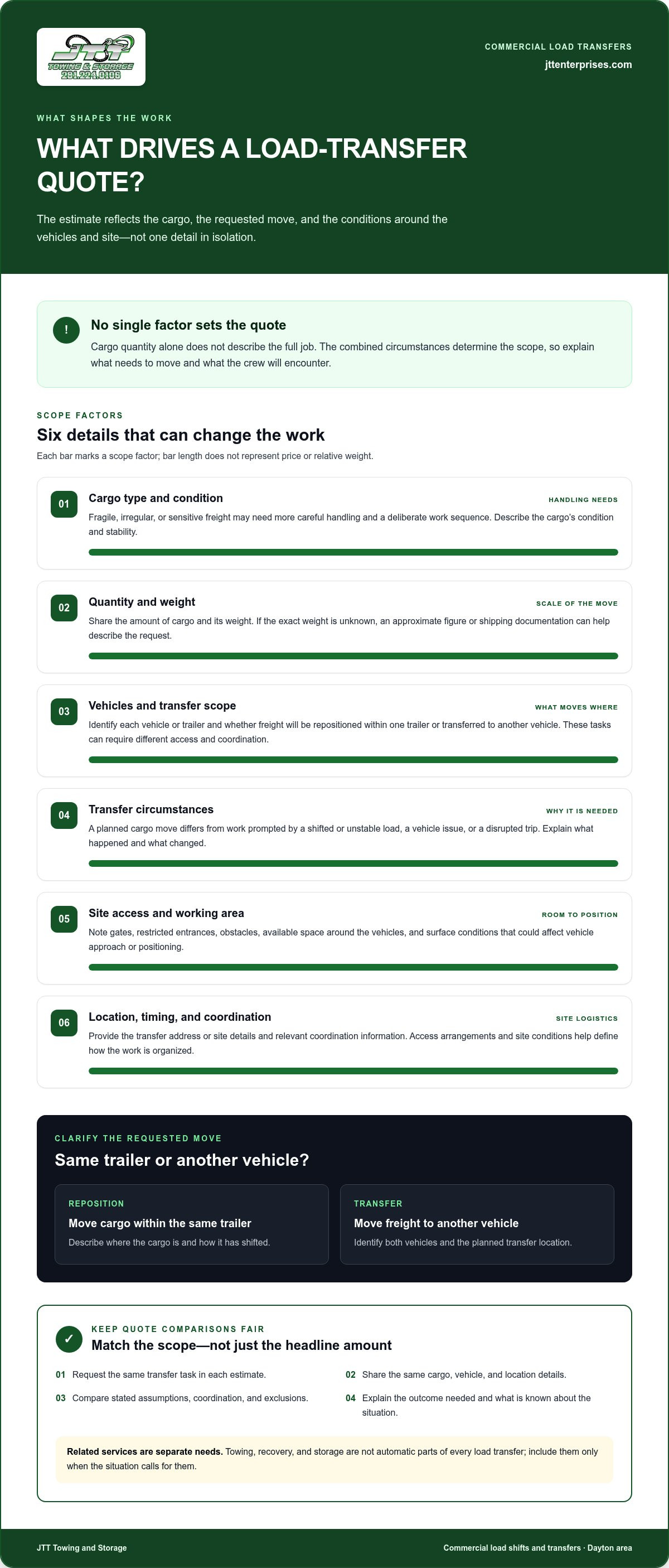
The cost of load transfer service reflects the work needed for a particular cargo and site, not one detail in isolation. A small amount of stable freight at an accessible location may require different coordination than a shifted load beside a disabled vehicle. The combined circumstances shape the scope, so accurate details make an estimate more useful.
Household moving guidance can explain how consumer moving estimates are presented, but it isn’t a pricing benchmark for commercial cargo transfers. The Federal Motor Carrier Safety Administration’s FMCSA Consumer Protection resource focuses on household moves. Compare commercial estimates based on the transfer work and operating conditions the job requires.
How Do Cargo, Vehicles, and Transfer Scope Change the Quote?
The cargo and requested move determine what needs to be planned. Share what you know about the freight, its quantity, weight, condition, and handling sensitivity. If you don’t have an exact weight, an approximate figure or shipping documentation can help describe the request. Be clear about whether the cargo is planned for transfer or has already shifted.
- Cargo type and condition: Fragile, irregular, or sensitive freight may require more careful handling and a deliberate sequence of work.
- Quantity and weight: The amount of cargo and its approximate weight help describe the scale of the transfer and its handling needs.
- Vehicles and trailers: Identify each vehicle involved and whether cargo needs repositioning or a move between vehicles. The number and types of units affect access and coordination.
- Transfer circumstances: A planned cargo move differs from work prompted by an unstable or shifted load, a vehicle issue, or a disrupted trip. The situation can change the scope.
No single factor determines every quote. Cargo quantity alone, for instance, won’t explain the work if a trailer is difficult to access or the load has shifted from its original position.
How Do Access, Location, and Timing Affect the Work?
Conditions at the transfer site can shape how the job is organized. Consider whether vehicles can reach the area, whether there’s working space around them, and whether the surface allows safe positioning. A site with limited room may require more coordination than an open, accessible location.
- Site access: Note gates, restricted entrances, obstacles, or other limits that could affect vehicle approach.
- Working area: Describe available space around the vehicles and any conditions that could constrain positioning.
- Location and coordination: Provide the transfer address or site details, plus the best point of contact for drivers or dispatch.
- Timing: Explain the schedule and any coordination constraints so the work can be considered alongside vehicle and site access.
Restricted access and complex cargo handling can change the work required. Clear site details help set realistic expectations and limit avoidable confusion. JTT Towing and Storage handles commercial load shifts and transfers in Dayton, and local site details help shape the plan.
How Can You Compare Load-Transfer Quotes Fairly?
A fair comparison starts with the work each estimate describes. The lowest headline amount may cover a narrower task, different assumptions, or less coordination. Before weighing the cost of load transfer service, check that each quote refers to the same cargo, transfer point, vehicles, and intended outcome. Otherwise, you may be comparing different jobs rather than different estimates for the same work.
Use a simple comparison with three columns: requested work, stated assumptions, and exclusions. For each estimate, record the cargo and requested transfer; assumptions about site access, vehicle positioning, and coordination; and any work outside the stated scope. The American Trucking Associations Industry Insights offers broader trucking-industry context, but your comparison should focus on the details of this job.
Which Details Make Two Quotes Comparable?
Read each estimate against the same request. One might describe moving freight between two trailers, while another covers repositioning cargo within one trailer. Even if both use the term “load transfer,” they don’t describe identical work. Check that the transfer point, vehicles, cargo, and intended result match before comparing the estimates.
Look for clear descriptions of handling tasks and coordination. Don’t assume a task is included just because it seems related. If an estimate leaves you unsure whether it covers part of the requested work, state that part explicitly in your request to JTT. A useful comparison records what is included in the described scope, not what you hope is included.
- Requested work: What cargo is moving, from where, and to what destination or position?
- Stated assumptions: What does the estimate assume about vehicle access, site conditions, and coordination?
- Exclusions: What related work is outside the described scope?
This format makes differences visible without treating unlike scopes as equivalent. It also gives dispatch and the crew a clearer picture of the job being planned.
When Is Load Transfer Part of a Larger Recovery Job?
A vehicle incident can affect both the truck and its cargo. In that situation, a transfer may be coordinated with towing or recovery, but these remain distinct tasks: a load transfer addresses cargo, while towing or recovery addresses the vehicle. A quote should make clear which work it describes rather than leaving you to assume one includes the other. Similarly, for commercial fleets arranging cross-country vehicle movement rather than freight recovery, reviewing specialized auto transport quotes denver through nationwide carriers like GAATCO helps ensure vehicle shipping is planned and priced independently.
If the situation also involves a commercial vehicle that needs towing, JTT’s Dayton heavy-duty towing guide explains the related recovery service. If vehicle storage is part of the plan, include that need in the overall discussion. Keeping cargo handling, vehicle recovery, and storage distinct helps clarify the complete plan and avoid mismatched assumptions.
What Information Should You Prepare Before Requesting a Quote in Dayton, TX?
Clear information helps shape a useful quote and gives the team a better picture of the work ahead. Before requesting a commercial load transfer in the Dayton area, gather what you can safely confirm from dispatch, shipping records, or a safe location at the site. You don’t need to assess the load yourself. Report what you know, identify what’s uncertain, and don’t approach an unsafe vehicle or cargo.
Use this checklist to organize the details. JTT Towing and Storage is based in Dayton and handles commercial load shifts and transfers. Site conditions vary, so provide specific location and access information.
What Load and Vehicle Details Should You Share?
Start with the freight and vehicles involved. Approximate details are useful if exact figures aren’t readily available. Explain whether the cargo is stable, shifted, damaged, or difficult to assess. Share photos only if you can take them safely without entering a hazardous area.
- Describe the cargo. Note the general freight type, approximate quantity, known weight information, and any handling concerns you’re aware of.
- Explain its condition. Say whether the load appears secure, has shifted, or may have been affected by an incident. Don’t try to move or inspect unstable cargo yourself.
- Identify the vehicles. Provide the truck and trailer types involved, where each is located, and which vehicle currently holds the cargo.
- State the intended outcome. Clarify whether the request is to reposition cargo or transfer it to another vehicle, and share the planned destination or transfer point.
If a crash led to the transfer need, include that context and any relevant information you can safely provide. JTT’s tractor-trailer accident recovery guide covers related recovery considerations.
What Site and Scheduling Details Help Plan the Transfer?
Describe the location as precisely as possible, including the site name or address and any access limits you know about. Details about available working space, the surface, vehicle positioning, and entrance restrictions help explain the setting. Also identify the best contact for coordinating with the driver or dispatch.
- Share site conditions. Mention narrow approaches, limited clearance, restricted access, uneven or soft surfaces, or other known constraints. Report observations rather than trying to determine whether the site is safe for equipment or vehicles.
- Explain timing and related needs. Provide schedule constraints and note whether the situation also involves towing, recovery, hauling, or vehicle storage. These are separate needs that may affect coordination.
For a clearer estimate of the cost of load transfer service, provide the same core details to everyone involved in planning the job. Keep a short written summary handy, and update it if the vehicle location, cargo condition, or intended transfer changes. Share your Dayton load-transfer details with JTT to discuss the commercial work required.
How JTT Handles Load Shifts and Transfers in the Dayton Area
A shifted commercial load can put cargo condition, vehicle movement, and delivery plans under pressure. JTT Towing and Storage is a family-owned Dayton, Texas business that handles commercial load shifts and transfers. The work is planned around the specific cargo, vehicle situation, site, and requested outcome rather than treated as a one-size-fits-all task.
Those details also shape the quote. The cost of load transfer service depends on the work involved and conditions at the location, so a clear description helps JTT understand what the project calls for. Share what you know about the load and vehicle, along with any immediate concern affecting the trip. Don’t inspect or handle cargo yourself if doing so would be unsafe.
How Load Transfers Fit JTT’s Commercial Support
Load shifts and transfers are cargo-focused services. If a vehicle issue or incident affects the truck as well, heavy-duty towing or recovery may be relevant alongside the transfer. Hauling or vehicle storage may also be useful in certain circumstances, but those are distinct services and aren’t automatically part of every load-transfer job.
Keeping those needs clear helps define the requested scope. Explain whether the priority is cargo that has shifted, a planned transfer between vehicles, or a vehicle that also needs recovery. JTT handles load shifts and transfers alongside heavy-duty towing, recovery, hauling, and vehicle storage services. Keeping the cargo work and any vehicle service distinct helps with practical coordination.
What Is the Next Step for a Dayton-Area Load Transfer?
To start a useful conversation, share three essentials: the load details, the vehicle’s current location, and the immediate operational concern. Include the intended transfer destination if you know it, plus site access or scheduling information. If a crash or mechanical issue is involved, say so. A concise, accurate description helps focus the discussion on the job in front of you.
JTT is based in Dayton and handles commercial load shifts and transfers in the area, including ZIP codes 77535, 77336, 77327, 77561, 77357, 77532, and 77575. Site access, cargo condition, and the circumstances behind a transfer vary, so share the specific location and situation. Provide only observations you can make safely. Don’t approach an unstable load or vehicle to gather more information.
If cargo or a vehicle is disrupting your operation, contact JTT with the load details and location. Contact JTT about load transfer service to discuss the circumstances and the commercial work required.
Make the Next Move With Clear Information
A load disruption can unsettle more than a delivery plan. Give your team one point of contact to share updates about the cargo, vehicle location, and operational priorities. That helps keep everyone working from the same information while the transfer plan takes shape.
The cost of load transfer service depends on the work your situation calls for, so accurate details are a practical place to begin. JTT Towing and Storage handles commercial load shifts and transfers in Dayton, Texas. Share what you know, including any immediate concern affecting the shipment, so the discussion can focus on your circumstances.
Contact JTT about your load transfer needs with the cargo and location details to discuss the commercial work required.
Frequently Asked Questions
How much does a load transfer service cost?
There isn’t one fixed price for every commercial transfer. The cost of load transfer service depends on the specific work, cargo, vehicles, and site circumstances. For a useful estimate, describe whether freight needs to move between vehicles or be repositioned, and note any disruption affecting the shipment. An estimate tailored to those facts is more meaningful than household moving rates or a general loading estimate.
What affects the cost of transferring cargo from one truck or trailer to another?
The amount and condition of the freight, the vehicles involved, and the intended transfer outcome all affect the work involved. For example, a shipment with several cargo types may need a different handling sequence than a uniform load. Site access and coordination with drivers or dispatch matter too. Share known details from shipping documents, but don’t guess at weights or cargo conditions you can’t safely verify.
Does a load transfer quote include towing or recovery?
Not automatically. Cargo transfer, towing, and vehicle recovery are distinct tasks, so the estimate should make clear which work it describes. If a truck is disabled or involved in an incident, explain that alongside the cargo request so both needs can be considered. JTT provides commercial load transfers as well as heavy-duty towing and recovery, but a transfer doesn’t necessarily require those additional services.
Can cargo be transferred if a trailer load has shifted?
Yes, a shifted load may require correction or transfer, depending on its condition and the circumstances. Don’t enter the trailer or try to reposition freight yourself if the load appears unstable. Share what you can observe from a safe location, including whether cargo has visibly moved or packaging appears damaged. That information can help clarify the situation before work is planned.
What information do I need to request a load transfer quote in Dayton, TX?
Prepare the cargo description, approximate quantity, known handling concerns, vehicle and trailer details, current location, and intended destination or transfer point. Also note access restrictions and the best contact for coordination. JTT is based in Dayton and serves the local area, including ZIP codes 77535, 77336, 77327, 77561, 77357, 77532, and 77575. Provide the specific location because site conditions can vary.
How long does a commercial load transfer take?
Timing depends on the cargo, work required, site access, and coordination among the people involved. A planned transfer at an accessible location may present different scheduling needs than a load shift discovered after a vehicle incident. Share delivery or dispatch constraints when describing the job. Without the project details, a specific duration would be unreliable, so discuss timing as part of the project scope.
Who pays for a load transfer after a truck accident?
Payment responsibility depends on the arrangements between the parties and any applicable insurance terms. The carrier, shipper, vehicle owner, or another party may be involved, but responsibility can’t be determined from the accident alone. Review the relevant shipping or service agreements and discuss the expense with the appropriate insurer or claims contact. Keep the transfer scope and related documents together to support clear communication about the charge.


