
The fastest semi tow often starts before a wrecker rolls: with a clear location and an accurate description of the truck’s condition. If a disabled truck is blocking traffic or delaying a delivery, searching for fast semi towing near me is a natural first move. The right help depends on the situation, whether the semi needs transport, truck repair, or recovery from a difficult position. Sharing useful details helps JTT understand the request and coordinate the appropriate next step.
JTT Towing and Storage is a family-owned company based in Dayton, Texas, with more than ten years of experience supporting commercial vehicles. Its services include heavy-duty towing, truck repair, and accident recovery, along with off-road recovery and load shifts or transfers. In this guide, you’ll learn what information to provide when you call, how the truck’s condition and location affect the type of response, and what to expect as the situation is assessed. The goal is practical: help you describe the need clearly and understand the options for towing, repair, or recovery.
Key Takeaways
- Fast semi towing near me depends on clear location details, safe access, and an accurate description of the truck’s condition.
- Learn how to distinguish a breakdown tow from truck repair, accident recovery, or off-road recovery.
- Use a short pre-call checklist to share the vehicle and access details that help guide the response.
- JTT supports commercial vehicles in Dayton and nearby communities, including ZIP codes 77535, 77336, 77327, 77561, 77357, 77532, and 77575.
Fast Semi Towing Near Me: What Fast Help Really Depends On
A quick response to a semi breakdown depends on more than distance. JTT needs to understand where the truck is, whether it can be reached safely, what condition it’s in, and whether the situation calls for a tow or recovery. Searching for fast semi towing near me can help you find local support, but accurate incident details make coordination more efficient. Arrival time depends on the specific situation, so don’t assume a time before the request is assessed.
Fast semi towing means coordinating the appropriate heavy-duty response using clear information about the vehicle, its location, and the assistance it needs. A semi stopped on a level shoulder presents a different situation from a tractor-trailer involved in a collision or stuck off the roadway.
Why semi towing needs different coordination
A tractor-trailer is larger and more complex to move than a passenger vehicle. The tractor, attached trailer, cargo, and position on the road all matter when assessing access and transport. A truck stopped near a driveway entrance, for example, may be easier to approach than one blocking a narrow road or sitting at an angle. Whether the trailer remains attached also affects how the vehicle is positioned and handled.
Heavy-duty towing is generally the right category when a disabled commercial vehicle needs transport. If the truck has been in a collision, accident recovery may be needed instead. A vehicle that has left the roadway or become stuck may require off-road recovery. Each situation has different access and handling considerations. General information about types of tow trucks and their functions helps explain why the right response depends on the job, not simply on finding the nearest tow truck.
What can affect a local towing response?
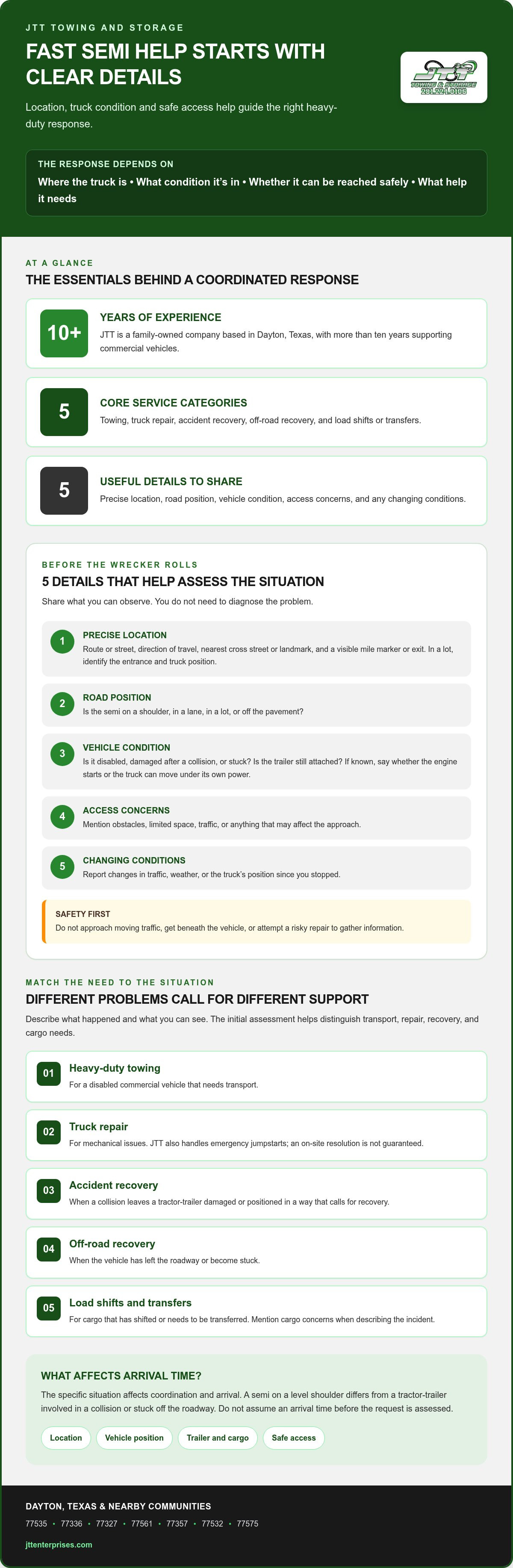
Start with the most precise location you can provide. On a Dayton-area road, share the route or street, direction of travel, nearest cross street or landmark, and a mile marker or exit if visible. If you’re in a lot or at a business, identify the entrance and where the truck is positioned. Clear directions reduce guesswork during coordination.
Then explain the vehicle’s condition and access:
- Road position: Is the semi on a shoulder, in a lane, in a lot, or off the pavement?
- Vehicle condition: Is it disabled, damaged after a collision, or stuck? Is the trailer attached?
- Access concerns: Are there obstacles, limited space, or traffic affecting the approach?
- Changing conditions: Has traffic, weather, or the truck’s position changed since you stopped?
These details help JTT assess whether heavy-duty towing, accident recovery, or off-road recovery fits the situation. Stay focused on safety while sharing what you know. Don’t approach moving traffic or attempt a risky repair to gather more information.
How JTT Matches Semi Towing and Roadside Needs
A disabled semi doesn’t always need the same response. JTT provides heavy-duty towing when a commercial vehicle needs transport, truck repair for mechanical issues, and recovery services for collisions or difficult terrain. JTT also handles cargo movement through load shifts and transfers. Clear details help the team understand the need and coordinate an appropriate response instead of treating every breakdown the same way.
When you search for fast semi towing near me, describe what the truck is doing, where it stopped, and whether it can be moved safely. You don’t need to diagnose the problem. Report the symptoms you can observe, and let those details guide the initial assessment.
When a semi needs towing rather than roadside repair
A truck that can’t continue its route may need transport, while another mechanical issue may call for repair. JTT provides professional truck repair as well as heavy-duty towing, and it handles emergency jumpstarts. Sharing what happened before the truck lost power helps describe the issue, but doesn’t guarantee an on-site resolution. If the vehicle is blocking traffic, visibly damaged, or unsafe to approach, prioritize safety and report that rather than attempting roadside troubleshooting.
Useful observations include whether the engine starts, whether warning indicators appeared, and whether the truck can move under its own power. Stick to what you know. Don’t get beneath the vehicle or work near moving traffic to gather more information. For broader commercial carrier safety and compliance resources, the Federal Motor Carrier Safety Administration provides information for the trucking industry.
When the situation involves an accident, recovery, or cargo
A collision can leave a tractor-trailer damaged or positioned in a way that calls for accident recovery rather than a routine breakdown tow. Off-road recovery is relevant if the vehicle has left the roadway or become stuck. Explain whether the tractor and trailer remain connected, where the vehicle is resting, and what damage or access limits you can see. Don’t try to move a damaged or unstable vehicle yourself.
Cargo details matter too. If a load has shifted, spilled, or needs to be transferred, mention it when describing the incident. Load shifts and transfers are specialized needs, separate from simply towing a disabled truck. Accurate information helps distinguish among transport, recovery, and cargo-related assistance. A collision also raises different concerns from an ordinary mechanical failure, so make the incident type clear when reporting it.
Share observable facts rather than guessing at the repair. JTT provides heavy-duty towing, truck repair, accident recovery, off-road recovery, and load shift services for different commercial vehicle situations. Explore JTT towing and recovery services to learn more about the support available.
How to Evaluate Semi Towing Help Near Dayton
Choosing the right response starts with the semi’s condition, not with the word “fast.” A nearby tow may not be the right fit if the truck is damaged, stuck off the road, or carrying a shifted load. For semi towing, service fit matters as much as proximity because the vehicle’s condition determines what kind of help can move the situation forward.
Towing, accident recovery, and off-road recovery compared
Heavy-duty towing transports a disabled vehicle when its position and condition allow. Accident recovery addresses a collision scene, while off-road recovery applies when a vehicle has left the roadway or become stuck. Truck repair is a separate option for a mechanical issue that may be addressed without transporting the semi. Use this comparison to describe what you see and help JTT identify the relevant service category.
| Reported situation | Likely service category | Key detail to share |
|---|---|---|
| Semi is disabled but hasn’t been in a collision or left the road | Heavy-duty towing or truck repair | Whether it starts or moves, plus the symptoms you observed |
| Truck or trailer has been involved in a collision | Accident recovery | Visible damage, vehicle position, and whether the trailer remains attached |
| Semi is stuck or positioned off the roadway | Off-road recovery | Where it is resting and any access obstacles you can safely observe |
| Cargo has shifted and needs attention | Load shift or transfer assistance | What appears to have moved and whether the load is affecting the vehicle’s position |
Each category relates to a different circumstance. JTT provides heavy-duty towing, accident recovery, off-road recovery, truck repair, and load shifts and transfers. The American Trucking Associations safety guidelines offer broader trucking-industry context, but the immediate service decision depends on the reported vehicle and incident.
Questions that clarify the right service
Before calling, separate the truck’s condition from the outcome you want. “The semi won’t start” describes a condition; “I need it taken to a repair location” describes a destination or goal. Both are useful, but they answer different questions. For a search such as fast semi towing near me, specific observations help turn an urgent request into a clear service assessment.
- Can the semi move under its own power, or is it fully disabled?
- What symptoms or visible damage have you noticed?
- Was there a collision, or is the vehicle stuck off the roadway?
- Is the trailer attached, and is cargo shifted or involved?
- What outcome do you need, such as transport, repair, or recovery?
Describe what happened without attempting a risky inspection. Clear answers help JTT distinguish a tow from repair or recovery needs and coordinate the next step based on the situation.
What to Do Before Calling for a Semi Tow
A few clear details can help JTT understand what kind of assistance the semi needs. Put safety first, then share the vehicle’s location, configuration, condition, and any access concerns. You don’t need to diagnose the problem or approach the truck to gather information. Report what you can observe safely.
Details to have ready for the call
Use this order to organize the information. If you don’t know an answer, say so rather than stepping into an unsafe area to find out.
- Move to safety. Follow roadway safety directions and get yourself and any passengers to a safer place if circumstances allow. Don’t stand near moving traffic to make the call.
- Identify the location. Give the road or highway, direction of travel, nearest exit, cross street, or visible landmark. A precise location or mile marker helps clarify where the semi is stopped. For a business or parking area, describe the entrance and where the vehicle is positioned.
- Describe the vehicle. Identify the tractor and trailer, including whether they’re still connected. Share any visible damage and whether the semi is blocking a lane, on a shoulder, in a lot, or off the roadway.
- Explain its condition. Say whether the truck can move, whether it starts, and what symptoms you noticed before it stopped. Mention a collision, if one occurred, and distinguish what you observed from what you suspect.
- Share access and cargo concerns. Note narrow or obstructed access, nearby hazards, or changing traffic conditions. If cargo has shifted, spilled, or may need attention, describe that from a safe position.
This information can help clarify whether the situation involves a breakdown tow, truck repair, accident recovery, off-road recovery, or load-related assistance. It doesn’t determine an arrival time or outcome in advance. A search for fast semi towing near me may start the process, but the details you provide help frame the request accurately.
Stay safe while waiting for assistance
Keep a safe distance from moving traffic and follow instructions from roadway or emergency personnel. Activate hazard warning lights only if you can do so safely and appropriately. Don’t attempt roadside repairs, recovery, or load adjustment in an unsafe location, and don’t move around the vehicle to get a better look if traffic or its position puts you at risk. If conditions change, share the update without exposing yourself to danger.
Once you’re in a safe position, give JTT the clearest information you can and explain what outcome you need, such as transport or help with a disabled truck. Contact JTT about semi towing assistance with those details ready.
Arrange Semi Towing With JTT in Dayton, Texas
JTT Towing and Storage is a family-owned business based in Dayton, Texas, with more than ten years of experience supporting local drivers and commercial vehicles. For a fleet dispatcher or truck driver looking for fast semi towing near me, JTT’s local base offers a starting point for requesting help. JTT serves Dayton-area communities in ZIP codes 77535, 77336, 77327, 77561, 77357, 77532, and 77575.
Commercial vehicle needs can call for different support. JTT provides heavy-duty towing when a semi needs transport, truck repair for mechanical issues, and accident recovery for collision-related situations. Off-road recovery addresses vehicles stuck away from the roadway. Vehicle storage may also be part of the next step after a tow. Describing the condition and outcome you need helps distinguish among these services.
What happens when you request semi towing?
Share the truck’s location, condition, access situation, and the type of help you’re seeking. A useful report identifies the road and direction of travel, whether the tractor and trailer are connected, whether the semi can move, and whether damage or cargo concerns are visible. If access is narrow or the vehicle is off the roadway, include that too. These details help JTT understand the request and coordinate around the reported situation. They don’t establish a guaranteed arrival time or predetermined outcome.
Drivers can describe what they observe, and dispatchers can relay details from the driver or fleet contact. Keep the facts distinct from the desired result. “The truck won’t start” describes its condition, while “we need it transported to a repair location” explains the requested outcome. Both help clarify the need.
Related support for commercial vehicles
If the semi may have a mechanical issue, truck repair is a different path from transport-only assistance. If it needs to be moved, heavy-duty towing may fit. Vehicle storage may be useful after a tow. For collision-related situations, accident recovery is distinct from an ordinary breakdown tow. Off-road recovery is relevant when the vehicle has left the roadway or become stuck away from it.
JTT’s commercial vehicle support includes these separate services, so describe the event and the truck’s current condition as clearly as you can. If storage may follow a tow, the commercial vehicle storage guide for Dayton can help you understand that next consideration. For a truck off the roadway, the off-road heavy recovery in Dayton guide covers that specific type of situation.
Share the details you have and explain what assistance you need. Contact JTT Towing and Storage to discuss semi towing in Dayton and nearby service communities.
Take the Next Step Toward the Right Assistance
A disabled semi can put pressure on a driver, dispatcher, and delivery schedule. Make the next move a clear one: share the truck’s condition, location, and the outcome you need. You don’t have to know whether the situation calls for a tow, repair, or recovery before reaching out. Accurate observations give JTT a useful starting point and keep the request focused on the vehicle’s needs.
If you’re searching for fast semi towing near me, prioritize a safe position and clear communication over guessing how quickly help can arrive. JTT supports commercial vehicles with heavy-duty towing and truck repair, as well as recovery services suited to different circumstances. Explain what happened, mention any access or cargo concerns, and describe the assistance you need. Contact JTT Towing and Storage for semi towing support to discuss the situation.
Frequently Asked Questions
How fast can a semi towing service near me arrive?
There isn’t a reliable arrival time to promise without knowing the situation. Location, traffic, road access, vehicle condition, and the type of assistance needed can all affect coordination. For a useful update, give JTT a precise location and report changes such as worsening traffic or a newly blocked lane. Searching for fast semi towing near me can help you find local support, but it doesn’t determine an arrival time.
What information should I give when calling for semi towing?
Share the road, direction of travel, nearest landmark, and the most precise location you can identify. Describe the tractor and trailer, whether they’re connected, whether the semi can move, and any visible damage or symptoms. Mention cargo concerns, limited access, and immediate hazards. For example, say if the truck is blocking a lane or positioned in a lot with a restricted entrance. Don’t approach traffic to collect details.
Can a semi truck be towed after a breakdown?
Yes. A disabled semi may be transported with heavy-duty towing when its condition and position allow. Tell JTT whether the truck starts or moves, what happened before it stopped, and whether the trailer is attached. If the vehicle is damaged or stuck away from the roadway, describe that too, since recovery needs differ from a routine breakdown tow. Keep clear of unsafe areas and let qualified personnel handle the vehicle.
Who provides semi towing near Dayton, Texas?
JTT Towing and Storage provides heavy-duty towing and commercial vehicle support from its Dayton, Texas base. Its local service ZIP codes are 77535, 77336, 77327, 77561, 77357, 77532, and 77575. Drivers and fleet dispatchers can share the truck’s location and condition to describe the need. JTT is family-owned and has operated for more than ten years, serving local commercial and industrial clients.
What is the difference between semi towing and heavy-duty recovery?
Semi towing generally means transporting a disabled tractor-trailer from one location to another. Heavy-duty recovery addresses a more difficult situation, such as a truck involved in an accident or stuck off the roadway. A shifted load can create a separate need for load assistance. Describe where the vehicle is, what happened, and whether cargo has moved so the situation can be understood before the next step is determined.
Should I stay inside my semi while waiting for a tow?
Choose the safest option for your location and follow directions from emergency or roadway personnel. If traffic is close or the truck is in a dangerous position, don’t step into moving traffic or stand beside the vehicle. If you can move to a safer place without crossing traffic or creating another hazard, do so. Use hazard lights only when you can activate them safely, and avoid roadside repairs.
Can JTT help if my semi needs repair instead of towing?
Yes. JTT provides professional truck repair and emergency jumpstart support as well as heavy-duty towing. Describe the symptoms you observed, such as whether the truck starts or lost power while operating, without attempting a risky inspection. The reported condition helps distinguish a repair need from a vehicle that must be transported. If the semi is unsafe to approach or obstructing traffic, prioritize safety and explain that when requesting assistance.


