
What happens when a leased truck breaks down and the coverage you expected does not match the help it needs? Roadside assistance for leased commercial trucks can involve separate lease terms, insurance provisions, and fleet plans. A tow, repair, or recovery may be handled differently under each arrangement.
A lease or fleet plan can make support easier to coordinate, but only if your team knows what each one covers and how to request service. Reviewing service descriptions, limits, and dispatch procedures before a breakdown helps reduce confusion when a truck is sidelined. This guide explains how to compare roadside arrangements with your fleet’s needs and prepare the details dispatchers need to describe an incident clearly.
You’ll learn how towing, repair, recovery, and storage differ, which plan terms to review, and what to share about a truck, its location, and the incident. For fleets operating around Dayton, Texas, JTT Towing and Storage provides local heavy-duty towing, accident and off-road recovery, load shifts and transfers, and vehicle storage. A practical response plan helps your team act more clearly when a truck is disabled.
Key Takeaways
- Roadside assistance for leased commercial trucks can involve separate lease, fleet, and service arrangements. Review each one to understand how responsibilities differ.
- Match support to the incident: a mechanical issue, disabled truck, accident, or shifted load may require different services and coordination.
- Before a breakdown, record truck and trailer details, common routes, operating locations, and cargo considerations to help dispatch describe the situation.
- Review towing limits, recovery language, and dispatch procedures in your agreements to spot potential coverage gaps before an incident.
- For fleet incidents around Dayton, JTT Towing and Storage provides heavy-duty towing, recovery, truck repair, jumpstarts, load shifts, and vehicle storage.
Roadside Assistance for Leased Commercial Trucks: What Fleet Managers Need
Roadside assistance is support for a disabled or damaged vehicle. Depending on the incident, it can involve a jumpstart, on-site assessment, towing, recovery, or related logistics. The term describes the help a truck needs, while a lease or fleet agreement may explain which services are arranged and how responsibilities are handled. A leased truck is not automatically covered for every roadside incident.
For fleet managers, Fleet Management means coordinating vehicles, operations, and support needs. That broader view helps put roadside planning in context: the response should fit the truck and incident, while the lease and any separate fleet arrangements have their own terms.
What roadside support can involve for a commercial truck
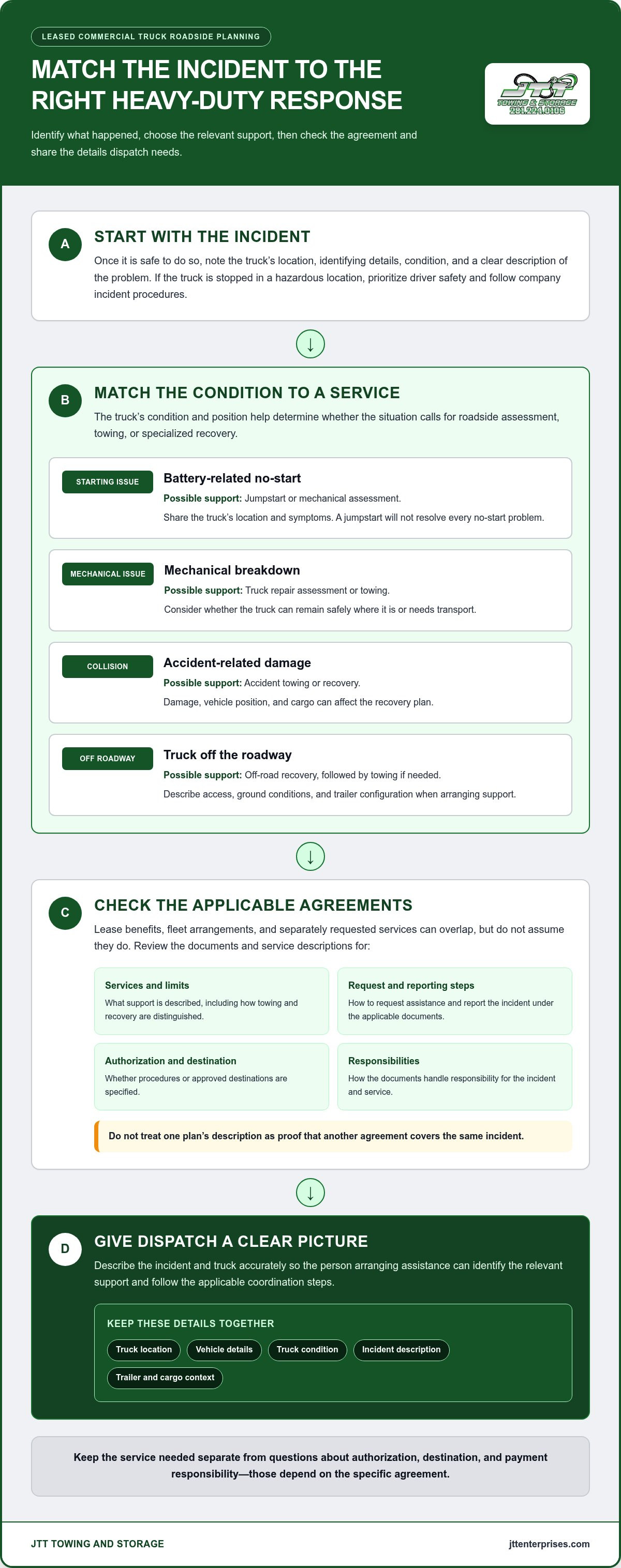
The right response depends on what has happened. A truck that will not start may need a jumpstart or mechanical assessment. If it cannot be made operational at the roadside, towing may be needed to move it to a suitable destination. A collision can call for accident recovery, while a truck stuck away from a paved road may require off-road recovery. These are distinct services, not interchangeable labels.
Truck size and condition, location, and the position of any trailer or cargo all affect the support required. A disabled tractor-trailer in a confined area poses different logistical challenges from a smaller commercial vehicle stopped in a safe, accessible place. Some problems can be addressed at the scene; others require transport, recovery, or further repair. Describe the situation accurately instead of assuming every breakdown can be fixed roadside.
Why leased vehicles call for an extra planning step
A lease may set procedures for reporting a problem, identify approved destinations, or assign responsibilities. Because terms vary, review the documents for each vehicle along with any separate fleet or roadside-plan terms. Make sure your team understands how they work together before a truck is disabled. Do not treat one plan’s description as proof that another agreement covers the same incident.
Keep contract review separate from the immediate response. If a truck is stopped in a hazardous location, prioritize driver safety and follow your company’s incident procedures. Once it is safe to do so, gather the vehicle’s location, identifying details, condition, and a clear description of the problem. Those details help the person arranging assistance identify whether the situation calls for a jumpstart, towing, collision recovery, or off-road recovery. Then follow the applicable reporting and coordination steps in your documents.
This preparation helps dispatchers understand the service needed and lets fleet managers distinguish that need from questions about authorization, destination, and payment responsibility. Those questions depend on the specific agreement, so review the terms instead of relying on assumptions.
Compare Lease Benefits With Heavy-Duty Roadside Services
A lease may include maintenance or roadside benefits. A fleet may also have a separate assistance arrangement or request help directly for a specific incident. These options can overlap, but do not assume they do. Compare the documents and service descriptions so dispatchers know what support to arrange and which procedures apply. The American Trucking Associations Industry Data offers broader trucking-industry context, but the right roadside setup depends on your fleet’s vehicles, routes, and operating needs.
Which roadside service fits the incident?
Match the service to the truck’s condition. A jumpstart may address a battery-related starting problem, while a mechanical assessment can help determine whether an issue can be addressed safely at the scene. If the truck cannot continue safely, towing may be the practical next step. A collision or off-road situation can call for specialized recovery rather than routine breakdown support.
| Incident type | Possible support | Contract check | Operational consideration |
|---|---|---|---|
| Battery-related starting issue | Jumpstart or mechanical assessment | Check whether the arrangement describes this support and how to request it. | Share the truck’s location and symptoms. A jumpstart will not resolve every no-start problem. |
| Mechanical breakdown | Truck repair assessment or towing | Review repair procedures, authorization steps, and destination instructions. | Consider whether the truck can remain safely where it is or needs transport. |
| Collision | Accident towing or recovery | Review incident reporting and responsibility provisions in the applicable documents. | Damage, vehicle position, and cargo can affect the recovery plan. |
| Truck off the roadway | Off-road recovery, followed by towing if needed | Check how the plan distinguishes recovery from standard towing. | Describe access, ground conditions, and trailer configuration when arranging support. |
For a closer look at heavy-duty towing considerations in the Dayton area, see the Heavy Duty Towing in Dayton, TX guide. JTT provides heavy-duty towing, truck repair, jumpstarts, accident recovery, and off-road recovery for different fleet situations. Incident details help identify which type of support is relevant.
What to compare before choosing a support arrangement
Compare eligible vehicle types, service scope, geographic reach, and authorization processes across the lease, fleet arrangement, and any roadside plan. Review exclusions, limits, payment responsibilities, and dispatch instructions in the applicable documents. A plan that describes towing, for example, may not describe collision recovery in the same way. Keep the terms accessible to the people who coordinate incidents.
For local commercial truck support, explore JTT’s commercial truck support alongside your fleet’s documented arrangements. Clear distinctions between plan terms and the service an incident calls for help your team make a more informed request.
Lease Terms, Dispatch, and the Biggest Coverage-Gap Concerns
A roadside plan and a lease can describe different responsibilities. One may outline how to request assistance, while another addresses reporting steps, vehicle care, or destinations. For roadside assistance for leased commercial trucks, the practical challenge is understanding how those documents work together before a driver is waiting on the shoulder and dispatch needs to make decisions quickly.
Review the lease, fleet policy, and applicable roadside-plan details in advance. If contract language is unclear, rely on the actual documents and consult the appropriate fleet, leasing, insurance, or legal adviser. This planning step does not replace action to address an immediate safety concern.
Never assume a tow destination or payment obligation.
What to review in the lease and fleet plan
Look for descriptions of roadside benefits, required notifications, approved destinations, and claim or incident procedures. Identify who can arrange service and what information that person needs. Terms may differ between vehicles or arrangements, so keep a clear record for each truck rather than relying on a general fleet assumption.
- Benefit and service details: Note whether the documents describe roadside support, towing, repair, or recovery. Record any stated limits or exclusions.
- Notification and authorization steps: Record who must be notified, who can approve a service request, and what to do if the usual contact is unavailable.
- Destination and documentation: Note any destination instructions and the records required after an incident, such as service details or supporting paperwork.
- Dispatch reference information: Keep the lease or account reference, vehicle identification, relevant policy details, and fleet contact information somewhere dispatchers can access.
Keep the summary practical. Dispatchers need clear instructions and current contact details, not an interpretation of legal wording. Have the person responsible for the agreement review the summary when documents or fleet procedures change.
How to reduce confusion when a truck breaks down
Give drivers a simple reporting sequence. First, follow company safety procedures and communicate immediate hazards. Then report the truck’s location, identifying details, trailer configuration, symptoms, and whether the vehicle is blocking traffic or carrying a shifted load. Dispatch can use those facts to describe the incident accurately and coordinate the next step without guessing.
Keep fleet contacts and lease instructions available to drivers and dispatchers, but do not let paperwork delay necessary safety actions. A disabled tractor-trailer after a collision, for example, may require a different coordination process from a truck with a mechanical problem. For collision-related planning, the guide Tractor Trailer Accident Recovery in Dayton, TX offers a related look at recovery considerations. JTT provides accident recovery, heavy-duty towing, load shifts and transfers, and vehicle storage for different incident needs.
After assistance is arranged, record who coordinated the request, what service was performed, and any follow-up directions. A consistent incident record can help the fleet review its procedures and resolve questions against the relevant documents later.
A Practical Checklist for Selecting Leased-Truck Roadside Support
A useful roadside plan starts with fleet details, not a vendor brochure. Use this checklist to connect each leased vehicle’s configuration and operating pattern with the documents and dispatch steps your team will rely on. That preparation makes roadside assistance for leased commercial trucks easier to coordinate without assuming that a lease, fleet arrangement, or service request covers every incident.
Prepare the fleet before a roadside incident
Build one accessible reference for authorized fleet personnel. Keep it current as trucks, trailers, routes, and lease arrangements change. Drivers should know whom to notify internally and what information to report. Dispatchers should be able to find relevant instructions without searching through scattered records.
- Identify each vehicle. Record the unit number, make and model, vehicle identification details, and the fleet contact responsible for that truck. Include trailer information where applicable.
- Document configuration and access needs. Note truck and trailer dimensions, combinations, and relevant equipment. Include details that could affect access, towing, or recovery at a particular location.
- Map operating patterns. List typical routes, delivery points, yards, and other regular work locations. Consider whether trucks operate on public roads, at customer sites, or on unpaved access roads.
- Record cargo considerations. Give dispatchers a way to learn whether the truck is loaded and whether cargo or a shifted load may affect the response. Do not ask drivers to put themselves at risk to inspect or manage cargo.
- Review applicable documents. Keep the relevant lease, fleet policy, and roadside-plan instructions available to authorized personnel. Summarize required notifications, authorization steps, and destination or documentation directions.
- Set dispatch and driver procedures. Establish an internal escalation path and a consistent incident report covering location, vehicle and trailer details, symptoms, and immediate hazards. Make sure drivers know how to reach the fleet contact.
Assess local operating needs around Dayton, Texas
For fleets operating around Dayton, map activity across ZIP codes 77535, 77336, and 77327, as well as 77561, 77357, 77532, and 77575. Use those locations to understand where trucks travel and what roadside scenarios may arise. A ZIP-code list supports planning, but it does not define the terms of a particular lease or roadside plan.
Plan for what happens after a recovery, too. A disabled vehicle may need a suitable next destination, and post-incident logistics can differ from the recovery itself. The Commercial Vehicle Storage in Dayton, TX guide is relevant when planning for vehicle storage following an incident. For heavy-duty towing support, review JTT’s heavy-duty towing services as part of your fleet planning. You can also explore JTT’s commercial truck support for towing, recovery, and related fleet needs.
How JTT Supports Commercial Trucks Around Dayton, Texas
A leased truck still needs practical support when it develops a mechanical problem, becomes disabled, or is involved in an incident. JTT Towing and Storage is a family-owned provider based in Dayton, Texas, established over 10 years ago. Its commercial services include heavy-duty towing, truck repair, jumpstarts, accident recovery, and off-road recovery. These services address different roadside situations; lease and fleet documents determine authorization and payment responsibilities.
For fleet managers arranging roadside assistance for leased commercial trucks, start by describing the incident clearly and keeping the applicable lease and fleet instructions in view. The truck’s condition, location, trailer, and cargo can all affect what kind of support is appropriate.
Match JTT’s services to the roadside situation
A truck with a starting problem may need a jumpstart, while a mechanical concern may call for truck repair. If the vehicle cannot safely continue, heavy-duty towing may be needed to move it. Collision damage calls for a different response, and accident recovery addresses recovery needs associated with an incident. If a truck is stuck away from the roadway, off-road recovery may be relevant.
Commercial logistics can extend beyond the disabled vehicle. If cargo has shifted, load shifts and transfers can address that separate issue. Equipment hauling and secure vehicle storage may also be useful after an incident or recovery. Share the truck and trailer configuration, cargo status, access conditions, and immediate hazards to clarify the request.
Make the service request clear and useful
When requesting assistance, provide the exact location, truck type, unit or identifying details, and a concise account of what happened. Describe whether the vehicle is operable, whether it was in a collision, and whether it is off-road or carrying a shifted load. Mention immediate safety concerns. Specific information helps distinguish a repair or jumpstart request from towing or recovery needs.
Also share any lease or fleet instructions that affect who can authorize service or where the vehicle may be taken. Keep those directions separate from the incident description so both the service need and coordination requirements are clear. For destination or payment questions, refer to the applicable documents. Do not assume those terms based on the service requested.
JTT serves commercial truck needs from its Dayton base, including in ZIP codes 77535, 77336, 77327, 77561, 77357, 77532, and 77575. Fleet managers can use their operating locations and dispatch procedures to plan for local support while keeping lease terms and authorization requirements in their records.
Contact JTT Towing and Storage for commercial truck assistance with the truck’s location, condition, and relevant fleet instructions ready to share.
Put Your Fleet’s Roadside Plan Into Practice
A plan is useful when the people who need it can act on it. Turn your coverage notes into a short dispatch reference, assign responsibility for keeping it current, and make sure drivers know how to report an incident safely. Review the process as vehicles, routes, and lease arrangements change. These habits help your team identify a clear next step when a truck is sidelined.
Use your fleet’s actual documents to guide authorization and destination decisions. Keep service needs distinct from questions about coverage or payment. For roadside assistance for leased commercial trucks, preparation means having the right information ready without assuming every incident follows the same path.
When you need commercial truck support around Dayton, contact JTT Towing and Storage and share the vehicle’s location, condition, and relevant fleet instructions. A clear request is a practical place to start.
Frequently Asked Questions
Is roadside assistance included with a leased commercial truck?
Not necessarily. Inclusion depends on the lease and any separate fleet or roadside plan. For roadside assistance for leased commercial trucks, review the vehicle schedule and benefit details together. Check whether each unit is eligible, which incidents are described, what limits apply, and who must be notified. A plan may describe a starting problem differently from a tow request. Keep the correct instructions with the truck’s dispatch record so staff can find them quickly.
Can I use my own roadside provider for a leased truck?
That depends on the lease terms, fleet policy, and incident circumstances. Before arranging non-emergency service, review instructions about authorization, repair locations, towing destinations, and required notifications. If a truck is in an unsafe position, prioritize immediate safety and follow company emergency procedures rather than delaying action to interpret contract language. Give the person coordinating assistance the relevant lease directions, then document who approved the request and what steps were taken.
What information should I give when requesting commercial truck roadside assistance?
Give the precise location, truck and trailer configuration, current condition, and a clear description of the symptoms or incident. Add a road name, direction of travel, nearby exit, mile marker, or visible landmark when available. Mention whether the truck is loaded, whether the load has shifted, and any immediate hazards. Share a callback contact and relevant fleet instructions so dispatch can understand the situation and coordinate the request appropriately.
Does roadside assistance for a leased truck cover heavy-duty towing?
Not automatically. The specific plan or lease determines whether heavy-duty towing is included, and the phrase “roadside assistance” alone does not establish coverage. Check eligible vehicle types, towing or equipment limits, incident exclusions, authorization processes, and destination rules. If a truck and trailer need towing, describe the full configuration and condition when arranging help. Keep coverage questions separate from the service request so the immediate vehicle need is clear.
What happens if a leased commercial truck is in an accident?
Follow applicable emergency and safety procedures first, then notify the fleet contact and use the reporting steps in the relevant lease and insurance documents. An accident may call for recovery rather than routine breakdown support. Share the scene location, truck and trailer condition, and any cargo or load concerns with those coordinating assistance. Record key communications and retain incident paperwork under your company’s procedures for later review.
How can a fleet prepare for roadside breakdowns before they happen?
Set a driver reporting process, keep vehicle records and contact details current, and make lease and plan instructions accessible to authorized staff. Check that dispatch can locate the correct unit information without relying on one person’s memory. Map regular operations across Dayton-area ZIP codes 77535, 77336, 77327, 77561, 77357, 77532, and 77575, then use the map to organize fleet contacts and incident escalation steps.
Can roadside assistance handle a shifted or unstable truck load?
A shifted load can require cargo-handling support beyond a routine repair or tow. The appropriate response depends on the load, truck condition, location, and hazards. Drivers should follow site and fleet safety procedures and avoid attempting to correct an unstable load themselves. Describe what has shifted and whether the vehicle is secure when reporting the incident. JTT provides load shifts and transfers for commercial logistics needs.


