
More pulling force isn’t always the safest way to free heavy equipment from mud. In Liberty County, soft ground and wet conditions can make an improvised pull risky for people, machinery, and the worksite. Safe mud recovery for heavy equipment Liberty County starts with understanding the ground, the machine’s position, and the safest way to coordinate an extraction.
If equipment is immobilized, it’s understandable to want it moving again quickly, especially when work or site access is affected. But a planned recovery is a better first step than adding strain without knowing how the machine is stuck. Based in Dayton, JTT Towing and Storage provides heavy-duty towing and off-road recovery for challenging equipment situations.
This guide explains what a safety-led recovery involves, which details to share when requesting help, and how to prepare a Liberty County worksite. Clear information about your location, equipment, ground conditions, and site access helps the recovery team plan its response. JTT serves commercial and industrial needs in local areas including ZIP codes 77535, 77336, 77327, 77561, 77357, 77532, and 77575.
Key Takeaways
- Wheel or track movement alone may not free equipment from soft, uneven ground.
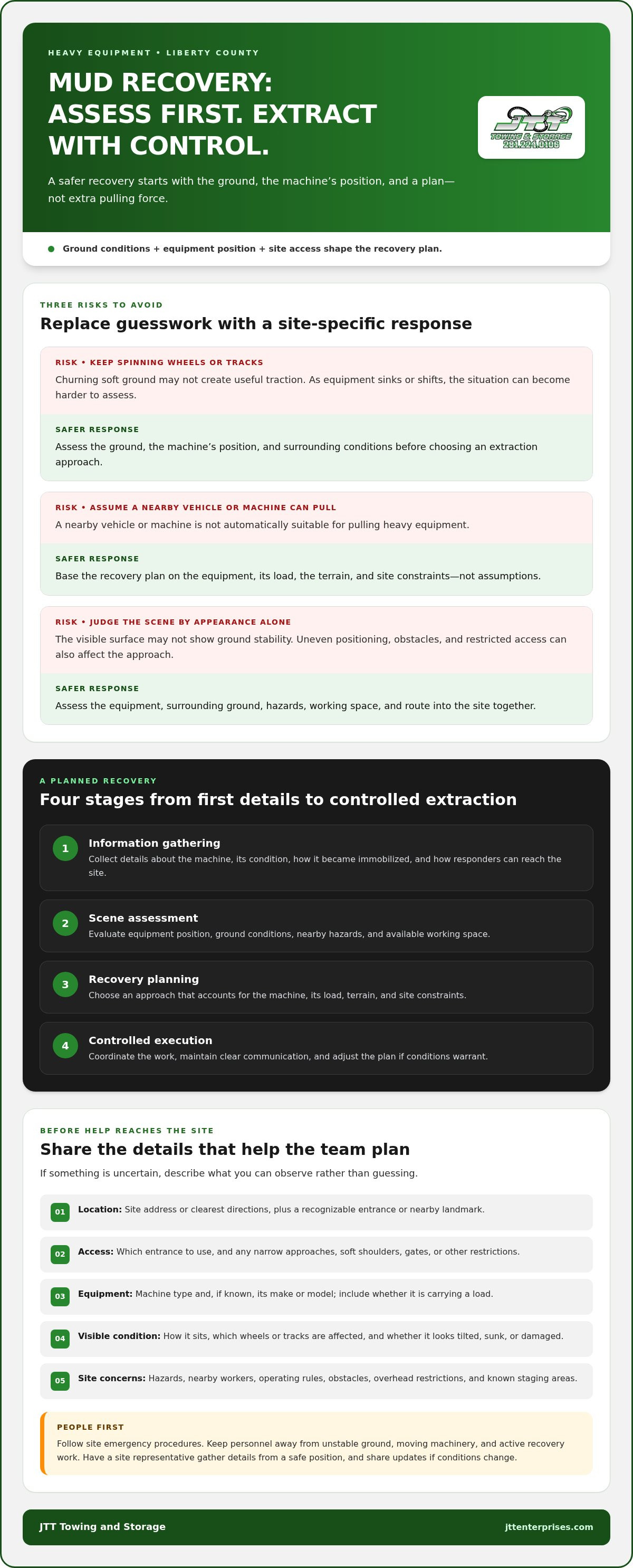
- Information gathering, scene assessment, recovery planning, and controlled execution all shape mud recovery for heavy equipment in Liberty County.
- A nearby vehicle or machine isn’t automatically suitable for pulling heavy equipment.
- A worksite checklist helps you communicate hazards, access limits, nearby workers, and site operating rules.
- JTT Towing and Storage provides heavy-duty towing and off-road recovery for commercial and industrial equipment situations.
When heavy equipment gets stuck in Liberty County mud, what matters first?
Start with the conditions, not the throttle. Mud recovery is a planned effort to free immobilized equipment while managing risks to people, the machine, and the worksite. Spinning wheels or tracks can churn soft ground without creating useful traction. As the machine sinks or shifts, its position and the firmness of the surrounding ground can change, so continued movement alone may make the situation harder to assess.
Safe mud recovery combines ground assessment, load control, and coordinated extraction to free equipment while managing site and machinery risks. That differs from routine equipment hauling, which transports machinery, or a standard roadside tow involving a vehicle on a road. Off-road recovery addresses equipment immobilized in difficult terrain, where the machine and site need to be considered together. The right plan for mud recovery for heavy equipment in Liberty County depends on the actual conditions at the site.
What makes heavy equipment recovery in mud different?
Heavy machinery differs from a passenger vehicle in its size, weight, and how its wheels or tracks meet the ground. A machine may be resting unevenly, with one side in softer soil, or in a position where the terrain limits access. Equipment stuck in a muddy shoulder beside a work area can present different constraints from a machine sunk into a soft section of a site.
Ground firmness, equipment position, and access all inform recovery planning. The visible surface may not show how stable the ground is around the machine, and the worksite layout or nearby obstacles may restrict the available approach. Wheeled and tracked machines can also present different recovery considerations. No single assumption fits every machine or muddy site, so conditions need to be assessed before recovery begins.
What should you do before help reaches the Liberty County site?
Put people first. Follow the site’s emergency procedures, and keep personnel away from unstable ground, moving machinery, and any active recovery operation. Don’t ask workers to approach the stuck machine or attempt a pull while the site is being assessed. A site representative can gather information from a safe position and relay it to the recovery team.
When requesting service, share clear details that identify the job and help the team reach the equipment:
- Precise location: Provide the site address or the clearest directions available, along with a recognizable entrance or nearby landmark.
- Safe access route: Explain which entrance to use and note narrow approaches, soft shoulders, gates, or other restrictions.
- Equipment details: Identify the machine type and, if known, its make or model.
- Visible condition: Describe how it sits, which wheels or tracks are affected, and whether it appears tilted, sunk, or damaged.
- Site concerns: Flag hazards, nearby workers, and site operating rules that could affect access or coordination.
Accurate information gives the recovery team a useful starting point. If conditions change while help is on the way, update the site representative and recovery team rather than sending workers back into an unsafe area.
How professional mud recovery for heavy equipment is planned
A professional recovery starts with information and judgment, not the assumption that one approach fits every machine. The team needs to understand the equipment, its position, the ground around it, and the route into the site. For mud recovery for heavy equipment in Liberty County, those conditions guide the work from the first conversation through the controlled extraction.
Recovery methods should follow an on-site assessment, not guesswork. A site representative can explain operating restrictions, hazards, and changes in conditions. The recovery team evaluates the scene and determines an appropriate course of action.
The process generally moves through four stages:
- Information gathering: Collect details about the machine, its condition, how it became immobilized, and how responders can access the site.
- Scene assessment: Evaluate the equipment’s position, ground conditions, nearby hazards, and available working space.
- Recovery planning: Choose an approach that accounts for the machine, its load, the terrain, and site constraints.
- Controlled execution: Coordinate the work, maintain clear communication, and adjust the plan if conditions warrant.
What information shapes the recovery plan?
Useful details include the equipment type, approximate size, whether it’s carrying a load, and how it became stuck. Mention visible damage or an unusual tilt, since these may affect how the machine can be approached and assessed. Nearby structures, vehicles, stored materials, or other obstacles can limit working space. Include access width, overhead restrictions, ground conditions, and safe staging areas where known. If a detail is uncertain, describe what you can observe rather than guessing.
These facts help the team prepare for a site-specific assessment, but they don’t replace one. A clear entrance may still lead to soft ground that limits access, while a machine that looks level from one angle may be sitting unevenly. A site representative can also clarify worksite rules and operational constraints, such as restricted areas or nearby activities. That context helps the recovery team understand the setting before work begins.
How does a controlled extraction protect people and equipment?
A controlled extraction depends on coordination, clear communication, and keeping bystanders outside the working area. The site representative can help communicate boundaries and prevent other work from interfering with the recovery. Personnel should follow the recovery team’s directions and avoid entering the work area unless instructed.
Recovery forces and equipment positioning require professional judgment at the scene. The appropriate setup depends on the machine’s condition and position, ground support, and available space. Deciding those details from a distance, or copying an approach used on a different machine, can overlook site-specific risks. The recovery team assesses conditions and coordinates the work accordingly. Don’t attempt a pull or operate recovery equipment yourself.
For a Liberty County worksite, sharing accurate details early helps JTT Towing and Storage coordinate heavy-duty towing and off-road recovery. Learn about JTT’s recovery services as you prepare to discuss the site and equipment.
DIY pull or professional recovery: choosing safely in Liberty County
A nearby vehicle or machine may look like a convenient way to pull stuck equipment free. But proximity doesn’t show that it’s suitable for the load, ground, or equipment position. A pull that seems straightforward can become harder to control if the machine shifts, sinks further, or moves unexpectedly.
Not every stuck machine needs the same response. Consider the specific equipment and site, especially when ground conditions or safe access are uncertain. This comparison can help you recognize when a professional assessment is appropriate for mud recovery for heavy equipment in Liberty County.
| Situation | Key concern | Why professional assessment may be appropriate |
|---|---|---|
| The ground is soft, uneven, or changing | Available traction and ground support may be difficult to judge | A site assessment considers the machine’s position and surrounding conditions before a recovery approach is chosen. |
| The machine is carrying a load | The load may affect how the equipment responds to movement | Equipment details and its loaded condition inform planning. |
| Access is narrow or restricted | Nearby obstacles or overhead limits may constrain the working area | Professional planning accounts for access and site limitations. |
| The machine appears tilted, damaged, or unstable | Its condition may make movement less predictable | An on-site assessment helps determine a considered course of action. |
| A nearby vehicle or machine is available | Its presence doesn’t show that it’s suitable for the pull | Suitability depends on the equipment, ground, and recovery conditions, not convenience alone. |
When can an improvised pull increase risk?
An informal pull can cause uncontrolled movement, disturb the ground further, or add strain to equipment. Engine power or apparent traction doesn’t prove that a pull is safe. If the machine is loaded, the ground is uncertain, or its position looks unstable, stop informal recovery attempts and seek professional assessment rather than escalating the effort.
What should a commercial recovery service explain?
JTT Towing and Storage provides heavy-duty towing and off-road recovery for commercial and industrial needs. A sound plan accounts for the equipment, site access, and conditions observed at the scene, rather than assuming one method suits every job. The assessment guides decisions, but different situations can call for different responses.
For additional context on off-road recovery planning, explore this Dayton off-road heavy recovery guide. The key decision is not whether a nearby machine can pull, but whether the situation has been assessed well enough to choose a controlled path forward.
Preparing a Liberty County worksite for heavy equipment mud recovery
A site representative can help coordinate mud recovery for heavy equipment in Liberty County by making the location and worksite conditions clear before the recovery team arrives. Focus on accurate communication and safe access. Don’t try to improve the route or change the equipment’s position on your own. Ground that looks passable from a distance may not be suitable for a recovery vehicle or crew.
Use this checklist to prepare useful information:
- Pinpoint the location: Share the site address or precise directions, including the correct entrance, gate instructions, and a reliable on-site contact.
- Describe the approach: Report narrow roads, soft shoulders, low clearances, gates, or other known access restrictions. Don’t assume the route is suitable.
- Identify hazards: Flag unstable ground, nearby structures, active work, or other conditions that may affect access or coordination.
- Account for people: Tell the team where workers or other site visitors are operating near the recovery area.
- Explain site rules: Share relevant operating procedures, restricted areas, and requirements for entering or moving around the site.
- Clarify authorization: Identify the equipment owner or the person authorized to coordinate decisions about the machine.
What location and access details help coordinate a response?
Give directions that someone unfamiliar with the worksite can follow, and name the entrance to use rather than relying on a general location pin alone. Describe the route as you understand it, including known width limits, overhead restrictions, gates, and changes in surface conditions. A clear path on a site map doesn’t establish that the ground can support access. If you can take photographs without approaching unstable ground or entering an active work area, share them to explain what’s visible. Don’t take pictures if doing so puts anyone at risk.
How can the site team support a safer operation?
Keep workers and bystanders clear of the recovery area, and follow the recovery team’s directions as the operation is coordinated. Tell the team about hazards, site-specific operating rules, and constraints that could affect movement or access. Don’t move, unload, or reposition the equipment unless the recovery team directs it. An unplanned change could alter the machine’s condition or the surrounding ground before the recovery is assessed.
If equipment also needs to be transported, JTT’s heavy equipment hauling in Texas provides related information. Share your location and site access details with JTT Towing and Storage to arrange professional recovery assistance.
Arrange heavy equipment mud recovery with JTT in Liberty County
When equipment is immobilized, a clear request helps turn a stressful disruption into a coordinated next step. JTT Towing and Storage is a family-owned and operated provider based in Dayton, Texas. The company provides heavy-duty towing and off-road recovery for commercial and industrial equipment situations in Liberty County.
To discuss mud recovery for heavy equipment in Liberty County, gather the essential details about the site, machine, and conditions. You don’t need to diagnose the problem yourself. Share what you know clearly, and describe anything you can’t determine as unknown.
What to include when requesting Liberty County recovery assistance
Start with the precise site location and the safest known access point. Include gate codes or entry instructions, a contact person who can meet the recovery team, and any restrictions on reaching the equipment. On a large property, specify where the machine is located, not just the main entrance.
Describe the machine and its visible condition. Say whether it’s carrying a load, appears damaged or tilted, or is obstructing work or access. Add known hazards, current ground conditions, and site rules that could affect the operation. Share photographs only if they were taken from a safe position. Accurate observations are more useful than guesses.
How recovery connects with related heavy-duty services
Recovery and transportation are related, but they solve different problems. Recovery addresses equipment that can’t move from its current position; transportation moves equipment to another location afterward. The next step depends on the situation and the equipment’s condition. If transport is also needed, JTT’s Dayton heavy-duty towing guide offers related information.
Before making the request, gather the location, equipment details, condition, access instructions, and immediate hazards in one place. If site conditions change, share that update. Keep workers away from the recovery area and follow the recovery team’s directions. These steps support clear communication without asking site personnel to assess or alter the recovery setup.
JTT’s heavy-duty towing and off-road recovery services support Liberty County businesses facing challenging equipment situations, including in ZIP codes 77535, 77336, 77327, 77561, 77357, 77532, and 77575. Describe the site and machine, then Request heavy-duty recovery assistance.
Keep the next move clear and coordinated
Once equipment is immobilized, the next decision can shape how smoothly work at the site moves forward. Pause, communicate, and coordinate with the person responsible for the site. This keeps attention on safe operations while the equipment’s situation is assessed, rather than allowing schedule pressure to prompt an uncertain pull.
For mud recovery for heavy equipment in Liberty County, bring the essential details together and arrange professional support. JTT Towing and Storage provides heavy-duty towing and off-road recovery for challenging equipment situations. Share what you know about the machine and site, and let the recovery team guide the discussion.
Request heavy-duty recovery assistance and take the next step toward a coordinated recovery. Clear communication and a safety-focused plan help your team move forward with confidence.
Frequently Asked Questions
Can heavy equipment be recovered from deep mud?
Heavy equipment can often be recovered from deep mud, but the conditions at the site determine the approach. A machine partly sunk on level ground presents different considerations from one tilted near a ditch or structure. Access for the recovery team also matters. An on-site professional assessment helps determine a suitable approach; depth alone can’t establish what’s feasible or promise a particular outcome.
What information should I provide when requesting mud recovery in Liberty County?
Provide the precise location, equipment type, visible condition, access details, known hazards, and a contact who can meet the recovery team. If the site is large, specify where the machine is within the property, not just the main entrance. Mention whether operations are blocked or the machine is near a structure, drainage feature, or active work area. Share only details you can report safely and accurately.
Is it safe to pull heavy equipment out of mud with another vehicle?
Not necessarily. A vehicle’s size, traction, or engine power doesn’t show that it’s appropriate for the stuck machine or ground conditions. An unassessed pull can lead to sudden movement, more ground disturbance, or equipment damage. Don’t treat a nearby work truck or machine as a recovery solution by default. If the load, footing, or equipment position is uncertain, stop and seek a professional assessment.
How does a recovery team decide how to free stuck equipment?
The team gathers details about the equipment and site, assesses conditions in person, and then plans and carries out a controlled recovery. A machine’s tilt, visible damage, nearby obstacles, and changes in ground firmness may affect the plan. The site representative can clarify operational limits that aren’t obvious on arrival. The team uses professional judgment at the scene rather than relying on a generic method.
Can loaded equipment be recovered from mud?
Loaded equipment may be recoverable, but its load and overall condition are important parts of the assessment. The type and position of the machine, signs of damage or instability, ground firmness, and access all influence planning. Share whether the equipment is loaded and describe what you can observe. Don’t unload, move, or reposition it on your own. Wait for professional direction so the situation can be assessed before changes are made.
Does JTT Towing and Storage provide off-road recovery in Liberty County?
Yes. JTT Towing and Storage provides off-road recovery and heavy-duty towing for commercial and industrial needs. Its local service focus includes areas identified by ZIP codes 77535, 77336, 77327, 77561, 77357, 77532, and 77575. Share the equipment and site details to coordinate your request. Visit the JTT Towing and Storage homepage to request assistance with an off-road recovery situation.


