
The hardest pull is often the wrong first move. When a loader, excavator, or dump truck loses traction in soft ground, spinning the wheels or attaching a strap to an unsuitable point can deepen the rut or damage equipment. Safe construction vehicle extraction from mud starts with pausing, securing the area, and assessing the machine and ground before choosing a recovery method.
It’s understandable to want equipment moving again quickly, especially when a crew and schedule are waiting. But the right approach depends on how deeply the vehicle is stuck, whether it’s stable, and what suitable recovery equipment and attachment points are available. This guide explains what to do first, how to compare recovery options, and which actions to avoid.
You’ll also learn when to stop a self-recovery attempt and call for professional heavy-duty or off-road recovery support. JTT Towing and Storage provides off-road recovery from Dayton, Texas, serving commercial and industrial clients in the local areas covered by ZIP codes 77535, 77336, 77327, 77561, 77357, 77532, and 77575. The goal is a measured decision that protects people, machinery, and the job site.
Key Takeaways
- Assess the machine’s position, ground conditions, and site hazards before choosing a recovery approach.
- Plan construction vehicle extraction from mud in stages, from preparing access to a gradual recovery and post-recovery check.
- Compare operator-led checks with professional off-road recovery using practical factors such as machine stability, visible damage, and site access.
- Record equipment and site details to give the recovery team a clearer picture of the situation.
- Stop self-recovery attempts if the ground changes, the machine becomes unstable, or damage is visible.
Construction Vehicle Stuck in Mud? Start with a Safe Site Assessment
Protect people first. Pause the machine and assess the scene from a safe position before anyone approaches or attempts a pull. Spinning wheels or tracks can churn soft ground, deepen ruts, and reduce the support beneath the vehicle. That can make recovery more difficult and create new hazards around the machine.
For safe construction vehicle extraction from mud, build a clear picture of the site and equipment. Note the machine type, how far its tires or tracks appear to have sunk, whether the ground slopes, and how close the vehicle is to structures, utilities, or an edge. Identify possible access routes for recovery equipment, but don’t assume a route is stable because it looks firm from a distance.
What to check before anyone attempts recovery
Make observations from a position that doesn’t expose workers to shifting equipment or unstable ground. Keep bystanders out of the work area and follow the site’s established safety procedures. Look for workers or moving traffic nearby, overhead hazards, buried utilities, and ground that may give way under a person or vehicle.
Check the machine’s position without approaching if doing so would be unsafe. Is it level or leaning? Is it carrying a load? Is there visible damage, or is it close to a slope or edge? These details help distinguish a traction problem from a situation where an attempted pull could worsen the machine’s position. If there’s a clear hazard or the vehicle appears unstable, stop and leave recovery planning to a professional recovery team.
- Machine: Record the equipment type and whether it’s loaded, damaged, or leaning.
- Ground: Estimate visible sink depth and note ruts, slopes, and soft areas.
- Surroundings: Identify nearby workers, traffic, structures, overhead hazards, and buried utilities.
- Access: Note potential approach routes and obstacles without driving or walking onto uncertain ground.
Why construction equipment can become harder to extract
Heavy machinery can press into saturated ground, while ruts and limited tire or track grip reduce its ability to move. Continued power can make the machine dig in further or disturb a larger area. The effect depends on the equipment, its position, and the ground beneath it, so assess actual site conditions rather than relying on the weather or location alone.
A vehicle with reduced traction may still be level and supported. A deeply bogged machine, one leaning noticeably, or one near an edge presents different concerns. If its position is changing, the ground is breaking away, or there’s visible damage, don’t treat it as a routine traction problem.
A controlled recovery is a planned pull matched to the machine, its position, and the site conditions. Assessment comes before force. When those conditions aren’t clear, pause self-recovery and arrange professional off-road recovery support rather than risking further ground disturbance or equipment damage.
How Professional Mud Extraction Works for Construction Vehicles
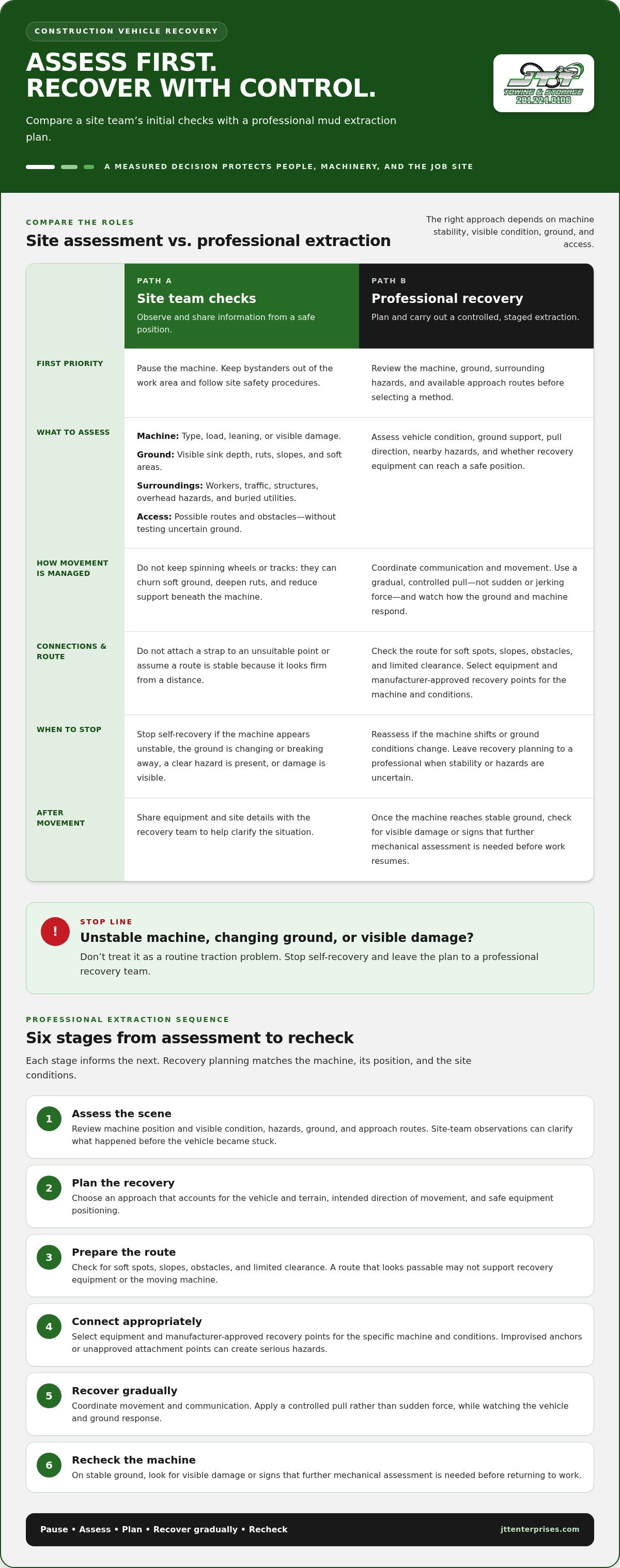
Professional recovery follows a sequence rather than relying on a sudden burst of pulling force. The operator evaluates the machine and site, then chooses a method that accounts for the equipment’s condition and the ground’s ability to support the recovery setup. For construction vehicle extraction from mud, this planning helps limit unnecessary movement, protect workers, and guide the machine toward firmer ground.
Recovery planning considers vehicle condition, ground support, pull direction, and site access. Each stage informs the next. If the machine shifts or the ground changes, the operator can reassess before proceeding.
- Assess the scene. The recovery operator reviews the machine’s position and visible condition, surrounding hazards, ground, and available approach routes. Information from the site team can clarify the equipment’s condition and what happened before it became stuck.
- Plan the recovery. The operator selects an approach based on the vehicle and terrain, including the intended direction of movement and where recovery equipment can be positioned safely.
- Prepare the route. Check the path out for soft spots, slopes, obstacles, and limited clearance. A route that looks passable from a distance may not support recovery equipment or the moving machine.
- Connect appropriately. The operator selects recovery equipment and connection points for the specific machine and conditions. Connections should use manufacturer-approved recovery points. Improvised anchors or unapproved attachment points can create serious hazards.
- Recover gradually. The operator coordinates movement and communication, applying a controlled pull rather than a sudden, jerking force. The team watches how the vehicle and ground respond.
- Recheck the machine. Once it reaches stable ground, the operator and site team can look for visible damage or signs that it needs further mechanical assessment before returning to work.
Planning the pull around the machine and terrain
The recovery direction depends on the machine’s position, the slope, nearby obstacles, and the access available to recovery equipment. A narrow entrance or soft approach may affect where equipment can be placed and whether the planned route is practical. The machine’s weight and manufacturer-approved recovery points also matter. A professional operator assesses these factors together instead of relying on a generic setup or unverified force calculations.
Controlled extraction and post-recovery checks
Clear communication helps the people involved coordinate movement and monitor changing conditions. Recovery should stop if the machine shifts unexpectedly, sinks further, or the setup no longer matches the plan. After extraction, check for visible damage and arrange an appropriate mechanical assessment if there are signs of a problem. Reaching firmer ground doesn’t prove the machine is ready to operate.
When a machine needs a planned on-site recovery, JTT Towing and Storage provides off-road recovery support from Dayton, Texas, for local commercial and industrial clients.
Which Mud-Recovery Option Fits the Construction Vehicle and Site?
The safest option depends on what the assessment reveals, not simply on whether another vehicle is available. A machine on firm, level ground with no visible damage may allow limited checks by its operator. Deep sinkage, a changing position, or restricted access calls for a more cautious response. Use the comparison below to guide the decision, not as a substitute for a site-specific assessment.
| Site factor | Limited operator-led checks | Stop and seek professional recovery |
|---|---|---|
| Site access | Access is clear and the ground appears stable from a safe vantage point. | Approach routes are soft, obstructed, narrow, or uncertain. |
| Machine position | The vehicle is level and its position is not changing. | It is leaning, near an edge, or shifting or sinking further. |
| Visible damage | No damage is apparent from a safe distance. | Damage is visible, suspected, or cannot be assessed safely. |
| Ground conditions | The machine has limited traction without deep bogging or unstable support. | Ruts are worsening, the ground is giving way, or support is uncertain. |
| Suitable next action | Pause movement and follow site procedures for assessment. Don’t start a pull based on guesswork. | Secure the work area and arrange a professional recovery assessment. |
When a basic self-assessment should stop
Stop attempts if the machine is leaning, the ground is unstable, sinkage is worsening, or nearby hazards make access unsafe. Visible damage, uncertain recovery points, or a lack of safe equipment access are also reasons to leave extraction planning to a professional recovery team. Stopping movement and keeping people clear are safety steps, not a way to pull the machine free.
How professional recovery differs from an improvised pull
A vehicle-to-vehicle pull isn’t automatically safe for heavy construction equipment. The vehicles, connection points, ground support, and direction of force all matter. A second machine doesn’t make an unassessed setup suitable. A recovery provider evaluates the stuck machine, pull path, site constraints, and appropriate equipment before proceeding. The plan may change if conditions shift, and no approach can promise a damage-free extraction.
For more context on heavy-vehicle recovery decisions, see JTT’s Off-Road Heavy Recovery in Dayton, TX guide. JTT Towing and Storage provides professional off-road recovery support for challenging recovery situations.
What to Do While Waiting for Construction Vehicle Recovery
Once you’ve stopped movement and determined that professional support is needed, use the waiting period to keep the area organized and gather useful details. Don’t attempt another pull or move the machine while recovery is being arranged. A clear, accurate handoff helps the recovery team understand the site and plan its approach.
Information that helps the recovery team plan
Share what you can observe from a safe position. Note the equipment type, approximate position, whether it’s loaded, visible damage, and any changes since it became stuck. Describe the site entrance, the route to the machine, narrow areas, overhead restrictions, nearby obstacles, and hazards. Don’t enter unstable ground to take photos or measurements. If you have a safe view, a photo may help clarify the machine’s position and access conditions.
Keep the work area organized and people clear
Assign one site contact to communicate with the recovery team and coordinate access. This reduces conflicting instructions and gives the operator a reliable point of contact for new observations. Keep workers and unrelated vehicles clear of the recovery area, and follow the site’s established safety procedures while waiting. If onward transport is needed after recovery, equipment hauling may be a separate next step.
When to call for off-road recovery in the Dayton area
Seek professional support if the machine is unstable, deeply stuck, visibly damaged, close to an edge, or near other site hazards. These conditions can make an improvised attempt harder to control. For construction vehicle extraction from mud, location and access details matter as much as the machine’s position. If the site is in one of the local ZIP codes JTT serves, 77535, 77336, 77327, 77561, 77357, 77532, or 77575, share its exact location and any access restrictions. For broader commercial recovery context, see this guide to heavy-duty towing in Dayton.
What to expect from a recovery request
JTT Towing and Storage is a family-owned, Dayton-based provider of heavy-duty towing and off-road recovery for commercial and industrial needs in Dayton and nearby communities. To help explain the situation clearly, have these details ready:
- Personnel: Confirm workers are clear of the recovery area and identify the site contact.
- Machine: Note the equipment type, approximate position, loading status, and visible condition.
- Location: Give the site address or entrance information, including narrow access, overhead restrictions, and nearby obstacles.
- Changes: Report whether the machine has shifted, sunk further, or shown new signs of damage.
Clear information supports an informed recovery plan, though the approach depends on conditions at the site. For recovery assistance, contact JTT Towing and Storage and share the machine, location, access, and current condition.
Make the Next Move a Planned One
Once the machine is secure, treat the recovery as useful information for the next phase of the job. Share what changed on site with the people responsible for equipment and work planning, and reassess the access route or machine position before operations resume. If the vehicle shows signs of damage, arrange an appropriate mechanical inspection rather than assuming it’s ready to return to work.
For construction vehicle extraction from mud, a calm pause and a clear recovery plan can keep a difficult site situation from becoming more complicated. Give the recovery team a straightforward account of the machine’s condition and site constraints. Those details provide a practical starting point for planning the next step.
JTT Towing and Storage provides heavy-duty towing and off-road recovery from Dayton, Texas, serving local areas including ZIP codes 77535, 77336, 77327, 77561, 77357, 77532, and 77575. Contact JTT Towing and Storage for construction vehicle recovery and share what’s happening on site.
Frequently Asked Questions
Can I pull a construction vehicle out of mud with another machine?
Not automatically. A second machine may also lose traction or become unstable, and its presence doesn’t make it a safe anchor. The right recovery method depends on the stuck machine’s weight, approved connection points, ground stability, pull direction, and hazards around the site. Don’t use improvised attachments or attempt an uncontrolled pull. If the setup or risks are uncertain, stop movement and arrange a professional assessment before either machine moves.
What should I do first when construction equipment gets stuck in mud?
Protect people and pause unnecessary machine movement first. Keep workers clear, then assess the situation from a safe position. Note whether the equipment is level, what parts appear buried, and whether its position is changing. Also observe visible damage, nearby obstacles, and possible access constraints. Don’t step onto unstable ground to inspect it. If the machine begins leaning or sinking further, stop self-recovery efforts and seek professional support.
How do professionals extract heavy construction equipment from mud?
Professionals begin by evaluating the equipment and ground, then plan a route and prepare access for the recovery operation. They select suitable equipment and manufacturer-approved connection points for the specific machine before coordinating controlled movement. For example, a loaded machine near a slope presents different considerations from an unloaded vehicle on level ground. The method depends on position, access, and ground support, so damage-free results or a fixed recovery time can’t be promised.
When should I call a professional for construction vehicle mud recovery?
Call for professional support if the machine is leaning, deeply bogged, visibly damaged, near an edge or utility, or getting worse as it moves. Professional help is also appropriate when there’s no clear plan, safe access, or approved recovery point. Stopping an uncertain attempt can prevent additional risk. JTT provides off-road recovery from Dayton for local areas including ZIP codes 77535, 77336, 77327, 77561, 77357, 77532, and 77575.
Can spinning the wheels get a construction vehicle unstuck?
It may not, and continued wheel or track movement can deepen ruts or reduce traction, depending on the machine and ground. Repeatedly applying power can also make it harder to judge whether the vehicle is settling further. Stop unnecessary movement and reassess rather than continuing to spin the wheels. If the machine keeps sinking, begins to lean, or shows visible damage, arrange a professional assessment before attempting another recovery method.
What information should I provide when requesting heavy equipment recovery?
Give the recovery team the equipment type, exact site location, approximate position, and apparent sink depth. Mention whether it’s loaded or visibly damaged, and describe any changes since it became stuck. Include practical access details, such as the site entrance, narrow routes, overhead restrictions, and nearby hazards. Share observations from a safe location; don’t enter unstable ground to measure or photograph the machine. Clear details support planning without guaranteeing a response time.


