
A disabled truck doesn’t always need a trip to the shop. When the fault can be safely assessed and addressed on-site, reducing downtime with mobile truck repair may remove a transport step before the vehicle returns to work. But roadside repair isn’t right for every breakdown, and attempting it in an unsafe location can create greater risks.
For fleet managers, a truck out of service can disrupt deliveries, schedules, and vehicle availability. Arranging a tow and repair can add coordination time, too. The practical response depends on the truck’s condition, where it stopped, and whether the issue can be handled safely outside a repair facility.
This guide explains how to weigh on-site repair against towing, what information helps assess a breakdown, and how to prepare drivers and dispatchers to reduce avoidable delays. JTT Towing and Storage provides truck repair and mechanical support alongside heavy-duty towing and recovery for commercial vehicles in Dayton, Texas, and the surrounding service area, including 77535, 77336, 77327, 77561, 77357, 77532, and 77575. Knowing how repair and recovery fit together can help your team choose a sound next step when a truck stops moving.
Key Takeaways
- Use the truck’s condition, location, and safe access to judge whether on-site repair or towing is the more practical next step.
- For reducing downtime with mobile truck repair, give dispatch clear details about the vehicle, its symptoms, and where it stopped.
- Keep drivers focused on scene safety and company procedures rather than attempting risky roadside checks or repairs.
- Prepare a breakdown checklist so dispatch can coordinate the driver, vehicle, access conditions, and a callback contact.
- JTT Towing and Storage provides truck repair, mechanical support, jumpstarts, and heavy-duty towing for commercial vehicles in the Dayton-area service region.
How Mobile Truck Repair Can Reduce Downtime for Commercial Fleets
Mobile truck repair brings repair support to a commercial vehicle where it has stopped or is operating, instead of moving it to a shop before the issue can be assessed. That can remove a transfer step and help fleet staff make a clearer repair-or-recovery decision. For fleets focused on reducing downtime with mobile truck repair, the value is not simply having help reach the truck. It’s getting useful information and coordinating the next decision without avoidable delays.
Downtime extends beyond the time a truck sits idle. Dispatch may need to assign another vehicle, revise a route, adjust load plans, or update delivery expectations. The disabled unit is also unavailable for its next scheduled work. These decisions are part of Fleet Management, where vehicle maintenance and operational efficiency affect how a fleet uses its resources.
Where downtime accumulates after a truck breaks down
The response runs from recognizing a fault to sharing details, arranging an assessment, deciding on repair or transport, completing the work, and returning the truck to service. Delays can build between each step. A vague symptom description gives the repair team little to work from, while an incomplete location can complicate dispatch and access planning.
The operational decision matters as much as the repair. While the truck’s status is assessed, dispatch needs to know whether to hold, reroute, or reassign affected work.
What mobile truck repair changes in the response
With on-site support, the vehicle can be assessed where it stopped, rather than requiring a tow to a shop before anyone can decide what to do. An assessment helps determine whether the issue is suitable for on-site work or whether the truck needs recovery and transport. It doesn’t guarantee an immediate repair: the fault, location safety, and work required all shape the next step.
When a truck can be safely accessed and the issue is suitable for on-site work, mobile repair may avoid unnecessary transport and help the fleet decide what to do next.
That distinction keeps expectations practical. Some breakdowns still require towing, and shop-level work may take time even after the vehicle arrives. JTT Towing and Storage provides commercial and industrial customers in Dayton, Texas, with professional truck repair and mechanical support, as well as heavy-duty towing and recovery when a disabled vehicle needs transport. Repair and recovery are connected options in a response plan, not competing choices.
How to Triage a Truck Breakdown Before Requesting Mobile Repair
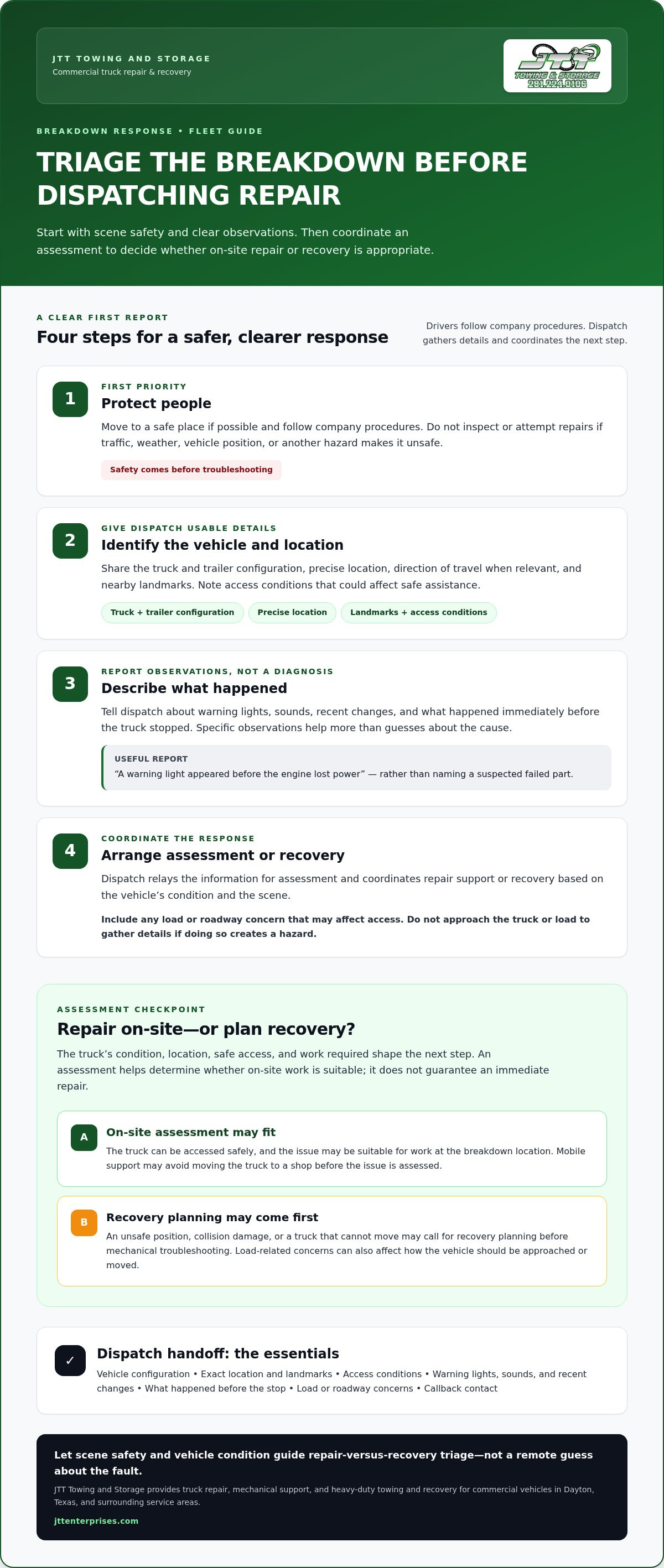
A clear first report helps the response begin with the right priorities. Drivers should follow company breakdown procedures and focus on people and scene safety, not roadside troubleshooting. Dispatch can collect the details needed to decide whether an on-site assessment is appropriate or whether recovery planning should come first.
- Protect people. Move to a safe place if possible and follow company procedures. Don’t inspect or attempt repairs if traffic, weather, vehicle position, or another hazard makes it unsafe.
- Identify the vehicle and location. Share the truck and trailer configuration, precise location, direction of travel if relevant, and nearby landmarks. Note access conditions that could affect safe assistance.
- Describe what happened. Report warning lights, sounds, recent changes, and what occurred immediately before the truck stopped. Share observations, not guesses about the cause.
- Coordinate next steps. Dispatch can relay the information for assessment and coordinate repair support or recovery based on the vehicle’s condition and the scene.
What information helps assess a truck breakdown
Specific observations are more useful than a diagnosis. For example, report that a warning light appeared before the engine lost power, rather than naming a suspected failed part. Include the trailer configuration, precise location, and landmarks, along with any load or roadway concern that may affect access. Don’t approach the truck or load to gather information if doing so creates a hazard.
Consistent internal procedures make this exchange easier. Fleet teams can use state vehicle maintenance programs as a reference for how formal maintenance processes are organized, then make sure drivers know what information dispatch needs during a breakdown.
When repair may not be the first response
A truck positioned unsafely, showing collision damage, or unable to move may need recovery planning before mechanical troubleshooting. Accident recovery and load-related concerns differ from assessing a mechanical fault, and each can change how the vehicle should be approached or moved. Don’t ask a driver to test whether the truck can move if its condition or location makes that unsafe.
Safety and vehicle condition should guide repair-versus-recovery triage, not a remote guess about the fault. A technician’s assessment helps determine whether on-site repair is appropriate or whether towing and recovery are the next step. That’s a practical foundation for reducing downtime with mobile truck repair: gather accurate details, leave diagnosis to the assessment, and coordinate the response accordingly. For truck repair, mechanical support, or heavy-duty recovery in the Dayton area, JTT’s truck and recovery support can help fleet teams take the next step.
Mobile Truck Repair vs. Shop Repair vs. Heavy-Duty Towing
The right response depends on whether the truck can be safely accessed, what the reported symptoms suggest, and where the required work can be performed. Mobile repair brings support to the vehicle. Shop repair offers a controlled workspace for work that needs it. Heavy-duty towing moves a truck that shouldn’t continue operating or can’t be moved safely under its own power. These options can also form part of the same response: an on-site assessment may help determine whether repair at the scene or transport is the next step.
| Response | Best-fit situation | Vehicle movement | Operational trade-off | Next decision |
|---|---|---|---|---|
| Mobile truck repair | The truck is safely accessible, and the issue may be suitable for on-site work. | Support comes to the vehicle. | May avoid arranging transport before the issue is assessed, but not every repair can be completed roadside. | Assess the vehicle and determine whether the work can proceed at the scene. |
| Shop repair | The work requires a controlled workspace, specialized equipment, or a more extensive repair process. | The truck must reach the shop, driven only if safe or transported if it isn’t. | Provides a suitable work environment, but adds a transfer step when the vehicle is away from the facility. | Determine how the truck can be moved safely and where the work should take place. |
| Heavy-duty towing | The truck cannot move safely, should not continue operating, or needs recovery. | The vehicle is transported or recovered. | Adds a recovery and transport step, but avoids relying on an unsafe or unsuitable vehicle to travel. | Plan recovery and the destination for further assessment or repair. |
When on-site truck repair may be the practical choice
Consider the truck’s position, safe access, reported symptoms, and the nature of the work. If the vehicle is stable and reachable, an on-site assessment can help clarify whether further work is suitable at the scene. That doesn’t mean every mechanical fault can be repaired there or that the truck will return to service immediately. Reducing downtime with mobile truck repair starts with choosing the right response, not assuming every breakdown has the same solution.
When shop repair or towing may make more sense
A repair that needs a controlled work area or more extensive equipment may be better suited to a shop. If the truck cannot move safely, heavy-duty towing supports transport or recovery without asking it to continue operating. For more on recovery planning, see the guide “Heavy Duty Towing in Dayton, TX: The Complete Commercial Recovery Guide.” The practical question is whether the vehicle can be assessed and worked on safely where it is, or needs to be moved first.
How Fleet Teams Can Prepare for Faster Mobile Truck Repair
Preparation helps dispatch turn a driver’s report into a clear service request and manage the work affected by a disabled truck. Keep a simple breakdown checklist available to drivers and dispatchers, and make sure everyone knows who will coordinate updates. For fleets operating around Dayton and nearby areas, including 77535, 77336, 77327, 77561, 77357, 77532, and 77575, precise directions and access details help with coordination.
A driver-and-dispatcher checklist for a breakdown
Drivers should prioritize personal safety and follow their company’s roadside procedures. Dispatch can then gather and record the information needed to coordinate the next step:
- Location: Exact position, direction of travel where relevant, and nearby landmarks.
- Vehicle details: Truck and trailer configuration, plus identifying information available to the driver.
- Symptoms: Warning lights, sounds, changes in performance, and what happened just before the truck stopped.
- Access and load concerns: Roadway position, safe access conditions, and any load issue that could affect assistance. Don’t ask the driver to make an unsafe inspection.
- Callback contact: A reliable number for the driver or designated fleet contact, along with the person coordinating the response.
Clear internal updates matter too. Dispatch should share the truck’s status with the staff responsible for loads and routes, then record decisions and changes as they happen. This gives the team one current picture of the breakdown and helps prevent departments from acting on conflicting information.
Reducing repeat disruption through maintenance planning
Keep vehicle and maintenance records accessible to the people coordinating service. Previous repair notes, recurring symptoms, and recent maintenance history can provide useful context, but they don’t replace a technician’s assessment of the current fault. They help fleet staff explain what has happened before and keep follow-up decisions grounded in the vehicle’s history.
Reviewing service records can also help identify repeat issues and inform maintenance planning before the next dispatch. Preventive maintenance complements breakdown response, but it can’t guarantee a vehicle won’t fail. For teams focused on reducing downtime with mobile truck repair, preparation supports a more organized response while maintenance planning helps address patterns over time.
Keep your breakdown details and callback contact ready, then connect with JTT’s truck repair support for commercial vehicle assistance in the Dayton-area service region.
Mobile Truck Repair and Roadside Support in Dayton, Texas
A disabled commercial truck needs a response that fits its condition. JTT Towing and Storage is based in Dayton, Texas, and provides professional truck repair, emergency jumpstarts, and mechanical support, along with heavy-duty towing and recovery. These options work together: repair support can address a mechanical need, while towing or recovery helps when the truck needs transport or cannot safely continue from its location. JTT serves the local areas represented by 77535, 77336, 77327, 77561, 77357, 77532, and 77575.
How repair and recovery support fit together
The first decision is whether the vehicle can be safely assessed where it stopped. If so, truck repair or mechanical support can help determine the next step. An emergency jumpstart may be relevant when the situation calls for one. If the truck cannot move safely, or its condition makes travel unsuitable, heavy-duty towing or recovery may be needed instead. The right path depends on the truck and scene, not on an assumption that every breakdown can be fixed roadside.
Collision-related incidents call for recovery considerations beyond a routine mechanical issue. JTT provides accident recovery, which may be relevant when a disabled truck is involved in a collision or requires recovery from its position. Fleet teams handling a tractor-trailer collision can also consult Tractor Trailer Accident Recovery in Dayton, TX: The Professional Guide for related recovery information.
A clear next step when a commercial truck is down
To coordinate support, fleet staff should be ready to share the truck’s precise location, its symptoms, and any safety or access concerns. Include relevant details about the vehicle and its condition, and keep a contact available for updates. Clear information helps connect the reported problem to the appropriate response, whether that means repair assessment, a jumpstart, mechanical support, or towing and recovery.
JTT is a family-owned local business with more than 10 years of operating history, serving commercial and industrial customers in Dayton and its surrounding service area. For fleet managers, reducing downtime with mobile truck repair starts with choosing a practical response and communicating the situation clearly. JTT brings repair and recovery support together without assuming every breakdown has the same solution.
Contact JTT for truck repair and roadside support to discuss a disabled commercial vehicle and the support it needs.
Build a Clear Plan for the Next Breakdown
Reducing downtime with mobile truck repair starts with a sound decision, not an automatic call for a roadside fix. Protect the driver and scene first, share clear vehicle and location details, then use the truck’s condition to guide the choice between on-site assessment, shop repair, or heavy-duty towing. Keeping dispatch, drivers, and operations aligned can also help limit disruption to loads and routes.
For commercial fleets in Dayton, Texas, JTT Towing and Storage provides truck repair, emergency jumpstarts, mechanical support, and heavy-duty towing and recovery as practical options for a disabled vehicle. This family-owned and operated business has served its community for over 10 years.
Keep the breakdown details ready and choose the response that fits the situation. Contact JTT for truck repair and roadside support. A prepared team can make a steadier decision and take the next step with confidence.
Frequently Asked Questions
How does mobile truck repair reduce downtime?
Mobile truck repair can reduce the steps needed to assess a disabled vehicle by bringing repair support to where the truck has stopped. This may avoid arranging transport to a shop before the issue is evaluated. Clear details about symptoms, location, and vehicle condition also help the fleet coordinate its next move. On-site support doesn’t guarantee an immediate repair, and some problems still require towing or shop work.
Is mobile truck repair faster than taking a truck to a shop?
It can be faster to begin an assessment on-site when the truck is safely accessible and the issue is suitable for roadside work. However, mobile repair isn’t automatically faster overall. The fault, location, access conditions, and work required all affect how long the vehicle remains out of service. If the repair needs a controlled workspace or more extensive equipment, transport to a shop may be the practical next step.
What repairs can be handled by mobile truck repair?
The work depends on the truck’s condition and what can be safely handled at its location. JTT Towing and Storage provides professional truck repair, mechanical support, and emergency jumpstarts for heavy-duty trucks and machinery. An assessment helps determine the appropriate next step, but not every repair can be completed on-site. Share the symptoms and any recent changes so the situation can be assessed without relying on a driver’s remote diagnosis.
When should a truck be towed instead of repaired roadside?
Arrange towing or recovery when the truck can’t move safely, its position creates a hazard, or its condition calls for transport before repair. Collision damage or a load-related recovery situation may also require recovery planning rather than routine mechanical troubleshooting. Don’t ask a driver to test whether the truck can continue if safety is uncertain. Heavy-duty towing and recovery can move the vehicle to an appropriate location for further assessment or repair.
What information should I provide when requesting mobile truck repair?
Provide the truck and trailer details, precise location, nearby landmarks, and a callback number for the driver or fleet contact. Describe observable symptoms, such as warning lights, sounds, or changes in performance, and explain what happened before the truck stopped. Include access, roadway, or load concerns that could affect safe assistance. Drivers should follow company roadside procedures and avoid hazardous inspections or repair attempts.
Can mobile truck repair prevent future fleet breakdowns?
Mobile repair responds to a current issue; it can’t guarantee that future breakdowns will be prevented. Fleet teams can use service records to spot recurring symptoms and plan maintenance before dispatch, while addressing reported concerns promptly. JTT serves commercial and industrial customers in 77535, 77336, 77327, 77561, 77357, 77532, and 77575 with truck repair, mechanical support, emergency jumpstarts, and heavy-duty towing or recovery.


