
A truck goes down near Dayton, and the delivery schedule, driver assignment, and next dispatch all need attention at once. A fleet towing service Dayton TX businesses can call is important, but having a tow number alone does not tell your team what to do next. A clear response plan helps dispatchers decide whether a vehicle needs roadside assistance, towing, or recovery, and gives responders the details they need to coordinate support.
When a commercial vehicle is disabled, uncertainty can complicate the response. Your team needs a consistent way to report the incident, share the vehicle’s location and condition, and communicate load concerns. JTT Towing and Storage is a family-owned business based in Dayton, with commercial support that includes heavy-duty towing, accident and off-road recovery, truck repair, emergency jumpstarts, and load shifts and transfers.
This guide explains how to build a locally relevant fleet response plan. You’ll learn what information to collect, how to match a vehicle and incident to suitable towing or recovery support, and how to prepare dispatchers and drivers to make clear decisions when a truck is out of service.
Key Takeaways
- Set shared reporting steps so dispatchers can coordinate assistance while managing schedules and driver assignments.
- Use a fleet towing service Dayton TX checklist to assess vehicle types, incident needs, and coordination requirements.
- Choose between a jumpstart, repair, tow, accident recovery, or storage based on the vehicle’s condition and the situation.
- Prepare drivers to share the exact location, vehicle type, condition, load details, access issues, and a callback contact.
- Clear incident details help JTT Towing and Storage coordinate the support your fleet needs, from heavy-duty towing to recovery and truck repair.
Fleet towing service in Dayton, TX: why a response plan matters
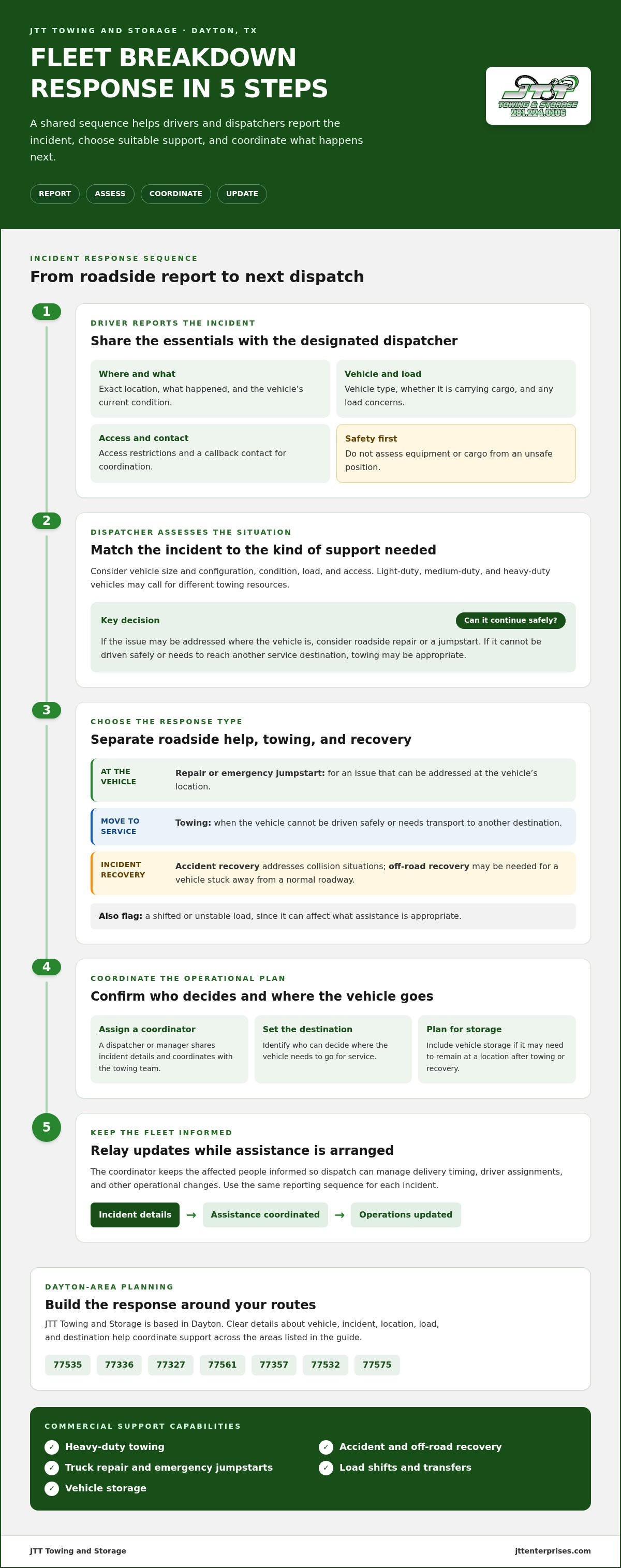
A fleet towing response plan gives drivers and dispatchers shared instructions for reporting a roadside incident, deciding what assistance is needed, and coordinating updates. Instead of making decisions under pressure, your team can follow the same process and focus on the essential questions: What type of vehicle is disabled? What happened? Where is it? Is it carrying a load? Where does it need to go?
A breakdown or collision can affect more than one truck. A delayed vehicle may disrupt delivery timing, require a change in driver assignments, or complicate cargo operations. A practical fleet towing service Dayton TX plan helps your team communicate the incident and decide whether roadside assistance, repair, towing, recovery, or another next step fits the situation.
Keep incident response separate from planned vehicle shipping or equipment transport. Shipping moves a vehicle from one location to another as part of a planned job. Towing and recovery address an immediate problem, such as a truck that cannot continue operating or a vehicle that needs to be moved after an incident.
Which fleet situations call for towing or recovery?
A truck with a problem that can be addressed at its location may need repair or a jumpstart rather than transport. If it cannot be driven safely or needs to reach another destination for service, towing may be appropriate. The vehicle’s type and condition help determine suitable equipment. This overview of types of tow trucks explains some of the equipment used for different towing needs.
Other situations call for recovery support. Accident recovery addresses vehicles involved in a collision, while off-road recovery may be needed when a vehicle is stuck away from a normal roadway. A shifted or unstable load can also affect what assistance is appropriate. Describe what happened and the load situation clearly. Drivers should not assess equipment or cargo from an unsafe position.
What should a Dayton-area fleet plan accomplish?
Set a consistent reporting sequence: the driver shares the location and incident details with the designated dispatcher, who coordinates assistance and relays operational updates to the people affected. Identify who can decide the vehicle’s destination and approve changes to schedules or assignments.
Build the process around where your vehicles operate and the support available for those routes. JTT Towing and Storage is based in Dayton and provides commercial support that includes heavy-duty towing, accident and off-road recovery, truck repair, emergency jumpstarts, and load shifts and transfers. Whether your fleet operates in 77535, 77336, 77327, 77561, 77357, 77532, or 77575, clear information about the vehicle, incident, location, load, and destination helps your team communicate its needs and coordinate a focused response.
How to evaluate a fleet towing service in Dayton
Plan for the vehicles your fleet operates and the incidents your team may face. A fleet towing service Dayton TX should help you distinguish a tow from recovery or mechanical roadside assistance, then coordinate using clear details from your driver or dispatcher. Use this checklist to see whether your response process covers the practical needs of your operation:
- Vehicle coverage: Account for light-duty, medium-duty, and heavy-duty vehicles. Size, condition, and configuration can call for different towing resources.
- Incident capabilities: Treat towing, accident recovery, off-road recovery, repair, and emergency jumpstarts as distinct needs.
- Load and access: Record whether the vehicle is carrying cargo, has restricted access, or is in a position that may complicate service.
- Coordination: Decide who shares incident details, coordinates with the towing team, and updates dispatch or operations.
- Next steps: Set a process for deciding the vehicle’s destination and whether storage may be needed after a tow or recovery.
Match service capabilities to fleet vehicles and incidents
A truck that cannot continue may need towing, while a mechanical issue that can be addressed at the vehicle’s location may call for roadside support or repair. Accident recovery and off-road recovery involve different circumstances from a routine tow. Vehicle size, condition, load, and access all help shape the response. For more detail on commercial vehicle needs, see this heavy-duty towing guide.
JTT Towing and Storage supports commercial needs with heavy-duty towing, accident and off-road recovery, truck repair, and emergency jumpstarts. The Federal Motor Carrier Safety Administration (FMCSA) is a resource for broader commercial motor vehicle safety information. Keep your fleet’s safety practices alongside its roadside response procedures.
Assess coordination, updates, and asset handling
Assign a dispatcher or manager to coordinate incident details and share operational updates. This keeps driver assignments and delivery planning informed while assistance is arranged. If a vehicle cannot return to service or needs to remain at a location after a tow or recovery, include vehicle storage in your plan. JTT provides vehicle storage, and its commercial vehicle storage guide covers related fleet considerations.
Build your checklist around your vehicles, routes, and communication process, then use it to keep incident calls clear and consistent. For local towing and recovery information, visit JTT Towing and Storage.
Does every fleet breakdown need a tow? Choose support by scenario
No. A breakdown does not automatically mean a truck needs towing. The right next step depends on the vehicle’s condition, what happened, and whether it can be reached safely. Use this comparison to help dispatch plan a response, not to make a remote mechanical assessment. Drivers should report what they observe and leave decisions about diagnosis and safe movement to qualified responders.
| Scenario | Support to consider | Useful dispatch details |
|---|---|---|
| No-start | An emergency jumpstart may be relevant. | Report whether the vehicle starts, warning indicators, and visible damage. |
| Mechanical issue | Truck repair may be appropriate. Towing may be needed if the vehicle cannot continue. | Describe symptoms and whether the vehicle is immobilized. |
| Disabled vehicle | Towing can move a vehicle that cannot safely travel under its own power. | Share vehicle type, location, access conditions, and destination. |
| Collision | Accident recovery may be needed, depending on vehicle condition and scene circumstances. | Report visible damage, vehicle position, and load information. |
| Vehicle held after recovery or towing | Vehicle storage may be part of the next-step plan. | Tell dispatch where the vehicle needs to go and who will coordinate it. |
When roadside repair or a jumpstart may fit
A no-start or mechanical problem may call for roadside support rather than immediate transport. JTT Towing and Storage provides emergency jumpstarts and truck repair, but an initial description cannot establish whether a fault can be fixed at the roadside. Ask the driver to report warning signs and visible damage. They should not attempt a repair or move the vehicle to improve access.
When towing or recovery becomes the practical next step
Collision damage, immobilization, difficult terrain, or a vehicle that cannot be moved safely may make towing or recovery the practical option. Accident recovery and off-road recovery require situation-specific handling, especially when vehicle position, access, or cargo complicates the incident. For more on commercial collision scenarios, read the tractor-trailer accident recovery guide.
Clear communication supports an informed dispatch decision. The Towing and Recovery Association of America offers broader industry context. For local fleet towing service Dayton TX support, share the vehicle type, observed condition, location, load, and access concerns with JTT Towing and Storage.
Prepare drivers and dispatchers for a fleet towing call
A short, consistent call process helps your team share useful facts without asking a driver to inspect a disabled vehicle or approach a hazard. Drivers should follow instructions from emergency responders when they are present. Dispatchers can use the reported details to explain the situation and coordinate the requested assistance.
What information should a driver report?
Drivers should report only what they can observe from a safe position. A photo can clarify vehicle position or visible damage, but only if taking it is safe and permitted. Use this sequence to prepare a call for fleet towing service Dayton TX:
- Prioritize safety. Move away from traffic and unsafe equipment when possible. Follow directions from emergency responders at the scene.
- Give the location. Share the road or facility name, nearby landmarks, direction of travel, and the clearest available location description.
- Identify the vehicle. Provide the fleet or unit number, vehicle type, and details that help distinguish it from other vehicles.
- Describe the condition. State whether it can move, what warning signs are showing, and any visible damage. Do not try to diagnose the fault.
- Report the load and access. Explain whether cargo is on board, whether the load appears affected, and whether gates, soft ground, narrow access, or other obstacles could matter.
- Share contact and next-step details. Give a callback number and the requested destination or operational need, such as moving the vehicle to a repair location.
How can dispatch keep fleet operations organized?
Dispatch should record the incident time, driver’s contact information, vehicle details, location, reported condition, load status, known hazards, and assistance requested. Separate the driver’s observations from assumptions about the cause. This gives the towing or recovery team a clearer account without turning the report into a remote diagnosis.
Assign one dispatcher or manager to coordinate the incident and relay updates to operations and affected customers. That person can track changes to the vehicle’s condition, destination, or access details, then share relevant updates with the people managing schedules and assignments.
If the vehicle is in difficult terrain, include ground and access conditions in the report. The Dayton heavy recovery guide provides more context for off-road recovery situations. Keep your call checklist available to drivers and dispatchers, and share fleet incident details with JTT Towing and Storage to coordinate towing, repair, or recovery support.
Coordinate fleet towing and roadside support with JTT in Dayton
A fleet response plan is most useful when it connects your team’s incident process with practical local support. JTT Towing and Storage is a family-owned business based in Dayton, Texas. Its commercial support includes heavy-duty towing, accident recovery, off-road recovery, truck repair, and emergency jumpstarts. Fleet managers can plan around these services when a commercial vehicle is disabled, damaged, or unable to continue its route.
How JTT’s services fit a fleet response plan
Match the reported situation to the assistance your dispatcher needs to coordinate. Towing can move a disabled vehicle, while accident recovery addresses vehicles involved in collisions. Off-road recovery may be relevant when a vehicle is stuck away from a normal roadway. A no-start or mechanical issue may call for a jumpstart or truck repair instead of immediate towing. The vehicle’s condition and the circumstances guide the next step.
Some incidents involve more than the vehicle itself. If cargo has shifted or needs to be moved, load shifts and transfers or hauling may be relevant. Vehicle storage can also be part of the plan when a vehicle needs to be held after a tow or recovery. Include these as separate needs rather than assuming every incident requires the same response.
What to do before an incident happens
Document the vehicle types in your fleet, dispatcher and manager contacts, and the steps drivers should follow when reporting an incident. Keep the response checklist accessible to drivers and operations staff. Record the Dayton-area routes and relevant ZIP codes, including 77535, 77336, 77327, 77561, 77357, 77532, and 77575, so dispatch can report where an incident occurred and provide local context.
During a call, share the vehicle type, reported condition, exact location, load status, access concerns, known hazards, and requested destination or operational need. Clear details help JTT understand the situation and coordinate appropriate towing, recovery, or roadside support. They also help your team organize internal updates without asking a driver to assess something they cannot safely determine.
For fleet managers building a practical roadside process, JTT offers a local point of coordination for commercial towing, recovery, repair, and related needs. Contact JTT about fleet support to discuss your fleet’s towing and roadside requirements.
Put a Clear Fleet Roadside Plan in Place
A reliable fleet response starts before a vehicle is disabled. Give drivers and dispatchers a shared process, record the details responders need, and match assistance to the vehicle’s condition and circumstances. Not every incident calls for a tow: a jumpstart or repair may fit one situation, while towing or recovery may be the practical next step in another.
For fleet towing service Dayton TX, JTT Towing and Storage brings local commercial support from its base in Dayton, Texas. Its services include towing, accident and off-road recovery, truck repair, emergency jumpstarts, and vehicle storage, helping fleet managers plan for different roadside needs across local routes, including 77535, 77336, 77327, 77561, 77357, 77532, and 77575.
Prepare your checklist, share it with your team, and contact JTT to discuss your fleet towing and roadside support needs. Clear information helps your team coordinate a more organized response when a vehicle incident occurs.
Frequently Asked Questions
What does a fleet towing service in Dayton, TX typically handle?
A fleet towing service can coordinate help for disabled commercial vehicles, including towing, accident recovery, and off-road recovery. JTT Towing and Storage also provides heavy-duty towing, truck repair, emergency jumpstarts, load shifts and transfers, hauling, and vehicle storage. The right support depends on the vehicle and incident. A clear fleet towing service Dayton TX plan helps dispatchers share those details and communicate the assistance needed.
Can a fleet towing service help with roadside repairs and jumpstarts?
Yes. JTT provides truck repair and emergency jumpstarts for commercial vehicles. A no-start issue may make a jumpstart relevant, while another mechanical problem may require repair or towing. A driver’s description helps dispatch understand what is happening, but it is not a remote diagnosis or a promise that every fault can be fixed roadside. Report warning signs, visible damage, and whether the vehicle can move safely.
How do I decide whether a disabled commercial truck needs towing or repair?
Base the decision on the truck’s condition, the incident, and whether it can be moved safely. A mechanical issue may call for repair or a jumpstart if the vehicle can remain where it is. A truck that is immobilized or unsafe to drive may need towing. Do not ask the driver to diagnose the problem. Have them report observations so the response team can assess the appropriate support.
What information should a driver provide when requesting fleet towing?
Share the exact location, road or facility name, direction of travel, and nearby landmarks. Identify the vehicle by type and fleet or unit number, then describe its condition, visible damage, drivability, and any warning signs. Include load status, access issues, known hazards, requested destination, and a callback contact. Photos can help show the situation, but drivers should take them only when it is safe and permitted.
Does fleet towing include accident recovery for trucks and trailers?
Accident recovery is a distinct type of assistance for commercial vehicles involved in a collision. The response depends on vehicle damage, position, access, and load conditions. JTT provides accident recovery and heavy-duty towing for commercial support needs. Share what is known about the truck and trailer, visible damage, location, and cargo situation, and follow any instructions from emergency responders at the scene.
Can a towing service help after a commercial vehicle leaves the roadway?
Yes. If a vehicle is stuck off the roadway or cannot return to a safe position under its own power, off-road recovery may be appropriate. Ground conditions, vehicle position, access, and load can affect the recovery approach. Drivers should report what they can observe from a safe location and avoid trying to move the vehicle or assess recovery equipment themselves.
How can a fleet manager prepare for towing incidents in the Dayton area?
Document fleet vehicle types, dispatcher contacts, and a shared process for reporting incidents. Make sure drivers know to provide the location, vehicle condition, load details, access concerns, and a callback number. Keep the checklist available to operations staff and identify who will coordinate updates. For locally relevant planning, account for routes in ZIP codes 77535, 77336, 77327, 77561, 77357, 77532, and 77575.


