
What happens when a loaded truck or trailer overturns near Dayton and can’t be moved like an ordinary tow? An unstable vehicle, shifted cargo, and limited access call for a controlled heavy-vehicle recovery plan. An airbag recovery service Dayton TX drivers and fleets can turn to uses large, low-pressure recovery cushions to lift and upright certain overturned commercial vehicles in a measured way.
The vehicle’s position, cargo, and access to the scene all affect how recovery is planned. When you request help, share what you can safely observe so dispatch can understand the incident and coordinate the response.
This guide explains what airbag recovery involves, how it differs from ordinary towing, and what information to share when requesting help. It also introduces JTT Towing and Storage, a family-owned recovery provider based in Dayton. You’ll learn what to expect and how local heavy-duty support fits into a complex recovery.
Key Takeaways
- Airbag recovery uses a controlled lifting approach to upright certain overturned heavy vehicles. It is different from repairing a vehicle’s occupant-protection airbags.
- When requesting an airbag recovery service Dayton TX, share the vehicle’s position, scene access, visible hazards, and any concerns about the load.
- Standard towing may suit a stable vehicle, while an overturned or unstable truck calls for careful recovery planning.
- Stay clear of unstable vehicles and shifted cargo while waiting, and follow instructions from emergency responders at the scene.
- JTT Towing and Storage provides local heavy-duty towing, accident recovery, and airbag recovery from its base in Dayton.
What an Airbag Recovery Service Does for Heavy Vehicles in Dayton
An airbag recovery service uses specialized lifting methods to upright an overturned heavy vehicle in a controlled manner. In this context, “airbags” are recovery cushions used under or alongside a vehicle, not the airbags designed to protect people inside a passenger compartment.
If a tractor-trailer has overturned or a truck is resting at an unstable angle, ordinary towing may not be the right first step. Recovery planning needs to account for the vehicle’s position, its load, and the space available to work. Pulling without first assessing the scene can create additional movement or complicate handling the load.
What does airbag recovery mean in truck recovery?
Airbag recovery is a specialized method within vehicle recovery. Large, low-pressure cushions can lift a heavy vehicle in a measured way as part of a planned uprighting operation. The method and sequence depend on the vehicle’s position and stability, the recovery site, and the condition of its cargo. This is not a routine tow. Recovery personnel determine the approach based on the circumstances at the scene.
When might a Dayton-area incident need specialized recovery?
An overturned tractor-trailer is one example. A truck or trailer that hasn’t fully rolled over may also need a recovery assessment if it’s resting in an unstable position. Vehicle size, site access, surrounding hazards, and possible cargo shifts can all affect how the work is coordinated.
A narrow roadside area may limit where recovery vehicles can be positioned. A damaged trailer or uncertain load condition can also affect the plan. Describe these conditions when requesting help, but don’t approach the truck or try to move it yourself.
Drivers, fleet contacts, and bystanders may be unsure what will happen next. Stay back and share what you can safely observe. JTT Towing and Storage provides airbag recovery as part of its heavy-duty towing and accident recovery services in Dayton.
How Heavy-Vehicle Airbag Recovery Is Coordinated in Dayton, TX
A heavy-vehicle recovery begins with clear communication and an assessment of the scene before movement starts. If you’re arranging an airbag recovery service Dayton TX, dispatch needs practical details about the incident to coordinate an appropriate response. The plan may depend on the truck’s position, access, nearby hazards, and cargo condition.
What information helps dispatch understand the incident?
Share what you know, even if some details are unclear. Useful information includes:
- The incident location, including nearby roads, landmarks, or access points.
- The vehicle type and, if applicable, trailer details.
- How the vehicle is resting, such as overturned, leaning, or off the roadway.
- Access restrictions, visible hazards, and concerns about shifted or damaged cargo.
Photos may help explain the scene, but take them only from a safe location. Don’t approach an unstable vehicle or move closer for a better view. Guidance on emergency response and recovery operations also emphasizes coordination during commercial vehicle incidents.
What happens during the recovery assessment?
Recovery personnel consider the vehicle’s orientation and stability, available access, surrounding conditions, and the state of the load. This assessment informs the recovery approach and any coordination needed at the scene. A blocked approach, nearby traffic, or cargo that may have shifted can affect how the work is planned.
The exact method depends on the incident, so there isn’t one sequence for every overturned or unstable vehicle. Updates between dispatch and people at the scene can help keep information consistent as conditions change.
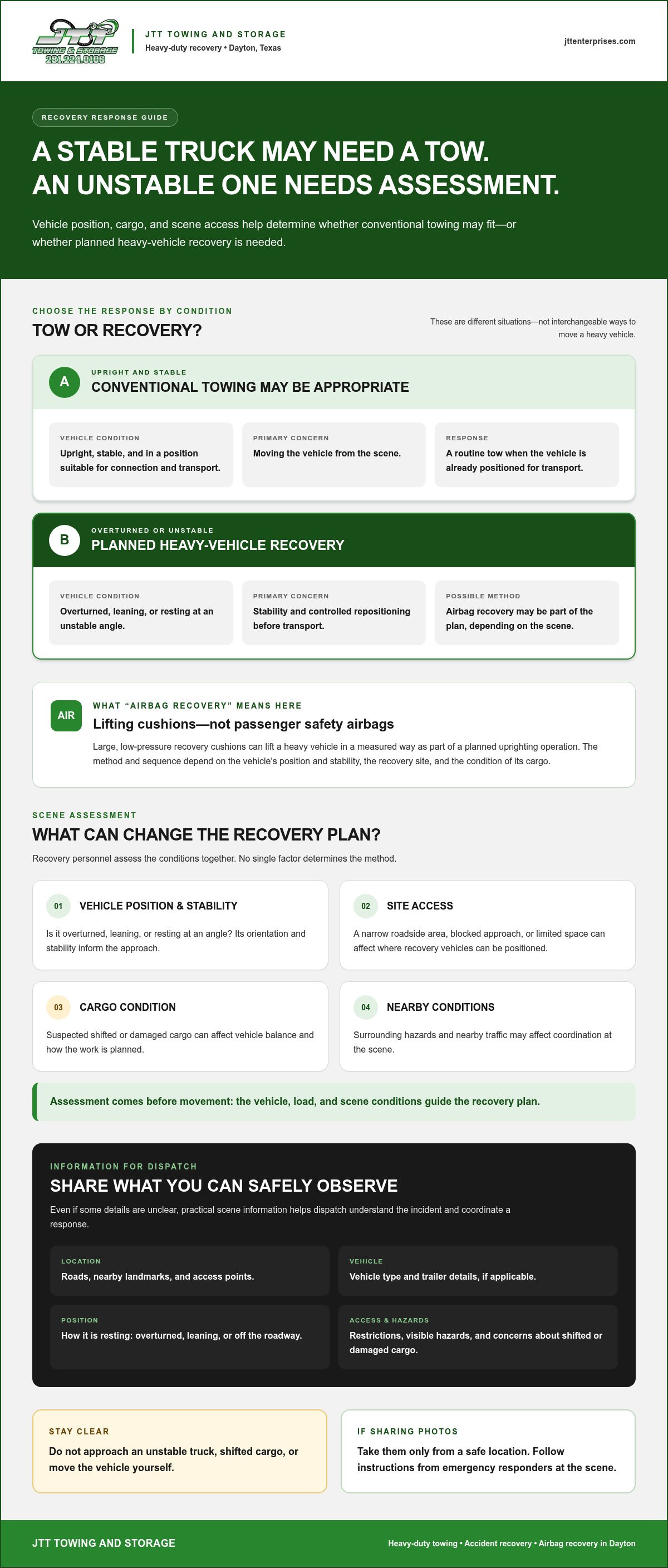
Assessment comes before movement because the vehicle, load, and scene conditions determine how recovery should be coordinated.
For information about JTT’s local services, explore its heavy-duty recovery services. JTT Towing and Storage provides heavy-duty towing and accident recovery from its base in Dayton.
Airbag Recovery Versus Standard Towing: Choosing the Right Response
Not every accident scene calls for the same kind of help. A vehicle that’s upright and stable may be suitable for conventional towing. An overturned or unstable heavy vehicle needs a recovery plan that considers how it can be repositioned before transport. Treating every incident as a straightforward tow can overlook the vehicle’s position, site access, or cargo condition.
| Incident condition | Primary concern | Response type |
|---|---|---|
| Upright, stable vehicle that can be connected for transport | Moving the vehicle from the scene | Conventional towing may be appropriate |
| Overturned or unstable heavy vehicle | Stability and controlled repositioning | Planned heavy-vehicle recovery, potentially including airbag recovery |
| Vehicle with suspected shifted cargo | How the load may affect vehicle balance | Recovery assessment that accounts for load condition |
When is a routine tow different from a recovery operation?
A routine tow generally moves a vehicle that’s already in a position suitable for connection and transport. Recovery may be needed when the vehicle must first be stabilized or repositioned, such as a truck on its side or resting at an angle. Vehicle orientation and surrounding conditions influence the response. Leave the technical assessment to recovery personnel rather than trying to determine the method yourself. The Towing and Recovery Association of America offers broader industry context on towing and recovery.
For more background on how a truck incident can involve different recovery considerations, read the tractor-trailer accident recovery guide.
How can load condition affect a truck recovery?
Cargo may shift during an incident or settle unevenly while a vehicle is overturned. That movement can affect the vehicle’s balance and the planning needed to reposition it. Share any known cargo concerns when requesting help, but don’t approach the truck or try to inspect or adjust the load.
Airbag recovery can be part of a broader recovery plan, but the approach depends on the vehicle and scene. It doesn’t mean every load can be corrected during uprighting. For related reading, see the article about how airbag recovery protects semi-truck loads. An airbag recovery service Dayton TX response starts by matching the plan to the conditions, rather than assuming one method fits every accident.
What to Do While Waiting for Airbag Recovery Near Dayton
An overturned or unstable heavy vehicle can make the scene stressful for drivers, coworkers, and bystanders. Keep your distance and let emergency responders direct activity. Their instructions take priority because they can account for the conditions at the scene.
How can drivers and bystanders stay clear of hazards?
If you can do so safely, move away from the truck and roadway to a safer location. Follow directions from emergency personnel. Don’t enter traffic, approach unstable equipment, or try to move the vehicle. Keep clear of the trailer and any cargo that may have shifted. A vehicle or load can remain unstable even when it appears still.
Don’t put yourself at risk to take photos or inspect damage. If you notice an immediate safety concern, tell emergency responders rather than approaching the vehicle. Staying back leaves room for responders and recovery personnel to assess the scene.
What should fleet contacts prepare for the call?
A concise update can help dispatch understand the incident and coordinate assistance. Gather what you know without going closer to the vehicle:
- Location: Share the road, direction of travel if known, nearby landmark, or safe access point.
- Vehicle details: Identify the truck type and trailer, if applicable.
- Visible conditions: Describe whether the vehicle is upright, overturned, leaning, or off the roadway.
- Access and cargo: Mention blocked access, nearby hazards, visible damage, or concerns about shifted cargo.
- Callback number: Provide a reliable number and share important updates as conditions change.
If several people are coordinating from a fleet, one designated contact can help keep information consistent. Share photos only if they’re already available or can be taken from a safe location. Don’t delay contacting dispatch to collect details you can’t safely reach.
JTT Towing and Storage provides airbag recovery alongside heavy-duty towing and accident recovery for commercial vehicle incidents. Share the scene details you have so the recovery team can coordinate the next steps.
Contact JTT for Dayton-area recovery assistance.
JTT Airbag Recovery Service in Dayton and Nearby Areas
An overturned or unstable commercial vehicle needs a recovery plan shaped by the truck, its load, and conditions at the scene. JTT Towing and Storage provides airbag recovery alongside heavy-duty towing and accident recovery for heavy-vehicle incidents. The company is family-owned and based in Dayton, Texas.
Why work with a local Dayton heavy-duty recovery team?
JTT’s Dayton base gives commercial drivers and fleet contacts a local point of contact for recovery assistance. Clear location and access details help the team understand where the vehicle is and what conditions may affect the operation. Each incident still needs its own assessment. For related service information, see the Dayton heavy-duty towing guide.
JTT is based at 8290 FM 1960 in Dayton, TX 77535. Share the closest road, landmark, or access point to help identify the vehicle’s location, especially if the incident is away from a familiar business address. A ZIP code alone may not describe the exact location or access conditions. JTT’s local coverage includes ZIP codes 77535, 77336, 77327, 77561, 77357, 77532, and 77575.
How to request airbag recovery assistance
Call JTT and describe what you know about the incident. You don’t need to determine the recovery method yourself. Clear details help the team understand the situation and coordinate an appropriate response.
- Location: Provide the road, direction of travel if known, and a nearby landmark or access point.
- Vehicle: Identify the truck and trailer type, if applicable.
- Position and conditions: Describe whether the vehicle is upright, overturned, leaning, or off the roadway. Mention visible hazards or access restrictions.
- Load concerns: Share any known information about shifted or damaged cargo.
- Callback number: Give a number where the person coordinating can be reached.
For an airbag recovery service Dayton TX commercial vehicle operators can reach locally, contact JTT Towing and Storage with the location, vehicle details, and known incident conditions. Stay clear of an unstable truck or trailer while assistance is being coordinated.
Choose a Clear, Coordinated Recovery Path
Airbag recovery is a planned heavy-vehicle operation, not simply a routine tow. The vehicle’s position, access to the scene, surrounding hazards, and cargo condition help shape the recovery approach. Clear details about the location, truck, trailer, and visible conditions help dispatch coordinate assistance.
If a truck or trailer is unstable, stay clear and follow directions from emergency responders. Don’t approach the vehicle or shifted cargo to gather more information. Share only what you can safely observe.
JTT Towing and Storage provides local heavy-duty towing and accident recovery from its base in Dayton. The family-owned company also provides airbag recovery for commercial vehicle incidents.
Describe the incident clearly and contact JTT for airbag recovery assistance in Dayton. Share the location, vehicle details, and conditions you can safely observe.
Frequently Asked Questions
What is airbag recovery for a semi-truck?
Airbag recovery is a specialized heavy-vehicle recovery method used to upright an overturned truck in a controlled manner. Recovery cushions help lift the vehicle as part of a plan based on its position, stability, the site, and the condition of its load. These recovery airbags are different from occupant-protection airbags installed in vehicles. They’re used in recovery work, not to protect people during a collision.
Is airbag recovery different from regular heavy-duty towing?
Yes. Heavy-duty towing generally moves a vehicle that’s already in a suitable position for towing, while airbag recovery is a specialized approach for uprighting an overturned heavy vehicle. A truck’s orientation, stability, access, nearby hazards, and cargo condition can affect which response is appropriate. Recovery personnel assess these factors before movement. Not every accident needs airbag recovery, but an unstable vehicle may require more planning than a routine tow.
When does an overturned truck need airbag recovery?
An overturned truck may need airbag recovery when it must be carefully uprighted before transport. A vehicle resting on its side or in another unstable position may require a planned recovery rather than a conventional tow. The specific approach depends on the truck’s orientation, access to the scene, surrounding conditions, and load. Share what you can safely observe, and let recovery personnel assess the situation.
Can airbag recovery help protect a shifted trailer load?
Airbag recovery may be used as part of a controlled uprighting plan, but it can’t guarantee that cargo will remain undisturbed or correct every load shift. Cargo movement can affect a trailer’s balance and influence recovery planning. Tell dispatch about known load concerns, and stay clear of the trailer and cargo. Recovery personnel can account for that information when assessing the scene and coordinating the work.
What information should I provide when requesting airbag recovery in Dayton, TX?
Share the incident location, truck and trailer details, and the vehicle’s position if known. Describe access restrictions, visible hazards, and any concerns about shifted or damaged cargo. Give dispatch a reliable callback number, too. These details help the team understand the scene and coordinate an appropriate response. Don’t approach an unstable vehicle or enter a hazardous area to gather information or take photos.
What should I do while waiting for a heavy-truck recovery team?
Move to a safe location if you can, and follow instructions from emergency responders. Keep away from the truck, trailer, traffic, and any cargo that may have shifted. Don’t try to move or inspect unstable equipment. If you have new information about the vehicle or scene, share it from a safe position. Your safety comes first, and responder directions take priority over general guidance.
Does JTT provide airbag recovery near Dayton, Texas?
Yes. JTT Towing and Storage provides airbag recovery, heavy-duty towing, and accident recovery for commercial vehicle incidents. Based in Dayton, the family-owned business serves local areas including ZIP codes 77535, 77336, 77327, 77561, 77357, 77532, and 77575. For an airbag recovery service Dayton TX drivers and fleets can contact JTT with the vehicle, location, and known incident conditions.
Contact JTT Towing and Storage for airbag recovery assistance in Dayton.


