
A semi-truck breakdown doesn’t always require a tow, but the next step depends on the fault and whether the necessary parts are available at the roadside. For emergency semi truck repair in Dayton, TX, a repair that can be completed safely with parts on hand may keep the truck roadside; otherwise, towing or recovery may be needed. Sharing the road and nearest exit can help responders pinpoint a truck’s location.
A disabled truck can disrupt a delivery and leave its driver facing an urgent, uncertain situation. Knowing what roadside assistance can address, and how parts availability may affect the repair plan, helps clarify the practical options.
This article explains what information to provide when requesting help, what can determine whether roadside repair or towing is appropriate, and how parts needs may shape the next step. It also covers how heavy-duty towing and recovery can support a breakdown response in Dayton.
Key Takeaways
- Describe the truck’s symptoms and whether it can move safely to help determine whether roadside assistance or recovery is the practical next step.
- Parts availability can shape the repair plan: identifying the failed component and truck details helps clarify what may be needed.
- Share the truck’s exact location, route, identifying details, and breakdown symptoms when requesting roadside help.
- Accident Recovery, Heavy-Duty Towing, and Off-Road Recovery can help when a disabled truck needs more than an on-site repair.
- Vehicle Storage may be useful when the truck needs to be moved from the breakdown location while next steps are arranged.
Emergency roadside assistance
A breakdown can leave a tractor-trailer stopped on a highway, shoulder, or access road near Dayton. Start by identifying its precise location and describing what changed. For emergency semi truck repair in Dayton, TX, a clear location and symptom report helps guide the response toward assessment, repair, or recovery. An engine that cranks but will not start requires a different response from a trailer with damaged running gear.
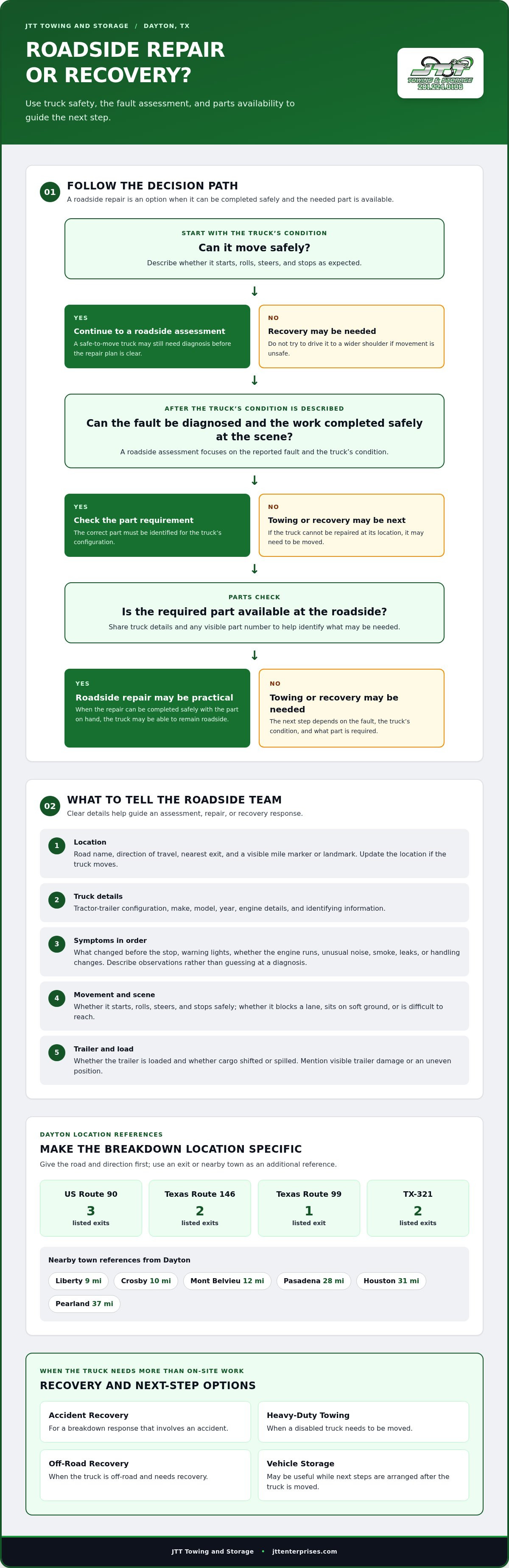
Dayton’s main routes provide practical location references. The local coverage map lists three exits on US Route 90, two on Texas Route 146, one on Texas Route 99, and two on TX-321. Tell the dispatcher the road, direction of travel, nearest exit, and any visible mile marker or landmark. “Eastbound US Route 90, near the next exit” is more useful than “outside Dayton.”
Nearby towns can also help describe where a truck stopped. Liberty is 9 mi from Dayton, Crosby is 10 mi away, and Mont Belvieu is 12 mi away. Pasadena is 28 mi from Dayton, Houston is 31 mi away, and Pearland is 37 mi away. Give the nearest place only as a reference, then add the truck’s road and direction. That combination narrows the location without relying on a town name alone.
After sharing the location, explain the symptoms in sequence. Say what happened just before the truck stopped, which warning lights appeared, and whether the engine still runs. Mention smoke, fluid on the ground, unusual noise, or a trailer sitting unevenly. Avoid guessing at the failed component. A direct description, such as “the engine lost power after a warning light appeared,” gives a mechanic useful observations without presenting a suspicion as a diagnosis.
These details help organize the first response:
- Location: Road name, travel direction, nearest exit, and a visible landmark.
- Vehicle: Tractor and trailer configuration, make, model, and identifying details.
- Symptoms: Changes in engine performance, warning lights, noises, leaks, or handling.
- Movement: Whether the truck starts, moves, or can be positioned safely.
- Load: Whether the trailer is loaded and whether cargo shifted or spilled.
Whether the truck can move is central to choosing the next step. A truck that starts and moves normally is different from one with a locked wheel, severe vibration, or an engine that stalls. Describe whether it can roll, steer, and stop as expected. Don’t try to drive it to a wider shoulder if its condition makes movement unsafe. These details help determine whether roadside inspection is practical or recovery is needed.
A roadside assessment focuses on the reported fault and the truck’s condition at the scene. An engine problem, damaged air line, electrical issue, or trailer defect may require different tools and parts. Your initial description guides the assessment, but visible symptoms may not show the underlying cause. Mention any changes after the truck stopped, such as a new warning light or loss of air pressure, rather than treating the first symptom as a confirmed diagnosis.
Location conditions matter, too. A truck on an access road has different working space from one stopped beside a narrow shoulder or near an interchange. Tell responders whether the truck blocks a lane, sits on soft ground, or is difficult to reach. In Dayton, naming US Route 90, Texas Route 146, Texas Route 99, or TX-321 gives a useful starting point. The exit and direction make that description more precise.
Roadside assistance may lead to an on-site repair if the fault can be diagnosed and the work completed there. If the truck cannot be repaired at its location, towing or recovery can move it to the next stage. A trailer problem may also involve the tractor-trailer combination, not just the engine. Describe any damage and load concerns before movement is planned, so the response accounts for the entire vehicle and its position.
Keep communication focused as circumstances change. If the truck moves, the engine stops running, or a warning light appears, update the location and symptom details. For example, “now stopped beyond the TX-321 exit” is more useful than repeating an earlier position. A concise sequence of events helps roadside personnel understand what changed and prepare for an appropriate assessment. Clear facts support a measured decision between roadside work and vehicle recovery.
Parts availability
A roadside repair depends on two questions: what failed, and which replacement part fits. A no-start condition, for example, can result from an electrical connection, a battery, or another component. Diagnostics help narrow down the fault before a replacement is identified. Providing the truck’s make, model, year, engine details, and component information helps avoid a parts mismatch.
Parts identification matters because similar-looking components can differ by configuration. A tractor’s engine, transmission, axle, and electrical system all affect which part is suitable. Trailer equipment adds another layer: brakes, lights, suspension, and wheel-end components each have distinct requirements. Share the truck’s identification details and any part number visible on the failed component. A clear photo can also help distinguish a damaged connector from a damaged assembly.
Mobile roadside work starts with an assessment, not an assumption about what is in stock. A mechanic examines the affected system to determine whether the fault points to a replaceable part or a larger problem. For example, a trailer light outage could involve a lamp, wiring, a connector, or a power issue. Replacing the first visible item without diagnosing the circuit may leave the underlying fault unresolved.
Some parts are easier to identify than others. A cracked mirror or visibly damaged light assembly is easier to describe than an intermittent electrical fault. Suspension damage may involve multiple components, while a warning light can have several possible causes. Explain when the symptom occurs, what changed, and whether it affects the tractor, trailer, or both. These details help focus diagnostics and parts identification.
When a replacement is needed, the repair plan depends on the specific component and the truck’s condition. The part must match the vehicle configuration and address the diagnosed fault. The location matters, too: roadside access, the truck’s position, and whether it can remain safely where it stopped all affect how work proceeds. If the required component cannot be brought to the scene, moving the truck for further repair becomes part of the plan.
Gather useful details before the mechanic arrives. Keep the following information together:
- Vehicle identification: Make, model, year, engine details, and tractor or trailer location.
- Component clues: Part number, label, connector shape, or a clear photograph.
- Failure description: What stopped working, when it began, and whether the symptom changes.
- System affected: Engine, electrical, suspension, braking, lighting, or another area.
- Recent work: Repairs or part replacements that could help explain the current fault.
For example, “the trailer’s left rear lights stopped working after a connector was disturbed” gives more direction than “the trailer has electrical problems.” Likewise, “the tractor loses power under load but restarts after stopping” describes a pattern without claiming a diagnosis. Include dashboard warnings and visible damage. Accurate observations help distinguish a failed part from a wiring, adjustment, or connection issue.
Parts decisions also depend on the scope of the repair. A damaged component may be replaceable at the scene, while related damage may require further inspection. A suspension concern, for instance, calls for attention to the affected assembly and the truck’s ability to move safely. A mechanic uses observations and diagnostics to decide whether roadside work can address the fault or the vehicle needs transport.
Keep removed parts, labels, and photographs available when practical. These records help compare the replacement against the failed component and preserve useful details for follow-up work. If a repair must continue elsewhere, note which system was inspected and what work remains. For planning around roadside issues and next-step transport, commercial roadside support information can help clarify the options.
What information to give a semi truck mechanic when requesting emergency roadside repair
A concise report helps the mechanic understand the truck’s condition before arriving. Start with the exact location, then describe the vehicle and the failure. For example: “The tractor is stopped on the shoulder, and the engine shut down after losing power.” Separate what you observed from what you suspect. “The battery may be bad” is a guess; “the dash lights dimmed before the engine stopped” is a useful observation.
Give the truck’s position in terms someone can locate on the road. Name the road, direction of travel, nearest exit, and a visible landmark or mile marker. In Dayton, “eastbound near the US Route 90 exit” is more actionable than “outside town.” If the truck is on an access road, say so. Add whether it blocks a lane or sits on soft ground, since the position affects how responders approach it.
Then identify the equipment. Provide the tractor and trailer make, model, year, and any available vehicle identification details. Explain whether the problem affects the tractor, trailer, or both. A tractor that will not start is different from a trailer with a damaged wheel end. If you have a dashboard message, component label, or clear photograph, describe it or share it through the appropriate communication channel.
Organize your call around these details:
- Location: Road, direction, nearest exit, and a landmark.
- Vehicle: Tractor and trailer details, including make, model, and year.
- Symptoms: What happened, when it began, and any warning lights or sounds.
- Current condition: Whether the engine runs and the truck can move or steer.
- Load: Whether cargo is aboard, shifted, or creating an access concern.
Describe the sequence, not just the final symptom. For example, “the engine lost power after a warning appeared, then restarted once” gives a mechanic more context than “engine trouble.” Mention whether the issue began while starting, idling, accelerating, or turning. If the symptom comes and goes, explain what triggers it. Avoid repeated restart attempts if they change the condition or make it harder to describe what happened.
Report visible signs without diagnosing them. Say “fluid is beneath the rear axle” rather than naming a failed seal. Note smoke, burning smells, unusual vibration, or a tire that appears damaged. For a trailer lighting problem, identify which lights are out and whether they changed after a connector was moved. Specific observations help focus the inspection on the relevant system.
Share any recent maintenance or repairs related to the fault. A recently replaced battery, electrical connector, or suspension component may be relevant. Give the mechanic the part name, roughly when it was replaced, and whether the symptom started afterward. If you have service records or photographs, keep them available. These details can help distinguish a new failure from an unresolved issue.
Be clear about what the truck can do now. State whether it starts, idles, rolls, steers, or stops normally. Don’t call it “drivable” without explaining any limitations. “It starts, but loses power when accelerating” is more precise. Also mention whether the trailer is attached and loaded. These facts help determine whether roadside diagnosis is suitable or vehicle movement needs consideration.
Before ending the call, repeat the location and the main symptom. Correct a wrong direction or exit immediately, and update the mechanic if the truck moves. If you’re arranging help in Dayton, share your truck’s breakdown details clearly so the next step can be planned around the vehicle’s condition and position.
JTT Towing and Storage: Accident Recovery
JTT Towing and Storage provides Accident Recovery when a collision leaves a semi truck disabled or difficult to move. If roadside diagnostics show the truck cannot be driven safely, Heavy-Duty Towing can move it from the scene. Off-Road Recovery is available when a truck has left the roadway or become stuck away from a paved surface. Vehicle Storage provides a secure place to keep the vehicle after recovery.
Share the truck’s location and condition, and say whether the trailer is still attached. Include any access or load concerns so the recovery plan accounts for the entire vehicle. This information helps clarify whether accident recovery, towing, or off-road assistance fits the situation.
Contact JTT Towing and Storage to discuss recovery for your disabled truck.
Choose the Right Next Step for Your Truck
A breakdown calls for a practical decision: continue with roadside diagnosis or arrange recovery when the truck cannot proceed safely. For emergency semi truck repair in Dayton, TX, clear communication about the truck’s condition helps keep that decision focused. The next step should account for the tractor, trailer, and circumstances at the scene.
When a disabled or collision-damaged truck needs to be moved, JTT Towing and Storage provides Accident Recovery and Heavy-Duty Towing. Off-Road Recovery can help when a truck has left the roadway or become stuck. These services address recovery and transport needs, helping you move from an urgent scene toward a manageable plan.
Share the truck’s location and condition when arranging assistance. Contact JTT Towing and Storage to discuss the recovery support your situation calls for. A clear next step can help you move forward with greater confidence.


