
A wobbling wheel, clanking during a turn, or visible axle damage needs prompt attention. Broken axle semi truck repair may be necessary if you also notice vibration, steering difficulty, or grease or oil near a wheel. If axle trouble appears, pull over safely and arrange a professional inspection before driving farther.
Axle trouble can be stressful, especially when a truck is loaded or a route is disrupted. Recognizing the warning signs helps you decide when to stop and arrange help instead of risking further damage.
This guide explains common signs of axle trouble, why prompt inspection matters, and what professional repair may involve. You’ll learn how the axle’s condition and connected components affect the repair decision, plus what details to share when arranging heavy-duty recovery around Dayton, Cleveland, and nearby communities.
Key Takeaways
- Watch for clunking, vibration, steering difficulty, uneven tire wear, or grease and oil near a wheel as possible signs of axle trouble.
- If you notice signs of a worn or damaged axle, pull off the road and arrange a professional inspection promptly.
- A thorough assessment helps identify whether the axle, hub bearings, differential, seals, or related components need attention.
- Repair decisions depend on the type and extent of damage, the truck’s handling symptoms, and the condition of connected parts.
- When axle trouble leaves a heavy-duty truck unable to continue safely, towing and accident recovery can help move it for further attention.
WHAT ARE THE COMMON SIGNS YOUR HEAVY-DUTY TRUCK NEEDS AXLE REPAIR?
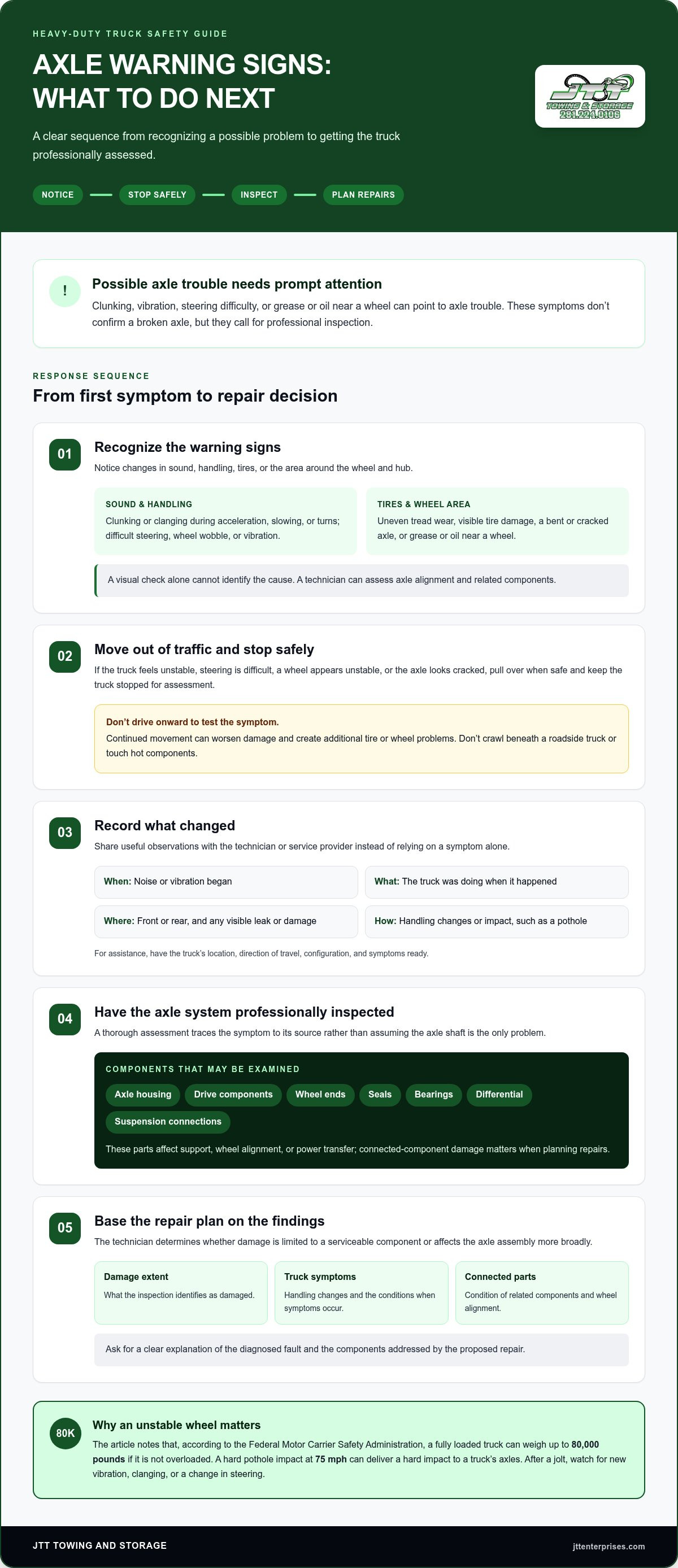
Axle trouble may first show up as a change in sound, steering, or ride. Listen for clunking or clanging during acceleration, slowing, or turns. Notice difficult steering, wheel wobble, or vibration beneath the truck or trailer. These symptoms don’t confirm a broken axle, but they call for prompt attention.
Check the tires for uneven tread wear, including differences across a tire or between sides. Misalignment can wear tires unevenly, and axle damage may affect wheel position. Cuts, bulges, and other visible tire damage also deserve attention. A visual check alone cannot identify the cause; a technician can inspect axle alignment and related components before further driving adds wear.
A hard pothole impact can damage axle components, especially when a loaded truck hits it at speed. A pothole at 75 mph can deliver a hard impact to a truck’s axles. After a jolt, pay attention to new vibration, clanging, or a change in steering. Pull over safely if the truck feels unstable, rather than continuing to test whether the symptom goes away.
Look for visible damage around the axle, wheel, and hub, such as a bent or cracked axle or grease or oil near a wheel. A damaged axle seal may leak oil, while hub-bearing damage can affect steering and handling. Don’t crawl beneath a roadside truck or touch hot components. Note where you see a leak and share that information during inspection.
Weight makes these warning signs consequential. According to the Federal Motor Carrier Safety Administration, a fully loaded truck can weigh up to 80,000 pounds if it is not overloaded. If a wheel appears unstable, the axle looks cracked, or steering becomes difficult, move out of traffic when safe and stop. Avoid driving onward to test the truck; continued movement can worsen damage and create additional tire or wheel problems.
What DOT rules apply to operating a semi truck with axle damage? DOT compliance depends on the defect and its effect on safe vehicle operation. A cracked axle, unstable wheel, or impaired steering calls for stopping and professional inspection before continuing.
Does commercial truck insurance cover broken axle repair or towing? Coverage depends on the policy terms and the cause of the damage. Review the policy provisions for mechanical repairs and towing separately, and keep inspection and incident details available when making a claim.
To help focus the inspection, record when the noise or vibration began, what the truck was doing, and whether a pothole or other impact occurred. Note any visible leaks and changes in handling. Sharing these details helps the technician assess the axle, seals, bearings, and related components without relying on guesswork.
Timely professional inspection and repair
Use a location-based search for “24-hour semi truck axle repair,” then narrow results to the truck’s current location. Compare stated service hours and whether the listing addresses heavy-duty trucks. A prompt inspection can identify the damaged component and help determine whether the truck can move safely.
Professional Inspection and Repair
A professional inspection should trace the symptom to its source rather than assume the axle shaft is the only problem. The technician can examine the axle housing, drive components, wheel ends, seals, bearings, differential, and suspension connections. Each part affects support, wheel alignment, or power transfer, so damage to connected components matters when planning repairs.
Describe what changed: when the noise began, whether it happens during a turn or acceleration, and whether handling changed after an impact. Point out any visible leak or damage. These details help direct the inspection toward the affected wheel end or axle assembly instead of relying on a symptom alone.
Repair planning follows the inspection. The technician determines whether the damage is limited to a serviceable component or affects the axle assembly more broadly. The condition of connected parts, wheel alignment, and signs of impact all inform the work. Ask for a clear explanation of the diagnosed fault and the components addressed by the proposed repair.
Finding 24-Hour Axle Repair
For nearby help outside standard business hours, search using the truck’s location and terms that specify both “24-hour” and “semi truck axle repair.” Narrow the results to the breakdown area or route, and look for listings that clearly describe heavy-duty truck service. This helps distinguish relevant results from general automotive repair listings.
Before choosing a listing, note whether its stated hours cover the time help is needed and whether it describes work on heavy-duty trucks. Have the truck’s location, direction of travel, truck configuration, and symptoms ready. A precise description helps the service provider understand the situation and the type of assistance required.
Don’t treat an advertised response window as permission to keep driving with suspected axle damage. If the truck is unstable or steering is affected, move out of traffic when safe and keep it stopped for assessment. Record the location and visible symptoms, then share those details when arranging help. A clear handoff helps focus the next steps.
Axle problem warning signs
Axle symptoms can involve more than the axle shaft. The wheels, hub bearings, differential, and related drive components all affect how a heavy-duty truck moves and responds. Note whether a symptom comes from the front or rear, changes during a turn, or appears as power reaches the wheels. This pattern gives a professional useful context for locating the fault.
Pay attention to how the wheels behave when the truck is in gear. If a wheel doesn’t move as expected, stop trying to drive and arrange an inspection. Clicking or clanking during a turn can also point to a problem around the axle or wheel end. Describe when the sound repeats instead of reporting only that the truck “makes noise.”
Pay attention to the dashboard, too. An axle-related issue can sometimes trigger the ABS warning light. The light alone doesn’t identify the failed component, but it adds a clue when paired with handling changes or a new sound. Record when it appeared and whether it followed an impact, turn, or change in truck behavior. Share those observations during inspection.
Steering and acceleration symptoms can help locate the trouble. Damaged hub bearings can affect steering and handling, while a damaged differential can cause acceleration or handling problems. If the truck pulls, turns differently, or struggles to accelerate, describe exactly when the change occurs. Don’t treat one symptom as a diagnosis, since several connected components can affect the same response.
- At startup: Note whether the truck responds normally when placed in gear.
- During a turn: Listen for clicking or clanking and note which direction brings it on.
- During acceleration: Record hesitation or a change in handling.
- On the dashboard: Note whether the ABS warning light appears alongside other symptoms.
- At the wheel: Report wobbling or instability without approaching an unsafe truck.
Together, your observations can distinguish a recurring symptom from a one-time sound. For example, clicking that returns during turns and a new handling change provide more diagnostic detail than either observation alone. Keep the truck stopped if the wheels seem unstable or steering is impaired. A professional inspection can assess the axle, hub bearings, differential, and other connected parts.
Don’t continue a route simply because the truck still moves. A suspected axle fault combined with poor steering, a wheel that fails to move in gear, or worsening vibration calls for stopping in a safe place. Note the location and sequence of symptoms, then pass that information to the technician. Clear observations help focus the assessment and reduce guesswork.
Axle repair
Repair planning begins by identifying the failed part and checking connected components. Inspection findings determine whether a component can be repaired or the axle assembly needs replacement. The right approach depends on the damage, not simply on whether the truck can still move.
Repair Versus Replacement
Should a broken semi truck axle be repaired or replaced? The decision depends on the location and extent of the damage and the condition of connected parts. A professional inspection can distinguish a damaged serviceable component from a bent, cracked, or severely compromised axle that requires replacement.
Ask which component failed and how the proposed work addresses it. Damage limited to an axle seal differs from damage affecting the axle, wheel end, or differential. A broken axle semi truck repair plan should explain whether the work repairs a component or replaces the assembly, and identify related parts that need attention.
Alignment also matters after axle work. Misalignment can affect steering and handling, so the repair plan should account for wheel position and connected suspension components. The replacement must match the truck’s configuration and support the vehicle and cargo while connecting the wheels and transmitting power as designed.
Repair and Replacement Costs
How much does it cost to repair or replace a semi truck axle in the United States? The price depends on the case and is provided after a quote request; key factors include the damaged component, axle configuration, replacement parts, labor, and related damage.
Repairing a seal or bearing has a different scope from replacing a complete axle assembly. A differential or suspension component that also needs attention can change the parts and labor involved. Share the truck’s configuration, symptoms, and inspection findings when requesting a quote so the estimate reflects the work required.
Ask for the proposed scope to separate the main axle work from repairs to related components. This makes it easier to understand what the estimate covers and how the diagnosed damage shaped the recommended repair or replacement.
Repair Time
How long does semi truck axle repair take? The time depends on the repair scope, axle configuration, condition of connected parts, and whether the work involves a component repair or complete replacement.
Inspection findings help clarify the work sequence. A technician may need to assess the axle, differential, bearings, seals, and suspension connections before finalizing the job. If damage extends beyond the initial failure, addressing connected components can add work compared with a repair limited to one part.
Ask which steps remain after diagnosis, including component removal, installation, and alignment checks. This helps clarify what determines completion without treating an estimate as a universal timeline for every truck.
Replacement Parts and Labor
What parts and labor are included in semi truck axle replacement? The scope can include removing the damaged axle, installing a compatible replacement, and inspecting related components such as the differential, seals, bearings, and suspension connections.
Not every replacement requires the same parts. The truck’s axle arrangement and inspection results determine which components need replacement and which can remain in service. Spicer and Meritor axles and parts are used for truck suspension repairs and axle replacements.
Labor may include disconnecting affected components, fitting the replacement, reconnecting the assembly, and checking alignment. A broken axle semi truck repair estimate should identify the axle being replaced and any related work. A clear scope distinguishes the core replacement from additional repairs prompted by damage found during inspection.
Truck axle repair experience
Axle repair experience matters because the axle, differential, wheel ends, and suspension work together. A sound diagnosis considers how the truck behaves, which components connect to the affected axle, and whether wheel alignment has changed. For example, a steering change after axle damage calls for attention to alignment as well as the visibly damaged part.
Proper axle alignment supports smooth, safe driving, while misalignment can cause steering and handling issues. After repair, consider wheel position and handling alongside the repaired or replaced component. This is especially relevant if the problem followed an impact or involved a bent axle. Repairing one part without assessing its relationship to the wheels may leave handling symptoms unresolved.
Understanding the axle’s role in the truck helps guide inspection. A drive axle transfers power from the differential to the wheels, while the axle assembly helps support the vehicle and cargo. A dead axle, by contrast, supports additional weight without transmitting power. These differences shape what a technician examines and how symptoms relate to the truck’s configuration.
When reviewing a repair explanation, look for a clear connection between the observed problem and proposed work. The explanation should identify the affected area, say whether the axle or a connected component needs attention, and describe how alignment and handling factor into the next steps. If the truck’s steering has changed, ask how that symptom relates to the inspection findings.
- Diagnosis: The explanation connects a symptom, such as handling change, to the affected axle area.
- Configuration: The assessment distinguishes a powered drive axle from a load-supporting dead axle.
- Related components: The repair discussion considers the differential, wheel connection, and suspension relationship.
- Alignment: The plan addresses wheel position when axle damage may have affected steering.
Keep the truck’s symptom history specific. Note whether the change began after an impact, appears during a turn, or affects steering consistently. These details help the technician compare the driver’s experience with the axle and wheel condition. A clear explanation should distinguish the diagnosed cause from other possible damage, rather than treating every axle-related symptom as the same repair.
If axle trouble has left the truck unable to travel safely, request help for a disabled heavy-duty truck and share its location and condition.
JTT Towing and Storage: Accident Recovery
JTT Towing and Storage provides accident recovery when axle damage leaves a truck unable to continue safely. Heavy-duty towing can move a disabled semi truck from the roadside, while off-road recovery can help if a truck is stuck away from a paved route. Vehicle storage provides secure, monitored short-term or long-term storage for a vehicle after recovery.
Share the truck’s location, condition, and visible damage when arranging assistance. This helps clarify whether recovery or towing is the immediate need. Towing and recovery move or secure the truck; a mechanical inspection determines what repair work is needed afterward.
For recovery or towing related to axle trouble, contact JTT Towing and Storage or visit jttenterprises.com.
Make the Next Move With Confidence
A clear next step can make a roadside setback easier to manage. If axle trouble has stopped your truck, focus first on arranging safe movement and sharing useful details about its condition. This helps organize recovery while you plan what comes next.
For broken axle semi truck repair, separate the immediate need to move the vehicle from the mechanical assessment that follows. JTT Towing and Storage can assist with recovery when the truck can’t continue safely. Call to discuss the truck’s location and condition and arrange the next practical step.
Reach out to discuss recovery for your truck and explain where it is and what happened. Contact JTT Towing and Storage to get started. With the right information and a clear plan, you can move forward steadily.
Frequently Asked Questions
What are the symptoms of a broken axle on a semi truck?
Common symptoms include a wheel that doesn’t turn when the truck is in gear, repeated clicking during turns, rumbling, or wheel wobble. An ABS warning light may also appear. No single sign establishes the cause, since axle, hub, and differential problems can affect similar parts of the truck. Note which symptoms occur together and when, then share those details during inspection.
What causes semi truck axles to break?
A hard impact, such as hitting a pothole, can damage axle components. Wear or damage to connected parts can also contribute to axle trouble. The precise cause depends on the truck’s condition and the affected component, so a technician examines the axle and related wheel-end and drive parts. Details about a recent impact or when symptoms began can help focus the inspection.
Can a semi truck with a broken axle be driven or moved?
Don’t drive a truck if you suspect a broken axle, especially if its wheels wobble, steering changes, or a wheel won’t move in gear. Stop in a safe location rather than trying to reach a repair site under its own power. A qualified professional should assess the damage and determine how to move the vehicle. Arrange heavy-duty towing if it can’t travel safely.
How do you safely respond to a broken axle roadside breakdown?
If you can do so safely, move the truck out of moving traffic, then stop and avoid driving farther. Don’t crawl beneath the vehicle or try to inspect a damaged wheel at the roadside. Note the truck’s location, whether it’s on pavement or off-road, and what happened before the breakdown. Share those details when arranging recovery so the next steps account for the truck’s position and condition.


