
A box truck problem can involve several systems. A box truck repair shop in Cleveland, TX can diagnose engine, electrical, brake, and air-system faults. The parts needed depend on the truck’s make and model, the failed component, and whether it must be sourced. Start by identifying the fault so the repair plan and parts requirements are clear.
When a truck is out of service, you need a practical understanding of what may be wrong and what could affect the repair. This guide covers common engine, electrical, brake, and air-system problems, how diagnosis narrows the required work, and what to consider when replacement parts are needed in Cleveland.
You’ll also learn how to assess whether a repair shop is suited to the problem and what information can help move the process forward. The goal is a clear next step, whether the truck needs a specific system repair or assistance getting to a repair location.
Key Takeaways
- Learn what can affect replacement-part timing and how to describe the needed component clearly.
- Find out what details to gather when looking for a shop’s location, hours, and phone number.
- Understand which factors shape labor charges and repair estimates without relying on a one-size-fits-all figure.
- See how engine type, make, model, and the specific fault influence repair needs for a box truck.
- Learn when accident recovery, heavy-duty towing, off-road recovery, or vehicle storage can help with a disabled truck.
Parts availability
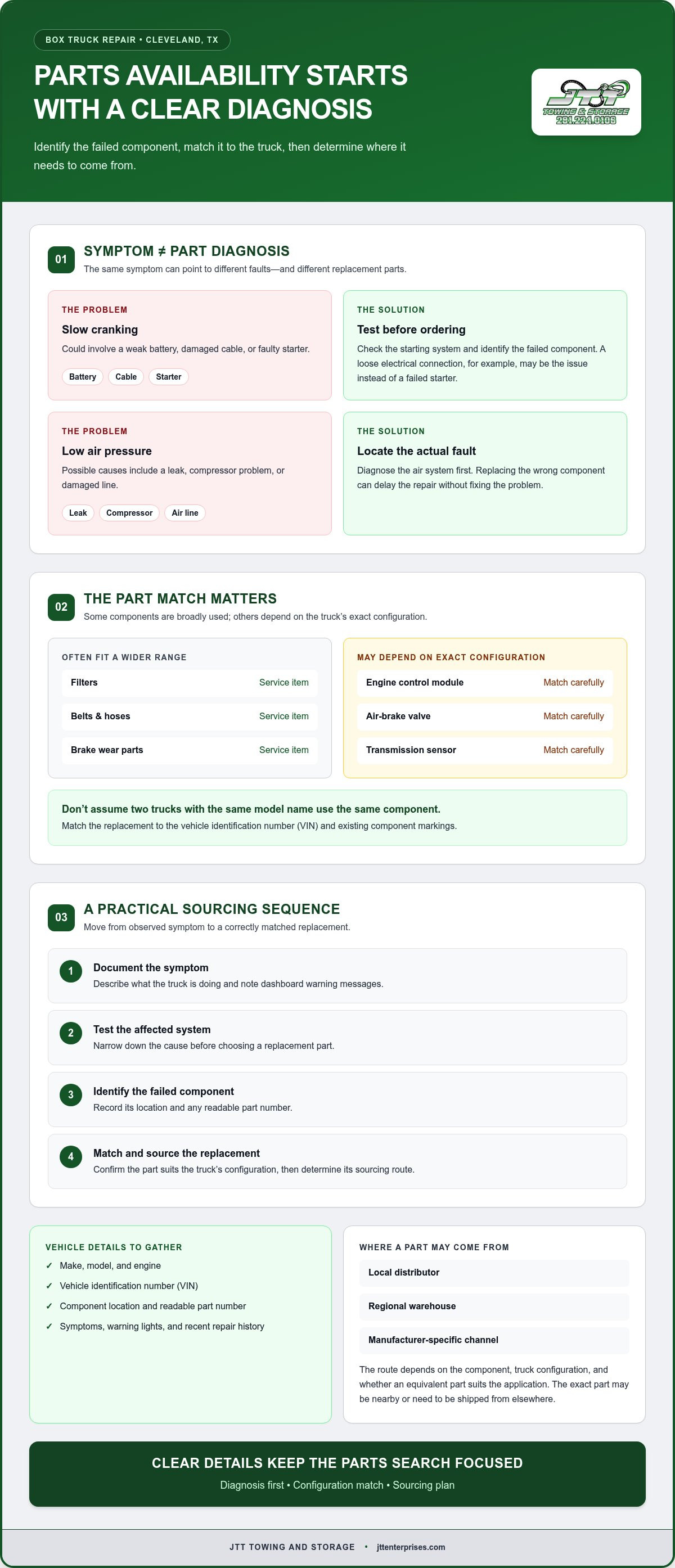
Parts sourcing starts with identifying the failed component, not ordering based on a symptom alone. A box truck that cranks slowly, for example, could have a weak battery, damaged cable, or faulty starter. Since these require different parts, diagnosis helps identify what to order. Record the truck’s make, model, engine, and vehicle identification number. Include the component’s location and any visible part number. These details help distinguish similar parts and reduce ordering errors.
Common service items and model-specific components follow different sourcing paths. Filters, belts, hoses, and brake wear parts often fit a wider range of vehicles. An engine control module, air-brake valve, or transmission sensor may depend on the truck’s exact configuration. Two trucks with the same model name, for example, can have different engine equipment. Match the part to the vehicle identification number and existing component markings before assuming it is interchangeable.
Diagnosis also establishes whether a replacement part is necessary. A starting problem could come from a loose electrical connection rather than a failed starter. Low air pressure could indicate a leak, compressor problem, or damaged line. Replacing the wrong part can cause delays without fixing the fault. A practical sequence is to document the symptom, test the affected system, identify the failed component, then source its replacement.
Parts may come from a local distributor, regional warehouse, or manufacturer-specific channel. The route depends on the component, truck configuration, and whether an equivalent part suits the application. A standard hose and a control module have different sourcing requirements. In Cleveland, TX, the key question is whether the exact component is nearby or must be shipped from elsewhere. That affects the repair plan as well as the order.
Give the repair facility clear information before parts are selected. Share the truck’s identifying details, symptoms, warning lights, and recent repair history. If the vehicle is immobilized, explain where it is and whether it can be moved. This helps the repair team connect diagnosis, parts selection, and the next step. For a box truck repair shop in Cleveland, TX, accurate vehicle details keep the parts search focused.
- Provide the vehicle identification number and engine details.
- Describe symptoms and share dashboard warning messages.
- Use the existing component number when it is readable.
- Ask how the selected part matches the truck’s configuration.
What are the hours, addresses, and phone numbers of box truck repair shops near Cleveland, TX?
Roadside truck repair coverage around Cleveland lists 3 on-call providers. Mobile truck repair is advertised as available 24/7 in Cleveland, but that does not establish every shop’s hours. A shop’s street address, phone number, and opening schedule are specific to that business. Use its current business listing or direct contact details to identify those particulars before planning a visit.
Start with the truck’s location and the type of help needed. A vehicle parked near Interstate 69 may need a different response plan than one at a business address in town. Cleveland has 1 Interstate 69 exit listed, 3 US Route 59 exits, 2 Texas Route 105 exits, and 2 Texas Route 321 exits. Mention the route, nearest exit, and a visible landmark when describing the truck’s position.
Nearby communities can also help clarify location. Splendora is listed 8 miles from the Cleveland service area, while Patton Village is 11 miles away. Roman Forest is 12 miles away, and The Woodlands is 27 miles away. Houston is 43 miles away, while Cypress is 44 miles away. These distances provide context, but they don’t identify a shop’s street address or establish its service boundary.
For a shop visit, record the street address and confirm that it leads to the repair location, not an office or mailing address. For a roadside call, provide the highway name, travel direction, nearest exit, and truck description. A box truck stopped near US Route 59, for example, should be identified by its nearest exit and nearby landmark. This gives responders a clearer location than a city name alone.
- Save the shop’s full street address and phone number together.
- Note whether the posted hours describe the repair facility or mobile service.
- Share the truck’s route, nearest exit, and landmark when requesting help.
- Keep the truck’s make, model, and problem description ready for the call.
Before setting out, compare the listed hours with the time you plan to arrive. A 24/7 mobile-service advertisement describes availability for mobile work, not necessarily walk-in repair hours. If the truck cannot be driven, use its exact location and roadway details when calling. For a box truck repair shop in Cleveland, TX, separating facility hours from roadside coverage helps you choose the right next step.
What is the typical hourly labor rate for box truck repair in Cleveland, TX?
One hourly rate cannot describe every box truck repair in Cleveland, TX. Labor depends on the fault, diagnostic work, vehicle configuration, and access to the repair area. Replacing a starter and tracking down an intermittent electrical fault require different testing and work. The relevant figure is the labor rate for the specific repair, along with the time needed to complete it.
A repair quote sets the price for the specific job. The labor estimate may account for diagnostic time, the repair procedure, and access to the failed component. For example, a technician may need to trace wiring to identify an intermittent starting problem. That investigation affects labor differently from replacing a component that has already been identified.
Ask for the estimate to separate labor from parts and other charges. This breakdown shows whether a change is due to additional diagnosis, a longer repair procedure, or a replacement component. If the initial symptom suggests a brake concern, for instance, inspection may reveal a separate electrical fault. The final work should reflect the diagnosis, not just the first symptom.
Compare estimates by scope, not by hourly rate alone. One quote may include diagnostic labor, while another lists diagnosis separately. A lower rate can still produce a different total if the estimated time or included tasks differ. Check that both estimates cover the same repair, affected system, and comparable work steps.
- Describe the symptom and when it occurs, such as during startup or braking.
- Share the truck’s make, model, engine, and recent repair history.
- Ask which diagnostic steps and repair tasks the labor estimate covers.
- Request separate labor and parts amounts in the quote.
- Compare the work scope before comparing hourly rates.
For a truck that cannot be driven, explain its location and condition before arranging the repair. Roadside diagnosis may involve different access and work conditions than service at a repair facility. A truck stopped near US Route 59, for example, requires a clear location description as well as its repair symptoms. Those details help define the work being quoted.
Keep the written estimate with the repair records. If the diagnosis changes, compare the revised tasks with the original scope before approving additional work. A clear breakdown of labor, parts, and diagnostic steps makes the hourly rate easier to understand. It also explains why a particular box truck repair requires the quoted labor.
The hourly rate depends on the fault, diagnostic work, vehicle configuration, and repair access, so the quote sets it for the specific job. Compare labor estimates only when their diagnostic and repair scopes match.
How much do common box truck repairs cost near Cleveland, TX?
Common repair costs depend on the failed part, diagnostic work, labor, and parts sourcing. Repairing a battery connection differs from replacing a starter, even if both cause slow cranking. A brake concern might involve adjustment, a worn component, or an air-system fault. Since these repairs require different work, one figure cannot accurately represent every box truck in Cleveland.
The price depends on the specific job and is provided through a quote. Factors include diagnosis, labor, parts, vehicle configuration, and access to the repair area. Reaching a component behind other equipment, for example, can take more work than replacing an accessible part. The truck’s engine and installed systems also determine which replacement parts fit. The estimate should reflect the diagnosed fault and the work required to address it.
Common repair categories include engine, electrical, brake, and air-system work. An engine problem might involve a starting fault or leak. Electrical diagnosis may uncover damaged wiring or a poor connection. Brake repairs can involve worn components, while air-system work may address a leaking line or pressure problem. These are different repair scopes, not interchangeable jobs with one standard cost.
Diagnosis can change an estimate. A dashboard warning may indicate a system, but testing helps identify the failed component. A no-start problem, for example, could involve the battery, cable, or starter. Replacing a part before isolating the fault can add work without resolving the underlying issue. Ask for diagnostic labor, repair labor, parts, and additional work to be listed separately.
- Describe the symptom and when it occurs, such as during startup or braking.
- Share the truck’s make, model, engine, and recent repair history.
- Ask which parts and labor tasks the estimate includes.
- Compare quotes only when they cover the same repair scope.
Parts sourcing can also affect the final amount. A common filter or hose may be easier to source than a model-specific sensor or control module. The truck’s exact configuration helps identify a compatible replacement. A readable part number and vehicle identification number can narrow the search and help prevent ordering the wrong component.
For a clear estimate, give the repair facility the truck’s location, symptoms, and identifying details. Ask what finding supports the recommended repair and whether the estimate could change if diagnosis uncovers another fault. A documented scope helps you understand what the repair covers before authorizing work. Keep the estimate with the truck’s service records for future maintenance decisions.
Do local repair shops service diesel box trucks and specific makes or models
Diesel box trucks need diagnosis suited to their engines and installed systems. A repair shop’s ability to handle a particular truck depends on its equipment, technical knowledge, and access to compatible parts. “Diesel service” alone does not describe every repair. Engine diagnostics, electrical troubleshooting, brakes, and air systems each involve different components and procedures.
Make and model matter because trucks with similar bodies can have different engines, transmissions, and control systems. A diesel starting problem, for example, may involve a battery circuit, starter, fuel system, or engine control component. The model year and engine configuration help identify the right diagnostic path. “Diesel box truck” alone does not provide enough detail to identify the parts.
Prepare the vehicle information before arranging a repair. Record the manufacturer, model, model year, engine designation, and vehicle identification number. Add the mileage and a clear description of the symptoms. Note whether a warning light appeared, whether the engine cranks, and whether the problem began after another repair. These details help distinguish configurations and narrow down the work.
The system involved also shapes the repair. A diesel engine concern differs from an air-brake leak or an electrical fault affecting starting. If the truck loses power, note when it happens, such as under load or during acceleration. If an air-pressure warning appears, include that detail rather than describing the issue only as a brake problem. Accurate symptoms help guide diagnosis.
- Identify the truck’s manufacturer, model, year, and engine.
- Share the vehicle identification number and relevant warning messages.
- Describe when the fault occurs and whether the truck can move safely.
- Separate engine, electrical, brake, and air-system symptoms.
Parts compatibility is another consideration for diesel models. A sensor or control component may vary across engine configurations, even within one model line. The vehicle identification number and existing part markings can help identify a match. For example, select a fuel-system component for the truck’s actual engine, not simply because it fits another truck from the same manufacturer.
For a disabled diesel box truck, provide its location along with the identifying details and symptoms. A clear description helps determine whether the next step involves diagnosis at the vehicle or moving it to a repair location. Plan next steps for a disabled truck with the vehicle’s details and current condition ready.
JTT Towing and Storage: Accident Recovery
JTT Towing and Storage provides Accident Recovery when a collision leaves a box truck damaged or unable to continue. Heavy-Duty Towing can move a disabled truck, while Off-Road Recovery helps recover vehicles that have left a stable roadway. Vehicle Storage provides secure, monitored short-term or long-term storage when a recovered vehicle cannot continue directly to its destination.
These services support recovery and transport after an incident, rather than replacing mechanical diagnosis or repair. Share the truck’s location, condition, and whether it is off-road or has been in an accident. This information helps clarify the recovery situation and the appropriate next step.
If an accident or breakdown leaves your truck stranded, contact JTT Towing and Storage or visit JTT Towing and Storage online.
Choose the Right Next Step for Your Truck
A disabled box truck can create two separate needs: fixing the mechanical fault and arranging safe recovery. If damage or location prevents the truck from reaching a repair facility, arrange recovery before deciding how to proceed. Choosing a box truck repair shop in Cleveland, TX is only part of the decision; the truck’s condition and position matter too.
JTT Towing and Storage provides Accident Recovery, Heavy-Duty Towing, and Off-Road Recovery for collisions, disabled trucks, and vehicles off the roadway. Share the truck’s location, condition, and what happened to clarify the recovery need. Then you can focus on the next practical step for the vehicle.
Contact JTT Towing and Storage to discuss recovery assistance. Take the next step with a clear account of what your truck needs.
Frequently Asked Questions
Which Cleveland TX shops repair box truck engines, transmissions, brakes, and electrical systems?
JTT Towing and Storage provides truck repair and maintenance for commercial vehicles in the Cleveland area. Its local address is 21 Private Road #34901, Cleveland, TX 77327, and its phone number is 281-224-0106. Engine, transmission, brake, and electrical faults require different diagnostic work. Describe the truck’s make, model, and symptoms so the repair need is clear. For example, report whether a transmission slips while driving or an electrical fault prevents starting.
How soon can Cleveland TX shops diagnose or repair a box truck?
Timing depends on the fault, diagnostic work, repair access, and whether the required part is nearby or must be sourced elsewhere. Mobile truck repair is advertised as available 24/7 in Cleveland, but that does not guarantee a diagnosis or repair timeframe.


