
For Bobcat and skid steer hauling across the Texas service area, the specific machine model matters because transport weight can vary considerably. The Bobcat S70 Classic weighs 2892 lb, while the S86-2 Pro weighs 9728 lb. Identifying the model and its weight helps establish the starting point for planning the haul.
Choosing bobcat and skid steer hauling in Dayton involves more than moving equipment. The machine’s specifications, hauling setup, and support needed for the move all shape the plan.
This guide compares Bobcat skid steer models and key specifications, then explains what to consider when arranging equipment hauling in the area. You’ll also find an overview of service, parts, and field-service considerations, so you can better understand how they fit into a hauling plan and what information is useful when organizing the move.
Key Takeaways
- Compare the skid steer’s model and operating weight before planning transport; Bobcat models vary substantially in weight.
- Learn which machine and load details matter when matching a truck and trailer to the haul.
- Review the key loading and securement considerations that help prepare a skid steer for transport.
- Understand what information helps organize an equipment-hauling request, especially when a move is time-sensitive.
- Recognize when accident recovery may be a more appropriate next step for damaged or stranded equipment.
Trailer and truck requirements for hauling a skid steer
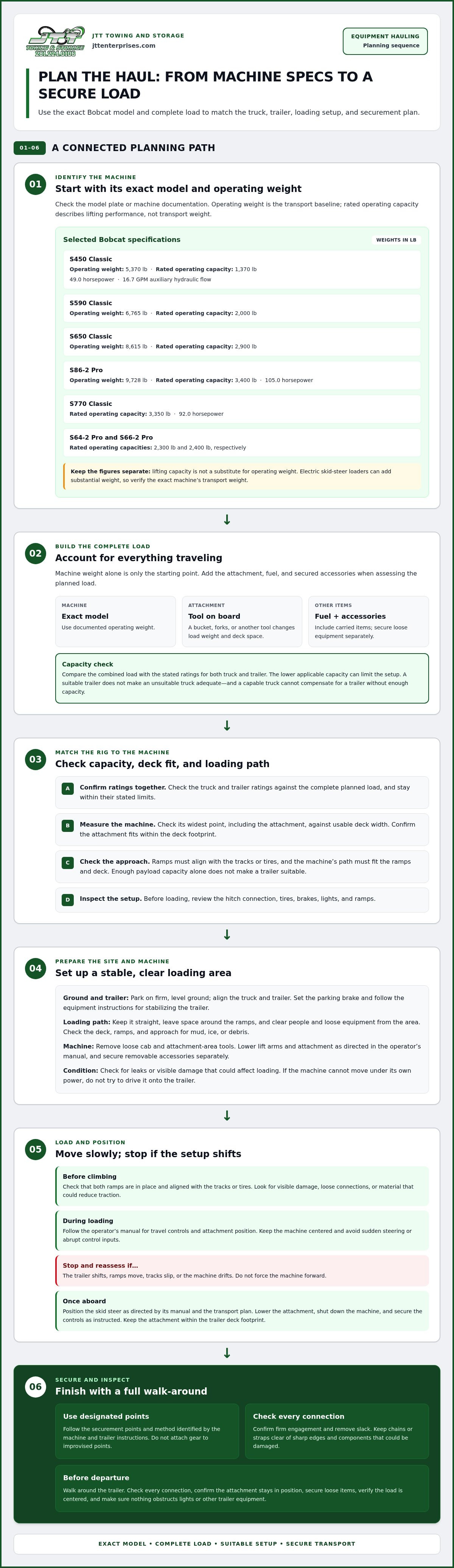
Start with the skid steer’s operating weight. Bobcat models differ substantially, so the model name matters. A Bobcat S450 Classic weighs 5370 lb. A Bobcat S590 Classic weighs 6765 lb. The S650 Classic weighs 8615 lb. Electric skid-steer loaders can add substantial weight to a haul, so verify the exact machine’s transport weight. These figures help establish the machine’s transport baseline. They don’t include every attachment or item carried with it.
Match the truck and trailer to the complete load, including the skid steer, attachment, fuel, and secured accessories. Compare the combined load with the equipment ratings for both truck and trailer. The lower applicable capacity can limit the setup. A suitable trailer does not make an unsuitable truck adequate, and a capable truck cannot compensate for a trailer without sufficient capacity.
Rated operating capacity describes lifting performance, not transport weight. For example, the S450 Classic has a rated operating capacity of 1,370 lb. Its operating weight is 5370 lb. The S590 Classic has a 2,000 lb rated operating capacity, but weighs 6765 lb. Keep those two specifications separate when assessing a haul. A lifting rating isn’t a substitute for the machine’s weight.
- Bobcat S450 Classic: 5370 lb operating weight, 1,370 lb rated operating capacity, 49.0 horsepower, and 16.7 GPM auxiliary hydraulic flow.
- Bobcat S590 Classic: 6765 lb operating weight and 2,000 lb rated operating capacity.
- Bobcat S650 Classic: 8615 lb operating weight and 2,900 lb rated operating capacity.
- Bobcat S86-2 Pro: 9728 lb operating weight, 3,400 lb rated operating capacity, and 105.0 horsepower.
- Bobcat S770 Classic: 3,350 lb rated operating capacity and 92.0 horsepower.
- Bobcat S64-2 Pro and S66-2 Pro: rated operating capacities are 2,300 lb and 2,400 lb, respectively.
Use the model plate or machine documentation to identify the exact configuration, then record which attachment will travel with it. A bucket, forks, or another tool changes the load weight and the deck space required. Include loose equipment only if it can be secured separately.
Deck length and width matter as much as capacity. Measure the machine at its widest point, including the attachment, and compare that with the usable trailer deck. Check the loading path, too: the ramps must align with the tracks or tires. A trailer may have enough payload capacity but still be unsuitable if its deck cannot accommodate the machine safely.
For a specific haul, write down the pickup location, destination, model, operating weight, and attachment. For example, an S650 Classic requires planning around its 8615 lb operating weight before adding carried equipment. Share those details when arranging transport. Clear measurements help determine whether the truck, trailer, and loading approach fit the actual machine.
Check the truck and trailer ratings together, not in isolation, and confirm that the planned load stays within their stated limits. Before loading, review the hitch connection, tires, brakes, lights, and ramps. These checks can reveal equipment issues before travel. Match the setup to the exact model and complete load, not a rough estimate based on skid-steer size.
How to safely load and secure a Bobcat skid steer for hauling
Before loading, park the trailer on firm, level ground. Keep the loading area clear of people and loose equipment. Check the trailer deck, ramps, and approach for mud, ice, or debris. A Bobcat S450 Classic and an S86-2 Pro differ greatly in operating weight. Use the exact machine’s manual and transport instructions, not assumptions based on appearance.
Prepare the skid steer before it reaches the ramps. Remove loose tools from the cab and attachment area. Lower the lift arms and attachment to the position specified in the operator’s manual. Secure removable accessories separately. Check for leaks or visible damage that could affect loading. If the machine cannot move under its own power, don’t try to drive it onto the trailer.
- Position the trailer. Align the truck and trailer on firm ground. Set the parking brake and follow the equipment instructions for stabilizing the trailer. Keep the loading path straight, with space around the ramps. Don’t begin if the trailer shifts, the ramps move, or the ground cannot support the setup.
- Inspect the ramps. Check that both ramps are in place and aligned with the Bobcat’s tracks or tires. Look for visible damage, loose connections, or material that could reduce traction. Confirm the machine’s path fits the ramp and deck. Stop if either ramp moves under pressure.
- Load slowly. Follow the Bobcat operator’s manual for travel controls and attachment position. Keep the machine centered as it climbs. Avoid sudden steering or abrupt control inputs. If the tracks begin to slip or the machine drifts, stop and reassess the setup instead of forcing it forward.
- Set the machine for travel. Once aboard, park the skid steer in the position directed by its manual and the transport plan. Lower the attachment, shut down the machine, and secure the controls as instructed. Keep the attachment within the trailer’s deck footprint, rather than extending it over an edge.
- Secure the load. Use the designated attachment points and securement method identified by the machine and trailer instructions. Check each connection for firm engagement and remove slack. Keep chains or straps clear of sharp edges and components that could be damaged. Don’t attach securement gear to improvised points.
- Inspect before departure. Walk around the trailer and examine every connection. Check that the attachment stays in position and loose items are secured. Confirm the load is centered and nothing obstructs lights or other trailer equipment. Recheck the securement after the first part of the trip, in a safe place.
The attachment affects the loading plan. A bucket may sit differently from forks, and either can change the machine’s position. Keep the attachment low during movement, following the Bobcat manual, and make sure it does not contact the ramps or trailer while loading. Once parked, check that the attachment cannot shift independently.
Give securement its own visual check. Follow the machine manufacturer’s designated tie-down points and the trailer instructions. Inspect hardware for wear, deformation, or loose connections. Arrange tie-downs so they do not press against hoses, controls, or other vulnerable components. Even a tight strap or chain can be poorly positioned.
When arranging hauling in the Dayton area, share the Bobcat model, attachment, and operating condition. Explain whether it drives, steers, and loads normally. These details help determine the loading approach. If the machine is damaged, stuck, or unable to climb ramps, do not improvise a method. Pause and arrange an approach suited to its condition.
Same-day equipment hauling services in Dayton Ohio
For a time-sensitive skid steer move in Dayton, start with clear details. The pickup address, destination, machine model, and loading conditions all shape the plan. Say whether the Bobcat can drive, steer, and climb a ramp, and mention attachments, restricted access, or site hazards. This information helps define the work before dispatch and avoids leaving key loading or access needs unresolved.
Same-day scheduling depends on the details and conditions around the move. Route, equipment needs, traffic, site access, and machine condition all affect coordination. A clear construction entrance differs from a crowded yard, and a machine that runs and loads normally presents different needs from a disabled skid steer. Describe the actual situation, not just the model.
Use this checklist when organizing a Dayton hauling request:
- Machine details: Provide the Bobcat model and identify its attachment.
- Operating condition: Explain whether it starts, moves, steers, and loads.
- Pickup access: Describe gates, surface conditions, available turning space, and obstacles.
- Delivery access: Identify the unloading area and any restrictions around the destination.
- Timing need: State when the machine must move and why the schedule matters.
Site access can change the transport approach. A Bobcat parked behind another machine may need room cleared first, while a narrow entrance can limit trailer positioning. Soft ground can also complicate access at a construction site. Tell the coordinator what to expect, including locked gates or active work areas. Clear site details help avoid preventable delays during loading and unloading.
Be specific about the location. In Dayton, a street address alone may not identify a jobsite entrance. Add a building name, gate location, or nearby landmark when useful. Explain where the machine sits on the property and, if the pickup point differs from the public entrance, describe the route to it. At the destination, specify where the skid steer should be unloaded.
Condition matters as much as location. Describe a flat tire, damaged track, dead battery, or control issue directly. Do not assume the Bobcat can climb ramps under its own power. Explain whether the attachment is stuck or the machine is immobilized. A clear description helps determine the loading method and equipment needs before the move.
Prepare the machine and both sites. Remove loose materials from the cab and attachment area, make the pickup path accessible, and keep people clear of the loading zone. Identify who can provide access at each location. Share any unloading restrictions at the destination early. These steps support an organized handoff, especially when the work schedule depends on the equipment's arrival.
For a time-sensitive move, provide complete information in one update: both addresses, model, attachment, condition, access notes, and preferred timing. If circumstances change, such as a blocked entrance or a newly disabled machine, communicate the update before loading. This helps the plan reflect actual conditions in Dayton rather than earlier assumptions.
Prepare the move details before arranging transport. Organize your equipment hauling request with JTT Towing and Storage using the machine condition, locations, and access information ready.
JTT Towing and Storage: Accident Recovery
JTT Towing and Storage provides Accident Recovery when a collision leaves a skid steer or transporting vehicle damaged or stranded. Off-Road Recovery addresses recovery situations when equipment is off-road or cannot be moved safely. Heavy-Duty Towing helps when a heavy vehicle needs towing, and Vehicle Storage is available when a vehicle needs secure storage after recovery.
When describing the situation, share the equipment’s condition, location, and any immediate hazards. This helps clarify whether recovery, towing, or storage is the relevant next step. If a collision has disrupted your equipment move, contact JTT Towing and Storage to discuss the situation.
Plan the Next Move with Confidence
For bobcat and skid steer hauling in Dayton, turn the equipment details into a clear move plan. Consider who can provide access at pickup and delivery, and whether conditions at either site have changed. A change in machine condition or site access can affect the plan. Share updates promptly so it reflects what is happening on the ground.
If a collision leaves equipment or a vehicle stranded, JTT Towing and Storage provides Accident Recovery, Heavy-Duty Towing, and Off-Road Recovery. These services address recovery needs beyond a routine equipment move. When you get in touch, describe the situation and location to discuss the relevant next step.
Contact JTT Towing and Storage to discuss your recovery or towing needs. With the right information in hand, you can move forward with a practical plan for your equipment.


