

There’s no single statewide rate for big rig towing in Texas. The cost per mile depends on the distance, truck and trailer configuration, equipment required, and whether the job is a straightforward tow or a complex recovery.
A breakdown is stressful enough without uncertainty about the bill. Mileage is only part of the total: hookup, access, recovery work, and other charges can affect the cost.
This guide explains the main cost factors, how local conditions can influence a quote, and how Texas rules for certain non-consent tows differ from commercial heavy-duty towing. Use it to understand what a quote covers and what work is involved.
Key Takeaways
- Separate per-mile charges from hookup, dispatch, recovery, and other fees to understand what a towing quote covers.
- Truck size, weight, trailer configuration, access, and recovery complexity can all affect the work and final bill.
- Long-distance quotes may use different mileage pricing than local tows, so clarify how the route and included miles are calculated.
- For Texas private-property tows involving vehicles weighing 25,000 pounds or more, the maximum fee is $489 per unit, up to $978 total, according to the Texas Department of Licensing and Regulation.
- Regional conditions can influence rates; compare the quote’s structure and included services, not only its per-mile figure.
Does Texas have a regulated towing price list?
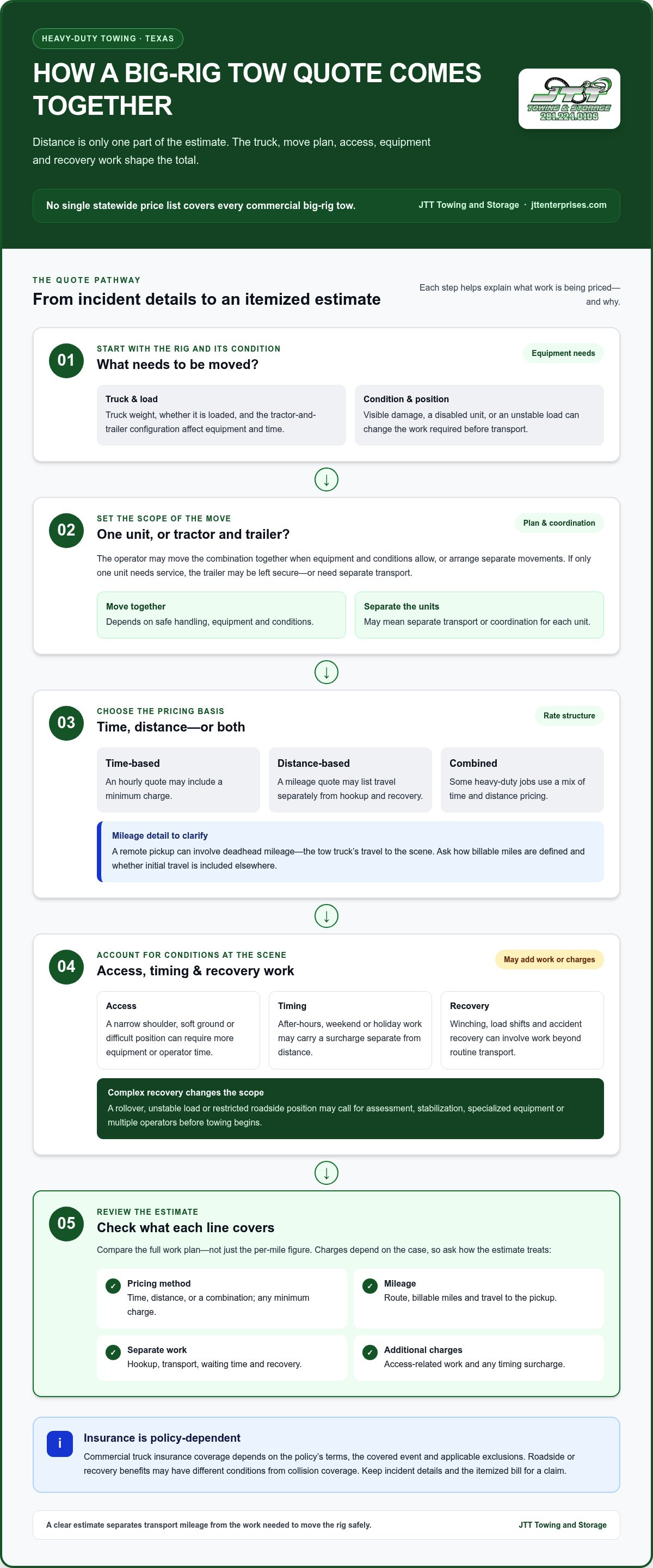
Texas does not have one universal price list covering every big rig tow. State limits apply to certain non-consent and police-dispatched tows, while a requested commercial tow is priced around the job. The distinction matters: a Class 8 semi-truck voluntarily sent for service is not automatically priced like a vehicle removed under a police-initiated tow. The big rig towing cost per mile in Texas therefore depends on the service arrangement as well as the distance.
A Class 8 tractor may need a heavy-duty tow truck, specialized connections, and careful handling. A disabled tractor on a highway shoulder presents a different task from one stuck off-road or damaged in a collision. Operators assess the truck’s position, damage, load, and access before choosing equipment and a recovery plan. A 10-mile transport can involve more work than distance alone suggests if the rig first needs to be stabilized or recovered.
A loaded truck-and-trailer combination adds another consideration: the tow plan must account for both units and their connection. The operator may move them together when the equipment and conditions allow, or arrange separate movements. Cargo, trailer condition, road access, and destination all affect the work. If the combination cannot be moved safely as one unit, a separate tow or another tractor may be needed, changing the equipment and coordination required.
Separating the tractor from its trailer may make sense if one unit is disabled, the trailer can remain secure, or only the truck needs to reach the destination. It may also mean arranging separate transport for each unit. For example, moving a tractor to a repair facility while leaving a loaded trailer in secure storage involves different handling from towing both together. Compare the full scope of each plan, not just the mileage for one vehicle.
Recovery expertise affects how operators approach Class 8 incidents. A rollover, unstable load, or restricted roadside position calls for assessment before towing begins. Rotator recovery and accident recovery involving multiple trucks require coordination and equipment beyond a routine transport. The operator considers load stability, rig position, access for the tow truck, and the sequence for lifting or moving vehicles. Each decision can change the type and duration of work.
For a useful quote, describe whether the tractor is loaded, whether the trailer must move, and where each unit needs to go. Include the truck’s location, visible damage, and access constraints, such as a narrow shoulder or soft ground. Those details help distinguish a direct tow from recovery followed by transport. Luxury passenger-car towing uses different equipment and criteria, so its pricing model is not a sound comparison for a Class 8 rig.
What factors affect towing prices?
Commercial towing quotes reflect more than distance. Truck weight, equipment, recovery work, route, and timing all shape the total.
Heavy-Duty Rates and Minimum Charges
Heavy-duty towing may be priced by time, distance, or a combination of both. The pricing method matters because even a short job can require substantial equipment and operator time. An hourly quote may include a minimum charge, while a mileage quote may list travel separately from hookup and recovery. Compare what each amount covers, including dispatch, loading, transport, and waiting time.
Texas semi-truck towing rates vary with distance and truck weight: a heavier Class 8 rig typically needs more capable equipment than a lighter commercial truck, while longer trips add transport mileage. A route of 50 miles also differs from a short local move in total distance and likely job duration.
Per-Mile Rates and Surcharges
A per-mile rate covers transport distance, but it may not include every mile the tow truck travels. A remote pickup can involve deadhead mileage, meaning the operator travels to the scene before towing the truck. Distance, gross weight, tractor-and-trailer configuration, and road access affect the equipment and time required. Ask how the quote defines billable mileage and whether initial travel is included in another charge.
Timing can affect the total, too. After-hours, weekend, or holiday work may carry a surcharge, while difficult access can require more equipment or operator time. These charges are separate from towing distance and should appear as distinct quote items. The estimate depends on the case, including distance, truck weight, access, timing, and work required.
Additional Recovery Charges and Insurance
Winching, load shifts, and accident recovery involve work beyond routine transport. Winching depends on the truck’s position and the equipment needed to free it. A shifted load may need handling before the vehicle can move safely. Accident recovery can involve stabilization, multiple operators, or specialized equipment. The scope determines any additional charges, so the quote should distinguish recovery work from mileage and transport.
Commercial truck insurance covers towing costs according to the policy’s terms, covered event, and applicable exclusions. A roadside or recovery benefit may have different conditions from coverage following a collision. The driver should record the incident details and retain the itemized bill for the claim. For a disabled rig or accident scene, heavy-duty towing and recovery can address the equipment and recovery needs involved.
How Much Does Towing Cost?
For a long-distance heavy-truck tow, distance is only one part of the estimate. The route, truck condition, equipment, and delivery requirements also shape the quote.
Long-Distance Towing Quotes
A long-distance quote outlines the planned transport from pickup to delivery, often with a defined route and service scope. This helps clarify what the estimate covers before the tow begins.
In Texas, a 50-to-150-mile tow is considered a long-distance trip in the market estimates. A flat-rate quote can make the total easier to plan, but its value depends on what it includes. Check whether the route, hookup, loading, recovery, and delivery are covered, or listed as separate work.
For example, a disabled tractor going from the roadside to a repair facility may need transport only. A truck that cannot roll or steer may need recovery work first. These are different jobs, even if both end at the same facility. A clear quote ties the price structure to the work required.
Towing Estimates by Distance
Distance-based estimates calculate transport using the mileage between pickup and destination. A longer route can increase travel time and the demands on the tow truck.
Ask how the estimate measures the route: the direct mileage, the actual road route, or another defined basis. A 50-mile route on accessible highways differs from a route with restricted access, detours, or a difficult pickup. The tow truck may also travel to the scene before transporting the rig, so clarify whether that travel is included.
For a tractor-and-trailer, define the delivery plan for both units. If the tractor goes to a repair shop while the trailer goes elsewhere, the estimate should describe each destination and movement. If the rig travels together, confirm that the quote covers the full combination and intended route. This prevents one mileage figure from hiding separate transport needs.
Compare quotes by matching their scope, not just their mileage calculations. One estimate may include loading and delivery, while another lists recovery or access work separately. Ask for the route, included services, possible extra work, and conditions that could change the plan. These details make an estimate more useful for budgeting and dispatch decisions.
Roadside assistance can also affect the amount an operator pays directly. Some premium membership plans may cover towing up to a mileage limit of 100 or 200 miles. That benefit is separate from the tow estimate; the driver should compare the covered distance with the route and review whether the plan applies to a commercial truck.
Flatbed towing may suit certain damaged vehicles, but a Class 8 rig requires equipment appropriate to its size and condition. The quote should identify the transport method and destination. For long-distance truck towing, route, vehicle configuration, recovery needs, and delivery arrangements together explain why mileage alone cannot describe the full job.
Tow fees for vehicles weighing 25,000 pounds or more
Texas rules for a private-property tow of a heavy vehicle differ from a commercial tow arranged by its owner. According to the Texas Department of Licensing and Regulation, the maximum private-property tow fee for a vehicle weighing 25,000 pounds or more is $489 per unit, up to $978 total. This cap concerns the private-property tow fee; it is not a general price list for every requested heavy-duty tow or recovery job.
The distinction matters for a tractor-trailer. A private-property tow may involve two units, while a commercial dispatch may be requested directly by the truck owner or carrier. Depending on the incident, the quote may cover transport, access, or recovery work. Don’t treat the private-property maximum as a mileage rate or a limit for every service. Identify whether the tow was from private property, dispatched by law enforcement, or requested by the vehicle owner.
Impound and storage charges are separate from towing and recovery work. In Texas, a vehicle storage facility that charges an impoundment fee must list the exact services performed and the dates they were performed on the written bill. The bill, for example, should distinguish a tow-related service from later storage. An itemized record shows what work was performed and when, rather than presenting only a combined total.
Governmental or law-enforcement fees are subject to a specific payment rule. A Texas vehicle storage facility may charge such a fee only if it is paid to the relevant agency, its authorized agent, or a governmental entity. This is separate from charges for work such as winching, recovery, or moving a disabled vehicle. A weekend dispatch or difficult recovery does not, by itself, make a governmental fee payable to a storage facility.
Commercial hook-up charges are commonly treated separately from mileage and recovery. The amount and structure depend on the work, including the vehicle’s weight, equipment required, and whether the rig can be connected for routine transport. A Class 8 truck that needs winching or accident recovery involves a different scope from a vehicle ready to tow. Ask for the written breakdown to show hookup, transport, and additional work as distinct items.
If a heavy vehicle is held after a tow, compare the written bill with what happened at the scene. Note whether the tractor, trailer, or both were moved, and whether recovery or winching took place. Texas facilities may charge for towing services directly related to the tow, in addition to permitted storage-facility charges. Clear documentation helps distinguish the private-property tow cap from charges for separate, documented services.
Regional per-mile towing rates
Per-mile towing rates can vary across Texas because location affects access, dispatch logistics, and the route between pickup and delivery. A roadside call near Dayton may involve different travel and access conditions from one near Cleveland, even if the towing distance is similar.
Standard towing rates offer a comparison point, but they don’t set the price for every commercial rig. Heavy-duty work depends on the truck, equipment, and recovery needs. Consider the big rig towing cost per mile in Texas alongside the full job scope, not as a stand-alone figure.
Local differences can show up even between nearby service areas. A pickup in ZIP code 77535 may require different dispatch planning from a call in 77327 or 77336. The precise roadside location, access for the tow truck, and destination all matter. Similar mileage does not necessarily mean identical work if one rig is easy to reach and another is in a restricted position.
Rates also depend on what the per-mile charge covers. Some quotes count only the mileage while transporting the vehicle. Others may list travel or hookup separately. Before paying, identify the pickup point, delivery address, billable route, and whether the quoted mileage covers the tractor, trailer, or both. This makes estimates easier to compare.
For commercial trucks, weight and configuration matter as much as geography. A loaded tractor-trailer may need different equipment from a disabled tractor traveling alone. A route through a local business district can require different access planning from a highway shoulder or industrial entrance. Travel to the roadside, equipment needs, and recovery work can all affect the total beyond transport mileage.
Regional rates for standard and medium towing shouldn’t be treated as a big-rig rate. Light-duty estimates describe a different vehicle class, while a Class 8 truck may require heavy-duty equipment and specialized handling. Check that an estimate matches the vehicle type and complete service scope. A per-mile figure that excludes recovery or separate trailer movement won’t show the full job cost.
For a useful local comparison, provide the same details for each estimate: pickup ZIP code, truck and trailer configuration, destination, and requested work. Then clarify whether the quote covers hookup, transport, or recovery. Comparing the same scope helps show whether a rate difference reflects location, route, or distinct services.
For roadside assistance involving a commercial rig, request heavy-duty towing with the pickup location, vehicle configuration, and destination details ready.
JTT Towing and Storage: Accident Recovery
JTT Towing and Storage provides accident recovery when a commercial vehicle is damaged or disabled in a collision. A scene may require more than transport, especially if the rig is off the roadway, unstable, or separated from its trailer. Heavy-duty towing moves large trucks, while off-road recovery helps with rigs that have left paved access. Vehicle storage provides a secure place for a vehicle after recovery.
When arranging help, share the truck’s location, condition, trailer status, and intended destination. These details clarify whether the job involves accident recovery, towing, off-road access, or storage. They also help distinguish a mileage estimate from the full recovery scope.
For help with a commercial vehicle incident, contact JTT Towing and Storage.
Plan the Next Move With Confidence
The big rig towing cost per mile in Texas is most useful when you connect the estimate to the work your truck actually needs. Before arranging service, gather the pickup location, vehicle condition, tractor-and-trailer details, and destination. This gives the team a clear picture of the job and keeps the conversation focused on recovery and transport.
For a collision, disabled commercial vehicle, or rig that has left the roadway, JTT Towing and Storage offers accident recovery, heavy-duty towing, and off-road recovery. Each situation has its own demands, so describe what happened and what assistance is needed. You can discuss the job directly with the team.
Contact JTT Towing and Storage to talk through your towing or recovery needs. A well-informed next step can help you move forward with greater clarity.
Frequently Asked Questions
How Much Does a Tow Truck Cost?
A tow total depends on the vehicle, distance, equipment, and work required. The big rig towing cost per mile in Texas is only one part of the estimate: routine transport differs from winching, accident recovery, or moving a tractor and trailer separately. The estimate depends on the case. Share the truck’s location, condition, configuration, and destination to describe the job clearly.
Are Towing Rates Higher at Night or on Weekends?
Night and weekend towing can cost more than standard daytime service because dispatch timing affects the job. For a commercial truck, location, access, and recovery work also shape the total. A roadside breakdown that requires recovery, for example, involves a different scope from a truck ready for direct transport. Include the time and circumstances of the incident when describing the job.
How Much Does a Tow Truck Charge Per Mile for Long Distances?
Long-distance towing charges depend on how billable mileage is calculated and what the quote includes. Ask whether mileage starts at the pickup point or includes travel to the scene, and whether hookup or recovery is separate. For a tractor-trailer, clarify whether the quoted route covers both units and their destinations. These details make estimates easier to compare.
How much is a tow truck for 100 miles in Texas?
A 100-mile big-rig tow in Texas has no single fixed total because the truck’s weight, condition, and transport needs affect the job. The big rig towing cost per mile in Texas can vary with whether the tractor travels alone, the trailer moves too, or recovery is needed before transport. Provide the pickup and delivery points, truck configuration, and access conditions to describe the work.
What is the average big rig towing cost per mile in Texas?
There isn’t one average rate for every big-rig tow in Texas. A mileage figure alone doesn’t explain dispatch, hookup, or work at the scene. Compare estimates using the same truck configuration and route, then check whether they cover the same services. This gives you a clearer basis for understanding the per-mile rate and its contribution to the full towing total.
What do Texas heavy-duty towing companies charge for hookup and call-out fees?
Hookup and call-out charges depend on the equipment dispatched and the work needed to connect or recover the truck. A rig ready for transport involves a different scope from one requiring winching or accident-scene recovery. Ask for these as separate quote items, alongside mileage and recovery work. A clear breakdown shows how dispatch fits into the total job.
Do Texas big rig towing prices differ by city or region?
Yes, local access, traffic, distance to the scene, and available routes affect towing estimates across Texas. A pickup in Dayton or Cleveland can involve different dispatch and road conditions from one in a more congested area. For service in the targeted communities, including ZIP codes 77535, 77336, and 77327, share the precise pickup and delivery points.
What factors affect the cost of towing a tractor-trailer in Texas?
The main factors are truck and trailer weight, whether the combination is loaded, vehicle condition, distance, access, and recovery needs. A disabled tractor with a trailer that can remain in place is a different job from moving both units or recovering a rig off-road. Provide the incident details and destination, and specify whether the estimate should include recovery as well as transport.


