
A cement mixer rollover can quickly become a rescue and traffic-control operation. Emergency response for an overturned cement mixer typically begins with crews assessing the truck, stabilizing it if needed, and securing the scene before recovery. Blocked lanes can cause delays while responders work and clear the roadway.
It’s understandable to focus first on whether the truck can be moved and when traffic will flow again. Those answers depend on the truck’s position, stability, and any roadway hazards. A mixer blocking lanes on a multi-lane highway can disrupt traffic until responders complete their work.
This article explains how emergency crews assess and stabilize an overturned mixer, manage roadway hazards, and carry out recovery. It also explains why lane closures may remain in place until crews can safely move the truck and clear the scene.
Key Takeaways
- Learn how responders assess the scene and coordinate rescue, traffic control, and vehicle recovery.
- Understand why a mixer’s position, load, and condition shape the recovery plan.
- Know how to keep clear of the roadway and avoid approaching leaks or unstable equipment.
- Recognize why spilled concrete and vehicle fluids can create hazards beyond the initial crash.
- See when accident recovery and heavy-duty towing can help move a disabled mixer after emergency crews secure the scene.
Emergency vehicle response
Emergency response for an overturned cement mixer begins with a scene assessment. Fire crews look for injuries, fuel leaks, unstable ground, and nearby traffic risks. Police or highway personnel may restrict access and direct vehicles away. These steps make room for rescue work and reduce exposure to the truck and spilled materials.
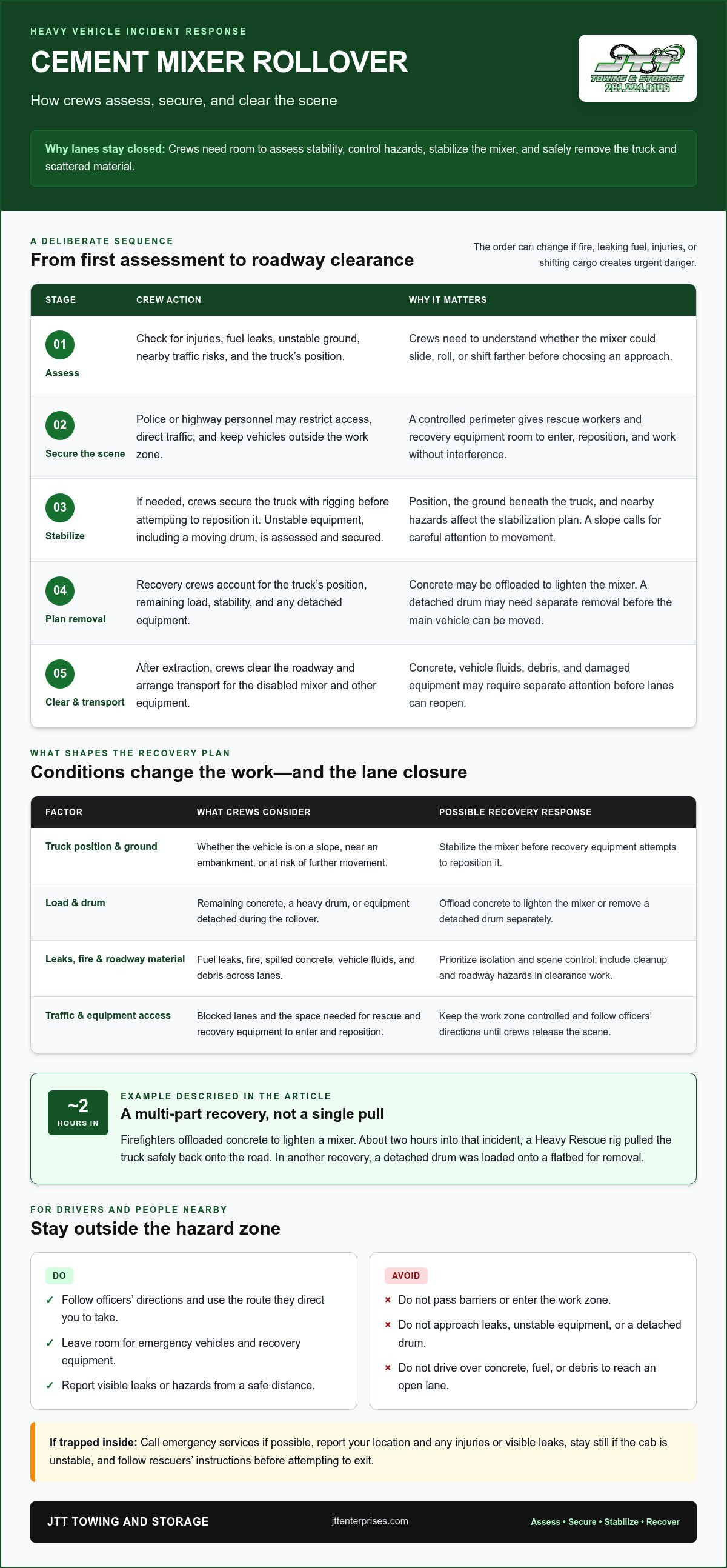
Responders assess whether the mixer could slide, roll, or shift farther. Before choosing an approach, they consider its position, the ground beneath it, and nearby hazards. A truck on a slope requires careful attention to movement and stability. Crews may secure it with rigging before recovery equipment attempts to reposition it.
Traffic control can extend beyond the immediate crash site. On a highway near Dayton or Cleveland, responders may keep traffic outside the work zone while rescue and recovery equipment gains access. Officers can direct drivers around blocked lanes. Follow their directions and leave room for emergency vehicles to enter and reposition.
Crews generally follow a deliberate sequence: assess immediate threats, secure the area, stabilize the truck, then plan its removal. The sequence may change if fire, leaking fuel, injuries, or shifting cargo creates urgent danger. Responders coordinate so rescue workers, traffic personnel, and recovery equipment do not interfere with one another.
Who handles cleanup and environmental reporting? The truck operator coordinates cleanup of truck-related debris, while responders manage immediate scene safety. Relevant authorities handle environmental reporting under applicable procedures.
How do rescuers handle a moving drum? They keep people clear, assess the drum and truck, and secure unstable equipment before recovery. Trained crews use an assessed stabilization plan and rigging rather than approaching a drum that could shift.
What happens if fire, fuel, or hazardous materials are involved? Responders prioritize isolation, scene control, and assessment of the leak or fire before recovery begins. Keep clear and tell emergency personnel what you observed, including the material and its location.
- Rescue teams assess truck position and nearby hazards before choosing a recovery approach.
- Police or highway personnel may restrict roads and direct traffic around the work area.
- Crews stabilize the mixer before attempting to move its drum or remove the vehicle.
Incidents illustrate why early stabilization and perimeter control matter. The Los Angeles City Fire Department responded to a concrete mixer truck at risk of rolling down an embankment in Highland Park at 2:42PM on May 22, 2020, in the 1400 block of N Av 57. Los Angeles Police Department personnel led the evacuation and secured roads to keep traffic out of the area. Keeping vehicles and bystanders beyond the hazard zone gives crews room to assess movement and coordinate a safe response.
Emergency crews responded to a cement mixer crash near Matfield Street and Route 28 in West Bridgewater, Massachusetts, just after 6:30 a.m. A clear approach for equipment and a controlled perimeter can help responders assess stability and immediate hazards without unnecessary movement around the vehicle. Drivers should obey closures and instructions, while people at the scene should report hazards from a safe distance rather than approaching the mixer. These precautions give crews room to secure the vehicle and proceed with recovery.
Overturned cement mixer on a highway
A rollover can block multiple lanes, bringing traffic to a crawl or a complete stop. When a cement mixer overturned on a multi-lane highway, it blocked lanes and caused delays. Drivers approaching a crash should follow directions from officers and highway crews. Don’t pass barriers or enter the work zone, even if traffic appears stopped.
Lane closures may remain while crews assess the truck and clear its load. A mixer’s heavy drum may detach in a rollover, and material can scatter across the roadway. In one recovery, crews loaded a detached mixer drum onto a flatbed truck for removal. Separating equipment can help crews address different parts of the scene.
Recovery depends on the truck’s position, remaining load, and stability. Firefighters offloaded concrete to lighten a mixer before moving it. About two hours into that incident, a Heavy Rescue rig pulled the truck safely back onto the road. This example shows why crews may remove material or equipment before moving the main vehicle.
After extraction, responders still need to clear the roadway and arrange transport. In one recovery, a wrecked mixer was towed from the street into a nearby business’s parking lot. Another incident involved fuel spilled along highway lanes, adding cleanup and roadway hazards to the recovery work.
What should occupants do if trapped inside an overturned cement mixer? Call emergency services if possible, report your location, and describe any injuries or visible leaks. Stay still if the cab is unstable, avoid touching damaged controls, and follow rescuers’ instructions before attempting to exit.
If you’re caught behind a closure, take the route officers direct you to use. Don’t drive over concrete, fuel, or debris to reach an open lane. These materials can hide roadway damage or reduce tire traction. Leave room for emergency vehicles and recovery equipment to enter and reposition.
- Watch for changing lane controls as crews move equipment around the mixer.
- Keep clear of the truck’s path and any detached drum.
- Expect clearance to involve separate steps for concrete, equipment, and the truck.
Once responders release the scene, a disabled vehicle may need secure holding before its next move. Vehicle storage after recovery can provide that next step.
A cement mixer overturned on a highway in Northwest, Chula Vista, on Jun 26, 12:10AM. The location and time help identify the incident, but they do not establish whether anyone was hurt. In a separate West Bridgewater cement mixer crash, it was not clear whether anyone was injured. When injury information is uncertain, people at the scene should avoid guessing and leave assessment to responders. If you witnessed a crash, share what you observed with emergency services, including any visible danger, without entering the roadway or approaching an unstable vehicle.
If a mixer recovery delays you, be patient and keep your distance while crews work. Stay clear of the truck, its load, and equipment being moved, and follow directions from officers and highway crews. If you’re involved, tell responders your location and describe injuries or visible leaks if you can do so safely. Wait for rescuers to direct any exit from a damaged cab. Once the scene is released, allow recovery vehicles room to move and follow the route officers direct you to take.
How can people stay safe around a leaking or overturned cement mixer truck?
Stop well clear of the mixer and any visible spill. Don’t walk toward the cab to offer assistance. The truck may shift, and leaking fluids can spread beyond the visible wet area. Call emergency services and give the road name, travel direction, and nearest landmark. Tell the dispatcher if you see smoke, fire, leaking liquid, or trapped occupants. Those details help responders assess the scene before approaching.
If you’re driving, follow police or highway crew directions. Don’t stop beside the wreck to take photographs. Don’t cross closed lanes or move cones and barricades. A rescue scene needs space for emergency vehicles and recovery equipment to maneuver. If traffic is stopped, remain in your vehicle unless authorities direct you elsewhere. Keep escape routes open, and don’t block shoulders or access roads.
- Keep people and pets away from the truck, spilled fluids, and scattered debris.
- Avoid touching the mixer, damaged hoses, cables, drum, or nearby equipment.
- Don’t step through wet concrete or track it onto the roadway.
- Tell responders about visible leaks, smoke, flames, or damaged containers.
- Follow evacuation or shelter instructions from emergency personnel.
A leaking truck calls for extra caution. Don’t approach to identify a fluid by smell or touch. Fuel, hydraulic fluid, and other liquids may be hard to distinguish at the roadside. Instead, report the leak’s location and direction of flow. If liquid is moving toward a drain, ditch, or waterway, tell the dispatcher. Don’t try to block it with clothing, soil, or roadside debris.
Wet concrete can cling to shoes and make footing unreliable. Avoid walking across a spill, even if the surface looks shallow. A detached drum or shifting load can create danger beyond the truck’s immediate position. Keep behind barriers, and don’t stand downhill from a tilted vehicle. If wind carries smoke or fumes toward you, move away from the scene and tell responders where you relocated.
If someone is trapped, share their location and condition with the dispatcher. Don’t pull them through a damaged opening or try to move the truck. A rollover can leave the cab unstable, so rescue crews need to assess it before entering. Stay available to identify the person’s last known position, then follow responders’ instructions. Leave cleanup and vehicle access to trained crews.
What hazards can spilled wet concrete, diesel fuel, hydraulic fluid, or battery acid create?
Each spill creates different hazards around a rollover. Wet concrete can coat pavement, tires, and nearby equipment. Diesel and hydraulic fluid can spread across the roadway. A damaged battery may expose acidic contents. Don’t identify a liquid by touch or smell. Keep clear, report what you see, and let responders assess the material before cleanup.
Wet concrete makes the road surface uneven and difficult to cross. It can conceal debris or damage beneath a gray coating. As it sets, removal becomes harder and may require different equipment. A West Bridgewater recovery illustrates how concrete affects vehicle removal: firefighters offloaded concrete to lighten the mixer before crews moved it. That was a controlled recovery step, not a reason for bystanders to approach the load.
Diesel fuel creates a fire concern, while any liquid spill can reduce tire grip. Fuel can also travel beyond the truck, following the road’s slope toward drains or low spots. Don’t drive through a visible spill or park beside it. Tell emergency services where the leak begins and where it appears to be flowing. Keep flames and ignition sources away from the area.
Hydraulic fluid may leak from damaged lines or equipment. A thin, spreading film can be difficult to see on wet pavement. Don’t touch hoses, valves, or pooled liquid to locate the source. Give responders a clear description, such as a leak beneath the chassis or near the drum. They can assess the equipment and control access while planning recovery.
A damaged battery or battery housing calls for particular caution. Avoid contact with liquid, residue, or contaminated debris. Don’t attempt to disconnect cables or move the battery. Tell responders where the damaged battery is and whether liquid is visible. If someone contacts the material, notify emergency personnel promptly and follow their directions.
- Stay outside the closed area and avoid walking through any spill.
- Report the material’s visible location, movement, and proximity to drains.
- Keep vehicles, flames, and bystanders away from leaking fuel.
- Leave cleanup, removal, and damaged equipment to trained responders.
In Dallas, a cement mixer spilled fuel along Interstate 45’s southbound lanes near Martin Luther King Jr. Boulevard on May 9, 2014. That example shows how a rollover can create a roadway hazard beyond the truck itself. Responders must account for the spill’s location as well as vehicle recovery. A clear report helps crews assess both problems before reopening lanes.
How should emergency responders approach and stabilize an overturned cement mixer truck?
Responders begin by assessing the truck’s position and the surrounding ground. They look for movement, leaking fluids, damaged equipment, and nearby hazards. A mixer resting on a slope presents a different recovery problem from one lying on level pavement. Crews also consider the positions of the drum, cab, and load before choosing an approach.
In Highland Park, Los Angeles Fire Department Heavy Rescue crews worked with Urban Search and Rescue crews to assess how to stabilize a concrete mixer at risk of rolling down an embankment. The teams planned to secure it with rigging. This example shows why responders evaluate the truck’s likely movement before trying to reposition it.
Stabilization comes before pulling or lifting. Crews assess suitable contact points and the direction forces may travel, then place rigging and stabilization equipment according to the truck’s position. A recovery plan must account for the chassis and mixer drum, which may move differently. Responders monitor the setup as conditions change and pause if the vehicle shifts or equipment loses secure contact.
The approach also depends on access. A highway shoulder, embankment, or blocked lane can limit where rescue equipment can be placed. Traffic control helps maintain a protected work area while crews position their equipment. Responders coordinate movements so personnel stay clear of the truck’s potential path and rigging remains controlled.
A practical sequence is:
- Assess the vehicle, ground, load, and visible hazards.
- Control access and establish a safe working area.
- Plan stabilization around the truck’s position and likely movement.
- Secure the mixer with suitable rigging before recovery begins.
- Reassess stability as crews prepare to move the truck.
This sequence is not a do-it-yourself guide. Rigging forces can shift suddenly, and an unstable mixer can move without warning. Bystanders should remain outside the work area and follow responders’ directions. Report changes, such as a new leak or visible movement, rather than approaching the vehicle.
Once crews secure the truck, they can decide whether to reposition it, remove material, or separate damaged equipment first. In West Bridgewater, firefighters offloaded concrete to lighten the mixer before it was moved. The right recovery order depends on load, stability, and access. For a disabled truck after responders secure the scene, request heavy-duty recovery support.
JTT Towing and Storage: Accident Recovery
JTT Towing and Storage provides Accident Recovery when a mixer needs professional recovery after the crash scene is secured. Heavy-Duty Towing can help move disabled commercial vehicles, while Off-Road Recovery addresses vehicles that have left the roadway. If the truck needs to be held after recovery, Vehicle Storage offers a practical next step.
These services fit the recovery stage, after emergency responders have managed immediate hazards and established safe access. The right approach depends on the truck’s position, damage, and location. Share those details when arranging help so the recovery can be planned around the situation.
Contact JTT Towing and Storage or visit jttenterprises.com to discuss accident recovery.
Plan the next move with confidence
A sound emergency response for an overturned cement mixer depends on clear information and a controlled handoff from scene response to vehicle recovery. If you’re responsible for the truck, have relevant details ready, including its location, visible damage, and any cargo or equipment concerns. Share them with the people coordinating recovery so the next step can be planned around the vehicle’s condition.
Once emergency crews have secured the scene, JTT Towing and Storage can assist with recovery needs involving a disabled commercial vehicle. The appropriate support depends on where the truck is and what condition it’s in. Contact JTT Towing and Storage to discuss the situation and the next step.
Clear communication helps everyone move forward with care. Keep a safe distance until responders release the area, and leave vehicle access to the recovery team. With a deliberate handoff, attention can shift from immediate scene safety to handling the truck appropriately.
Frequently Asked Questions
What should bystanders do immediately when a cement mixer truck overturns?
Move away from the truck and alert emergency services from a safe place. Don’t approach to help occupants, inspect damage, or take photographs. If you’re driving near the scene, keep moving when directed and avoid stopping where responders need access. From a safe position, note the nearest exit, cross street, or landmark. That detail can help responders locate the rollover, especially on a busy highway.
When should you call 911 after a cement mixer rollover, and what information should you give?
Call 911 as soon as you see an overturned mixer, especially if anyone may be injured, trapped, or exposed to a leak or fire. Give the dispatcher the highway name, direction of travel, nearest exit or cross street, and what you can see. For example, distinguish a blocked travel lane from a truck off the shoulder. Don’t get closer to identify a fluid or check on occupants.
How should traffic be managed and a roadway secured after a cement mixer overturns?
Traffic should be controlled by responding police or highway personnel, not by untrained bystanders. Follow lane signals, barricades, and directions, and don’t move cones or try to guide vehicles yourself. Near Dayton or Cleveland, drivers encountering a rollover should leave room for emergency vehicles to enter the scene. If a route is closed, use the marked detour rather than turning through the response area or following other vehicles past barriers.


