
The best heavy duty wrecker service near me is the one with equipment and recovery expertise suited to the vehicle, its load, and the situation. An 80,000-pound vehicle can require a different recovery approach from a disabled truck on a clear roadside, so the details of the job matter from the start.
Finding help quickly is important, but a nearby operator also needs the right capability for the recovery. Heavy-duty towing can involve winching, vehicle recovery, and specialized equipment, such as a 40-ton rotator for certain jobs.
This guide explains how to compare local towing options, what heavy-duty wrecker services can include, and what affects the approach to a recovery. It also covers places to find reputable providers and how JTT Towing and Storage can help with heavy-duty towing and recovery needs.
Key Takeaways
- Match the wrecker’s capabilities to the vehicle, load, and recovery conditions rather than choosing by proximity alone.
- Use online directories to build a shortlist, then compare the details and service information on each listing.
- For urgent towing needs, look for clear information about dispatch coverage and the recovery process.
- Read customer reviews for recurring details about communication, care, and how complex recoveries were handled.
- Identify whether the situation calls for accident recovery, off-road recovery, heavy-duty towing, or vehicle storage.
10 Places to Find Reputable Heavy Duty Towing Companies?
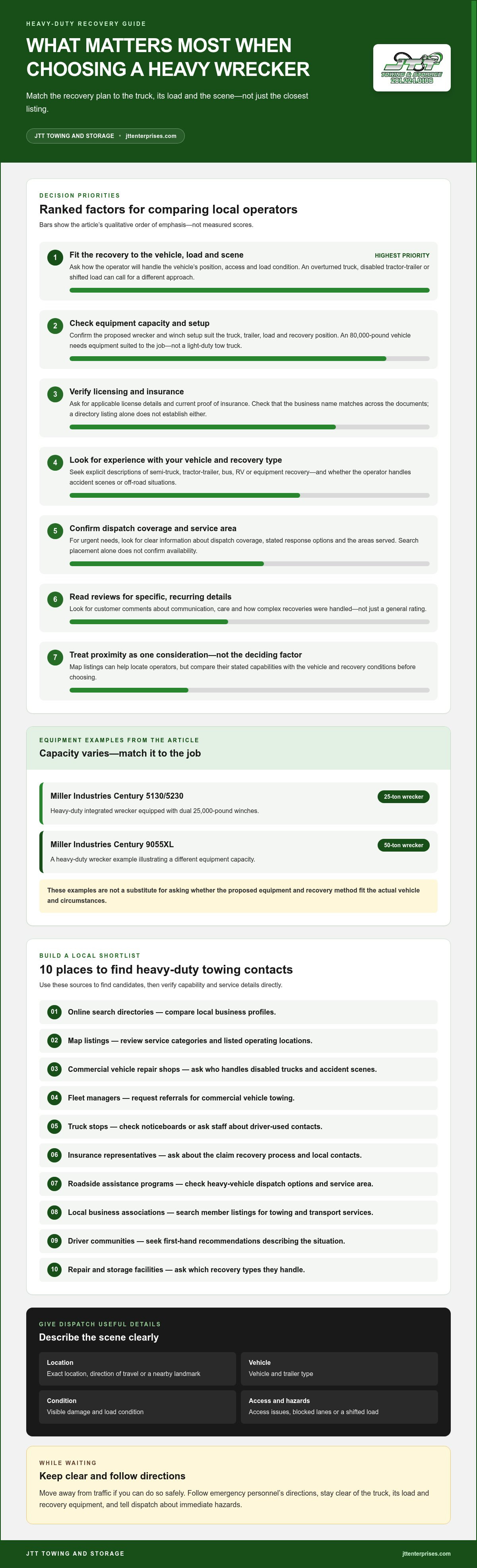
For a commercial truck incident, don’t choose on proximity alone. Recovery capability and suitable equipment matter. Use these sources to build a local shortlist, then assess which operator can handle your vehicle and the scene.
Truck Recovery Capabilities
Commercial truck accident recovery can involve an overturned vehicle, a disabled tractor-trailer, or a heavy load that has shifted. Ask how the operator approaches the specific recovery, including vehicle position, access, and load condition. An 80,000-pound vehicle calls for equipment suited to the job, not a light-duty tow truck.
Equipment examples help explain the range. The Miller Industries Century 5130/5230 is a 25-ton heavy-duty integrated wrecker equipped with dual 25,000-pound winches. The Miller Industries Century 9055XL is a 50-ton heavy-duty wrecker. These examples show why equipment capacity and recovery method should match the vehicle and circumstances.
- Online search directories: Search by your location and heavy-duty towing needs, then compare business profiles.
- Map listings: Look for nearby towing operators and note their stated service categories and operating locations.
- Commercial vehicle repair shops: Ask which local recovery operators handle disabled trucks and accident scenes.
- Fleet managers: Request referrals from companies that arrange towing for commercial vehicles.
- Truck stops: Check local noticeboards or ask staff about towing contacts used by truck drivers.
- Insurance representatives: Ask about the recovery process for a commercial vehicle claim and available local contacts.
- Roadside assistance programs: Review your plan’s heavy-vehicle dispatch options and service area.
- Local business associations: Search member listings for towing and commercial transport services.
- Driver communities: Look for first-hand recommendations that describe the vehicle and recovery situation.
- Repair and storage facilities: Ask where they receive recovered trucks and which recovery types they handle.
Licensing, Insurance, and Equipment Checks
A directory listing alone doesn’t establish licensing or insurance. Ask for the operator’s applicable license details and current proof of insurance, then check that the business name matches across documents. Confirm that the proposed wrecker and winch setup suit your truck, trailer, load, and recovery position.
When calling, give the truck’s location, vehicle and trailer type, visible damage, load condition, and access issues. Include the direction of travel or a nearby landmark to help dispatch identify the scene.
While waiting, move away from traffic if you can do so safely, and follow emergency personnel’s directions. Stay clear of the truck, its load, and recovery equipment. Tell dispatch about immediate hazards, such as blocked lanes or a shifted load.
Online directories for finding heavy-duty towing companies
Online directories can narrow a local search, but a listing category alone doesn’t prove heavy-vehicle capability. In Dayton and Cleveland, Texas, search for heavy-duty towing and specify the vehicle type, such as a semi, bus, RV, or heavy equipment. Review profiles for descriptions of work suited to the situation.
Google Maps can help locate businesses near a breakdown or accident scene. Enter a location-based phrase, such as “heavy-duty towing Dayton TX” or “tractor-trailer towing Cleveland TX.” You can also search using a nearby ZIP code, including 77535 or 77327. Review map listings and note which profiles describe commercial vehicle recovery rather than general roadside assistance.
Use directory results as a starting point, not a substitute for specific service details. Look for explicit references to semi-truck towing, tractor-trailer recovery, bus towing, RV towing, and equipment recovery. A profile that says only “towing” doesn’t explain which vehicles or situations the operator handles.
- Search by vehicle: Try “semi-truck towing” or “bus recovery” with Dayton or Cleveland.
- Compare service categories: Look for heavy-duty towing, accident recovery, and commercial vehicle recovery.
- Read profile descriptions: Look for tractor-trailers, RVs, or heavy equipment named directly.
- Check the mapped location: Compare the listed business area with the vehicle’s location and route.
- Review listing details: Look for current contact information and descriptions that fit the job.
For semi-truck and tractor-trailer towing, include the trailer and load in your search. A loaded combination, a disabled tractor without a trailer, and a vehicle off the roadway may require different recovery approaches. Look for listings that describe heavy-vehicle work, not just passenger-car towing.
Emergency and on-call searches need the same care. Phrases such as “emergency towing” or “on-call wrecker” may surface relevant profiles, but search placement doesn’t establish dispatch coverage. Read the business description for its stated response options and service area. Include the vehicle’s exact location and situation in your search.
Which local wreckers handle semis, buses, RVs, and heavy equipment? In Dayton and Cleveland, focus on profiles that explicitly describe the vehicle class and heavy-duty recovery work. Search each vehicle type separately to distinguish a relevant listing from a general towing category.
Once you’ve identified a relevant service category, review truck recovery details to understand the type of assistance available for a heavy-vehicle situation.
24-Hour heavy wrecker service
A “24-hour” label describes advertised availability, not necessarily immediate arrival. To find the best heavy duty wrecker service near me, confirm the dispatch process, service area, and recovery type before relying on a listing. For a disabled semi-truck at night, check whether the operator handles heavy-duty recovery, not only light roadside assistance.
Clarify what round-the-clock coverage means
Start with the exact location, vehicle type, and problem. Ask whether dispatch can take the call at that time and whether the operator handles that recovery. A truck needing a tow differs from a tractor-trailer that has left the roadway. Explain which situation applies so dispatch can direct the request appropriately.
Explain access conditions, too. A narrow shoulder, blocked lane, soft ground, or shifted trailer load can change the recovery plan. Give a nearby exit, road name, or visible landmark. Clear location details help distinguish a roadside breakdown from a recovery that requires scene access or traffic coordination.
Share details that shape the response
During an emergency call, describe the truck and trailer, visible damage, load condition, and whether the vehicle is upright. Mention hazards such as smoke or traffic close to the scene. These details help dispatch understand the job before assigning equipment. If the vehicle is off-road, describe the ground and access route.
Ask what happens after dispatch accepts the call. Clarify where the wrecker will approach, what information the driver should relay, and whether the truck should remain untouched. Don’t follow directions that require approaching traffic or unstable equipment. Keep communication focused on the scene and vehicle condition.
Match equipment to the recovery
Heavy-duty calls can involve towing, winching, or recovering a vehicle from a difficult position. A 40-ton rotator is one example of equipment used in a heavy-duty towing job. The appropriate setup depends on the vehicle, load, position, access, and recovery method. Describe those conditions rather than requesting a specific truck by name.
Before the wrecker arrives, keep drivers and bystanders away from the vehicle’s path and recovery area. Follow emergency personnel’s directions at an accident scene. Don’t handle a shifted load or attach equipment yourself. When searching for the best heavy duty wrecker service near me, clearly share vehicle details and hazards with dispatch.
- Give the exact location: Include the road, direction of travel, and a visible landmark.
- Describe the vehicle: Identify the truck, trailer, load, damage, and position.
- Explain scene hazards: Mention blocked lanes, soft ground, or unstable cargo.
- Confirm the dispatch plan: Clarify the next communication step and meeting point.
Customer reviews and reputation checks
Reviews can offer insight into how a towing operator communicates, handles equipment, and completes difficult recoveries. On Google Maps, search the company name alongside terms like “tractor-trailer recovery” or “commercial truck towing.” Look for detailed accounts of a specific vehicle and situation, not just a star rating.
Read recent and older comments together. A review about a loaded semi-truck recovery may offer more relevant detail than one about a passenger-car tow. Check whether reviewers describe clear updates, careful handling, and an explanation of the recovery process. Treat these as reported experiences, not proof that every job will be identical.
Pay attention to how the business responds to criticism. A useful reply, for example, may address a stated concern directly and explain the next step without sharing private customer information. A response that avoids the issue offers less insight. Compare response styles across multiple reviews instead of judging from one exchange.
- Match the job: Prioritize reviews about semis, buses, RVs, or heavy equipment if that’s your vehicle.
- Look for specifics: Note mentions of winching, accident recovery, vehicle position, or load condition.
- Compare platforms: Check Google Maps and another review directory for consistent descriptions.
- Read the full account: Separate comments about dispatch communication from comments about recovery work.
- Assess response quality: See whether replies address the concern respectfully and clearly.
Patterns matter more than isolated praise or complaints. If several reviewers mention unclear updates, note that as a recurring communication concern. Multiple accounts of careful commercial-vehicle handling may help you assess relevance. Read each review’s details and context rather than treating repeated wording as independent evidence.
Review dates and job descriptions provide useful context. A comment about a routine tow may not apply to a rollover or off-road recovery. Compare similar situations: for a tractor-trailer incident, focus on accounts involving comparable vehicles or complex scenes. This makes the feedback more useful to your decision.
Use reviews alongside the company’s directory profile and service description. If the profile says heavy-duty towing, look for customer accounts describing commercial vehicles and recovery work. Note any unanswered questions, such as how dispatch communicates or what incidents reviewers describe. This gives you a focused way to assess reputation without treating online comments as a guarantee.
Before choosing, write down recurring themes in the reviews. Note whether accounts mention clear arrival updates, careful vehicle handling, or recovery expertise. Use those themes to compare relevant evidence, giving less weight to vague praise that doesn’t describe the service received.
What heavy-duty wrecker services are available near me?
Local heavy-duty wrecker options can include towing, accident recovery, winching, and off-road recovery. The right service depends on the vehicle’s condition, position, load, and access to the scene. A disabled tractor-trailer on pavement, for example, may need a different approach from a truck stuck off-road.
Heavy-duty towing moves a disabled commercial vehicle from the roadside or a worksite. The operator considers the truck and trailer configuration, load, route, and destination. Explain whether the vehicle can roll, whether it’s attached to a trailer, and whether the load remains secure. These details help determine the recovery setup and transport method.
Accident recovery addresses vehicles damaged or displaced in a collision. A truck on its side, a blocked lane, or a shifted load can change the recovery sequence. Tell dispatch the vehicle’s position and any visible hazards. At the scene, follow emergency personnel’s directions and stay clear of the recovery area. If an incident results in extensive structural damage where repairs are no longer practical, vehicle owners may explore salvage and disposal alternatives, where operators such as Rapid Car Removal purchase and remove damaged commercial vans and vehicles.
Off-road recovery can involve a truck stuck on soft ground, down an embankment, or beyond a paved access route. Conditions such as slope, ground firmness, and available approach space affect the equipment and method. A 40-ton rotator is one example of equipment used in a heavy-duty towing job, though the specific recovery plan depends on the scene and vehicle.
- Heavy-duty towing: Relocates disabled trucks and commercial vehicles.
- Accident recovery: Recovers vehicles involved in collisions or left in difficult positions.
- Winching and extraction: Helps move a vehicle that cannot drive or is stuck.
- Off-road recovery: Addresses vehicles beyond paved roads or on challenging ground.
- Load handling: May be needed when cargo has shifted or requires transfer before moving the vehicle.
To identify the relevant service, state the vehicle type, location, damage, load condition, and whether it’s on-road or off-road. For example, tell dispatch if a loaded tractor-trailer is upright but unable to move, or if a truck has left the roadway. Clear details help distinguish a tow from a more involved recovery.
Compare local service descriptions against the actual situation, not just the word “wrecker.” A listing describing commercial truck towing may suit a disabled semi, while a vehicle off-road may require recovery capability. For a local heavy-vehicle situation, request heavy-duty towing assistance as a next step.
JTT Towing and Storage: Accident Recovery
JTT Towing and Storage handles accident recovery when a commercial vehicle is damaged, disabled, or in a difficult position. Its heavy-duty towing and off-road recovery services address situations where a standard tow may not suit the vehicle or scene. Vehicle storage is also available when a recovered vehicle needs a place to remain after the incident.
When requesting help, describe the vehicle, its position, visible damage, load condition, and exact location. These details clarify whether the situation calls for accident recovery, heavy-duty towing, or off-road recovery. For a vehicle involved in a collision, stay clear of the recovery area and follow emergency personnel’s directions.
Contact JTT Towing and Storage or visit jttenterprises.com to discuss your recovery needs.
Make Your Next Recovery Decision With Confidence
The next step is to turn a stressful roadside situation into a clear recovery plan. Consider the vehicle’s condition, load, and location when deciding what help is needed. The best heavy duty wrecker service near me is the one whose recovery capabilities match the job, not simply the operator that appears closest.
JTT Towing and Storage offers Accident Recovery, Heavy-Duty Towing, and Off-Road Recovery. These services can address different needs, from a commercial vehicle involved in a collision to a truck stuck in difficult terrain. Describe the situation clearly so the recovery request starts with relevant details.
If you’re ready to discuss a heavy-vehicle recovery, contact JTT Towing and Storage. Take the next step calmly and focus on getting the right kind of assistance for your situation.
Frequently Asked Questions
Which heavy-duty towing companies offer 24/7 emergency response?
JTT Towing and Storage states it is available 24 hours a day, 7 days a week. For a commercial vehicle breakdown, share the truck’s location and condition when arranging assistance. Describe whether it’s carrying a trailer, has visible damage, or is off the roadway. Those details help clarify the type of heavy-duty towing or recovery involved, including situations near Dayton or Cleveland, Texas.
What are the customer ratings and reviews for nearby heavy-duty wrecker services?
Review current Google listings for ratings and detailed accounts, focusing on comments about commercial vehicles and complex recoveries. JTT Towing and Storage has verified Google reviews describing compassionate service and careful handling. Read the full comments, since a rating alone doesn’t show whether the reviewer had a similar vehicle or recovery situation. Compare the context of each account before using it to inform your choice.
How quickly can nearby heavy-duty wreckers respond, and what areas do they cover?
Arrival timing depends on the truck’s location, road access, traffic, and the recovery conditions. Give dispatch a road name, direction of travel, and nearby landmark to help identify the scene. JTT Towing and Storage’s local targeting includes ZIP codes 77535, 77336, 77327, 77561, 77357, 77532, and 77575. Share the vehicle’s exact location so the request can be matched to the right area.
What services and equipment do heavy-duty wreckers provide for rollovers and off-road recovery?
Rollover recovery and off-road extraction may involve heavy-duty towing, winching, or specialized recovery equipment. The plan depends on the vehicle’s position, load, ground conditions, and access for the wrecker. A 40-ton rotator is one example of equipment used in a heavy-duty towing job. JTT Towing and Storage offers Accident Recovery and Off-Road Recovery; describe the scene and vehicle condition when requesting help.
Which local wreckers handle semis, buses, RVs, and heavy equipment?
Look for local listings that explicitly describe heavy-duty towing and recovery for semis, buses, RVs, or heavy equipment. Search each vehicle type separately and confirm the operator’s capabilities, service area, and equipment suit the job.


