
A fault in one core system can sideline a truck before its cause is obvious. Heavy-duty truck repair in Liberty County can address brake, driveline, engine, cooling, and electrical problems, with the repair shaped by the symptoms and the system involved. Heavy-duty trucks are classified as vehicles with a gross vehicle weight rating over 26,001 pounds.
When a truck loses power, runs hot, vibrates, or develops electrical faults, the symptom alone may not reveal the underlying problem. Heavy duty truck repair in Liberty County starts with identifying the systems that may be involved and assessing them carefully. This guide explains common repair areas and how diagnostics connect symptoms to next steps.
Learn what brake, axle, suspension, and driveline work can involve, along with diesel engine diagnostics, cooling problems, and electrical faults. We’ll also explain how symptoms guide troubleshooting, what affects repair scope, and when towing or recovery may be the practical next step if a truck cannot safely continue.
Key Takeaways
- Brake, axle, suspension, and driveline symptoms can overlap, so identify where the issue appears and how it affects handling before deciding on next steps.
- Use diagnostic trouble codes as a starting point, then assess operating data and related systems to narrow down the cause of an engine problem.
- Steering pull, uneven tire wear, or wheel-end noise can point to alignment or component concerns that affect stability and wear.
- Overheating and charging faults call for tracing the affected system, not just reacting to the warning or symptom.
- If a truck can’t safely continue after a breakdown or accident, heavy-duty towing or accident recovery can help move it toward the next step.
Brake, axle, suspension, and driveline repair
To compare truck repair reviews, look for specific, repeated details about diagnosis, communication, and completed work. Shop hours, addresses, and contact information vary, so use each business’s current listing for those details.
Brake and Air-System Repairs
Brake and air-system work can involve air lines, valves, chambers, drums, rotors, and related controls. Start by identifying the symptom: a pressure warning, air leak, pulling during braking, or a change in pedal response. Each clue points to different parts of the system. A technician can inspect connections and components, then trace the fault before recommending repairs.
Air brakes rely on pressure moving through connected components, so a leak can affect brake response elsewhere. A hiss near a line, for example, points inspection toward that connection, while uneven braking may call for checking both sides of an axle. Note when the symptom occurs, such as during braking or after the truck has been parked.
Brake and engine problems can appear at the same time. An engine that loses power may change how the truck responds on a grade, while a brake warning signals a separate system needs attention. Record both symptoms rather than assuming one caused the other. These details help technicians assess the brake system and engine without overlooking a second fault.
Axle and Driveline Work
Axle and driveline repairs address components that transfer engine power to the wheels. An inspection may include axle shafts, joints, differentials, and driveshaft connections. Note whether vibration changes with road speed, load, or acceleration. A clunk during gear changes, for example, offers a different diagnostic clue from steady vibration while cruising.
Suspension, brake, and transmission concerns can overlap during diagnosis because each affects how the truck moves and responds. If a transmission complaint occurs alongside driveline vibration, record when both happen. Technicians can inspect the relevant connections and components to distinguish a transmission problem from a driveshaft or axle fault.
Suspension issues can change handling and place uneven loads across tires and axles. Describe pulling, bouncing, or a new change in ride behavior, and note whether it began after an impact or while carrying a load. Heavy-duty trucks are classified by a gross vehicle weight rating over 26,001 pounds. That weight makes accurate inspection of connected brake, axle, and suspension systems important to effective diagnosis.
For heavy duty truck repair in Liberty County, organize symptoms before service: identify warnings, describe when they occur, and note related changes in braking, engine performance, transmission, or handling. This gives the inspection a useful starting point and helps separate connected symptoms from unrelated faults.
Heavy-duty diesel diagnostics and engine repair
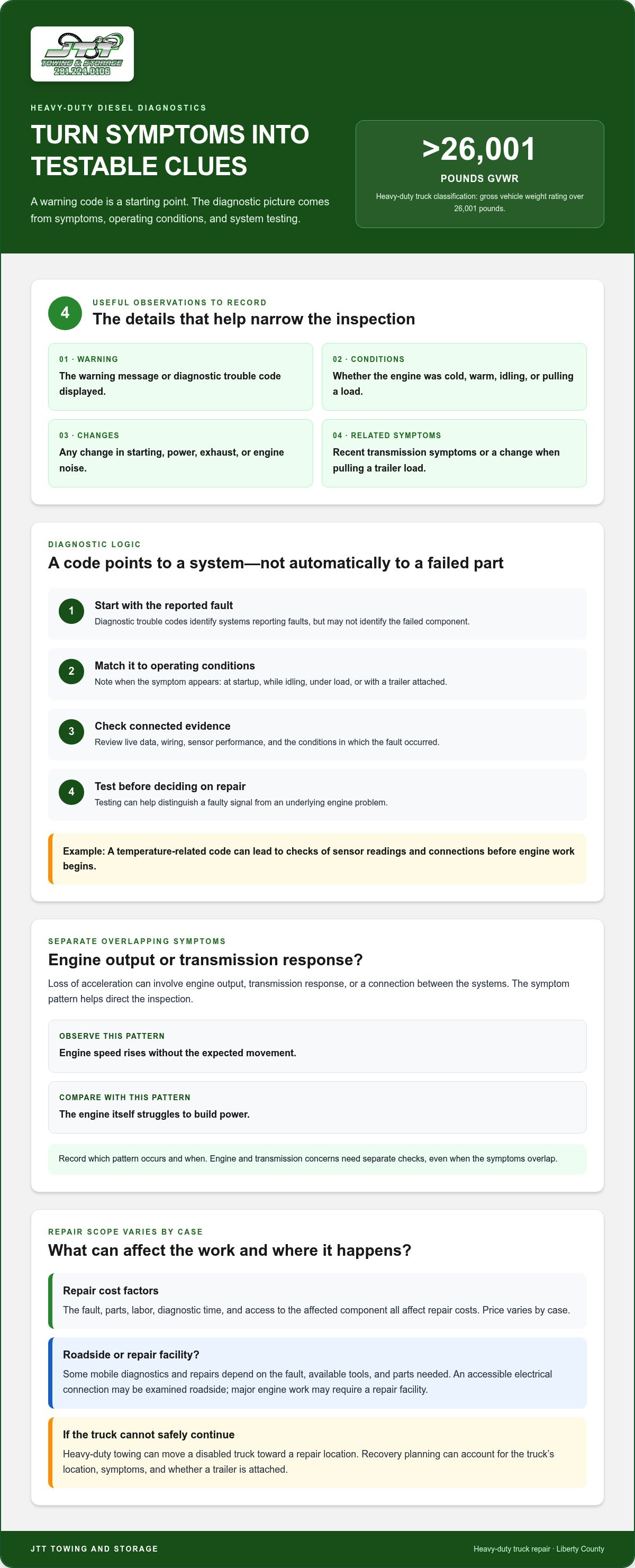
Start with the symptom and note when it occurs. A hard start, loss of power, unusual exhaust, or warning light can help guide diagnostics. Record whether the problem appears at startup, under load, or while idling. If a trailer is attached, note whether the symptom changes with the added load.
Diagnostic trouble codes identify systems reporting faults, but they do not always identify the failed part. A sound process reviews codes alongside live data, operating conditions, wiring, and sensor performance. For example, a temperature-related code may lead to checks of sensor readings and connections before engine work begins. Testing helps distinguish a faulty signal from an underlying engine problem.
Useful details to record include:
- The warning message or code displayed
- Whether the engine was cold, warm, idling, or pulling a load
- Changes in starting, power, exhaust, or engine noise
- Recent symptoms involving the transmission or trailer load
These observations help organize diagnostic steps. They do not replace system testing, but they can help identify when a fault occurs.
Diesel engine and transmission concerns need separate checks, even when symptoms overlap. Loss of acceleration might involve engine output, transmission response, or a connection between the systems. Note whether engine speed rises without the expected movement or whether the engine itself struggles to build power. These details narrow the inspection instead of treating every performance issue as the same repair.
When choosing heavy-duty truck repair, look for relevant diesel experience and a diagnostic process that connects test results to recommended work. Clear explanations of the fault, affected components, and repair sequence help you understand the next steps.
Repair costs in Texas depend on the fault, parts, labor, diagnostic time, and access to the affected component. The price varies by case, so request a quote for the work needed.
For a 24-hour emergency, use the shop’s published hours to determine whether repair support is available. If a disabled truck can’t safely reach a repair bay, heavy-duty towing can move it to a repair location.
Mobile diesel mechanics can perform some diagnostics and repairs at a truck’s location, depending on the fault, tools, and parts needed. An accessible electrical connection, for example, may be examined roadside, while major engine work may require a repair facility.
When the truck cannot continue safely, heavy-duty towing can help move it toward the next repair step. Share the truck’s location, symptoms, and whether a trailer is attached so the recovery plan accounts for the situation.
Suspension, steering, and wheel-end service
Suspension, steering, and wheel-end faults can produce similar symptoms. A truck pulling to one side may have steering play, uneven suspension, or tire-related concerns. Vibration may change with road speed or load. Record what the driver feels, when it starts, and whether it changes while turning, braking, or traveling straight. Those details help direct the inspection.
Begin with a visual check of suspension components and connections. Look for damaged springs, shifted components, loose fasteners, or uneven ride height. Then compare the truck’s response on a level road with the reported symptom. A pull that continues during steady travel, for example, differs from wandering over bumps. That distinction helps focus attention on suspension condition, steering linkage, or alignment.
A steering inspection follows movement from the steering wheel through the linkage to the wheels. Note excess play, delayed response, or changes in direction over uneven pavement. A report that the truck wanders on a straight stretch provides useful context. Pair it with checks of steering components and axle alignment rather than assuming one worn part explains every handling concern.
Wheel-end service focuses on the parts that support wheel rotation and attachment. Listen for a new hum, grinding sound, or rhythmic noise that changes with speed. During inspection, check for visible damage, abnormal movement, or uneven tire wear. Noise that grows during a turn can help distinguish a wheel-end concern from a general suspension complaint. Record where and under what driving conditions it occurs.
For heavy duty truck repair Liberty County fleets using the Hwy 90 corridor, measure all truck axles against the frame centerline. When a trailer is hooked up, square the trailer as part of the alignment assessment. This checks the truck-and-trailer relationship rather than treating the tractor alone as the full setup. Note whether the trailer tracks straight and whether tire wear appears uneven across axles.
- Describe whether the pull occurs while braking or cruising.
- Record where vibration or wheel noise seems strongest.
- Compare tire wear across the truck’s axles.
- Include trailer tracking when the truck is connected.
These observations suggest a practical inspection sequence: assess suspension condition, steering response, wheel ends, then alignment. If the truck’s behavior changed after a road impact, include that in the symptom history. Comparing the driver’s account with measured axle position and component condition can help identify the repair that addresses the cause.
JTT Towing and Storage provides professional heavy duty truck repair Liberty County services equipped to support a structured inspection process for suspension, steering, and wheel-end concerns, with reported symptoms documented before work begins. Keep the driver’s account tied to the conditions that trigger the fault, including road surface, turning, braking, and whether a trailer is connected.
Keep a clear record of what was observed and what still needs checking. Note where noise or vibration occurs, changes in steering response, visible component damage, tire-wear patterns, and trailer tracking. This helps compare inspection findings with the original complaint and determine whether an alignment assessment is needed after mechanical checks.
Cooling and overheating repairs
An overheating warning identifies a symptom, not its cause. The cooling system carries heat away from the engine through connected parts, including the radiator, hoses, thermostat, water pump, fan, and coolant. A leak, restricted flow, or failed fan can cause similar temperature changes. Diagnosis should trace the system rather than treating every warning as a radiator failure.
Record when the temperature rises. Note whether it happens while idling, climbing a grade, moving slowly, or pulling a loaded trailer. Overheating at low road speed, for example, may direct attention to airflow or fan operation. A rise during sustained engine load may call for checks of coolant circulation and system condition.
A visual inspection may reveal wet connections, damaged hoses, residue, or a loose belt. Debris on the radiator’s exterior can also restrict airflow. Record where a visible leak appears and whether the warning returns after the truck cools. These observations help technicians target pressure checks and component testing rather than guess at the failed part.
Useful details to share during diagnosis include:
- When the temperature warning first appeared
- Whether it rises at idle, on a grade, or under load
- Visible coolant residue or a leak location
- Changes in heater output, fan noise, or engine performance
Each clue helps distinguish cooling-system faults. A fan that fails to engage calls for a different diagnostic path than a hose leak. Low coolant may result from a leak rather than explain why coolant is missing. Repairs should address the source, then assess related components affected by heat or coolant loss.
Testing may include inspecting hoses and connections, checking coolant condition, and assessing circulation and fan operation. A thermostat that does not open correctly can interrupt flow. A water-pump concern may involve circulation or leakage. A technician compares test results with the operating symptoms to determine which component needs repair.
After a repair, the system needs a functional check. Confirm that the leak has stopped and temperature behavior remains stable under the conditions that produced the warning. If the truck overheated while pulling a trailer, include that load in the follow-up assessment. An idle check alone may not reproduce a fault that appeared under load.
Repeated overheating calls for prompt diagnosis because continued heat can affect engine performance and connected components. Keep a clear record of warnings, operating conditions, and prior repairs. That history gives the repair process a practical starting point and helps distinguish a recurring cooling fault from a new symptom.
Electrical and charging-system troubleshooting
A slow crank, dim lights, or repeated warning can point to different electrical faults. Note which systems behave unusually and whether symptoms appear during startup, idling, or driving. A truck that starts after a jump but later loses power, for example, needs checks beyond the battery. The charging system, cables, grounds, and connections all affect electrical performance.
Start by checking the battery terminals and visible cables. Look for corrosion, looseness, damaged insulation, or a connection that shifts by hand. Note whether the battery holds its charge after sitting. A weak battery can cause slow cranking, while a poor ground may create intermittent faults across several systems. These clues guide testing instead of guesswork replacement.
The charging system includes the alternator, drive belt, wiring, and battery connections. A charging warning while driving calls for checking the belt and inspecting alternator connections. Testing can determine whether the alternator supplies power and whether current reaches the battery. If lights dim while the engine runs, note whether other electrical functions change at the same time.
Intermittent faults call for a careful symptom record. Note whether a warning appears after rain, vibration, a stop, or engine startup. A loose harness connection might fail only when the truck moves, while a damaged wire may affect one circuit consistently. Identifying the affected circuit helps narrow inspection to its fuse, wiring, connector, and component.
Useful observations include:
- Whether the engine cranks slowly or not at all
- Which dashboard warning or electrical function changes
- Whether symptoms occur with the engine running or stopped
- Any visible corrosion, loose terminals, or damaged wiring
Starter problems can resemble battery or charging faults. If the lights remain bright but the engine does not crank, inspect the starter circuit alongside the battery connections. If the truck starts but the battery later loses charge, test charging output and inspect the alternator circuit. Comparing these conditions helps separate starting trouble from charging trouble.
Modern trucks also rely on sensors and control modules. A diagnostic trouble code can identify the system reporting a fault, but it may not identify the failed component. Pair code information with wiring inspection, connector condition, and system testing. A sensor code, for example, may involve the sensor, its wiring, or its connector.
Record the symptoms and warning messages before they disappear. If electrical failure leaves the truck unable to continue safely, request heavy-duty towing to move it toward the next step.
Diagnostic trouble codes can show where a system detected a problem, while live data, operating conditions, wiring, sensor performance, and mechanical testing can help identify why it occurred. Treat a code as a starting point for checking the reported system, then compare it with what the truck was doing when the fault appeared. A code may narrow the search without identifying the failed part.
Review fault codes and operating data, then test systems to isolate the cause rather than relying on parts replacement alone. Considering these clues together keeps diagnosis focused on the affected circuit and gives testing a role before components are changed. A clear record of the conditions makes that review more useful.
JTT Towing and Storage: Accident Recovery
JTT Towing and Storage provides Accident Recovery when a collision leaves a heavy truck unable to continue safely. Heavy-Duty Towing can move a disabled truck, while Off-Road Recovery helps recover vehicles stranded away from a suitable roadway. After recovery, secure Vehicle Storage provides a place for the vehicle while you arrange its next steps.
Share the truck’s location, condition, and whether it remains attached to a trailer. These details clarify the recovery situation and equipment needs. If a breakdown or accident has left your truck stopped in an unsafe or inaccessible place, contact JTT Towing and Storage for recovery or towing support.
Make the Next Repair Decision with Confidence
Create a clear handoff between the driver, dispatcher, and repair team. Keep the truck’s location, load status, warning messages, and recent changes together in one account. Sharing that information helps everyone make practical decisions without relying on scattered updates.
For heavy duty truck repair in Liberty County, deciding whether the truck can continue safely is part of planning what happens next. If a breakdown or incident requires recovery, JTT Towing and Storage provides Accident Recovery, Heavy-Duty Towing, and Off-Road Recovery. These services help move a truck from its current situation.
When you reach out, describe where the truck is and what support it needs. A clear starting point helps keep the next step focused. Contact JTT Towing and Storage to discuss recovery support, and move forward with a steadier plan.
Frequently Asked Questions
Best-rated truck repair shops near Liberty County reviews
When reviewing truck repair experiences, look for specific, repeated details about diagnosis, communication, and completed work.
Truck repair shop hours, locations, and contact information in Liberty County
Shop hours, addresses, and contact information vary; use each business’s current listing for those details.


