
A dead battery after dark can leave you wondering whether you need a jump or a tow. A jumpstart service in Dayton, TX can help when a weak or discharged battery keeps the engine from starting, including during a night or weekend breakdown. A jump-start won’t solve every no-start, so the symptoms matter.
It’s reasonable to want clear information about timing as well as help getting moving. This guide explains what a jump-start involves and how to recognize when the problem may involve the battery, alternator, or starter instead.
You’ll also learn what information helps explain the problem, what to watch for after the vehicle starts, and when towing may be the better next step. That can make a stressful roadside situation easier to assess, whether your car is at home or stopped along the road.
Key Takeaways
- Notice whether the engine cranks slowly, clicks, or starts and then dies; these clues can help distinguish battery, alternator, and starter trouble.
- A vehicle that dies again within minutes of a jump-start may have a failing battery or alternator, so a boost may not solve the underlying problem.
- Learn what details to share when arranging roadside assistance, including your location, vehicle, and what happens when you try to start it.
- Understand how a jump-start works and why driving afterward can help the alternator recharge a flat battery.
- See when a no-start may call for towing or recovery instead of another attempt to jump the vehicle.
Signs of battery, alternator, or starter trouble
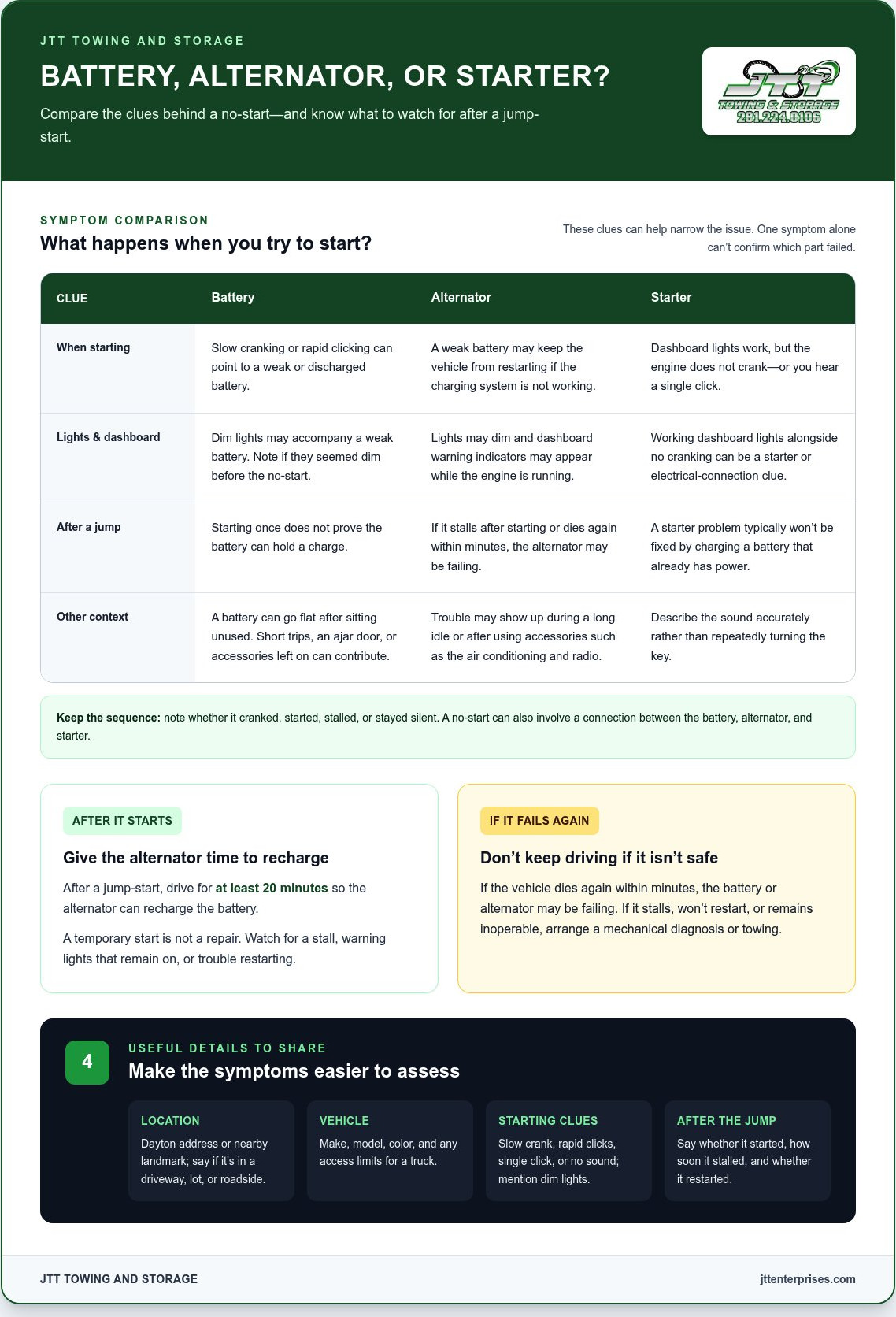
A no-start can stem from the battery, alternator, starter, or a connection between them. Note what happens when you turn the key or press the start button. The sounds and sequence offer useful clues, though one symptom alone can’t identify the failed part.
A weak battery often causes slow cranking, dim lights, or rapid clicking when you try to start the vehicle. A battery may also go flat after the vehicle sits unused for a while. Short trips, a door left ajar, or accessories left on can contribute to a discharge. Note whether the lights seemed dim before the engine stopped starting.
Pay attention to what happens after a jump-start. If the vehicle dies again within minutes of removing the jumper cables, the battery or alternator may be failing. Starting once doesn’t prove the battery can hold a charge or the charging system is working. Don’t treat a temporary start as a repair.
An alternator problem can show up while the engine is running. You might notice dimming lights, dashboard warning indicators, or an engine that stalls after starting. A weak or old battery may drain enough to prevent restarting if the engine idles with the air conditioning and radio running while you wait. In Dayton, note whether the trouble began during a long idle or after using accessories.
Starter trouble often looks different. If the dashboard lights work but the engine doesn’t crank, or you hear a single click, the starter or its electrical connections may be involved. A starter problem typically won’t be solved by charging a battery that already has power. Describe the sound accurately instead of repeatedly turning the key.
After a jump-start, drive for at least twenty minutes so the alternator can recharge the battery. If the car stalls, warning lights remain on, or it won’t restart, continuing to drive may leave you stranded. Note the sequence: whether it cranked, started, stalled, or stayed silent. Those details help distinguish a discharged battery from a charging or starting fault.
If a jump-start doesn’t work in Dayton, arrange a mechanical diagnosis or have the vehicle towed to a repair facility. Choose towing if the vehicle remains inoperable, stalls again, or can’t be driven safely.
- Slow crank or clicking: note the sound and whether dashboard lights dim.
- Starts, then dies: record how soon it happens after the cables come off.
- No crank with working lights: report the silence or single click as a possible starter clue.
24/7 Availability
Night and weekend coverage is a question of dispatch hours, not just jump-start equipment. For a driver in Dayton, Texas, “24/7” means a service can receive and handle calls throughout the day and night, including weekends. The phrase alone doesn’t explain whether a particular provider is answering calls or sending a suitable unit at that moment.
Distinguish call handling from roadside arrival. A phone line may accept a message outside regular hours, while dispatching a truck is a separate step. For example, a driver stranded after a late shift needs an active roadside response, not simply a way to leave a voicemail. Check the wording of the service hours and distinguish emergency response from office hours.
Night calls also require precise location details. A street address, nearby business, or clear landmark in Dayton helps identify where the vehicle is stopped. Tell the dispatcher the vehicle’s make, model, and color, and whether it’s in a driveway, parking lot, or roadside. Mention if it blocks access or is in a place that’s difficult for a truck to reach.
Weekend calls require similar details, though the situation may differ. A car that won’t start in a home driveway is different from one blocking a work entrance. Explain whether the vehicle is accessible and whether you need a jump-start attempt or transport because it can’t be driven. Clear information helps dispatch match the request to the right response.
Before calling, organize the details you can provide:
- Location: Share the Dayton address or a nearby landmark.
- Vehicle: Identify the make, model, color, and where it is parked.
- Problem: Describe what happens when you try to start it.
- Timing: State that the call is at night or on a weekend.
These details don’t establish whether overnight or weekend service is operating. They make your request clearer once you reach a roadside dispatcher. If the vehicle is in a garage or tight parking area, explain the access limits before a truck is dispatched. A cramped space can affect which equipment can reach the car.
For a night or weekend breakdown in Dayton, distinguish “call-taking” from “dispatch” in any published service-hours description. Then give your location, vehicle details, access conditions, and symptoms in one concise account. That gives the response team useful information to assess a jump-start request or another roadside need.
Service process and location details
In Dayton, Texas, the process starts with your exact location and a clear description of the vehicle’s problem. Share the ZIP code, access conditions, and whether you need a jump-start attempt or transportation.
Finding a Jump-Start Provider
Yes. Mobile mechanics and towing companies can provide jump-start service in Dayton, though their dispatch arrangements and roadside capabilities differ. A mobile mechanic may focus on diagnosing a no-start, while a towing company can also move a vehicle that remains inoperable. Describe the location and symptoms so the provider understands your request.
Dayton is identified by ZIP code 77535. Include that ZIP code, then give the street address or a nearby landmark, such as a business entrance. Say whether the vehicle is in a driveway, parking lot, or roadside position. Mention tight access, a blocked entrance, or other conditions that could affect where a service vehicle can stop.
Before arranging a visit, distinguish a jump-start request from a repair diagnosis. A jump may help a discharged battery, but it won’t resolve every starting fault. Tell the provider whether the engine cranks, clicks, or stays silent, and whether it starts but stalls. Those details help clarify whether roadside assistance or vehicle transport fits the situation.
Contacting Roadside Assistance
For roadside assistance in Dayton, call the number printed on your membership card or the provider’s official dispatch listing. State your location in ZIP code 77535, vehicle make and model, and the behavior you observe when starting. A precise location and symptom description make the request easier to understand.
A roadside assistance membership isn’t the only way to request help. You can contact a provider directly, while membership plans offer a separate route through their assistance line. Have your vehicle details and location ready either way. If you’re using a membership, provide its identifying information when asked.
Keep your phone available after placing the request. If your vehicle is parked somewhere difficult to locate, share a landmark or entrance description. For example, identify the parking lot entrance instead of saying only that you’re near a business. Clear directions help the responding crew find your vehicle in Dayton.
Provider Arrival Time
Arrival time in Dayton depends on the provider’s current dispatch workload, your location, road conditions, and access. A vehicle at a clearly marked address is easier to find than one described only as “near town.” Give the dispatcher a street address, cross street, or recognizable landmark to reduce confusion.
Explain whether your car is in a parking lot, driveway, or along a road. A blocked or restricted approach can affect how a service vehicle reaches it. If conditions change after you call, such as moving the vehicle to a nearby lot, update the dispatcher with the new location.
Ask for the provider’s estimated arrival time during the call, then follow any directions about staying reachable. Keep your phone nearby and make the vehicle easy to identify. Those steps help the roadside team coordinate its arrival without relying on an unclear location description.
What businesses offer jump-start service in Dayton, TX?
In Dayton, a jump-start may be available through a towing company or a mobile mechanic that handles roadside calls. The right option depends on whether you need a battery boost, an on-site mechanical assessment, or transportation because the vehicle still won’t start. Match the service description to your problem rather than choosing by business category alone.
A towing company may handle jump-start requests alongside vehicle recovery and towing. That can help if the car still won’t start and needs to be moved. A mobile mechanic may be a better fit if you want an on-site assessment of a recurring no-start. Tell the dispatcher whether the engine cranks, clicks, or stays silent, and explain what happened before it failed.
Look for clear service wording that specifically mentions jump-starts or roadside battery assistance. A general towing listing doesn’t necessarily explain whether jump-starts are included. For a Dayton request, confirm the exact pickup point, such as a driveway, business parking area, or roadside shoulder. Share the vehicle’s make and model, along with any access limits that could affect where a service vehicle can stop.
Consider what should happen if a boost doesn’t get the car running. If the vehicle remains inoperable, towing may be the practical next step. The type of tow depends on the vehicle and its position. For example, a car boxed into a narrow space may need a different approach from one parked in an open lot. Describe those conditions before dispatch so the request reflects the full situation.
Dayton’s ZIP code is 77535. Include it when describing your location, then add a street address or landmark that distinguishes your vehicle from nearby properties. A large parking lot, an unmarked access road, or a gated entrance can make a short description unclear. Name the entrance or nearby business and say where the car is positioned, such as near the front doors or along a side row.
Before deciding, match the provider’s stated service to your immediate need: a jump-start attempt, mechanical assessment, or vehicle transport. Be specific. “The car won’t start” gives less useful context than “the dashboard lights turn on, but the engine doesn’t crank.” That distinction helps a Dayton provider understand whether you need a battery boost or assistance with a broader no-start problem.
- For a boost: Seek a provider that expressly handles jump-start calls.
- For diagnosis: Consider a mobile mechanic when the problem recurs.
- For an inoperable vehicle: Ask about towing as the next step.
What is the phone number for roadside assistance in Dayton, TX?
There isn’t one shared phone number for every roadside assistance service in Dayton. Use the number on your roadside membership card for plan-based help, or the dispatch number published by the provider you choose. The right number depends on who you’re asking to respond, so keep the relevant contact information accessible before a breakdown.
For membership assistance, check the card, account materials, or official app connected to your plan. A household may have coverage through an auto insurer, vehicle manufacturer, or separate roadside plan, and each uses its own contact channel. Tell the representative you’re in Dayton, Texas, and provide your vehicle’s location before describing the problem.
If you don’t have a membership, contact a local roadside provider directly using its published business number. Use the provider’s official listing rather than a number copied from an old message or an unfamiliar post. Ask for roadside assistance and explain that you need a jump-start. If the car can’t be started, say whether you also need transportation.
Dayton’s ZIP code is 77535. Give it with the street address, nearby cross street, or recognizable landmark. A location such as “near the store” can be ambiguous, especially in a shared parking area. Add a useful detail, such as the lot entrance or the row where the vehicle is parked.
Prepare these details before placing the call:
- Location: Dayton address, ZIP code, and a nearby landmark.
- Vehicle: Make, model, color, and parking position.
- Symptoms: Whether the engine cranks, clicks, starts, or stays silent.
- Request: Jump-start assistance, diagnosis, or towing if the vehicle remains inoperable.
During the call, state the immediate issue first. For example, say, “My car is parked in a Dayton lot, and the engine won’t crank.” Then provide the vehicle details and exact location. If you’re using a membership, have your account or card information ready to help route the request.
Keep your phone nearby after calling, and answer follow-up questions about access or location. If the vehicle is behind a gate or in a narrow parking area, explain that before dispatch. For a vehicle that needs transport rather than a jump, request roadside towing assistance through the provider’s contact channel.
JTT Towing and Storage: Accident Recovery
JTT Towing and Storage can help when a breakdown involves a collision, a vehicle that can’t be driven, or a recovery beyond a jump-start. Its Accident Recovery service is relevant after a crash, while Heavy-Duty Towing can move larger vehicles that need transport. For a vehicle stuck away from a paved road, Off-Road Recovery may be the appropriate next step.
If the vehicle needs to be held after recovery, Vehicle Storage offers a practical next step. Describe what happened, where the vehicle is, and whether it’s damaged or difficult to access. That context helps identify the recovery needed. Contact JTT Towing and Storage to discuss the situation and next steps.
Choose Your Next Step With Confidence
A no-start is a good point to decide what you need next: a jump-start attempt, a repair assessment, or recovery for a vehicle that can’t continue. If the situation involves a collision, difficult terrain, or a larger vehicle, the right kind of recovery matters more than repeating an unsuccessful start attempt.
JTT Towing and Storage offers Accident Recovery, Heavy-Duty Towing, and Off-Road Recovery for situations that call for more than a battery boost. Share what happened and where the vehicle is so the request can focus on the recovery needed. For a jumpstart service in Dayton, TX, clearly describing the vehicle’s condition helps you take a practical next step.
Contact JTT Towing and Storage to discuss the situation. With a clear plan, you can move forward calmly and focus on getting your vehicle to the appropriate next stage.
Frequently Asked Questions
Are you available at night and on weekends in Dayton?
Yes. JTT Towing and Storage states it’s available 24 hours a day, 7 days a week, including nights and weekends. For an after-dark call in Dayton, explain whether the vehicle is in a lot, driveway, or roadside location. Keep your phone audible and stay somewhere safe and accessible while coordinating the response.
Which jump-start services in Dayton, TX operate 24 hours?
JTT Towing and Storage is the local option identified with 24/7 availability; call 281-224-0106. Its targeted ZIP areas include 77535, 77336, 77327, 77561, 77357, 77532, and 77575. Give your ZIP code first, then the nearest cross street or property entrance. This helps distinguish a Dayton address from a nearby community during a late-night call.
What information should I provide when requesting a jump start in Dayton, TX?
Provide your callback number, vehicle make and model, exact location, and whether the vehicle is in a garage, lot, or roadside. Explain whether it’s a personal vehicle or commercial truck, and mention access limits such as a locked gate or low-clearance garage. For a work vehicle, identify the company or fleet contact who can authorize service.
Is it safe to jump-start a car with a dead battery, and what precautions should I take?
A jump-start may be appropriate for a discharged battery, but follow the vehicle maker’s instructions and use suitable equipment. Check the owner’s manual for the connection points, since vehicle layouts can differ. Don’t proceed if you can’t identify the correct terminals or the battery appears damaged. Ask roadside assistance to handle the situation rather than improvising.


