
Hiring an out-of-state freight broker to move heavy machinery across Southeast Texas often costs you far more in job site downtime than the haul itself. You already know the headache of waiting on an unvetted rig that arrives hours late, brings the wrong trailer setup, or bogs down in deep mud on an unimproved rural access road. When tight construction schedules leave no room for error, partnering with a dependable backhoe transport service Liberty County contractors can trust is essential to keeping your project on track.
Discover how to choose a reliable local carrier to move your backhoe safely across Liberty County job sites without risking costly equipment damage. We will walk through critical trailer requirements, strict TxDOT four-point tie-down regulations, and the local route knowledge needed to move heavy machinery efficiently through Dayton, Cleveland, and Liberty.
Key Takeaways
- Choose an asset-backed backhoe transport service Liberty County contractors rely on to eliminate third-party broker markups, communication gaps, and costly staging delays.
- Match your machine's operating weight and cab height to the correct trailer platform, ensuring safe transit beneath low-clearance rural infrastructure.
- Implement a thorough pre-dispatch inspection checklist to confirm machine dimensions, secure auxiliary attachments, and meet strict TxDOT tie-down standards.
- Plan transit paths along primary East Texas corridors like US-90, SH-146, and SH-321 while preparing for soft, unimproved rural job site entries.
- Partner with an experienced local carrier capable of providing direct dispatch, integrated off-road recovery support, and secure yard storage.
Evaluating Backhoe Transport Service Options in Liberty County
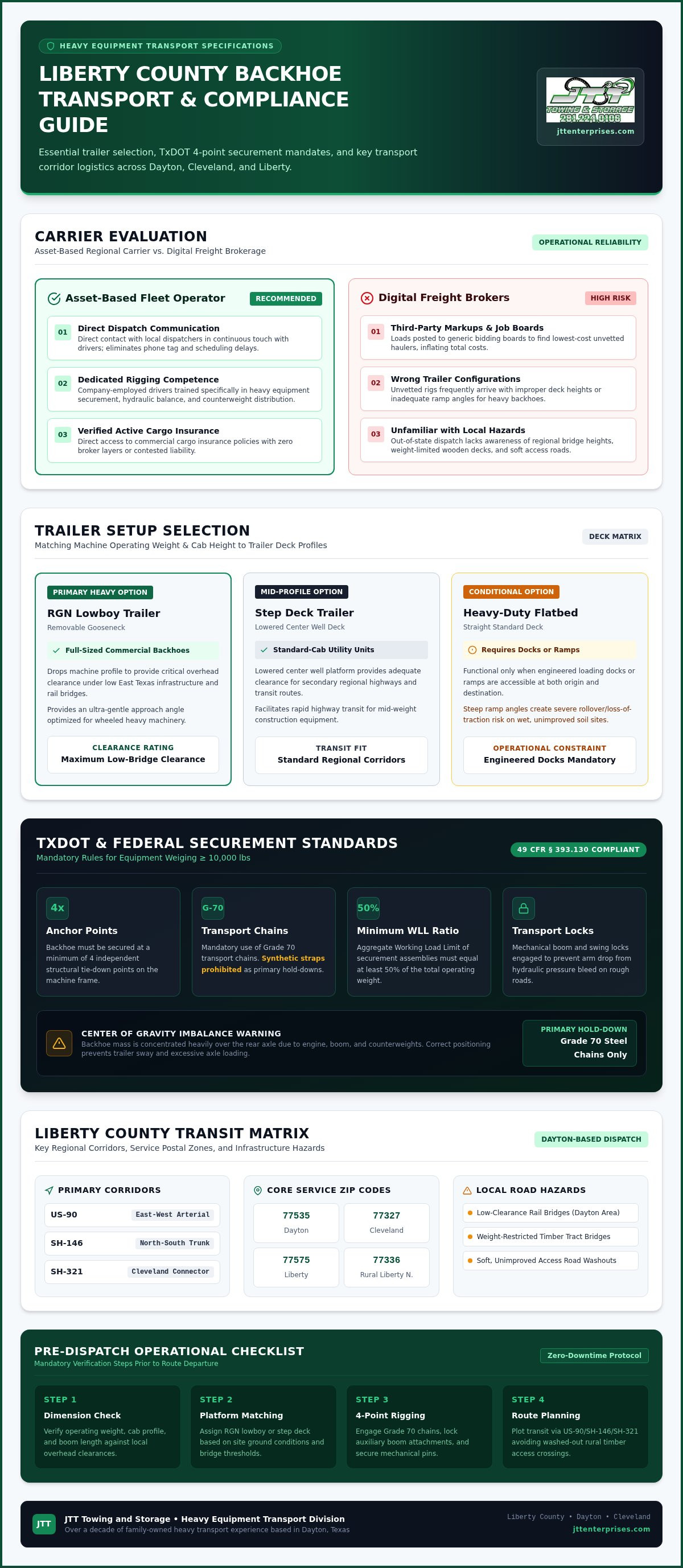
Securing heavy machinery transport in East Texas requires choosing between two fundamentally different business models: national digital freight brokers and asset-based regional haulers. Digital brokers operate as middlemen, posting your load onto generic job boards to find whoever is willing to haul it for the lowest bid. This disconnect often leads to unvetted rigs, miscommunicated arrival windows, and transport trailers ill-equipped for a heavy backhoe loader. In contrast, working directly with an established local fleet gives you immediate accountability and equipment precision from start to finish.
Asset-Based Haulers vs. Digital Freight Brokers
When you hire an asset-owned carrier, you work with the team that owns the trucks, maintains the rigging, and employs the drivers. This setup protects your machinery and job timeline in three distinct ways:
- Direct Communication: You speak straight to local dispatchers who remain in contact with the driver, preventing phone tag and scheduling delays.
- Rigging Competence: Company drivers undergo specific heavy equipment securement training, ensuring your machinery's hydraulic arms and counterweights are balanced properly.
- Direct Insurance Verification: You review the carrier's active commercial cargo policy directly without third-party broker confusion or contested liability.
Contractors seeking a dependable backhoe transport service Liberty County worksites can rely on quickly discover that dealing directly with the equipment owner prevents expensive misunderstandings.
Local Knowledge Matters for Liberty County Contractors
East Texas geography creates unique logistics problems that distant call centers simply do not understand. A broker sitting in another state won't know about low-clearance rail bridges near Dayton or weight-restricted wooden deck crossings tucked away in rural timber tracts. Moving heavy earthmoving machinery across key postal zones like 77535, 77327, 77336, and 77575 requires drivers who run these corridors daily.
Local asset haulers know which county roads wash out after heavy rains and which unimproved jobsites demand specialized off-road recovery capability if a loaded trailer loses traction. With over a decade of family-owned heavy transport experience based right in Dayton, our team dispatches equipment with full awareness of regional infrastructure. That ground-level insight keeps your machines moving safely between active commercial sites across Liberty, Cleveland, and Dayton without unexpected detours or structural fines.
Selecting the Right Trailer Setup for Safe Backhoe Hauling
Hauling a backhoe loader demands careful attention to weight distribution and physical dimensions. These machines carry an uneven center of gravity, with the engine, rear boom, and counterweights concentrating immense mass over the rear axle. Getting trailer dimensions wrong risks overhead strikes on utility lines or trailer sway on rural curves. A reliable safe backhoe hauling plan begins with matching your specific machine build to the correct deck profile.
Comparing Lowboy, Step Deck, and Flatbed Trailers
Trailer selection depends on operating weight, cab profile, and loading conditions:
- Removable Gooseneck (RGN) Lowboys: Essential for full-sized commercial backhoes. The low deck drops the machine's profile, providing crucial overhead clearance under East Texas bridges while offering a gentle approach angle for wheeled machines.
- Step Deck Trailers: Well-suited for standard-cab utility units. The lowered center well provides adequate bridge clearance while allowing easy transit along regional highways.
- Heavy-Duty Flatbeds: Functional when loading docks or engineered ramps are available on both ends. Steep ramp angles, however, make flatbed loading risky on wet, unimproved job sites.
DOT Chain Securement and Attachment Safety Standards
Federal regulations mandate strict tie-down rules for heavy equipment weighing 10,000 pounds or more. Haulers must secure the backhoe at four independent anchor points using Grade 70 transport chains. The aggregate working load limit of these securement assemblies must equal at least 50% of the machine's total operating weight. Synthetic straps are never acceptable as primary hold-downs for heavy earthmoving machinery.
Mechanical transport locks are equally critical. Hydraulic cylinders naturally bleed pressure during transit, especially over rough secondary roads. If an arm drops during transit, it creates an immediate hazard. Drivers must engage mechanical transport lock pins on both the front loader arms and the rear backhoe boom before transit. Furthermore, any auxiliary attachments, like hydraulic breakers or extra ditching buckets, require their own independent chains secured directly to the trailer deck.
Securing the proper trailer setup protects both your capital investment and public safety. If you need dedicated trailer capacity and experienced rigging from a trusted backhoe transport service Liberty County contractors rely on, consult with the heavy haul division at JTT Towing and Storage before your next equipment move.
Step-by-Step Preparation Checklist Before Equipment Dispatch
Thorough job site preparation prevents transport delays, road hazards, and unexpected equipment damage. Before the transport rig pulls up to your location, your crew should complete a systematic walkaround to ensure the machinery is road-ready. Booking a professional backhoe transport service Liberty County builders depend on works best when both the equipment and the staging area are fully prepped for immediate rigging.
Machine Walkaround and Physical Load Preparation
Mechanical preparation protects delicate components during high-speed highway transit:
- Clean Undercarriage and Tires: Pressure wash heavy clay and packed mud from wheels, rims, and stabilizers. Dislodged debris on state highways creates severe hazards for following motorists and exposes you to liability.
- Confirm Exact Dimensions: Measure the machine with buckets retracted in their lowest transit configuration. If your backhoe's height on the trailer exceeds 14 feet or its total width exceeds 8 feet 6 inches, your carrier must pull permits under state regulations. You can review official Texas Oversize/Overweight Permit requirements to verify standard dimensional thresholds.
- Protect Critical Engine Parts: Cover the exhaust stack securely. Air forced down an open stack while driving at highway speeds spins the turbocharger without oil pressure, causing premature bearing failure.
- Secure Enclosures and Fluids: Lock cab doors, latch side engine cowlings, and tighten fuel and hydraulic reservoir caps. Remove loose hand tools, chains, and grease guns from the operator cab.
Evaluating Job Site Access and Staging Areas
A heavy transport rig requires substantial room to maneuver. Lowboy combinations need broad turning radii and solid ground to safely load 20,000-pound machines. Liberty County's sandy loam and clay turn slick quickly after Gulf storms, making site evaluation critical.
Verify that tree branches and low-hanging service drops along the entrance maintain adequate clearance for a high-profile load. Designate a staging pad on compacted crushed stone or stable ground so the trailer outriggers and ramps don't sink during loading. Finally, appoint an on-site point of contact who remains reachable by phone to meet the driver, confirm property boundaries, and sign bill-of-lading documents without stalling the schedule.
Navigating Liberty County Routes, TxDOT Rules, and Rural Terrain
Hauling heavy construction equipment across Southeast Texas requires an understanding of both state regulatory compliance and localized geography. Transporting machines along primary corridors like US-90, SH-146, and State Highway 321 involves strict weight distribution limits, low clearances, and soft shoulders. Relying on an experienced backhoe transport service Liberty County contractors trust ensures your machinery moves along pre-vetted routes without costly fines or bridge delays.
TxDOT Oversize Regulations and Permitted Corridors
Moving a backhoe safely means operating within Texas Department of Transportation legal limits. Any transport load exceeding 8 feet 6 inches in width, 14 feet in height, or 80,000 pounds gross vehicle weight requires specialized state permitting. A standard single-trip oversize permit starts at a $60 base fee, but running permitted loads also restricts your travel windows and route options.
Older railway overpasses along the US-90 corridor present tight vertical margins for high-cab backhoes secured on standard flatbeds. Meanwhile, secondary farm-to-market roads often have lower axle weight tolerances that dictate specific multi-axle trailer spacing. Local drivers plan around these structural bottlenecks daily, avoiding weight-restricted county crossings near the Trinity River watershed and taking designated industrial freight lanes.
Tackling Trinity Basin Mud and Rural Job Site Challenges
Job sites off unimproved rural roads present severe ground stability challenges. The dense gumbo clay common to the Trinity River basin holds rainwater for days, turning stabilized entry roads into slippery quagmires under the weight of a loaded semi-trailer. Long-distance haulers unfamiliar with coastal plain soil often drop trailer tires into soft ditches, trapping equipment right at the job site gate.
Solving on-site access problems requires equipment flexibility. When unpaved rights-of-way give out, working with a carrier that maintains dedicated winching assets makes all the difference. Discover practical strategies for managing difficult site extractions through specialized off-road heavy recovery. Should an unexpected mechanical breakdown disable your machine on public right-of-ways, examine commercial heavy duty towing options designed for massive equipment transport.
When you encounter demanding regional routes and uncertain terrain, partner with a carrier equipped to handle transport and recovery simultaneously. Contact JTT Towing and Storage to coordinate your next heavy backhoe transport with confidence.
Booking Fast, Dependable Equipment Hauling with JTT in Dayton
Coordinating equipment transport shouldn't mean navigating anonymous digital dispatch boards or leaving messages with distant call centers. At JTT Towing and Storage, we run an asset-owned fleet stationed directly in Dayton, Texas. When contractors call our local facility, they speak directly with professionals who understand their machinery requirements, site access parameters, and project urgency. Securing a reliable backhoe transport service Liberty County contractors depend on comes down to local accountability and proven field capability.
The Advantage of a Dayton-Based Equipment Fleet
Operating from a centralized Dayton location allows our transport units to mobilize quickly across Southeast Texas. We provide direct dispatch throughout key regional hubs, including Dayton, Huffman, Cleveland, and Liberty, covering primary zip codes like 77535, 77327, 77336, and 77575.
Our drivers live and work in these communities. They know which rural approaches withstand loaded equipment trailers and which paths create clearance issues. Local dispatch makes coordinating project timelines simple:
- Targeted Arrival Windows: Staging machinery moves around your project schedule ensures crews aren't left waiting on delayed equipment drops.
- Direct Driver Coordination: Dispatchers communicate job site hazards, gate codes, and ground conditions directly to the rig operator before departure.
- Local Route Selection: Drivers take the safest, most efficient highways and county roads to keep machines out of congested corridors.
Comprehensive Fleet Logistics and Asset Security
Commercial equipment logistics frequently demands more than simple point-to-point transit. Project schedules change, job sites get rained out, and active leases expire before new work zones are prepped. If your delivery destination isn't ready to receive machinery, we provide safe staging through our dedicated commercial vehicle storage facility, keeping your equipment protected in an asset-secured yard until your site reopens.
Our complete service model also protects your investment on the roadway. Operating asset-owned heavy haulers and heavy wreckers allows us to handle unforeseen field emergencies without relying on third parties. Should severe highway incidents occur, our specialized tractor trailer accident recovery crew delivers immediate clearance and heavy recovery support.
Protect your job timelines and equipment investments with an established local carrier. Call our Dayton dispatch office today to discuss your machine specifications and schedule professional backhoe transport service Liberty County builders count on for every major build.
Secure Reliable Heavy Equipment Hauling for Your Next Job Site
Keeping heavy construction projects on schedule requires dependable equipment transport you don't have to second-guess. Long-term success starts with pairing your machine with the correct trailer deck, adhering strictly to four-point chain securement, and selecting routes engineered for heavy axle loads. When you bypass unvetted brokers and partner with an asset-backed backhoe transport service Liberty County builders trust, you protect your machinery and eliminate costly job site delays.
JTT Towing and Storage brings over a decade of family-owned heavy transport experience to Dayton, Liberty, Cleveland, and Huffman. Our asset-owned fleet features specialized trailers, heavy recovery wreckers, and off-road winch-out equipment ready to manage challenging East Texas soil conditions. Ready to keep your machinery moving safely between worksites? Schedule your equipment transport with JTT Towing and Storage today and get your earthmoving assets positioned for success.
Frequently Asked Questions
How much advance notice is required to schedule backhoe transport in Liberty County?
Scheduling 24 to 48 hours in advance is standard for planned equipment moves, though local carriers can often accommodate shorter timelines depending on daily fleet availability. Advance notice ensures the hauler reserves the ideal trailer deck and verifies local route clearances across Dayton, Liberty, and Cleveland. It also provides time to verify transit requirements if your equipment configuration approaches state dimensional thresholds.
Can a standard flatbed trailer safely move a full-size backhoe loader?
Standard flatbed trailers can move compact utility backhoes, but full-size commercial models usually require a step deck or lowboy RGN trailer. A high deck on a standard flatbed often pushes a cabbed backhoe over the 14-foot legal height limit, increasing overhead strike risks on regional bridges. Lowboy trailers lower the center of gravity and provide gentle ramp angles for safe loading on unimproved job sites.
Do I need special oversize permits to transport a backhoe in Texas?
You only need a TxDOT oversize permit if the total load exceeds 8 feet 6 inches in width, 14 feet in height, or 80,000 pounds gross vehicle weight. Most standard backhoes loaded onto a lowboy trailer stay within legal dimensional envelopes. However, wide auxiliary ditching buckets or oversized attachments can exceed standard widths, requiring a single-trip state permit before transit begins along public roadways.
What happens if the transport truck gets stuck on a muddy rural job site?
If a transport rig loses traction in heavy clay, a full-service carrier utilizes on-board winches or dispatches heavy wreckers to perform an off-road recovery. Unlike third-party freight brokers who leave contractors stranded to find their own tow trucks, an asset-backed backhoe transport service Liberty County builders rely on provides integrated recovery support. This capability ensures your equipment and the transport truck get extracted without costly delays.
How should backhoe attachments and buckets be secured during transit?
All movable attachments, including the front loader bucket and rear backhoe boom, must be lowered completely to the trailer deck and locked with mechanical transport pins. Federal regulations mandate that auxiliary attachments, such as hydraulic breakers or spare trenching buckets, receive independent Grade 70 chain tie-downs separate from the machine's four-point chassis securement. This prevents hydraulic drift or shifting loads during highway transit across uneven county roads.
Are backhoes insured against damage while on the transport trailer?
Legitimate commercial carriers carry active commercial cargo insurance that protects heavy machinery during transit, loading, and unloading. You should always request a direct Certificate of Insurance from the carrier to verify policy limits before scheduling your move. Working directly with an asset-owned carrier eliminates the confusion and coverage gaps often found with digital freight brokers who don't maintain their own primary cargo policies.
Can backhoe transport services accommodate emergency or same-day site transfers?
Local haulers can frequently handle urgent site transfers depending on trailer availability and daily dispatch volume. Working with a dedicated Dayton-based backhoe transport service Liberty County crews trust makes emergency staging much faster than waiting on long-distance broker networks. Contact dispatch directly with your machine's exact weight, pick-up location, and destination coordinates across local zip codes like 77535 or 77327 to coordinate rapid equipment hauling.


