
With Texas recording 21,787 commercial motor vehicle crashes in just the first six months of 2026, the greatest financial risk to your fleet often begins after the wheels stop turning. An overturned tractor-trailer frequently suffers more catastrophic structural loss during hasty recovery winching than from the initial rollover. You already know the intense pressure of meeting strict highway clearance windows while trying to keep high-value freight intact. Handling a commercial semi truck accident recovery Texas logistics corridors demand requires calculated engineering rather than brute force.
In this guide, you'll learn the exact technical, regulatory, and rigging standards required for safe commercial semi truck accident recovery across Texas. We examine advanced uprighting methods, cargo load transfers, and incident management protocols that keep your equipment protected, your drivers safe, and your fleet fully compliant on state roadways.
Key Takeaways
- Establish rapid scene containment to satisfy strict TxDOT clearance directives while maintaining full compliance with Texas Move Over laws.
- Learn how multi-point rigging lines and heavy rotators execute safe semi truck accident recovery Texas fleets rely on to prevent structural frame twisting.
- Discover proven load shift stabilization and roadside cargo transloading techniques that preserve high-value freight integrity after an overturn.
- Master off-road recovery strategies designed to extract heavy commercial vehicles from muddy soft shoulders and rural East Texas terrain without worsening equipment damage.
- Streamline post-incident claims and logistics by utilizing secure vehicle storage facilities prepared for detailed insurance appraisals and structural repairs.
Emergency Scene Protocol: Texas Highway Clearance and Safety Standards
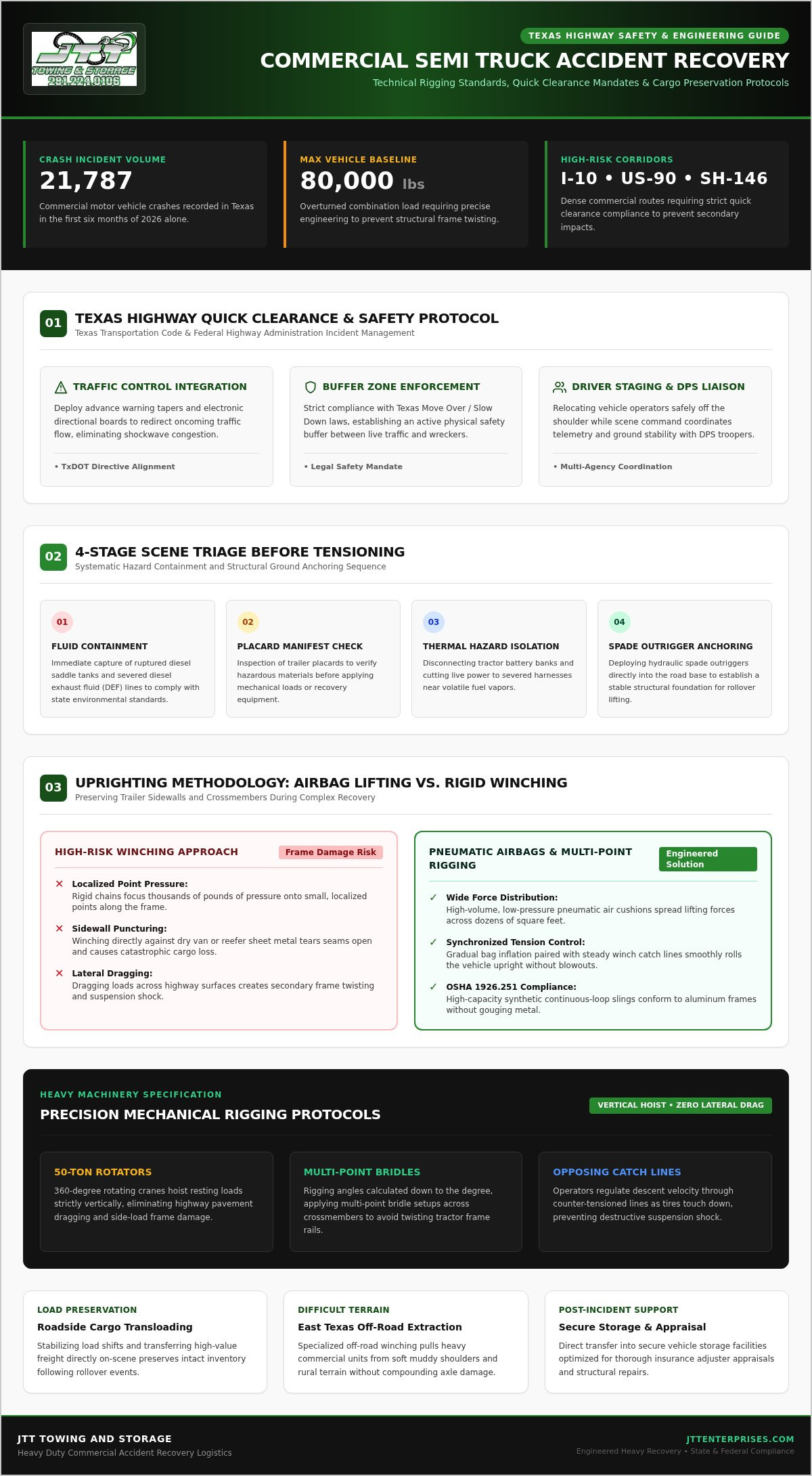
When an 80,000-pound combination vehicle overturns, the immediate operational priority shifts to scene containment under Federal Highway Administration guidelines. High-volume freight corridors like US-90, I-10, and State Highway 146 carry dense commercial traffic. A disabled tractor-trailer across these lanes rapidly creates shockwave congestion, dramatically raising the risk of severe secondary impacts. Recovery teams must coordinate directly with Texas Department of Public Safety troopers to secure the perimeter before evaluating ground stability. Technicians analyze vehicle telemetry, resting angles, and pavement gouging prior to tensioning a single line, ensuring physical clearance doesn't compromise highway safety.
Texas Quick Clearance Mandates for Commercial Corridors
Texas Transportation Code mandates quick clearance for disabled vehicles obstructing active roadways. Clearing lanes swiftly restores freight mobility and prevents rear-end collisions in traffic queues. Achieving rapid reopening without causing extra equipment damage requires structured execution:
- Traffic control integration: Deploying advance warning tapers and electronic directional boards to redirect oncoming traffic safely.
- Buffer zone enforcement: Complying with Texas Move Over/Slow Down laws, maintaining a physical safety buffer between live traffic and operating wreckers.
- Staging driver safety: Relocating vehicle operators to secure positions well off the roadway shoulder while scene command coordinates with transportation officials.
A successful tractor trailer accident recovery balances urgent roadway reopening with calculated rigging discipline, avoiding hasty winching decisions that can twist damaged vehicle frames.
Initial Incident Scene Triage and Hazard Mitigation
Before moving any heavy iron, technicians execute an immediate environmental and electrical triage. Fractured saddle tanks and ruptured diesel exhaust fluid lines demand fast containment to prevent environmental contamination and comply with state spill standards. Operators inspect trailers for hazardous cargo placards to verify manifest contents before introducing tension.
Crews quickly neutralize ignition risks by disconnecting tractor battery banks, cutting power to severed wiring harnesses near leaking fuel vapors. After mitigating thermal hazards, modern heavy-duty tow trucks deploy hydraulic spade outriggers into the road base. Anchoring into stable ground establishes the structural foundation required for the controlled semi truck accident recovery Texas carriers depend on during complex rollover events.
Advanced Rigging and Machinery in Heavy Duty Accident Recovery
Uprighting an overturned commercial rig requires precise mechanical engineering rather than raw pulling capacity. Deploying 50-ton heavy wreckers and 360-degree rotating cranes allows operators to hoist resting loads vertically while eliminating lateral drag against highway surfaces. Technicians calculate rigging angles down to the degree, applying multi-point bridle setups across crossmembers to avoid twisting the tractor's frame rails. As the combination vehicle breaks ground contact, operators regulate descent velocity through opposing catch lines. This controlled counter-tension prevents suspension damage when tires touch down, preserving drivable components for post-incident transit.
Airbag Recovery vs. Heavy Mechanical Winching
When dry van trailers or refrigerated reefers roll on their sides, mechanical winching often cuts directly through thin exterior sheet metal. Rigid chains focus thousands of pounds of pressure onto localized sections, ripping seams open. Advanced pneumatic recovery bags solve this mechanical challenge entirely:
- Force distribution: High-volume, low-pressure air cushions slide uninflated under the sidewall, expanding to spread lifting forces across dozens of square feet.
- Sidewall integrity: Airbags lift fully loaded trailers gently off road shoulders, preventing catastrophic skin blowouts and cargo loss.
- Synchronized tensioning: Recovery crews pair gradual pneumatic inflation with steady winch catch lines to roll the vehicle upright smoothly.
Following strict OSHA rigging equipment standards, recovery specialists replace traditional steel chains with high-capacity synthetic continuous-loop slings. These wide, protective straps conform cleanly to aluminum trailer frames without puncturing exterior walls.
Managing Jackknife Incidents and Articulation Failures
Severe jackknife incidents frequently bind the fifth wheel plate tightly against a bent kingpin. Forcing these pieces apart with heavy winches twists structural tractor components, turning a manageable mechanical failure into a total loss. Teams isolate binding friction by elevating trailer front corners with hydraulic booms, relieving downward pin stress before carefully detaching the plate.
Once separated, operators address locked drivelines, snapped steering linkages, and seized air brakes. Technicians manually cage compromised spring brake chambers and pull axle shafts curbside so wheels roll freely. Pairing technical rigging with specialized machinery through reliable heavy duty towing Dayton TX services ensures rolling stock loads directly onto lowboys without structural distortion. For fleet managers confronting articulated rollovers, partnering with experienced specialists at jttenterprises.com keeps complex semi truck accident recovery Texas operations safe, stable, and cost-effective.
Cargo Preservation, Load Shifts, and Environmental Remediation
Cargo damage often exceeds the physical damage to the tractor and trailer combined. Severe collision forces cause heavy freight to break internal restraints and slide violently, pinning tens of thousands of pounds against exterior walls. Attempting to tow a trailer with an off-center center of gravity invites structural collapse or secondary rollovers during transit. Seasoned recovery teams deploy telehandlers, skid steers, and roll-off boxes directly to the roadside. These units collect spilled inventory, restack scattered pallets, and secure high-value freight before the tow vehicle pulls onto the road.
On-Site Trailer Load Transfers and Cargo Shifting
Towing a damaged trailer with an active load shift violates federal cargo securement rules and risks highway safety. Technicians evaluate load distribution before moving the rig, executing immediate mitigation steps:
- Load re-balancing: Leveling shifted palletized cargo inside the trailer using heavy jacks and walk-behind equipment to restore safe axle weights across tandems.
- Roadside cross-docking: Transloading palletized goods or temperature-sensitive refrigerated freight directly into replacement trailers parked alongside the incident zone.
- Chain of custody documentation: Recording broken seal tags, photographing freight condition, and logging revised bill-of-lading counts for cargo adjusters and insurance verifications.
Performing these transfers efficiently protects freight integrity while keeping the comprehensive semi truck accident recovery Texas logistics networks rely on moving forward without unnecessary delays. For ecommerce businesses looking to safeguard their inventory through dependable warehousing and pick-and-pack distribution, check out Boost3PL.
Diesel Spill Containment and Soil Remediation
Ruptured aluminum saddle tanks release hundreds of gallons of fuel within minutes, threatening roadside ditches, storm drains, and local waterways. Recovery personnel deploy hydrocarbon-absorbent booms, containment berms, and pneumatic non-sparking transfer pumps to offload remaining fuel before uprighting the chassis.
Under Texas Commission on Environmental Quality (TCEQ) mandates, hazardous fluid discharges must be reported within 24 hours of discovery. Beyond clearing the wreckage, recovery operators excavate fuel-saturated roadside soil and contaminated gravel ballast. Crews package contaminated earth into approved disposal drums, ensuring the site meets rigorous state environmental standards before the road reopens.
Off-Road and Difficult Terrain Recovery Across East Texas
East Texas presents unique geographical obstacles that punish standard towing equipment. Heavy rainfall routinely saturates roadside borrow ditches, transforming road shoulders into deep gumbo mud. When an 80,000-pound rig leaves the asphalt along Liberty County freight lanes, the tractor and loaded trailer sink past their hubs within seconds. Winching a buried vehicle without calculating resistance coefficients almost guarantees severe damage. Surface muck can double the effective weight of an articulated combination, risking severed kingpins and torn tandem suspension mounts. Technicians mitigate this risk by driving spade outriggers through soft topsoil into solid substrata, creating immovable anchor points on highway shoulders.
Navigating Soft Shoulder Rollovers and Steep Embankments
Pulling directly against a steep ditch embankment acts like winching into a solid brick wall. Uprighting a unit stuck in a ravine demands deliberate, multi-directional rigging:
- High-angle lift lines: Using elevated rotator booms to lift the tractor upwards out of the soil suction zone before initiating lateral movement toward the roadway.
- Mediated line deflections: Rigging synthetic snatch blocks and tree savers around mature timber in wooded medians, directing pulling power precisely without stripping bark or snapping cables.
- Tandem harness rigging: Securing heavy recovery straps across primary suspension crossmembers rather than pulling by axle tubes, preventing component detachment.
For fleets dealing with severe off-road ditching, review comprehensive extraction approaches outlined in our guide on semi truck rollover recovery.
Waterway and Bayou Commercial Vehicle Extraction
Coastal plain bayous and standing drainage water introduce steep environmental and mechanical hazards. Submerged tractors lose electrical integrity instantly, while deep water complicates line attachment points on submerged frames. Technicians deploy specialized recovery divers to set rigging around main chassis components beneath dark water lines.
Crews place floating absorbent curtains around the perimeter to catch transmission fluid and engine oil before extraction begins. Uprighting the rig out of the mud bed requires gradual hydraulic hoist maneuvers to break surface suction without cracking submerged frame rails. When high-value assets slip off waterlogged roadways, contact the recovery team at jttenterprises.com to mobilize specialized off-road units built for harsh East Texas terrain. Their field-tested extraction methods deliver the exact mechanical control needed for demanding semi truck accident recovery Texas freight operators encounter.
Post-Recovery Logistics: Secure Storage, Repairs, and Fleet Support
Clearing the roadway is only half the battle. Once damaged equipment leaves the highway, carriers face the operational hurdle of asset protection. Delivering tractors, trailers, and cargo to a secure vehicle storage facility prevents secondary theft and vandalism while claims process. Rapid post-incident logistics also protect a motor carrier's safety profile by quickly isolating compromised equipment from ongoing fleet operations. Providing insurance adjusters immediate, well-organized access speeds up claim evaluations, helping fleets settle cargo losses or approve repairs without weeks of stalled revenue.
Secure Fleet Storage and Cargo Chain-of-Custody
Commercial freight requires strict containment protocols to prevent loss after an impact. Regulated yards feature continuous perimeter fencing, automated gates, and recorded video surveillance to maintain total physical security:
- Asset protection: High-value trailers and transloaded freight stay shielded inside gated, monitored storage grounds.
- Adjuster accessibility: Clean inspection lanes allow crash reconstructionists and insurance appraisers to perform frame measurements and black-box downloads safely.
- Chain-of-custody logging: Detailed intake records establish clear evidentiary custody for law enforcement and carrier safety directors.
To explore dedicated yard safeguards, review our detailed guide covering commercial vehicle storage Dayton standards.
Commercial Truck Diagnostics and Fast-Track Repair
Not every incident totals an asset. After completing the physical semi truck accident recovery Texas highways require, mechanical specialists inspect the tractor's underlying drive systems. Technicians run diagnostic evaluations on air brake lines, steering linkages, tandem suspension hangers, and electrical harnesses.
This methodical evaluation separates straightforward mechanical fixes from unrepairable structural frame twists. Partnering with an experienced provider like JTT Towing and Storage connects heavy recovery directly with professional mechanical repair and secure yard facilities. Handling recovery, storage, and mechanical diagnostics under one roof eliminates third-party shuttle fees, returning viable commercial tractors to service safely and efficiently.
Protect Your Fleet Assets with Precision Commercial Recovery
Safeguarding commercial investments after an overturn requires tactical precision rather than hurried pulling. From coordinating quick highway clearance with state troopers to engineering multi-point rotator lifts, disciplined execution protects equipment and prevents secondary cargo loss. Managing shifted freight roadside and securing tractor-trailers in monitored facilities ensures your carrier safety profile stays intact long after lanes reopen.
When roadside emergencies strike, complex rollovers don't have to derail your entire operation. Backed by over 10 years serving Dayton, Liberty County, and Southeast Texas freight corridors, JTT Towing and Storage operates heavy rotators, pneumatic airbag uprighting systems, secure storage yards, and in-house commercial repair facilities. For dependable results across every phase of semi truck accident recovery Texas logistics demand, contact JTT Towing and Storage for dedicated heavy recovery dispatch and keep your business moving forward with confidence.
Frequently Asked Questions
What should a fleet dispatcher do immediately following a semi truck accident in Texas?
Contact emergency responders to confirm driver safety first, then dispatch a qualified commercial heavy recovery operator. Collect precise mile markers, cargo manifest details, hazard placard classes, and tractor telemetry. Alert your safety department and insurance carrier promptly. Establishing direct contact with a dedicated recovery provider helps your fleet retain control over vehicle storage, cargo transloading, and incident handling rather than defaulting to rotation lists.
How does airbag recovery prevent secondary damage to overturned commercial trailers?
Airbag recovery spreads lifting forces across wide surface sections instead of concentrating stress on narrow contact points. Traditional steel chains focus thousands of pounds of tension into thin sidewalls, ripping exterior sheet metal. High-volume, low-pressure pneumatic bags slide underneath the trailer and inflate gradually. This controlled lift distributes weight evenly, preserving structural crossmembers and keeping cargo secure during complex semi truck accident recovery Texas rollovers require.
What equipment is required to recover a loaded 80,000-pound semi truck from a ditch?
Extracting a fully loaded commercial combination requires a 50-ton heavy wrecker or rotating crane supported by hydraulic outrigger spades. Operators utilize high-capacity synthetic continuous-loop slings, snatch blocks, and auxiliary winch units to overcome suction resistance in deep mud. In rural East Texas corridors across Dayton and Liberty County zip codes like 77535 and 77327, specialized off-road equipment anchors securely to avoid collapsing soft road shoulders.
Who is responsible for cargo cleanup and diesel fuel remediation on Texas highways?
The motor carrier operating the commercial vehicle bears legal responsibility for freight salvage and environmental cleanup under Texas law. The Texas Commission on Environmental Quality enforces strict rules requiring responsible parties to restore accident sites to pre-spill condition. Professional recovery teams deploy containment berms, non-sparking transfer pumps, and soil excavation gear to eliminate hazardous fuel runoff before state reporting deadlines expire.
Can an accident-damaged semi truck be repaired directly after recovery?
Yes, viable commercial trucks can transition straight from the recovery scene to specialized mechanical repair facilities. Comprehensive providers like JTT Towing and Storage combine heavy recovery with dedicated mechanical diagnostic shops. Technicians evaluate air brake lines, suspension hangers, steering linkages, and driveline integrity post-incident. Handling mechanical repairs and storage under one roof saves carriers time and avoids third-party transit expenses.
How quickly must an accident scene be cleared according to Texas Department of Transportation rules?
Texas law requires disabled vehicles obstructing active travel lanes to be cleared as quickly and safely as possible. Under Texas Transportation Code incident management directives, law enforcement and TxDOT personnel maintain statutory authority to clear roadways immediately to prevent secondary pileups. Working with experienced heavy incident specialists ensures fast lane clearance while avoiding hasty, uncontrolled pulls that cause unnecessary structural damage.
What is the difference between standard heavy towing and technical heavy recovery?
Standard heavy towing transports rolling or mechanically disabled vehicles using basic underlifts and safety chains. In contrast, technical semi truck accident recovery Texas corridors demand involves advanced rigging calculations, multi-point winch angles, and specialized machinery. Technical recovery addresses overturned trailers, severe jackknifes, off-road ditch extractions, roadside load transfers, and fluid remediation where vehicles cannot simply roll away under tow.


