
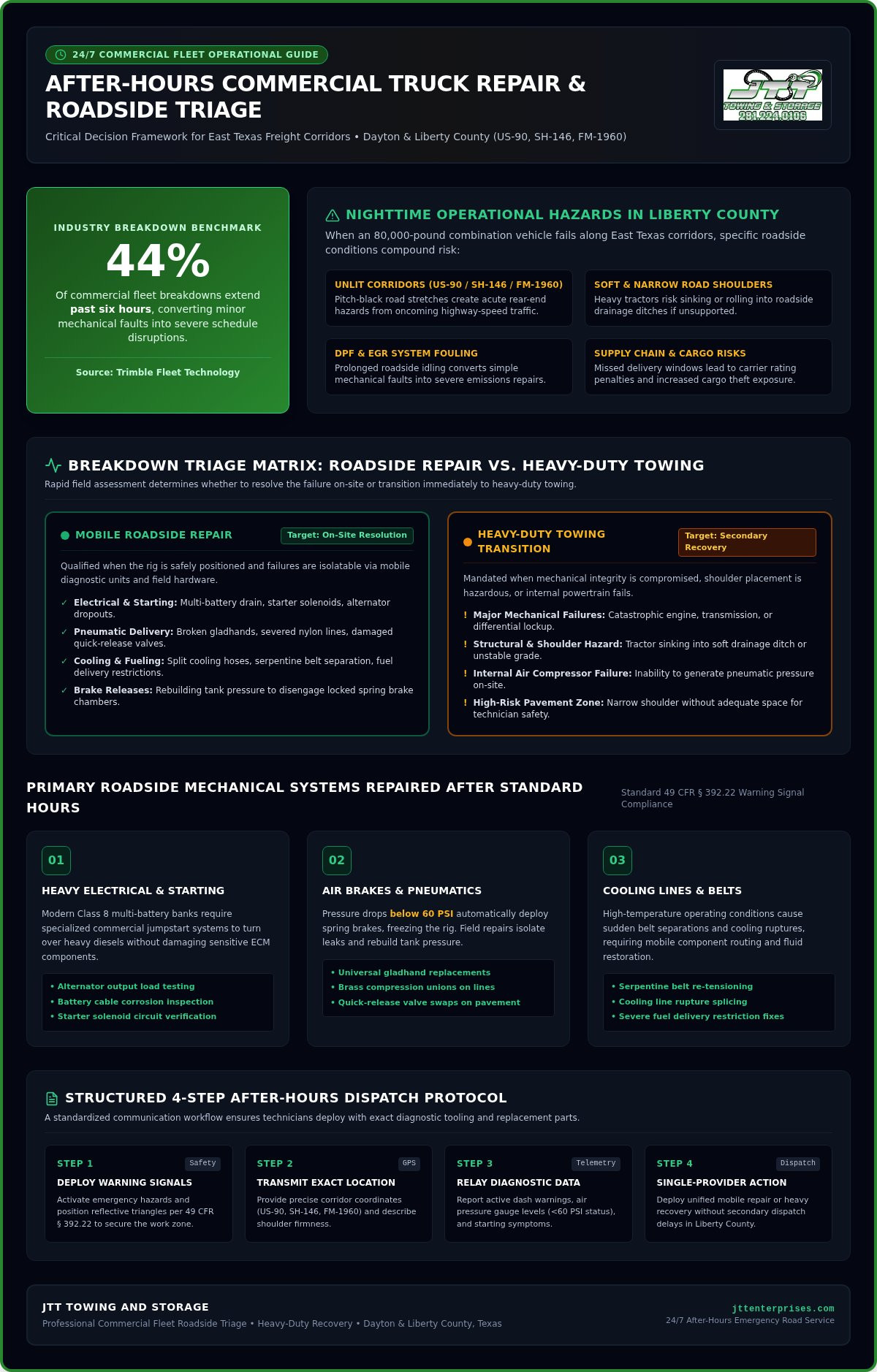
According to Trimble Fleet Technology, 44 percent of commercial fleet breakdowns extend past six hours, turning a manageable mechanical failure into a severe disruption for your delivery schedule. When your rig derails on an unlit shoulder of US-90 or SH-146 late at night, locating reliable after hours truck repair Dayton operators can trust becomes an urgent race against the clock.
You already know that every hour spent stranded on an East Texas highway shoulder drains operating margins, creates serious safety concerns, and risks steep delivery penalties. The uncertainty of whether an air leak or sensor fault requires an immediate tow only adds unnecessary stress when freight deadlines are looming.
Discover how 24/7 after hours truck repair in Dayton gets commercial rigs rolling fast without costly delays by resolving mechanical faults right where you sit. This guide outlines vital roadside safety requirements, clear triage criteria for mobile fixes versus heavy-duty towing, and the practical advantages of working with proven local technicians in Liberty County.
Key Takeaways
- Understand how mobile triage during after hours truck repair Dayton dispatches isolates fast fixes from major mechanical failures to keep your loads moving.
- Identify which common breakdowns, such as air line leaks, charging faults, and fuel delivery issues, qualify for safe roadside resolution.
- Recognize the clear operational thresholds that indicate when a commercial rig must transition from mobile roadside repair to heavy-duty towing.
- Master a structured four-step dispatch protocol that gives technicians the exact GPS and diagnostic data needed for rapid response.
- Learn how single-provider recovery in Liberty County prevents secondary dispatch delays and simplifies roadside scene management.
Emergency After Hours Truck Repair in Dayton: Critical Roadside Triage
Late-night mechanical failures along commercial freight corridors in East Texas demand immediate intervention. When an 80,000-pound combination vehicle loses air pressure or throws a serpentine belt at 2:00 AM, standard daytime business hours offer zero help. Engaging reliable after hours truck repair Dayton operators can trust ensures that trained technicians arrive on scene with mobile diagnostics, safety lighting, and the tools necessary to stabilize the vehicle.
Professional triage does more than patch equipment. It determines whether roadside mechanical repair is viable or if the incident warrants heavy-duty recovery. Established industry protocols for roadside assistance and breakdown triage prioritize driver safety, cargo protection, and clear mechanical evaluations right on the pavement. Dispatchers assess telemetry and driver feedback immediately, sending fully equipped service units directly to the rig rather than letting freight sit idle.
Nighttime Breakdown Challenges on US-90, SH-146, and FM-1960
Freight corridors such as US-90, SH-146, and FM-1960 feature pitch-black stretches with minimal overhead illumination. Parked commercial rigs face significant rear-end hazards from oncoming traffic traveling at highway speeds. Liberty County also presents notoriously soft, narrow roadside shoulders where heavy tractors can sink or roll into drainage ditches. Professional after-hours responders establish high-visibility safety perimeters with strobe light bars and physical markers to secure the scene before technicians begin mechanical work.
The Economic Cost of Delayed Commercial Fleet Repairs
Unresolved breakdowns quickly escalate beyond mechanical repair bills. Missing a designated delivery window triggers strict supply chain penalties and damages carrier reliability ratings. Prolonged idling during roadside delays also fouls complex diesel particulate filters (DPF) and exhaust gas recirculation (EGR) systems, converting a simple electrical glitch into a costly emissions repair. Stranded freight also attracts cargo theft along isolated corridors, making rapid mechanical dispatch vital for fleet security.
Common Roadside Mechanical Failures Repaired After Standard Hours
Commercial roadside repair is not about guesswork. When a driver contacts dispatch for after hours truck repair Dayton mechanics deploy fully stocked mobile units equipped with heavy diagnostic scanners, commercial charging rigs, and essential replacement hardware. Before turning a wrench, technicians ensure the stopped tractor-trailer adheres strictly to federal commercial vehicle warning signal protocols, confirming reflective triangles and hazard markers protect the physical work zone.
Specialized mobile service units can resolve dozens of high-frequency breakdowns on-site without hauling the vehicle to a bay. Drivers frequently encounter sudden malfunctions that paralyze an 18-wheeler, but seasoned road service teams isolate and repair these systems in place:
- Starting and charging circuit failures, including multi-battery drainage and alternator dropouts.
- Pneumatic delivery faults, such as broken gladhands, split brake lines, and locked spring brakes.
- Cooling line ruptures, belt separations, and severe fuel delivery restrictions.
Heavy-Duty Electrical Diagnostics and Emergency Jumpstart Support
Multi-battery banks on modern Class 8 rigs demand serious amperage to recover from deep drainage. Mobile diagnostic units employ heavy commercial jumpstart systems capable of turning over stubborn diesel engines without frying sensitive ECM components. Field technicians run output tests on the alternator to confirm charging health, inspect battery cabling for corrosion, and troubleshoot starter solenoids to verify whether ignition circuits remain operational.
Air Brake Lines, Governor Failures, and Valve Replacements
Any drop in pneumatic pressure below 60 PSI automatically deploys the tractor-trailer spring brakes, freezing the vehicle where it stands. Roadside technicians swiftly trace air leaks to severed nylon lines, cracked fittings, or compromised gladhand seals. By carrying standard brass compression unions, universal gladhands, and replacement quick-release valves, mobile crews replace damaged air system sections right on the pavement, rebuilding tank pressure to release locked brake chambers safely.
Cooling System, Belts, and Fuel Delivery Troubleshooting
Snapping a serpentine belt kills the water pump and alternator simultaneously, stopping engine operations in seconds. Field mechanics carry universal belt routing tools to install heavy-duty replacements before high temperatures warp cylinder heads. They also tackle sudden fuel starvation by installing fresh filters and priming contaminated systems. When unexpected mechanical issues leave your truck stranded off Highway 90, contacting professional roadside mechanical support ensures fast troubleshooting that avoids multi-day shop queues.
Roadside Repair vs. Heavy Towing: Evaluating the Breakdown
Every commercial breakdown presents a practical decision point: can the rig be fixed safely on the shoulder, or does it require transport to a repair facility? Attempting major repairs inches away from active traffic lanes introduces extreme hazards. Even with broad driver awareness of Move Over safety laws, high-speed corridors leave zero margin for error. A structured evaluation matrix helps fleet managers determine whether to dispatch mobile after hours truck repair Dayton technicians or call an immediate wrecker, preventing wasted roadside labor on irreparable damage.
Field mechanics use systematic criteria to assess physical workspace safety, environmental factors, and component damage. When conditions allow, mobile intervention gets freight moving again within hours:
- Shoulder Width and Surface: Sufficient paved clearance allows mechanics to set jack stands securely without sinking into soft East Texas soil.
- Component Accessibility: Work must be completed without extensive mechanical disassembly directly adjacent to open traffic lanes.
- Repair Time Horizon: Tasks that exceed two hours drain driver hours-of-service clocks, tipping the scale toward transport.
When Mobile Roadside Repair Is the Optimal Solution
Minor air system leaks, frozen fuel delivery circuits, failed pulleys, and accessible coolant hoses make ideal roadside projects. If a technician can resolve the fault using standard hand tools and portable diagnostic software, on-site repair is the quickest path back into service. These rapid fixes keep equipment out of backed-up regional shop queues and protect overall route schedules.
When Heavy-Duty Towing and Shop Transport Become Unavoidable
Severe mechanical failures cannot be solved on the side of the highway. Catastrophic internal engine damage, broken drivelines, snapped axles, and seized wheel hubs demand shop lifts and specialized rebuild tools. Attempting to force these repairs roadside wastes billable time and endangers personnel. In these high-impact scenarios, turning to professional heavy duty towing Dayton TX services ensures safe clearing of the roadway using appropriate under-reach wreckers.
Protecting Cargo and Managing Commercial Load Distribution
Sudden mechanical failures often result in severe cargo shifts inside trailers. Heavy, displaced pallets create dangerous lean angles that risk rollover during roadside jacking. When trailer structural integrity is compromised or transport cannot continue immediately, secure commercial vehicle storage Dayton facilities safeguard valuable freight overnight. Utilizing a single partner capable of shifting loads, towing equipment, and securing distressed assets keeps your entire recovery process coordinated from start to finish.
Step-by-Step Dispatch Protocol for After Hours Truck Support
A breakdown in the middle of the night creates immediate operational pressure. Without a structured intake process, critical details get lost between the driver, company dispatchers, and responding technicians. Establishing clear communication accelerates after hours truck repair Dayton services by ensuring the mobile team departs with the precise diagnostic software, fittings, and tooling necessary for the job.
Following a systematic four-step protocol cuts wasted field time and prevents costly return trips:
- Step 1: Secure and Mark the Rig. Immediately activate hazard lights, pull as far onto the shoulder as safety permits, and deploy warning triangles within ten minutes.
- Step 2: Collect Telematics and Fault Data. Document exact dashboard diagnostic trouble codes (SPN/FMI alerts), gauge behaviors, and fluid symptoms before shutting down systems.
- Step 3: Pinpoint Spatial Coordinates. Transmit exact GPS data, identifying travel direction, nearest mileposts, and adjacent access roads across Liberty County.
- Step 4: Execute Structured Intake. Call local roadside dispatch with trailer freight weights, hazmat status, and vehicle configuration details ready.
Gathering Vital Mechanical and Location Specifications
Modern commercial diesels communicate problems through distinct telemetry. Drivers must record active dash warnings, unusual engine knocking sounds, or sudden pneumatic pressure drops before placing the dispatch call. Noting the specific direction of travel along US-90, cross streets near FM-1960, or landmark structures helps service units navigate directly to the vehicle without searching. Technicians also need to know whether the trailer carries hazardous freight, as specific cargo types require specialized roadside safety precautions.
Securing the Scene and Ensuring Driver Safety
Nighttime highway shoulders present continuous hazards from passing traffic. Drivers must set out reflective triangles at standard intervals behind the vehicle to give high-speed motorists sufficient reaction distance. Keeping emergency hazard lights, side markers, and cab roof lights energized maximizes visibility through fog or heavy rain. Once the perimeter is established, staying belted inside the steel cab offers far greater protection than pacing beside an unlit traffic lane.
When unexpected equipment failures jeopardize your delivery timelines in Liberty County, contact our emergency dispatch team for immediate mechanical evaluation and roadside response.
Why Dayton Fleets Count on JTT Towing and Storage Around the Clock
Commercial fleet operations cannot afford disjointed emergency response when mechanical troubles strike outside standard business hours. JTT Towing and Storage has served Dayton and surrounding East Texas freight corridors as a family-owned and operated business for over ten years. Staged strategically along US-90 and FM 1960, our field units deliver dependable after hours truck repair Dayton drivers trust when every minute spent roadside threatens critical delivery deadlines.
Operating as a unified provider bridges the gap between mechanical roadside support and heavy transport. If a roadside technician determines that engine damage or differential failure exceeds highway repair limits, you do not have to restart your dispatch process from scratch. Our high-capacity heavy-duty wreckers, load transfer equipment, and dedicated asset protection units provide an immediate safety net, resolving mechanical disruptions without uncoordinated secondary contractors.
Rapid Response Across Liberty County and Surrounding Zip Codes
Local geography matters during late-night emergencies. Our dispatch grid covers key regional zip codes, including 77535, 77336, 77327, 77561, 77357, 77532, and 77575. Drivers unfamiliar with East Texas backroads often struggle to describe unlit intersections along SH-146 or rural bypasses. Our seasoned dispatchers know the terrain, marshy shoulder characteristics, and freight routes intimately, ensuring service trucks navigate straight to your exact coordinates without delays.
Seamless Escalation from Roadside Repair to Recovery
When unexpected structural or mechanical failures make highway departures impossible under the truck's own power, our heavy recovery fleet steps in instantly. We deploy heavy-duty wreckers equipped for under-reach towing and specialized rigging to safely pull commercial vehicles from compromised shoulders. For major highway mishaps, explore our specialized tractor trailer accident recovery protocols designed to clear lanes efficiently while preserving tractor and trailer assets.
Securing distressed freight is just as critical as recovering the equipment. Our secure vehicle storage facilities keep loaded trailers and valuable cargo protected under monitored fencing while fleet managers organize relief power units or schedule primary depot maintenance. From simple jumpstarts and airline repairs to complete heavy-duty towing and asset staging, JTT Towing and Storage provides the calm, capable support commercial operators need to stay protected across Liberty County.
Restore Roadside Control and Keep Your Fleet Moving
Commercial schedules don't stop when the sun goes down. Successfully resolving a late-night breakdown comes down to prompt roadside triage, disciplined driver communication protocols, and knowing when a mechanical fault can be solved on the shoulder versus towed to a facility. Securing dependable after hours truck repair Dayton fleets trust turns what could be an expensive logistical disaster into a safe, controlled turnaround.
With over a decade of family-owned commercial service in Liberty County, JTT Towing and Storage delivers comprehensive capabilities spanning mobile mechanical assistance, heavy-duty recovery, and secure vehicle storage. Staged strategically along Dayton's primary freight corridors, our units roll out fast to protect your drivers, stabilize your equipment, and safeguard your cargo.
Contact JTT Towing and Storage for 24/7 heavy truck support whenever sudden equipment failures threaten your delivery timeline. Partnering with a dedicated local team gives you the peace of mind that help is always ready, keeping your drivers safe and your freight rolling forward.
Frequently Asked Questions
How quickly can an after hours mobile mechanic arrive at my breakdown in Dayton?
Response times depend on your exact highway location and traffic, but units staged near US-90 and FM 1960 dispatch promptly. For commercial drivers stranded in Dayton or adjacent areas like 77535 and 77532, technicians aim to mobilize immediately once location details are confirmed. Communicating precise mileposts and access roads allows local crews to navigate East Texas bypasses without navigational delays.
What mechanical truck problems can be repaired directly on the roadside?
Roadside technicians resolve pneumatic leaks, broken belts, charging issues, and fuel line restrictions directly on the shoulder. Common roadside jobs include swapping split gladhand seals, replacing severed air hoses, priming fuel filters, testing alternators, and replacing blown fuses. Tasks requiring heavy machine work, deep engine teardowns, or differential rebuilds cannot be performed roadside and require wrecker transport to a fully equipped shop.
What information should dispatchers provide when calling for after hours truck repair?
Callers requesting after hours truck repair Dayton support should provide precise GPS coordinates, travel direction, and active diagnostic fault codes. It's also essential to relay gross vehicle weight, whether the trailer carries hazardous freight, and specific mechanical symptoms observed before shutdown. Providing complete equipment details upfront ensures dispatchers send the proper service truck, diagnostic tools, and replacement components on the very first run.
Can heavy-duty commercial truck jumpstarts be performed safely after hours?
Yes, specialized service units utilize heavy-duty commercial jumpstart equipment designed specifically for multi-battery 12-volt and 24-volt electrical systems. Professional mechanics verify correct polarity, inspect terminal cables for corrosion, and monitor voltage output to prevent surges that could fry sensitive engine control modules. Staging high-output booster systems on-site gets stalled Class 8 diesel engines turning over quickly without creating secondary electrical damage.
What happens if a mechanical breakdown cannot be fixed on the highway shoulder?
If on-site troubleshooting reveals catastrophic damage like a seized engine, broken driveline, or sheared axle, the situation shifts immediately to heavy-duty towing. A full-service provider deploys heavy under-reach wreckers to transport the tractor-trailer off the highway shoulder safely. Drivers also benefit from secure vehicle storage options and load transfer capabilities to protect commercial freight while repair logistics are coordinated.
Is mobile truck repair available on weekends and major holidays in Liberty County?
Fleets should verify specific weekend and holiday dispatch schedules directly with local service providers across Liberty County. Commercial transportation runs continuously, so reliable heavy-duty service operators maintain dedicated standby personnel to handle urgent mechanical interruptions during non-standard hours. Calling local dispatchers in zip codes such as 77535 or 77327 confirms immediate technician availability and estimated travel windows during holiday shifts.
How do roadside technicians ensure scene safety along busy Dayton highway corridors?
Responding crews establish a visible safety perimeter immediately upon arrival by activating amber strobe light bars and auxiliary work lamps. They inspect driver-deployed reflective triangles to confirm proper distance spacing along US-90 or SH-146 in accordance with safety standards. Securing the physical perimeter alerts high-speed traffic early, giving technicians the protected workspace needed to complete after hours truck repair Dayton calls safely.


