
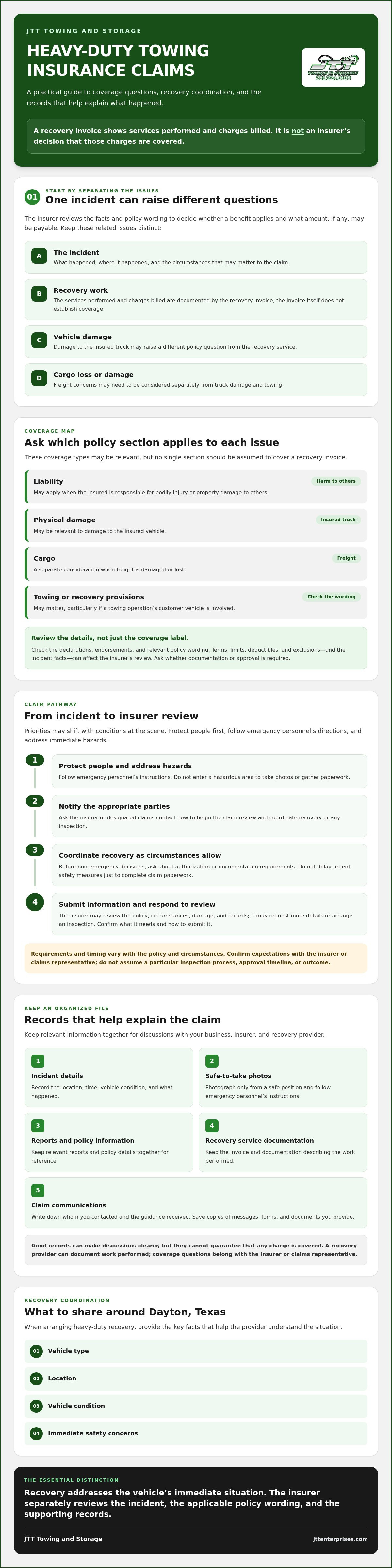
A heavy-duty recovery invoice doesn’t, by itself, show whether an insurer will pay it. After a commercial vehicle incident, it’s understandable to want a clear answer, especially when towing, vehicle damage, and cargo concerns overlap. Understanding heavy duty towing insurance claims starts with separating those issues: liability coverage may address harm to others, while vehicle damage and cargo may fall under different policy sections. The policy wording and the insurer’s review determine what applies.
This guide explains which coverage sections to ask about, how a claim may move from incident notification to review, and what to clarify with your insurer before non-emergency work proceeds. It also covers records that can help explain the incident and recovery invoice, including safe-to-take photos, service documentation, and claim communications. An organized file can make discussions with your business, insurer, and recovery provider clearer, but it can’t guarantee that any charge is covered.
Key Takeaways
- Understanding heavy duty towing insurance claims starts with distinguishing the incident, recovery work, vehicle damage, and cargo loss.
- Put immediate safety first, then notify the appropriate parties and ask your insurer how to begin the claim review.
- Review liability, physical damage, cargo, and towing-related policy provisions, but don’t assume any one section covers a recovery invoice.
- Keep incident details, safe-to-take photos, reports, relevant policy information, and claim communications together for reference.
- When arranging recovery around Dayton, share the vehicle type, location, condition, and any immediate safety concerns with the provider.
What Does a Heavy-Duty Towing Insurance Claim Usually Involve?
Understanding heavy duty towing insurance claims means separating several related but distinct issues: the truck incident, the recovery work, damage to a vehicle, and possible loss or damage to cargo. An insurance claim is a request for benefits under a policy after an incident that may be covered. The insurer reviews the facts and policy wording before deciding whether a benefit applies and what amount, if any, may be payable.
A recovery invoice records the services performed and charges billed. It is not an insurer’s decision that those charges are covered. For example, a disabled truck may need to be recovered from a roadway, while the insurance claim may separately concern damage to the insured truck or freight. Each issue can raise different coverage questions. Commercial policies can differ from personal vehicle insurance, as outlined in this overview of commercial vehicle insurance.
Which policies might be relevant after a truck incident?
The relevant policy depends on who is making the claim and what was affected. Liability coverage may apply when the insured is responsible for bodily injury or property damage to others. Physical damage coverage may be relevant to damage to the insured truck. Cargo coverage is a separate consideration if freight is damaged or lost. Towing or recovery provisions may also matter, particularly if a towing operation’s customer vehicle is involved. Ask the insurer which policy and provision it will review for each part of the incident.
Why towing and recovery do not guarantee claim payment
A recovery may be necessary to address a disabled or unsafe vehicle, but necessity alone doesn’t establish insurance coverage. The insurer’s review may depend on the incident circumstances and the policy’s terms, limits, deductibles, and exclusions. Check the declarations and endorsements alongside the relevant policy wording. Then ask how the recovery service relates to the claim and whether specific documentation or approval is required.
Coverage decisions depend on the policy and facts. A recovery provider can document the work performed, but it can’t determine what an insurer will pay. Keep the service invoice and related records, and direct coverage questions to the insurer or claims representative handling the matter. This distinction helps set expectations while you clarify which parts of the incident are being reviewed.
How a Heavy-Duty Towing Claim Typically Moves From Incident to Review
After an incident, it can be difficult to know whether to call the insurer, arrange recovery, or gather paperwork first. Set priorities in this order: protect people, follow directions from emergency personnel, and address immediate hazards. Claim steps can follow as circumstances allow. Understanding heavy duty towing insurance claims means treating the response as a sequence while recognizing that conditions at the scene may change what can be done first.
What to do before and during recovery
Once immediate safety needs are addressed, notify the appropriate parties and ask the insurer or designated claims contact how to coordinate recovery and any inspection. Before making non-emergency decisions, ask whether the insurer has authorization or documentation requirements. Don’t delay urgent safety measures just to complete claim paperwork, but keep a record of whom you contacted and what guidance you received.
When it’s safe and permitted, record the location, time, vehicle condition, and incident details. Take photographs only from a safe position, and follow emergency personnel’s instructions rather than entering a hazardous area. If recovery is needed, share relevant facts with the provider and ask for documentation of the work performed. Those records can describe the service, but they don’t determine how the insurer will handle the claim.
What happens when the insurer reviews the claim?
After you report the incident and submit available information, the insurer may review the policy, circumstances, damage, and records. It may request more details or arrange an inspection. Ask what information it needs, how to submit it, and whether additional steps apply before work proceeds, when the situation allows. Keep notes of calls and save copies of messages, forms, and documents you provide.
Requirements and timing vary with the policy and circumstances. Don’t assume a particular inspection process, approval timeline, or outcome. Confirm expectations directly with the insurer or claims representative. Federal motor-carrier financial responsibility filings are a separate compliance matter; the FMCSA explains its federal insurance requirements, but that information doesn’t determine whether a specific recovery charge is covered.
A practical sequence is:
- Address safety: Follow emergency personnel and attend to immediate hazards.
- Notify: Contact the appropriate parties and the insurer as circumstances permit.
- Document: Record incident facts and take safe, permitted photos.
- Coordinate: Ask about inspection, authorization, and record requirements before non-emergency decisions.
- Follow up: Submit requested information and keep a clear communication log.
For a commercial vehicle incident around Dayton, a local heavy-duty towing and accident recovery provider can document the recovery work performed. Coverage and payment decisions remain with the insurer.
Which Heavy-Duty Towing and Truck Insurance Coverages Could Apply?
One incident can raise several different coverage questions. A damaged tractor, a customer’s vehicle on a tow truck, freight that shifts during recovery, and the cost of moving or storing a disabled unit may not be handled under the same policy section. Coverage names and scope vary, so use the categories below to guide questions, not as confirmation that a particular expense is covered.
The policy, not the invoice label, determines whether a charge or loss is covered. Understanding heavy duty towing insurance claims means matching each loss to the policy wording and asking the insurer which provision it is reviewing.
| Coverage type | Possible relevance | Questions to ask the insurer |
|---|---|---|
| Liability | May be relevant if the insured is alleged to have caused injury to another person or damage to someone else’s property. | Which policy section applies to the reported injury or property damage? What limits, exclusions, or other conditions should I review? |
| Physical damage | May apply to damage to an insured truck, such as a damaged tractor after a collision, subject to the policy terms. | Does the policy address this type of damage? Is an inspection or repair estimate needed, and does a deductible apply? |
| Cargo | May be relevant if transported freight shifts, is damaged, or is lost. The cargo policy’s terms determine how the loss is considered. | What freight records and damage details are needed? Are any exclusions, limits, or reporting conditions relevant? |
| Towing or recovery provisions | May address certain towing-related exposures, such as damage to a customer’s vehicle while it is being handled. The applicable wording can vary. | Does the policy include a relevant provision, and what activities, property, or circumstances does it address? |
| Emergency towing, recovery, or storage expenses | May be addressed separately, or may not be included in the coverage being reviewed. | Does the policy address these expenses? Are there limits, deductibles, approval requirements, or exclusions? |
Vehicle damage, liability, and cargo are separate questions
Consider a collision that damages the insured tractor, injures another person, and shifts freight in the trailer. The tractor damage may prompt a physical damage review, the injury may raise a liability question, and the freight loss may require a separate cargo review. Don’t assume a decision about one part resolves the others. For customer property being transported over land, Inland marine insurance is a term worth asking about, but the policy wording controls whether it applies.
How to ask about towing, recovery, and storage charges
Give the insurer an itemized description of the service rather than relying only on a broad invoice label. Ask specifically whether the policy addresses emergency towing, specialized recovery, and post-recovery storage, and whether approval or inspection is required before non-emergency work proceeds. Confirm applicable limits, deductibles, and exclusions directly with the insurer. A recovery provider can document the work performed, but only the insurer can explain how the policy applies to the submitted claim.
What Records Can Help Explain a Heavy-Duty Recovery Claim?
Clear records connect the incident to the damage and recovery work that followed. They can also help you answer questions without relying on memory alone. The insurer decides which documents it needs, so treat this checklist as a starting point and confirm specific requirements with the claims contact. Understanding heavy duty towing insurance claims includes preserving useful information without assuming that documentation guarantees payment.
Organized records help reviewers understand what happened and what work was performed. Keep originals when possible, save digital copies in one clearly labeled folder, and note when each record was created or received.
Incident and vehicle records to gather
- Incident details: Record the date, approximate time, location, vehicles involved, and a brief account of what happened. Include any available report number or claim reference.
- Vehicle information: Note identifying details, such as the truck’s unit number or vehicle identification information, and describe visible damage or condition. Keep observations factual.
- Photographs: Preserve images of the vehicle, damage, and relevant surroundings when they were taken safely and lawfully. Don’t return to a hazardous area to obtain pictures.
- Reports and communications: Save available incident reports, dispatch notes, and messages related to the event. Record whom you contacted and the dates of conversations.
- Cargo or delivery records: If freight or delivery operations were affected, retain relevant cargo, dispatch, shipping, or delivery documents, along with notes about the condition of the load.
These records can help establish what was known before recovery and what changed afterward. Keep policy information and insurer correspondence with the incident file, but share documents through the insurer’s requested process.
Recovery invoices and communication records
Keep the recovery invoice and related service or storage documentation. An itemized record can clarify the work performed, dates, equipment used when listed, and sequence of services. That detail may help a reviewer understand the invoice, but it doesn’t establish coverage. If an entry is unclear, ask the recovery provider to explain it rather than editing the invoice or guessing what a charge means.
Save claim emails, letters, forms, instructions, and any approval or inspection communications. A simple log with the contact’s name, date, and main points discussed can make follow-up easier. Ask the insurer whether it needs additional records and how to submit them. Requirements can depend on the policy and circumstances.
If you need heavy-duty towing or accident recovery in the Dayton area, contact a local recovery provider and keep the service documentation with your incident records. The insurer remains responsible for deciding how the policy applies.
How to Coordinate a Heavy-Duty Recovery and Claim Around Dayton, Texas
After immediate safety needs are addressed, keep recovery arrangements and insurance decisions on separate tracks. A recovery provider handles operational work, such as heavy-duty towing or accident recovery, and can document the services performed. The insurer or its claims representative reviews the policy and information, then makes coverage decisions. A towing provider isn’t an insurer, adjuster, or claims administrator.
For a Dayton-area incident, give the recovery provider clear, practical information: the vehicle’s location, type, and condition, plus any immediate safety concerns. If freight or another vehicle is involved, mention that too. Share only what you can safely confirm. Clear details help the provider understand the recovery need and record the work accurately, but they don’t determine whether an insurer will pay the invoice.
Questions to ask before arranging non-emergency services
If circumstances allow, contact the insurer before arranging non-emergency work. Ask whether an inspection, authorization, or preferred-provider process applies. Then ask the recovery provider what work is proposed and what service documentation it can supply. Write down who gave instructions, when you received them, and any reference number. At the scene, follow emergency personnel’s directions and don’t delay steps needed to address an immediate hazard for claim paperwork.
These steps can help keep communication clear while the incident is being managed. For more background, review an accident recovery guide and a heavy-duty towing guide alongside the specific instructions you receive from your insurer. Requirements can vary with the policy and circumstances, so confirm them directly rather than relying on a general guide.
When a local recovery provider can help
JTT Towing and Storage is a family-owned heavy-duty towing and accident recovery provider based in Dayton, Texas. Its stated local service area includes communities represented by ZIP codes 77535, 77336, 77327, 77561, 77357, 77532, and 77575. Confirm current service-area boundaries when arranging assistance.
As you work through understanding heavy duty towing insurance claims, keep the roles clear: the provider can perform and document recovery work, while the insurer determines how the policy applies. If you need heavy-duty recovery in the area, contact JTT Towing and Storage about heavy-duty recovery. Ask about the operational service you need, and direct coverage and payment questions to your insurer.
Take the Next Step With Clear Records and the Right Contacts
Understanding heavy duty towing insurance claims starts with keeping recovery work and coverage decisions distinct. Review the relevant policy sections, contact your insurer to confirm its inspection and documentation expectations, and keep organized records of the incident, communications, and services performed. These steps can help you discuss the claim clearly, but coverage depends on the policy and the insurer’s review.
If a commercial vehicle needs recovery around Dayton, JTT Towing and Storage can assist with heavy-duty towing and accident recovery. The family-owned and operated business has been established for more than 10 years and also provides secure vehicle storage. For help with a recovery need, contact JTT Towing and Storage about heavy-duty recovery. Keep your insurer involved in coverage questions, and take the next step with clear communication.
Frequently Asked Questions
Does commercial truck insurance cover heavy-duty towing after an accident?
It depends on the policy and the circumstances of the claim. A policy may address certain towing or recovery expenses, but limits, conditions, exclusions, or approval requirements may apply. Ask the insurer which policy section it will review, what documentation it needs, and whether an inspection or authorization is required. A necessary recovery service doesn’t, by itself, mean the invoice will be reimbursed.
Will insurance pay for a semi-truck recovery or rollover recovery?
Payment depends on the applicable coverage, policy wording, incident facts, and insurer review. A rollover might raise separate questions about damage to the truck, affected cargo, and specialized recovery work. Keep incident and service records, contact your insurer, and ask how it wants recovery and any inspection coordinated. A recovery provider can document its work, but it can’t guarantee how the insurer will decide the claim.
What documents do I need for a heavy-duty towing insurance claim?
Ask the insurer for its documentation checklist because requirements vary. Useful records may include the incident date and location, claim reference, available reports, vehicle details, safe-to-take photographs, and relevant cargo or dispatch records. Keep insurer instructions, messages, and itemized recovery documentation together. Organized records can help explain what happened and what services were performed, but they don’t independently establish that a charge is covered.
Should I call my insurance company before arranging heavy-duty recovery?
Contact your insurer as soon as practical and, when circumstances allow, ask about inspection, authorization, and provider procedures before arranging non-emergency work. Safety comes first: follow emergency personnel’s directions and don’t delay action needed to address an immediate hazard. Tell the insurer what’s happening, note any instructions and who provided them, and ask how to document urgent recovery work. The right sequence depends on the policy and situation.
Can an insurer dispute a heavy-duty towing or recovery invoice?
An insurer may review an invoice against the policy, claim facts, available records, and its assessment of the services. If it questions a charge, ask the insurer to explain its concern and ask the recovery provider to clarify the relevant invoice entries or available service documentation. A question about one charge doesn’t automatically mean the entire claim is denied. Follow the insurer’s instructions for further review or appeal.
Are towing, recovery, vehicle damage, and cargo covered under the same policy?
Not necessarily. Liability, physical damage, cargo, and towing or recovery provisions may involve separate policy sections, limits, deductibles, or exclusions. One incident can raise distinct questions, such as damage to the insured truck, harm to another person’s property, and damaged freight. Understanding heavy duty towing insurance claims means reviewing each loss separately with the insurer and confirming how the policy wording applies.
Does JTT Towing and Storage handle insurance claims?
No. JTT Towing and Storage provides operational services, including heavy-duty towing, accident recovery, truck repair, hauling, and vehicle storage. It doesn’t make insurance coverage decisions or act as an insurer, broker, adjuster, or claims administrator. Contact your insurer about claim procedures and coverage, and coordinate recovery-service questions with the provider. Based in Dayton, JTT’s stated local service area includes communities represented by ZIP codes 77535, 77336, 77327, 77561, 77357, 77532, and 77575.


