
Imagine your driver is stranded on the narrow shoulder of Highway 90 as the sun sets, hauling a time-sensitive load that is already behind schedule. The mobile mechanic you called arrived with nothing but a basic toolbox, only to realize your rig has a complex air system failure he cannot fix on-site. This scenario is a nightmare for fleet managers, but it happens every day when the wrong partner is chosen for the job.
You already know that every minute your wheels are not turning, your company's bottom line takes a direct hit. You need a partner who understands that semi truck roadside repair is about more than just a quick fix; it is about safety, speed, and technical expertise. This guide will teach you how to choose the right roadside repair partner in Liberty County to minimize downtime and ensure your heavy-duty rig gets back on the road safely. We will examine the essential equipment a mobile unit must have, how to evaluate pricing for fairness, and why having a partner who can also provide heavy-duty towing is the ultimate safety net for your fleet.
Key Takeaways
- Understand when to authorize an on-site fix versus a tow by using a strategic "Fix vs. Tow" matrix based on safety and repair complexity.
- Identify the most common mechanical failures that qualify for semi truck roadside repair, including air system leaks and fuel delivery issues.
- Learn which specialized tools and diesel certifications to look for when vetting a reliable roadside partner in Liberty County.
- Discover five essential safety steps your drivers must take to secure the scene and communicate effectively with dispatchers during a breakdown.
- Gain insight into the benefits of choosing a provider capable of handling advanced recovery tasks like load shifts and airbag recovery.
Assessing the Breakdown: When Roadside Repair is the Right Call
In the heavy-duty transport industry, every minute a rig sits idle is a direct expense. A professional semi truck roadside repair involves on-site mechanical fixes designed to restore vehicle driveability without the need for a tow. This service is a critical component of modern roadside assistance, providing a lifeline for fleet managers who need to maintain tight delivery schedules. The goal is simple: identify the fault, apply a professional fix, and get the driver back en route safely.
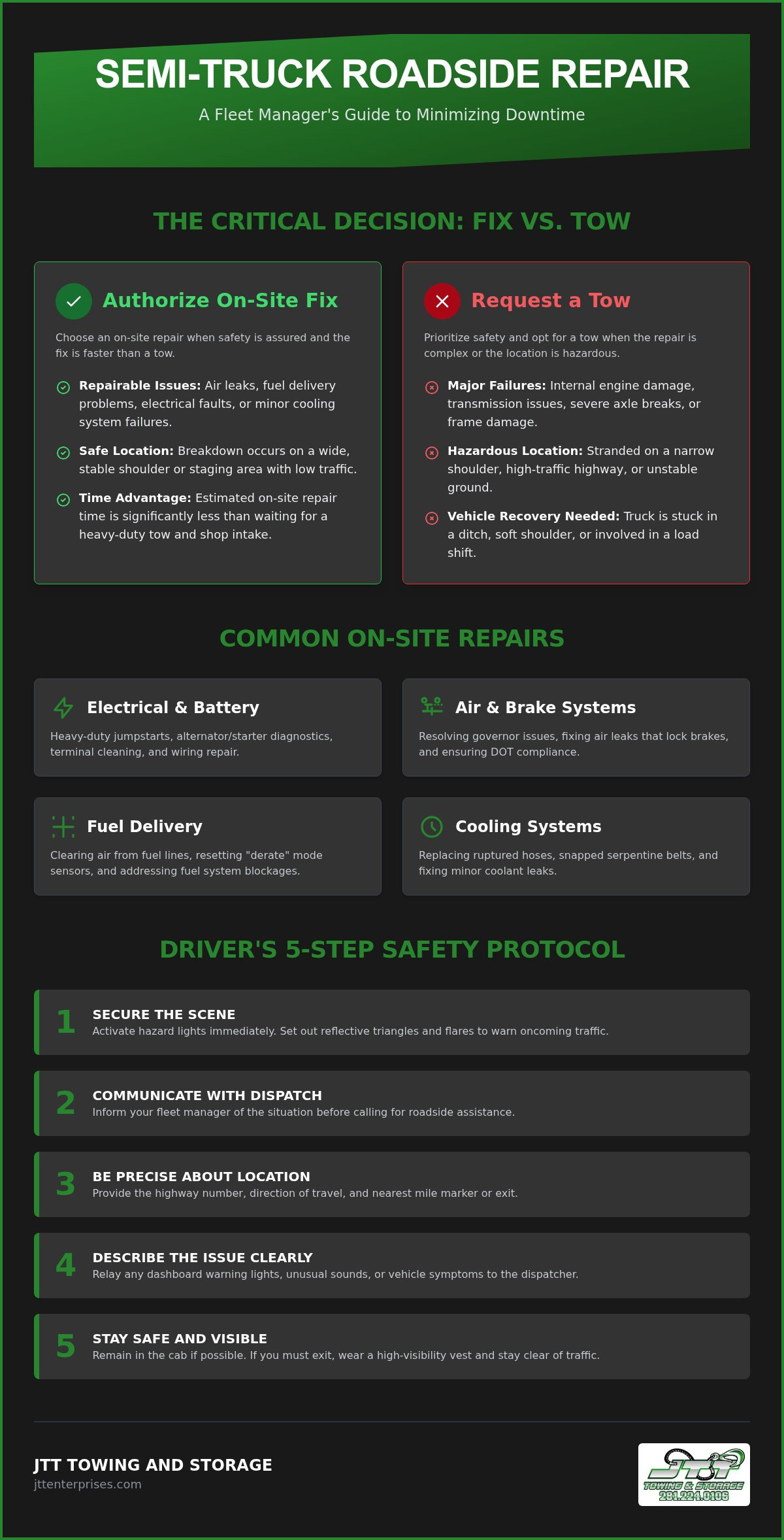
Choosing between an on-site repair and a full tow requires a quick analysis of the "Fix vs. Tow" matrix. You must weigh the estimated repair time against the urgency of the cargo and the safety of the technician. If a repair takes two hours on the shoulder but saves four hours of waiting for a heavy-duty tow and shop intake, the roadside option is clearly superior. This decision isn't just about time; it's also about the complexity of the failure and the environment surrounding the truck.
Location plays a decisive role in this assessment. A breakdown on a wide, flat staging area is vastly different from a failure on a narrow shoulder of Highway 90. If your driver is stranded in a high-traffic area with minimal clearance, the safety risk to the mechanic might outweigh the benefits of an on-site fix. In these cases, moving the vehicle to a safer location or a dedicated facility is the responsible choice. Avoiding late delivery fees is important, but protecting human life and the integrity of the rig is the highest priority.
Common Scenarios for On-Site Repair
Many mechanical issues don't require a full shop bay to resolve. Air system leaks, specifically governor issues that lock the brakes, are frequently fixed on the shoulder by technicians with the right diagnostic tools. Electrical failures are another common culprit; a heavy-duty jumpstart or a simple alternator swap can often be completed where the truck sits. Additionally, minor cooling system leaks or ruptured hoses are prime candidates for semi truck roadside repair, as these parts are often accessible and replaceable in the field.
When Roadside Repair Isn't Enough
There are times when even the best mobile mechanic can't safely or effectively complete a job. Major internal engine failures, such as a thrown rod or catastrophic transmission issues, require specialized lifting equipment and a controlled environment. Structural frame damage or severe axle breaks also fall into this category. Finally, if the truck is bogged down in a "soft" shoulder or is stuck off-road, a recovery and tow are necessary before any mechanical work can begin. In these high-stakes moments, having a partner who offers both repair and heavy-duty towing ensures you aren't left searching for a second provider while your downtime costs climb.
Common Semi Truck Roadside Fixes That Get You Moving
When a Class 8 rig fails on the shoulder, the problem usually stems from a few high-stress systems. Professional semi truck roadside repair focuses on these critical areas to restore driveability without the logistical headache of a tow. Diesel engines and fuel delivery systems often require specialized attention, such as clearing air from fuel lines or resetting sensors that have triggered a "derate" mode. Having a technician who understands these heavy-duty nuances is the difference between a thirty-minute fix and a day-long delay.
Brake system diagnostics are equally vital. A technician can often identify and resolve issues that would otherwise result in a driver being placed out-of-service during a random inspection. By addressing these faults on the spot, you ensure compliance with trucking safety regulations and protect your CSA scores. Beyond brakes, cooling system failures like ruptured hoses or snapped serpentine belts are common culprits that a well-equipped mobile unit can handle with ease.
Electrical and Battery Support
Standard jumper cables are insufficient for the demands of a heavy-duty truck. Class 8 vehicles typically utilize multiple batteries wired in parallel to provide the massive cold cranking amps (CCA) required to start a large-displacement diesel engine. A professional service truck carries high-output industrial jump packs and heavy-gauge cabling designed specifically for these multi-battery configurations.
The repair process shouldn't stop at just getting the engine to turn over. A seasoned technician will perform on-site diagnostic testing on the alternator and starter motor to identify the root cause of the failure. They also provide essential maintenance like cleaning terminal corrosion and repairing frayed wiring. These small steps prevent a repeat "no-start" situation at the next fuel stop, providing the peace of mind that your rig is truly road-ready.
Air Brake and Suspension Repairs
Air leaks are a primary cause of roadside downtime. Whether the leak is in the lines, the air bags, or the brake chambers, a skilled mechanic can quickly locate the source of the pressure drop. In cases where a brake chamber has failed completely, they can "cage" the brakes. This mechanical override releases the spring brakes, allowing the truck to be moved safely to a more permanent repair location rather than being dragged by a heavy-duty wrecker.
Suspension issues also require expert handling, particularly regarding leveling valves. If a loaded trailer isn't riding at the correct height, it can lead to uneven tire wear or dangerous shifts in the center of gravity. Adjusting these valves on-site ensures the load remains stable and the truck handles as intended. If your fleet encounters these mechanical hurdles in Dayton, relying on professional mechanical support can significantly reduce your total cost of repair.
Choosing a Partner: Equipment, Response Time, and Expertise
Selecting a partner for semi truck roadside repair requires more than a quick search on a generic directory. You must verify that the provider operates a fully stocked service truck capable of handling heavy-duty components. A technician arriving in a standard pickup with a basic wrench set will likely result in wasted time and an eventual tow. Look for experts who follow the standards set by the Technology & Maintenance Council; this ensures they're familiar with the latest maintenance protocols and diagnostic technologies used in modern Class 8 rigs.
Expertise should be backed by the right equipment. A professional mobile unit should carry industrial-grade compressors, diagnostic software for various engine makes, and a wide array of common replacement parts like hoses, belts, and sensors. If the repair proves impossible on the shoulder, you need the safety net of a provider that also offers heavy duty towing Dayton TX. This dual capability eliminates the risk of being stranded twice while waiting for a second company to arrive.
Understanding the difference between response time and arrival time is also vital in Liberty County. A dispatcher might respond immediately, but if their fleet is based an hour away, your downtime continues to climb. A local partner with a prompt response ensures that help is actually on the way from nearby, not from a distant county. This proximity is a cornerstone of reliable fleet support.
The Advantage of an All-in-One Provider
Managing a fleet is complex enough without juggling multiple vendors for a single breakdown. An all-in-one provider streamlines the entire process. If an initial repair attempt reveals deeper issues, they can initiate a seamless transition from mechanical support to tractor trailer accident recovery without a second dispatch call. This efficiency extends to your office. Unified billing and consistent insurance documentation simplify the administrative side of fleet management, letting you focus on logistics rather than paperwork.
Local Knowledge and Dispatch Efficiency
In Dayton, geography matters. A provider with deep roots in the area understands the specific challenges of navigating Highway 90 and Hwy 146 traffic patterns. They know which industrial zones are accessible and where the nearest safe havens for disabled rigs are located. This local expertise translates to faster navigation and safer scene management. As a family-owned business with over 10 years of experience, we prioritize a neighborly approach that combines technical proficiency with a personal commitment to the community. We don't just see a disabled vehicle; we see a local partner who needs to get back to work.
5 Critical Steps to Take While Waiting for Roadside Assistance
The period between your initial call and the arrival of help is a critical window for managing risk. While you wait for semi truck roadside repair, your primary focus must shift to scene management and driver safety. Effective preparation during these minutes can prevent secondary accidents and significantly speed up the repair process once the technician arrives on the scene.
- Prioritize visibility: Immediately activate your hazard lights. Deploy your warning triangles at the federally mandated intervals of 10 feet, 100 feet, and 200 feet from the rear of the trailer to give oncoming traffic ample notice.
- Communicate precisely: Provide the dispatcher with more than just a general highway name. Specificity helps the service unit find you without unnecessary searching.
- Document the failure: Take clear photos of the damaged component or the dashboard fault codes. These records are invaluable for fleet maintenance logs and insurance purposes.
- Secure the cargo: Check that the load hasn't shifted during the breakdown. Ensuring the trailer remains stable is vital, especially if the repair requires jacking up a portion of the rig.
- Maintain personal safety: If the shoulder is narrow or traffic is heavy, stay inside the cab with your seatbelt fastened. The cab is your "survival cell" against distracted drivers.
Location Reporting for Dayton Drivers
Precision is the key to a prompt response in Liberty County. When speaking with dispatch, identify your location using specific cross-streets like FM 1960 or major landmarks such as the Trinity River bridge. Clearly state which side of the highway you are on and describe the condition of the shoulder. If you're on a "soft" shoulder or a steep incline, the technician needs to know this beforehand to bring the appropriate stabilizing equipment. If you find yourself stranded in a high-traffic zone, contacting a professional mechanical recovery team ensures that local experts who know these roads are already on the way.
Preparing the Rig for the Technician
You can reduce downtime by preparing the vehicle before the service truck pulls up. Clear away any loose debris around the engine compartment or the affected wheel area to provide a clean workspace. Have the VIN and engine type readily available; this allows the mechanic to double-check their inventory for specific parts compatibility. Finally, perform a quick walk-around to check for any hazardous material leaks. Identifying a fluid leak early allows the technician to prepare the necessary containment materials, protecting the local environment and keeping your fleet in compliance with safety standards.
Why JTT Towing is the Preferred Choice for Dayton Fleet Managers
For over 10 years, JTT Towing and Storage has served as a dependable anchor for the Dayton and Huffman communities. When you call for semi truck roadside repair, you aren't just getting a technician; you're engaging a partner with deep local roots and a decade of specialized experience. Our family-owned operation combines the technical proficiency of a large-scale enterprise with the personal accountability of a neighbor. We understand that a breakdown in Liberty County is more than a mechanical failure. It's a disruption to your livelihood and a risk to your driver's safety. Our team arrives with the specialized equipment needed to handle the job, including rotators and high-capacity airbags for complex recovery tasks that basic mobile mechanics simply cannot touch.
We pride ourselves on being a "reliable guardian" for your fleet. This means we don't just look at the engine; we look at the entire scene. From providing emergency jumpstarts for multi-battery systems to offering secure vehicle storage, we cover every stage of the recovery process. Our goal is to provide stability and calm competence during stressful situations, ensuring that fleet managers have a single, trusted point of contact for any heavy-duty challenge on the road.
Beyond the Mechanical Fix
A mechanical repair is only half the battle if your cargo has shifted during a sudden stop or a breakdown. We provide expert load shift and transfer services to prevent trailer tip-overs and ensure your rig is balanced before it returns to the highway. This focus on total vehicle and cargo integrity is a cornerstone of our service model. If a repair cannot be completed on the shoulder, we offer secure storage solutions within Liberty County. Your truck and its valuable cargo remain under our protection in a controlled environment until you are ready for the next step. Our high-capacity logistics support is designed to meet the rigorous demands of industrial clients who require more than just a simple wrench-turner.
The JTT Commitment to Integrity
Reliability is built on the foundation of transparent communication. Throughout the repair or recovery process, we provide clear updates so fleet managers can make informed decisions without the guesswork. This professional assurance reduces driver stress and restores order to a chaotic situation. We act as a trusted partner, combining the efficiency of a large operation with the personal touch of a community-focused business. Whether you're dealing with a locked brake system or a complex engine derate, our team is prepared to respond with the right tools and a "can-do" attitude. Contact JTT Towing for 24/7 Roadside Support and experience the difference that professional, local expertise makes for your bottom line.
Securing Your Fleet's Future on the Road
Managing a fleet through the unpredictable challenges of the Texas highways requires more than just a list of phone numbers; it requires a strategic partnership with experts who prioritize your uptime. By utilizing a clear matrix to decide between on-site fixes and towing, and ensuring your drivers follow strict safety protocols while waiting, you can significantly reduce the financial impact of every breakdown. A reliable partner who provides both mechanical support and heavy-duty recovery ensures that no matter the complexity of the failure, your rig and cargo are in professional hands.
JTT Towing and Storage has served the Dayton area for over 10 years, offering 24/7 professional mechanical support for those moments when every second counts. With heavy-duty rotator and airbag recovery equipment ready for deployment, we stand as a reliable guardian for your business. Don't let a minor mechanical failure turn into a logistical disaster. Request Emergency Semi Truck Roadside Repair in Dayton to get your drivers back on the move.
We are ready to help you keep your wheels turning and your deliveries on schedule.
Frequently Asked Questions
What information should I have ready when calling for semi truck roadside repair?
You should have your precise location, the vehicle's VIN, and a clear description of the mechanical failure ready for the dispatcher. Providing the specific engine make and model helps the technician ensure they have the correct diagnostic software and replacement parts on the service truck. If you are hauling a time-sensitive or hazardous load, mention this immediately. Clear communication at the start of a semi truck roadside repair call significantly reduces the total time your rig remains out of service.
Can you perform a DOT inspection fix on the side of the highway?
Yes, many common DOT violations can be resolved on-site to get your driver back into compliance. Technicians frequently address air system leaks, faulty lighting, and brake adjustments that would otherwise result in an "out-of-service" order during an inspection. By correcting these issues on the shoulder, you protect your CSA scores and avoid the logistical nightmare of a forced tow. It's a proactive way to maintain fleet safety and operational integrity while on the road.
How do you handle a semi truck jumpstart differently than a car?
We use high-output industrial jump packs and heavy-duty cabling because Class 8 trucks require significantly more cold cranking amps than a standard passenger vehicle. Unlike a car, a semi truck often utilizes four batteries wired in parallel, which demands a high-voltage surge and specialized knowledge of heavy-duty electrical systems. Our team checks for terminal corrosion and tests the alternator during the process. This comprehensive approach ensures the engine starts reliably and remains running after the technician leaves the scene.
What happens if my truck cannot be repaired on the roadside?
If a vehicle is not fixable on the shoulder, we transition immediately to our heavy-duty towing and recovery services. This is the primary advantage of choosing an all-in-one provider; you don't have to wait for a second dispatch call or a different company to arrive. We can safely transport your rig to a repair facility or provide secure vehicle storage in Liberty County. This seamless process minimizes the stress on your driver and ensures your equipment is never left vulnerable.
Do you offer roadside repair for trailers as well as tractors?
We provide comprehensive semi truck roadside repair for both tractors and trailers. Common trailer issues we handle on-site include air line repairs, brake chamber replacements, and fixing faulty wiring or lighting systems. We also address suspension failures and landing gear issues that might prevent a trailer from being safely moved. Our service trucks are equipped with the specialized tools needed to handle the unique mechanical components found on various trailer types, from dry vans to flatbeds.
Is roadside repair available 24/7 in the Dayton and Huffman area?
We provide prompt mechanical support and recovery services for the Dayton and Huffman areas at all times. Breakdowns don't follow a standard business schedule, so our team remains ready to respond whenever a crisis occurs. We cover the major thoroughfares like Highway 90 and Hwy 146, along with the surrounding rural routes in Liberty County. Our local presence allows us to reach your location quickly, providing a dependable anchor for fleets operating in southeast Texas.
How do load shifts affect the ability to perform roadside repairs?
A shifted load can create dangerous instability that makes it unsafe to perform mechanical work on the rig. If the trailer is leaning or the center of gravity is off, our team must first perform a load shift correction using rotators or airbags before beginning repairs. Attempting to jack up a truck with an unstable load risks a catastrophic tip-over. We prioritize securing the scene and the cargo to ensure the technician and the driver remain safe throughout the entire process.
Do you work with major commercial insurance and fleet management systems?
We maintain a professional administrative process that coordinates with major commercial insurance providers and fleet management systems. Our team provides the detailed documentation and unified billing required for seamless insurance claims and corporate record-keeping. We understand the high-stakes nature of fleet logistics and work to reduce the administrative burden on managers. This professional assurance ensures that the focus remains on the technical recovery and getting your driver back to work as efficiently as possible.


