
It's 2 AM on a rain-slicked stretch of Highway 146 when your driver calls to report a jackknifed rig and a blocked lane. In that moment, the clock starts ticking against your bottom line. You aren't just looking for a winched pull; you need emergency heavy duty towing that understands the high stakes of a missed delivery window. Every minute your commercial vehicle sits idle, you're losing more than just time. You're risking cargo integrity and your hard-earned reputation for reliability.
We know that a roadside crisis is stressful enough without having to worry about an inexperienced operator damaging your equipment or a dispatcher who won't give you a straight answer. This 2026 guide will show you how to secure professional heavy-duty recovery that protects your cargo, minimizes downtime, and ensures safety on Texas highways. We'll explore the latest in rotator technology, the importance of efficient load transfers for keeping schedules on track, and the critical regulatory shifts every fleet manager needs to know this year.
Key Takeaways
- Identify the specific technical requirements for vehicles with a GVWR over 26,000 lbs to ensure you call for the correct class of recovery.
- Evaluate potential providers based on their equipment versatility, ensuring they have rotators and air cushions ready for complex scenarios.
- Master the immediate safety protocols to follow while waiting for emergency heavy duty towing to protect your driver and secure the scene.
- Learn how specialized airbag recovery and off-road winching protect your cargo from secondary damage during uprighting and extraction.
- Discover how local expertise in the Dayton area can streamline the transition from roadside recovery to secure storage and on-site repair.
What Is Emergency Heavy Duty Towing and When Do You Need It?
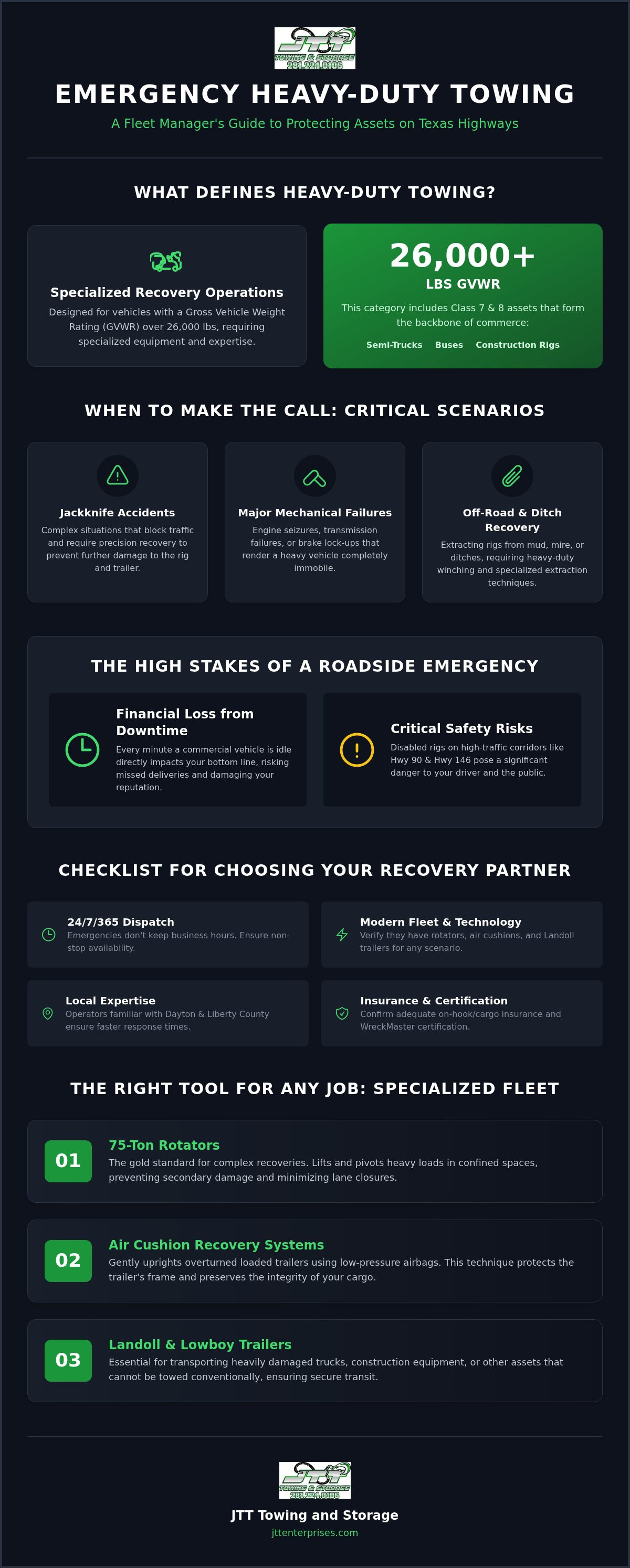
Emergency heavy duty towing is a specialized recovery operation designed for vehicles with a Gross Vehicle Weight Rating (GVWR) exceeding 26,000 lbs. This category includes the Class 7 and Class 8 assets that keep our economy moving, such as semi-trucks, tour buses, and heavy construction machinery. Standard towing services for passenger cars lack the hydraulic power and structural stability required to manage these massive loads. Instead, these situations demand heavy-duty tow trucks equipped with high-capacity booms, heavy-duty winches, and under-lift systems that can support the weight of a fully loaded trailer.
A critical need for emergency heavy duty towing arises when a commercial asset becomes a hazard or a liability. Common triggers include major mechanical failures like seized engines, jackknife accidents that block traffic, or a rig that has slid into an off-road mire. Because these vehicles are so large, they require specialized rigging and high-capacity wreckers to ensure the recovery doesn't cause secondary damage to the frame or the drivetrain. We treat every recovery as a precision operation where safety and asset protection are the top priorities.
Understanding Weight Classes and GVWR
Class 7 and Class 8 vehicles are the heavyweights of the road. They need more than a standard flatbed because their sheer mass requires a wrecker with enough counterweight to maintain steering and braking control during transport. Identifying your rig’s exact weight and load status helps us dispatch the correct equipment immediately. Professional heavy lift towing services differ from medium-duty options by offering the specific torque and stability needed to handle up to 80,000 lbs or more. If you don't use the right class of wrecker, you risk catastrophic equipment failure during the lift.
The High Stakes of Commercial Roadside Emergencies
Every hour a commercial rig spends on the shoulder is a direct hit to your bottom line. Beyond the financial loss of downtime, the safety risks on high-traffic Texas corridors like Hwy 90 and Hwy 146 are significant. Narrow shoulders and fast-moving traffic create a dangerous environment for your driver and the public. Rapid response is vital to clear the lane and move the vehicle to a secure facility. We focus on protecting the driver and the cargo, ensuring that a breakdown doesn't turn into a multi-car accident or a total loss of the delivery schedule.
Criteria for Choosing an Emergency Heavy Duty Towing Provider
Selecting a partner for emergency heavy duty towing requires looking beyond the first search result. For commercial fleets, 24/7/365 dispatch capability is a non-negotiable standard. Roadside crises don't wait for business hours. A provider rooted in Dayton and Liberty County offers a distinct advantage in response speed. These operators understand local traffic patterns and the specific challenges of regional routes, ensuring they reach your driver before a minor breakdown escalates into a major safety hazard.
Evaluating the Towing Fleet and Technology
The right equipment prevents secondary damage during a recovery. A 75-ton rotator is the gold standard for complex highway scenes, allowing operators to lift and pivot heavy loads without dragging them across the asphalt. This precision is vital for protecting the integrity of both the rig and the cargo. Modern providers also utilize GPS tracking and video-equipped trucks to provide fleet managers with real-time accountability and transparency during the recovery process.
Key equipment to look for in a professional fleet includes:
- 75-Ton Rotators: Essential for lifting overturned vehicles in confined spaces without blocking extra lanes.
- Landoll Trailers: Ideal for transporting damaged trucks or heavy machinery that cannot be towed traditionally.
- Air Cushion Systems: Used to upright loaded trailers gently, preserving the trailer frame and the goods inside.
From specialized flatbed towing for smaller assets to high-capacity wreckers for loaded semis, matching the truck to the task is essential for a safe transport.
Verification of Insurance and Licensing
Liability is a major concern during heavy-duty operations. You must verify that a provider carries adequate on-hook and cargo insurance to protect your assets from the moment the hook is attached until the vehicle is dropped off. Professional operators should hold WreckMaster certifications, proving they've mastered the technical skills required for high-stakes winching and uprighting. This level of training ensures that every move is calculated and safe.
Operators must also strictly adhere to Federal cargo securement regulations to ensure the load remains stable during the tow. In Texas, proper licensing isn't just a formality; it's a safeguard for your business. Cutting corners with uncertified "cheap" towing often results in expensive damage claims and legal headaches that far exceed the cost of professional service. Establishing a relationship with a dependable recovery team now can save your fleet thousands in avoidable downtime later.
Specialized Recovery Techniques: Beyond the Standard Hook
Emergency heavy duty towing is rarely a straightforward process of hooking a chain and driving away. When a commercial rig is overturned or stuck in a precarious position, the primary goal shifts from simple transport to advanced asset preservation. Modern recovery rigging utilizes physics and specialized machinery to upright vehicles without compromising the structural integrity of the trailer or the value of the cargo. This level of precision is often mandated by federal emergency towing regulations, which recognize the unique necessity of professional intervention during highway accidents.
One of the most versatile tools in a recovery fleet is the rotator. Often called the "Swiss Army Knife" of the industry, a rotator can operate in tight spaces where traditional wreckers can't maneuver. Whether it's working under a low-clearance bridge or lifting a vehicle from a narrow highway shoulder, the rotator's ability to pivot 360 degrees allows for a vertical lift. This minimizes traffic disruption and prevents the need for dragging the vehicle across the pavement, which can cause severe frame damage.
The Science of Airbag Recovery for Semi Trucks
When a loaded trailer is resting on its side, traditional winching can apply too much localized stress. This often causes the trailer frame to twist or the cargo to shift violently. Airbag recovery is a low-pressure, high-surface-area lifting method. By placing specialized air cushions under the vehicle and inflating them gradually, operators can upright even the heaviest loads with gentle, even pressure. This technique is often the only safe way to prevent "totaling" a vehicle during the uprighting process, as it distributes the weight across the entire side of the trailer rather than a single point.
Off-Road Winching and Mud Rescues
Texas soil is notorious for its ability to trap heavy commercial vehicles, especially after heavy rains. A rig that has slid off a narrow rural road into a ditch requires more than just raw power; it requires calculated pulls. Off-Road Recovery involves the use of snatch blocks and multiple winch points to double the pulling capacity while controlling the direction of the move. Specialized anchoring techniques are essential to ensure the wrecker doesn't simply pull itself toward the stuck vehicle. By using these methodical steps, we can rescue your assets from the mud without causing unnecessary strain on the drivetrain or axles.
Emergency Protocol: Steps to Take While Waiting for a Heavy Wrecker
The moments immediately following a breakdown or accident are the most dangerous for any commercial driver. Your priority must be securing the scene to prevent secondary collisions. Set out reflective triangles and flares at 10, 100, and 200 feet behind your vehicle to alert oncoming traffic. Visibility is your best defense on high-speed Texas corridors. Once the perimeter is established, move to a safe location. If the shoulder is narrow, the safest place is often inside the cab with your seatbelt fastened, or at a significant distance from the roadway if there is a risk of the trailer being struck by passing vehicles.
Documentation is another critical step that drivers often overlook in the heat of a roadside crisis. Use your smartphone to take clear photos of the vehicle's orientation, the road conditions, and any visible damage before the recovery begins. These images are invaluable for insurance claims and internal fleet management reviews. They provide a clear record of the situation before the emergency heavy duty towing team begins the technical winching or lifting process. This data helps establish a baseline for the recovery operation and protects you from liability regarding secondary damage.
Gathering Critical Information for the Dispatcher
An effective recovery starts with accurate information. When you call for help, be prepared to provide the vehicle's GVWR and the approximate weight of your cargo. This ensures the dispatcher sends a wrecker with the correct lifting capacity and counterweights. You must also identify temperature-sensitive loads or hazmat materials immediately. If you're near Dayton, pinpoint your location using mile markers or local landmarks. Knowing your vehicle's orientation, whether it's upright, in a ditch, or jackknifed, allows the team to prep the necessary rigging before they arrive on-site.
Safety Measures for Commercial Drivers
Managing traffic around a disabled rig is a high-stakes task that requires professional expertise. Never attempt to unhook a trailer if the vehicle is in an unstable position or on an incline. This can lead to catastrophic shifts that endanger you and everyone else on the road. Instead, focus on maintaining a safe perimeter and preparing for the arrival of accident recovery specialists. These professionals have the training and equipment to stabilize the load safely before any mechanical work begins. If you're facing a roadside crisis in Liberty County, reach out to JTT Towing and Storage for immediate, expert assistance from a team that treats your rig with the respect it deserves.
Why JTT Towing and Storage is Dayton’s Heavy Duty Choice
JTT Towing and Storage has spent over 10 years serving as the dependable anchor for commercial fleets across Liberty County. We aren't a faceless national dispatch center; we're a family-owned operation with deep roots in Dayton, Huffman, and the surrounding 77535 and 77336 areas. When you call for emergency heavy duty towing, you're speaking with professionals who understand the specific layout of our local highways and the urgency of your delivery schedule. This local expertise translates to faster response times and a level of personal accountability that large-scale operations simply can't match.
Our "Reliable Guardian" promise means we take full responsibility for your assets from the moment we arrive on the scene. We combine the technical proficiency of a large-scale recovery team with the neighborly care of a community business. Whether it's a high-capacity rotator lift or a complex airbag recovery, we approach every task with a calm competence designed to provide you with peace of mind. No task is too complex for our team, and we take pride in being the first choice for emergency heavy duty towing when the stakes are at their highest.
Beyond the Tow: Truck Repair and Load Transfers
Many providers consider their job done once the rig is off the roadway, but we understand that your primary goal is to get back in motion. JTT offers integrated solutions that include on-site truck repair at our Dayton facility, which significantly reduces the total downtime for your fleet. If your cargo has shifted during an accident or a hard braking event, we specialize in Load Shifts and Transfers. Correcting these issues is vital for preventing secondary accidents and ensuring that your cargo reaches its destination safely, even after a major mechanical failure or wreck.
Secure Vehicle Storage in Liberty County
Recovering a vehicle is only half the battle; finding a safe place for it to stay while insurance adjusters or repair teams do their work is the other half. We provide secure vehicle storage in Dayton for recovered assets and trailers, giving fleet managers a centralized, protected location for their equipment. This logistical support is essential for long-distance recovery operations where the home terminal might be hundreds of miles away. You can trust that your equipment and cargo are protected by a team that values integrity and comprehensive care. For a partner that combines heavy-duty power with a "can-do" attitude, Contact JTT Towing and Storage for 24/7 Emergency Support. We're ready to clear the road and protect your bottom line.
Securing Your Fleet's Future on Texas Highways
Professional recovery is about more than just moving a disabled vehicle; it's about preserving your investment and your reputation. By prioritizing providers with specialized equipment like high-capacity rotators and air cushions, you ensure that your rig and cargo remain intact throughout the process. Remember to follow strict safety protocols and document the scene thoroughly while waiting for professional assistance. These proactive steps minimize liability and help your recovery team operate with maximum efficiency once they arrive.
When you face a roadside crisis, you need a partner who offers more than a simple tow. Choosing a local expert with integrated repair and storage capabilities keeps your delivery schedule on track and reduces total downtime. JTT Towing and Storage brings over 10 years of family-owned experience to every call, serving as a reliable guardian for your commercial assets in Liberty County. Need Emergency Heavy Duty Towing? Call JTT Towing and Storage 24/7. We're ready to help you navigate the unexpected with confidence and get your drivers back on the road safely.
Frequently Asked Questions
What is the response time for emergency heavy duty towing in Dayton, TX?
We prioritize rapid dispatch for all calls in the Dayton area. While exact arrival times depend on current traffic conditions on Highway 90 or inclement weather, our local presence in the 77535 zip code ensures we reach you faster than regional providers. Our dispatchers provide real-time updates so your driver isn't left wondering. This proximity is a cornerstone of our reliable guardian promise for local fleets.
Can you recover a fully loaded semi-truck without unloading it first?
Yes, we specialize in recovering fully loaded semi-trucks without the need for time-consuming off-loading. By utilizing high-capacity rotators and precision rigging, we can lift and stabilize the entire rig as a single unit. This approach minimizes cargo handling and gets your vehicle to a repair facility much faster. Protecting the integrity of your load is our primary objective during any complex recovery operation on Texas roads.
What information should I have ready when calling for a heavy-duty wrecker?
When you call for emergency heavy duty towing, please have your exact location, the vehicle's GVWR, and the type of cargo ready. It's also vital to describe the vehicle's orientation, such as whether it's upright, jackknifed, or in a ditch. Mentioning any temperature-sensitive or hazardous materials helps us prepare the right equipment. Providing these details immediately allows our team to arrive on-site with the specific tools required for your recovery.
Do you provide heavy-duty towing services near Huffman and Cleveland, TX?
Our service area extends beyond Dayton to include Huffman, Cleveland, and the surrounding Liberty County regions. We frequently respond to calls in the 77336 area and along the major corridors connecting these communities. Whether you're stuck on a rural road or a high-traffic highway, our team is equipped to handle emergency heavy duty towing challenges throughout the region. We treat every local fleet with the neighborly reliability that has defined our business for over 10 years.
What is airbag recovery and when is it necessary for a semi-truck?
Airbag recovery is a specialized technique that uses low-pressure, high-surface-area air cushions to upright overturned trailers. It's necessary when a loaded trailer is resting on its side and traditional winching might twist the frame or damage the cargo. This method provides a gentle, even lift that preserves the structural integrity of your trailer. It's a precision solution for high-stakes situations where asset protection is the top priority for the fleet manager.
Does JTT Towing and Storage handle load shifts and trailer transfers?
We provide comprehensive load shifts and trailer transfers to keep your deliveries on schedule. If your cargo has shifted during transit and created an unsafe driving condition, our team can reposition the weight to meet safety standards. In cases where a trailer is too damaged to continue, we facilitate successful load transfers to a secondary vehicle. These services are essential for minimizing downtime and ensuring the safe transport of your goods.
Are your operators certified for complex accident recovery?
Our operators are highly trained and bring over 10 years of experience to every complex accident scene. We emphasize technical proficiency and safety, ensuring that every recovery is handled with methodical precision. This expertise allows us to manage high-stakes situations, such as overturned semis or off-road extractions, without causing secondary damage. You can trust that a seasoned professional is managing your assets with the highest industry standards for recovery and transport.
Do you offer secure storage for commercial vehicles after an accident?
We offer secure storage facilities in Dayton for commercial vehicles and trailers following an accident or recovery. Our storage yard provides a protected environment where your assets can remain while you coordinate with insurance adjusters or repair teams. This service is a vital part of our integrated logistics support, giving fleet owners peace of mind during a stressful situation. We ensure your vehicle is safe and accessible whenever you're ready for the next step.


