
You're just a few miles from the Dayton scales when you feel that unmistakable pull of a shifted load, and you know a DOT officer is likely waiting with a clipboard. The fear of an Out of Service order or a heavy fine is enough to make any seasoned driver lose sleep. Handling Load shifts and Transfers isn't just about moving boxes; it's about protecting your career and ensuring your trailer doesn't end up on its side during a tight turn.
We understand the immense pressure you're under to meet deadlines while facing the reality of an unstable rig. It's stressful to worry about cargo damage or a jackknife when you're stranded on the shoulder. This article will help you master the technical and safety requirements of cargo re-balancing so you can protect your equipment, your CDL, and your bottom line. We'll explore the essential steps for successful weight re-distribution to pass scales and the best practices for a safe cargo transfer after an accident. By the end, you'll know exactly how to get back on the road with total confidence.
Key Takeaways
- Understand the critical difference between correcting a minor shift and performing a full cargo transfer to choose the most efficient recovery path.
- Discover how proper weight distribution protects your CDL from DOT fines and prevents catastrophic trailer tip-overs or jackknifes.
- Learn about the specialized equipment, such as heavy-duty rotators and forklifts, required to execute Load shifts and Transfers safely.
- Master the technical requirements of cargo re-balancing to minimize downtime and protect your company's bottom line during a roadside emergency.
- Find out why professional logistics support near Dayton's major transport corridors is vital for rapid accident recovery and asset protection.
Understanding Load Shifts and Transfers in Commercial Logistics
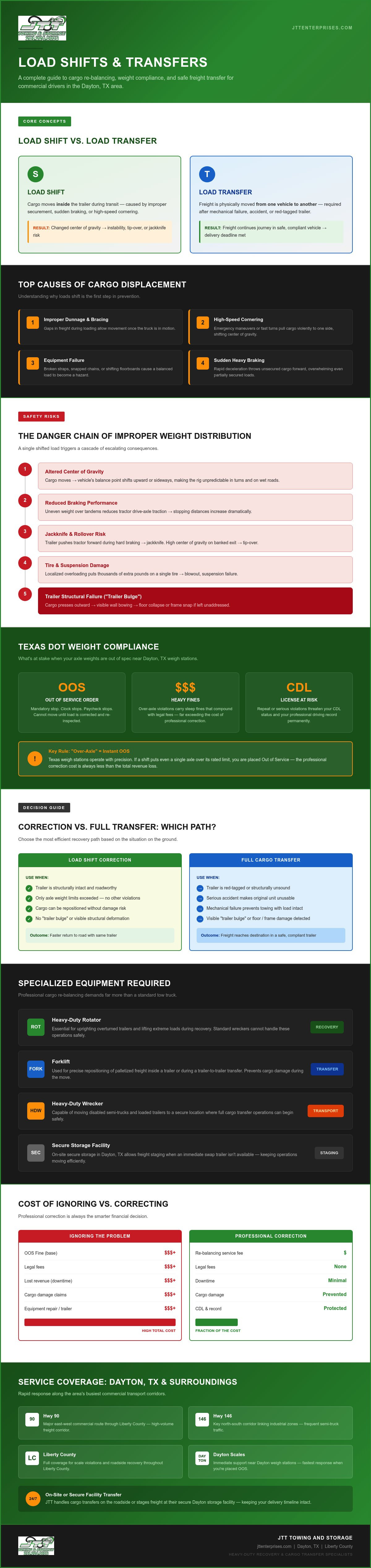
A load shift occurs when cargo moves inside a trailer during transit. This movement usually stems from improper securement or sudden, heavy braking. It isn't just a minor inconvenience; it's a major safety risk that can lead to a trailer tip-over or a jackknife. Conversely, a load transfer is the physical process of moving freight from one vehicle or trailer to another. This is often required after a mechanical failure or a serious accident makes the original trailer unusable. Managing Load shifts and Transfers is a specialized field. It requires more than a standard tow truck. It demands cargo handling expertise and heavy-duty equipment to ensure the job is done right. JTT Towing and Storage serves as a professional partner for Dayton area logistics. We provide the calm competence needed during these high-stakes situations on busy routes like Hwy 90 and Hwy 146. For those looking for specialized container logistics experts in other regions, you can discover Jagelo Haulage and their professional port-to-door solutions.
Common Causes of Cargo Displacement
Cargo displacement doesn't happen without a cause. It often starts with improper dunnage or bracing techniques during the initial loading phase. If there's any gap in the freight, it will find a way to fill it once the truck is in motion. High-speed cornering and emergency maneuvers can also violently pull the cargo toward one side. This affects the vehicle's center of gravity and makes the rig difficult to control. In other cases, equipment failure is the culprit. Broken straps, snapped chains, or even shifting floorboards can cause a balanced load to become a dangerous liability. Our team understands these dynamics and works to stabilize the situation before it escalates into a recovery operation.
The Logistics of a Professional Cargo Transfer
A professional cargo transfer is a methodical operation that requires patience and the right tools. It becomes necessary when a trailer is red-tagged by officials or is too structurally unsound to continue its journey. In these cases, the freight must be moved to a fresh trailer so you can meet your delivery deadlines. We provide on-site transfers or utilize our secure storage facility in Dayton to keep the process moving efficiently. Professional handling is essential for preventing expensive insurance claims and protecting your professional reputation. By using specialized tools like forklifts and heavy-duty wreckers, we protect the integrity of the freight while it's in transition. This help you avoid the headache of cargo damage reports and out of service orders. For those who also manage international logistics and require expert shipping coordination, you can find out more about professional forwarding services.
Improper weight distribution is a silent threat that many drivers overlook until they're fighting for control on a wet road. When cargo moves, it changes the vehicle's center of gravity. A high center of gravity significantly increases the risk of a rollover, especially during sudden maneuvers or on banked exits. Vehicle stability depends on the load staying exactly where it was secured. If that balance is lost, the physics of the entire rig change instantly. This instability makes every mile more dangerous for you and everyone else on the road.
Braking performance also suffers when weight isn't distributed evenly. If too much weight sits over the trailer tandems, the tractor's drive axles may lose the traction necessary for effective stopping. This imbalance often leads to jackknifing as the trailer tries to push the tractor forward during hard braking. Beyond the immediate safety risks, localized overloading puts immense stress on tires and suspension components. A single tire carrying several thousand pounds more than its rated capacity is prone to a blowout. These mechanical failures are preventable with professional Load shifts and Transfers that restore the rig's intended balance.
Navigating Texas DOT Weight Requirements
Texas weigh stations are notorious for their precision. If a shift puts you "over-axle," you aren't just looking at a fine; you're looking at a mandatory Out of Service (OOS) order. These orders stop your clock and your paycheck until the issue is resolved. The cost of professional correction is a fraction of the total lost revenue and legal fees associated with an OOS citation. Our team helps drivers clear scale violations quickly in Liberty County, ensuring you get back in compliance without unnecessary delays. If you're facing a scale issue, reaching out to a trusted recovery partner can save your professional record.
Structural Integrity of the Trailer
A shifted load can physically deform your equipment. Drivers should watch for "trailer bulge," which is a visible bowing of the trailer walls caused by cargo pressing outward. This stress can lead to catastrophic trailer floor failure or frame snapping if left unaddressed. Continuing to drive with a compromised trailer is a gamble that rarely pays off. Instead, utilize specialized load shift correction services to stabilize the rig before the damage becomes permanent. Taking action early prevents a simple weight issue from turning into a total equipment loss.
Load Shift Correction vs. Full Trailer Load Transfer
Choosing between a simple correction and a full transfer is a decision that impacts your timeline and your wallet. Load shift correction is a precision task. It involves moving specific pallets or crates within the same trailer to achieve proper weight distribution. This is often the fastest way to get back on the road. A full trailer load transfer is more labor-intensive. It requires moving every piece of freight to a new vehicle. This usually happens when the original trailer is no longer roadworthy. Understanding the difference between Load shifts and Transfers helps you communicate clearly with dispatch and recovery teams. It ensures you aren't paying for more service than you actually need.
Cost is a major factor in this decision. Correction is almost always the first line of defense. It requires less time and fewer man-hours. However, if the trailer structure is compromised, a correction is just a band-aid on a life-threatening wound. In accident recovery scenarios, a professional trailer load transfer in Dayton, TX is often the only safe path forward. Our team evaluates the structural integrity of your equipment before suggesting a course of action. We prioritize your safety and the security of your cargo above all else.
When to Choose Load Shift Correction
- The cargo is physically intact but the weight is improperly distributed across the axles.
- The trailer is structurally sound with no signs of frame stress or wall bulging.
- The shift is minor enough to be corrected through rear-door access or side-entry points.
If you've just left a shipper and failed a scale, a correction is usually the answer. It's a targeted fix that addresses the DOT violation without the need for a second truck. This approach minimizes downtime and keeps your delivery on schedule.
When a Full Load Transfer is Mandatory
- Following a rollover or collision where the original trailer's structural integrity is compromised.
- Mechanical failures, such as a broken kingpin or frozen tandems, where the tractor can't pull that specific trailer.
- High-value or sensitive cargo that requires a full floor inspection before continuing transit.
In these high-stakes moments, you need a partner who can provide more than just a tow. You need a team that can manage the entire logistics chain from the shoulder of the highway to a secure storage facility. We bring the right equipment, including forklifts and rotators, to ensure the transfer is seamless and damage-free. We treat your cargo with the same respect we'd give our own equipment.
Specialized Equipment Used for Safe Cargo Re-Balancing
Roadside cargo handling is a game of inches. You can't just shove freight around and hope for the best. Executing successful Load shifts and Transfers requires a fleet designed for precision. We don't just use standard wreckers. We deploy specialized tools that ensure your cargo remains intact while we fix the balance of your rig. This equipment allows us to work in tight spaces without causing further damage to your trailer or the freight inside. Our team operates with the calm competence you expect from a seasoned partner.
The heavy-duty rotator is the most critical piece of equipment for complex situations. It acts like a giant crane with a rotating boom. This allows for surgical access to your cargo, even when the trailer is positioned awkwardly on the shoulder of Hwy 90. Using a heavy duty rotator service in Dayton is often the only way to stabilize a load that has moved to a dangerous angle. We also utilize airbag recovery systems. These bags inflate gently to upright a trailer or support a heavy load. This method prevents the crushing damage that often occurs when using traditional chains and winches. For manual work, our units carry forklifts and pallet jacks to re-stack and secure freight efficiently.
The Precision of Rotator Technology
Rotators provide a level of control that standard tow trucks simply can't match. Our operators use this technology to lift and reposition cargo with extreme accuracy. This is vital in tight roadside environments where there's no room for error. We focus on preventing secondary damage to the trailer skin and frame during every lift. This high level of care requires specialized certification and years of experience. Our team is trained to handle the physics of shifting weights so your equipment stays protected throughout the process.
Securement and Dunnage Post-Transfer
Moving the freight is only half the battle. Once we've corrected the shift or completed a transfer, we focus on securement. We use professional-grade load bars, straps, and anti-slip mats to ensure the new load stays put. We also provide blocking and bracing to prevent a second shift from occurring. Before you pull back onto the highway, we perform a final weight verification. This step ensures you're ready to pass the next scale with zero issues. If you're currently facing a cargo emergency, reach out for expert load shift assistance today.
Professional Load Transfer Services in Dayton, TX
JTT Towing and Storage has spent over 10 years building a reputation as a reliable guardian for the trucking community. Our team understands that a cargo emergency doesn't wait for standard business hours. We provide 24/7 support for Load shifts and Transfers, ensuring that you're never left stranded on a dark shoulder. Our strategic location near major shipping corridors like Hwy 90 and Hwy 146 allows us to respond with the speed you need. We bring the heavy-duty wreckers and specialized staff required to handle complex cargo logistics right where they happen. This proximity ensures that help is always just a short drive away.
Sometimes, a roadside fix simply isn't enough. If your cargo requires a long-term hold or the trailer is too damaged for immediate transit, we offer integrated commercial vehicle storage in Dayton, TX. Our secure facility provides a safe harbor for recovered assets until a replacement trailer arrives or insurance adjusters complete their inspection. This seamless transition from recovery to storage protects your bottom line. It simplifies the logistics of a difficult situation by keeping all your assets in one professional location under our watchful eye.
Serving Dayton, Huffman, and Liberty County
Our deep roots in Liberty County give us an edge that national chains can't match. We know the specific enforcement patterns and local weigh station locations that often catch drivers off guard. Whether you're in Huffman or moving through the 77535 and 77336 zip codes, we know the "trouble spots" where heavy loads are most likely to shift. As a family-owned and operated business, we treat every driver with the respect they deserve. We aren't just service providers; we're your neighbors invested in your professional success. Our local knowledge helps us navigate the fastest routes to reach you when every minute counts.
Getting Your Fleet Back in Motion
Efficiency is our priority because every hour of downtime is lost revenue. We coordinate directly with insurance adjusters and fleet dispatchers to streamline the paperwork and approval process. Our equipment-heavy response teams arrive ready to work, minimizing the time your rig spends out of service. We handle the heavy lifting and technical re-balancing so you can focus on your next delivery. We've seen every type of cargo challenge and have the "can-do" attitude to solve them. If you're dealing with a shifted load or need a full transfer, contact JTT Towing and Storage for immediate, professional assistance.
Protect Your Equipment and Professional Reputation
Maintaining proper cargo balance is essential for the safety of your rig and the longevity of your career. Improper weight distribution leads to dangerous vehicle instability and costly DOT violations that can stall your progress. Whether you need a minor correction to clear the scales or a complex transfer after an accident, the right equipment and expertise make all the difference. Mastering the technical requirements of Load shifts and Transfers ensures you stay in compliance and keep your freight moving toward its destination safely.
JTT Towing and Storage brings over 10 years of heavy-duty recovery experience to every job site in Liberty County. Our family-owned operation relies on a full fleet of rotators and specialized cargo equipment to handle even the most delicate freight with precision. We understand the pressure of delivery deadlines and provide the calm, competent support you need during a roadside crisis. Stuck with a shifted load? Contact JTT Towing and Storage for 24/7 expert load transfers in Dayton. Stay safe on the road knowing that a reliable guardian is always ready to help you get back in motion.
Frequently Asked Questions
What is the difference between a load shift and a load transfer?
A load shift involves re-securing cargo within its original trailer to correct distribution, while a load transfer is the complete removal of freight to a new vehicle. These services are vital for meeting axle weight requirements at local scales. JTT Towing and Storage handles both scenarios in the Dayton area using specialized rotators and forklifts. This ensures the integrity of your freight remains intact while we resolve the immediate logistics challenge.
How long does a typical load shift correction take on the roadside?
Roadside corrections typically range from two to four hours, depending on the cargo type and the severity of the displacement. Complex loads requiring heavy machinery or manual re-stacking of palletized goods may take longer. Our recovery teams prioritize efficiency to reduce your downtime on major routes like Hwy 90. We arrive with the right tools to ensure you get back in compliance and avoid further delays at the weigh station.
Will my cargo insurance cover the cost of a professional load transfer?
Most commercial cargo insurance policies cover professional Load shifts and Transfers when they are necessary to prevent further damage or are required following a collision. You should verify your specific coverage limits with your insurance adjuster or fleet dispatcher. We coordinate directly with your insurance provider to provide the necessary documentation. This helps streamline the claims process and minimizes out-of-pocket expenses for your operation.
Can a shifted load cause a truck to fail a DOT inspection?
Yes, an improperly distributed load is a significant safety violation that can lead to a failed DOT inspection and an Out of Service order. If your rig is "over-axle" at a Texas scale, you won't be allowed to move until the weight is corrected. Our team assists drivers in Dayton and Liberty County with immediate re-balancing. Resolving these issues early protects your professional CDL record and prevents costly legal citations.
What equipment is needed to fix a leaning trailer?
Fixing a leaning trailer requires specialized lifting equipment like heavy-duty rotators and airbag recovery systems. These tools allow us to upright the trailer or support a shifting load without causing structural damage to the trailer walls. Once the rig is stabilized, we use forklifts and pallet jacks to reposition the freight. This methodical approach ensures the trailer's center of gravity is restored to its safe, intended position.
Do you provide secure storage if the cargo cannot be transferred immediately?
We offer secure vehicle and cargo storage at our local facility if your freight cannot be transferred or delivered right away. This is often necessary when a replacement trailer is delayed or when an insurance adjuster needs to perform a detailed inspection. Our Dayton facility provides a safe harbor for your assets across the 77535 and 77336 areas. This ensures your cargo remains protected until the logistics chain is ready to resume.
Are your operators trained in hazardous material (Hazmat) load transfers?
Our operators possess extensive experience in complex cargo handling and heavy-duty recovery for diverse commercial freight types. While specific Hazmat handling depends on the material class and regulations, JTT Towing and Storage provides the specialized equipment and 10 years of expertise needed for high-stakes recovery. We recommend calling us directly to discuss your specific load requirements. We offer professional assurance and neighborly reliability for every recovery job in the region.
How do I know if my trailer is safe to drive after a minor load shift?
You can identify a dangerous shift by checking for "trailer bulge" or a visible lean in the suspension while the truck is parked. If the rig pulls to one side during transit or feels unstable during braking, it is not safe to drive. Even a minor displacement can lead to a catastrophic rollover or jackknife if left unaddressed. A professional inspection is the only way to confirm your equipment is structurally sound and roadworthy.


