
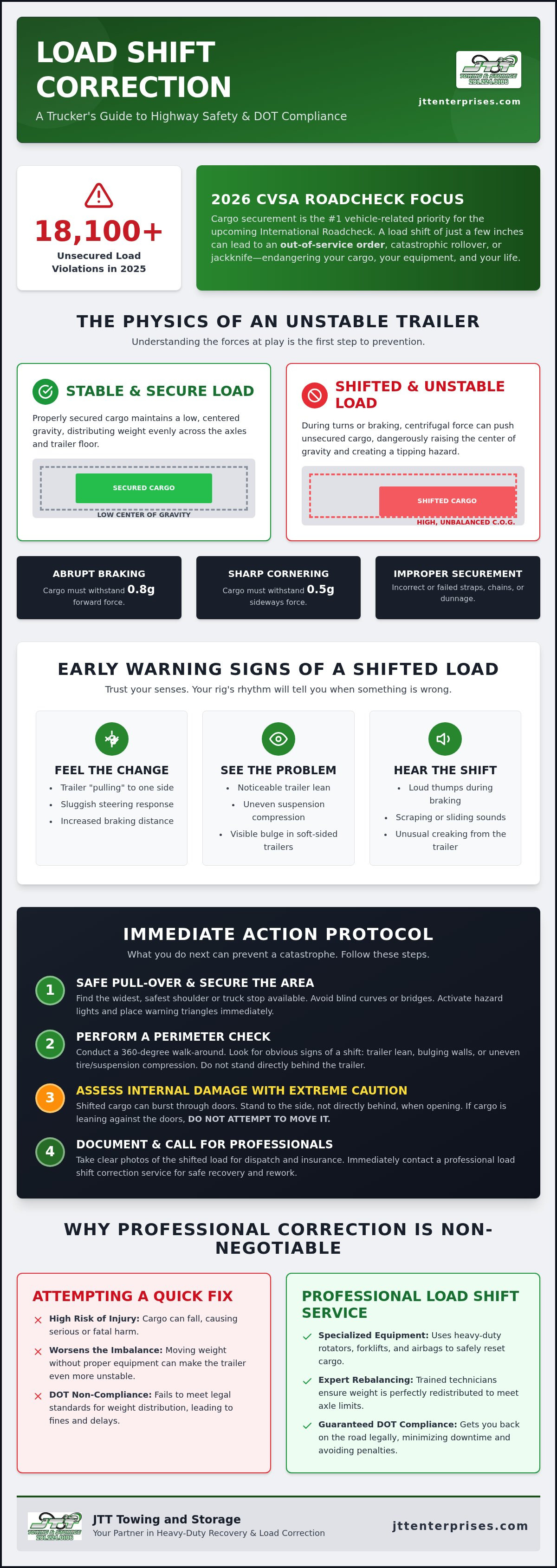
Did you know that cargo securement is the primary vehicle focus for the 2026 CVSA International Roadcheck? With more than 18,100 violations recorded in 2025 for unsecured loads, the margin for error on the highway has never been thinner. You understand the sudden, sinking feeling when a heavy load shifts during an emergency brake or a sharp turn. It's a high-stakes moment that puts your trailer, your cargo, and your CDL at immediate risk. When your freight moves out of place, professional load shift correction services are often the only way to restore balance and ensure you aren't sidelined by an out-of-service order.
This guide will help you identify the early warning signs of instability and manage the situation before it becomes a catastrophe. You'll learn how to maintain strict DOT compliance while protecting your truck from the dangers of jackknifing or tip-overs. We'll walk through the technical requirements for cargo securement and explain the specialized recovery methods used to get you back on the road safely. Whether you're dealing with a minor shift at a truck stop or a full trailer rework, having a reliable guardian on your side makes all the difference for your safety and your schedule.
Key Takeaways
- Learn why cargo shifts occur and how they impact your vehicle’s center of gravity and overall highway safety.
- Discover the sensory and visual indicators that signal a shifted load before it leads to a trailer tip-over or jackknife.
- Understand why attempting manual correction is dangerous and how professional load shift correction services use specialized equipment like heavy-duty rotators to safely reset your freight.
- Follow a step-by-step guide on how to stabilize your trailer and coordinate with recovery experts to minimize downtime and avoid DOT fines.
- Gain peace of mind by knowing how to maintain DOT compliance and protect your cargo through proper stabilization and professional transfers.
Understanding Load Shifts: Why Cargo Moves and the Risks Involved
A load shift occurs when freight moves within a trailer, fundamentally altering the vehicle's center of gravity. This instability usually stems from abrupt braking, sharp cornering, or improper initial securement. It is often called a "silent threat" because a shift of just a few inches can lead to a catastrophic rollover. According to FMCSA standards, cargo must be secured to withstand specific forces, including 0.8 g forward and 0.5 g sideways. When these thresholds are exceeded and the cargo moves, load shift correction services are required to restore balance. Load shift correction is the professional redistribution of cargo to meet FMCSA safety standards.
The Physics of an Unstable Trailer
Centrifugal force is the primary enemy of a stable trailer during a turn. When you navigate a curve, this force pushes the load toward the outside of the trailer. If the freight isn't secured properly, it slides, significantly raising the center of gravity on one side. This makes the trailer prone to tipping even at moderate speeds. While liquid tankers deal with "surge," palletized freight shifts create a permanent weight imbalance that won't correct itself during travel. You'll notice the impact immediately through increased braking distances and a sluggish steering response. If you're wondering what a load shift is in a technical sense, it's the loss of static friction that keeps your cargo anchored to the trailer floor. Once that anchor is lost, the trailer's momentum becomes unpredictable.
Legal and Financial Consequences of Improper Loading
Maintaining DOT compliance is essential for staying on the road and avoiding costly delays. Federal regulations set strict axle limits, typically 12,000 lbs for steers and 34,000 lbs for tandems. A shifted load can easily push an axle over these limits, leading to heavy fines during a scale house inspection. With cargo securement being the vehicle focus for the 2026 CVSA International Roadcheck, enforcement is stricter than ever. Roadside inspectors frequently issue "Out of Service" orders for weight imbalances, forcing you to stay parked until the cargo is reset. The financial impact of these delays, combined with potential cargo damage claims, is substantial. Utilizing professional load shift correction services is a proactive way to avoid these high-stakes penalties. It's far more efficient to fix the load professionally than to risk a jackknife or a rejected delivery at the receiver's dock.
How to Identify a Shifted Load Mid-Transit
Identifying a shift mid-transit requires a sharp ear and a steady hand. You know your rig's rhythm. When that rhythm changes, it's usually a sign that something has gone wrong behind the cab. If you suspect your freight has moved, seeking professional load shift correction services is the safest way to prevent a rollover. You might feel the trailer "pull" or "lean" excessively during a routine lane change. Perhaps you notice a slight tilt in your side-view mirrors that wasn't there at the last fuel stop. For those pulling soft-sided trailers, a visible bulge in the curtain is a red flag. Don't ignore thumping or sliding sounds during braking; these are auditory warnings that your cargo has broken free from its securement. Ignoring these signs violates Federal cargo securement rules and puts everyone on the road at risk.
Step 1: Safe Pull-Over and Perimeter Check
Finding a safe spot is your first priority. If you're on a busy Texas highway, look for a wide shoulder or a designated truck stop. Avoid stopping on narrow bridges or blind curves. Once you've stopped, activate your hazard lights and set up your warning triangles immediately to establish a safety zone. Conduct a slow, 360-degree walk-around. Look for any visible trailer lean or uneven suspension compression. If the trailer looks "heavy" on one side, you may need professional load shift and transfer services to safely rebalance the weight. This visual check is the first step in the "Pull-Over Protocol" designed to keep you and other motorists safe.
Step 2: Assessing the Internal Damage
Approaching the rear doors requires extreme caution. Shifted cargo often leans against the doors, meaning they could fly open with enough force to cause serious injury. Stand to the side as you crack the seal. Look for broken dunnage, snapped straps, or pallets that have collapsed under the pressure of the shift. If you see cargo stacked against the door or leaning precariously, do not attempt to move it yourself. Take clear photos of the damage for your dispatch records and insurance claims. This documentation is vital for proving that external factors, such as sudden road hazards, may have caused the shift. In these complex situations, calling for expert load shift correction services ensures the cargo is handled with specialized equipment rather than risky manual labor. It's the most reliable way to protect your equipment and your reputation.
Why Professional Load Shift Correction Surpasses Quick Fixes
Attempting a "quick fix" on a shifted load is a dangerous gamble. You might be tempted to pry a leaning pallet back into place with a crowbar or manual jack, but these DIY methods frequently lead to severe injuries. A single pallet often weighs over 2,000 pounds. If it tips while you're inside the trailer, there's no room to escape. Professional load shift correction services eliminate this risk by using industrial-grade tools designed for heavy-duty stabilization. Beyond physical safety, professional intervention provides critical liability protection. When a certified team documents the correction, it creates a verifiable record that the cargo was reset to industry standards. This documentation is your best defense against future cargo damage claims or carrier disputes. For situations where a shift has already led to a rollover, specialized tractor trailer accident recovery is the only way to salvage the freight and clear the roadway safely.
Precision Equipment for Complex Transfers
Standard forklifts are useful, but they aren't always enough for a severely leaning trailer. Our team utilizes heavy-duty rotators to stabilize the trailer's frame while the internal cargo is reset. We also employ specialized air bags to gently upright fallen crates without causing further damage to the packaging. If the trailer itself is compromised, we perform on-site load transfers. This involves moving the entire shipment from the damaged unit to a relief vehicle with precision and care. These advanced techniques ensure that even the most complex shifts are corrected without sacrificing the integrity of your freight. Our "can-do" attitude means we handle the transfers that standard tow companies simply can't manage.
Compliance with Texas DOT Standards
A corrected load isn't just about making the trailer look straight; it must be legal. We verify that the new weight distribution complies with Texas axle requirements, ensuring you won't be flagged at the next weigh station. Every correction adheres to the strict guidelines found in 49 CFR Part 393 Subpart I, which governs the protection against shifting or falling cargo. Our operators re-secure the freight using industrial-grade straps and bracing tailored to the specific load type. Before you resume your route, we verify the new center of gravity to ensure the rig handles predictably on the highway. This methodical approach provides the peace of mind you need to complete your haul safely.
The Step-by-Step Load Shift Correction Process
When you call for load shift correction services, precision and speed are our primary goals. To ensure a fast response, provide our dispatch team with your exact location, the type of freight you're hauling, and the direction of the lean. This information allows JTT to arrive with the specific recovery vehicles and tools needed for your unique situation. Once our team is on-site, we follow a methodical sequence to stabilize your rig and protect your cargo from further damage. This process is designed to handle the high-stakes nature of highway recovery with calm competence and technical expertise.
Initial Assessment and Site Safety
Our "reliable guardian" approach begins by securing the work area. We position our heavy-duty recovery vehicles to create a protective barrier between the crew and passing highway traffic. Operators conduct a thorough inspection to determine if the freight can be safely reset in-place or if the trailer's integrity requires a full load transfer. We don't take shortcuts with stabilization. If the trailer is leaning severely, we use specialized rotators or outriggers to lock the frame in place before any internal work begins. This ensures the safety of the driver and the recovery team throughout the entire process.
Mechanical Correction and Cargo Handling
Once the rig is secure, we begin the systematic redistribution of weight. We utilize on-site pallet jacks and specialized forklifts to move heavy pallets back to their designated positions. For "messy" shifts involving loose materials or ruptured packaging, our crew handles the debris with care to minimize further loss. We don't just push the freight back into a pile. We replace broken dunnage, install new blocking, and re-apply industrial-grade bracing to ensure the cargo stays anchored. This "can-do" attitude allows us to manage complex shifts that standard towing companies often lack the equipment or patience to handle correctly.
Weight Verification and Documentation
The final stage of the process focuses on legal compliance. We calculate estimated axle weights based on the new cargo placement to ensure your rig meets Texas DOT standards. You'll receive a detailed service report that documents the correction process, the equipment used, and the final state of the load. This report is a vital piece of evidence for DOT inspectors or insurance adjusters. After we verify that every strap and brace is tightened to specification, we provide a final "all-clear." You can proceed to the nearest scales with the confidence that your rig is balanced, legal, and ready for the remainder of your journey.
JTT Towing: Dayton’s Specialized Load Transfer Partner
JTT Towing and Storage serves the heart of Liberty County, providing dedicated support to drivers in Dayton, Huffman, and the surrounding regions. As a family-owned and operated business with over 10 years of experience, we understand that your cargo is your livelihood. We don't view a shifted load as just another service call. We treat every piece of freight with the same care and precision as if it were our own. Our team provides comprehensive solutions that keep you moving, ranging from specialized load shift correction services to expert heavy duty towing in Dayton, TX. We are here to act as a dependable anchor within the community, offering the calm competence you need when things go wrong on the road.
Our "Reliable Guardian" promise is built on a foundation of integrity and readiness. We know that a cargo shift is a high-stakes emergency that can derail your entire schedule and threaten your safety. By combining seasoned expertise with specialized equipment, we reduce the stress of these situations. Our operators are trained to handle the technical complexities of weight redistribution and trailer stabilization, allowing you to focus on your recovery. We don't just clear the scene; we ensure your rig is road-ready and compliant with all safety standards before you pull back onto the highway.
Strategic Location for Fast Response
Timing is everything when you're sidelined by a weight imbalance. JTT is strategically located near the major Texas freight corridors, including Hwy 90 and Hwy 146. This proximity allows us to reach drivers quickly, minimizing downtime and reducing the risk of further complications. We possess deep expertise in local terrain and the specific needs of industrial hauling in the Liberty County area. If your trailer is too damaged for immediate transit or the receiver cannot accept the load right away, we offer secure commercial vehicle storage in Dayton. This temporary holding option ensures your assets remain protected while you coordinate the next steps of your delivery.
Ready for Any Commercial Challenge
We pride ourselves on a "can-do" attitude that tackles the most complex commercial challenges. Whether you're hauling sensitive electronics or heavy industrial machinery, our team has the specialized equipment to manage unique cargo types that standard companies avoid. We are committed to keeping Texas commerce moving safely and efficiently. No task is too demanding for our capabilities, and we operate with a level of organization that mirrors the precision required in the field. When your cargo shifts and your deadline is looming, you need a trusted partner who responds with speed and professionalism. Contact JTT Towing and Storage for immediate load shift assistance and experience the peace of mind that comes with expert care.
Secure Your Load and Your Future on the Road
Maintaining cargo stability is about more than just avoiding a DOT fine; it's about ensuring every trip ends safely at the receiver's dock. You now understand how to spot the subtle warning signs of a shift and why relying on professional load shift correction services is the most responsible choice for your equipment and your career. From the physics of weight distribution to the technical precision of a trailer reset, taking the right steps today prevents a catastrophic rollover tomorrow. You've worked hard for your CDL, and protecting it requires a commitment to safety that doesn't cut corners.
JTT Towing and Storage has served the Dayton, Huffman, and Liberty County areas for over 10 years. Our family-owned team is ready with 24/7 emergency heavy recovery to act as your reliable guardian on the highway. We handle the complex transfers that keep Texas commerce moving with calm competence and integrity. You don't have to manage an unstable load alone or risk your safety with a DIY fix. Reach out to a partner who values your cargo as much as you do. Get Professional Load Shift Help in Dayton Now. Stay vigilant, trust your instincts, and drive with the confidence that expert help is always just a phone call away.
Frequently Asked Questions
What is the difference between a load shift and a load transfer?
A load shift involves cargo moving out of place within your current trailer, often requiring a reset to balance axle weights. A load transfer is the process of moving freight from one trailer to another relief vehicle, usually because the original equipment is damaged. JTT Towing and Storage provides both load shift correction services and full transfers throughout Dayton and Liberty County. We use specialized equipment to ensure your freight is handled safely during either process.
Can I drive to a truck stop if I feel my load has shifted?
Driving with a shifted load is extremely dangerous and increases the risk of a rollover or jackknife. If you feel your trailer leaning or pulling, you should pull over to the widest available shoulder immediately. Attempting to reach a truck stop can lead to a catastrophic accident if you encounter a sharp curve or need to brake suddenly. Our recovery team can meet you on the roadside in Huffman or Dayton to stabilize the situation before you move another mile.
How much do load shift correction services typically cost?
The cost of correcting a shift depends on the severity of the movement and the equipment required for the job. Minor shifts handled on-site typically involve different resource needs than a full trailer rework that requires multiple hours of labor and specialized forklifts. While we don't provide flat-rate pricing due to the unique nature of every recovery, factors like duration and technical complexity will influence the final total. Professional correction is always more cost-effective than a cargo damage claim.
Does insurance cover professional load shift correction?
Many commercial insurance policies cover professional recovery and cargo stabilization, but coverage depends on your specific provider and the cause of the shift. It's common for inland marine or cargo insurance to include provisions for loss mitigation, which covers the cost of preventing further damage. We recommend checking your policy details or speaking with your adjuster. JTT provides the comprehensive documentation and service reports you'll need to support your claim for load shift correction services.
How long does a typical load shift correction take?
A minor shift can often be corrected in about an hour if the cargo is easily accessible and requires minimal movement. More complex situations involving collapsed pallets or a full trailer rework can take between four and five hours to complete properly. Our crew works efficiently to minimize your downtime while ensuring every strap and brace meets DOT standards. We prioritize getting you back on the road safely without sacrificing the quality of the securement.
What information should I have ready when calling for a load shift service?
When you call our dispatch team, please have your exact mile marker or landmark in Liberty County ready. We also need to know the type of cargo you're hauling, the trailer type, and the estimated weight of the shifted items. Describing the direction of the lean helps us determine if we need to bring a heavy-duty rotator or specific pallet jacks. Providing these details upfront allows JTT to deploy the right resources for a faster, more effective response.
Will a shifted load always result in a DOT violation?
A shifted load doesn't guarantee a violation, but it significantly increases the likelihood during a roadside inspection. Since cargo securement is the focus of the 2026 CVSA International Roadcheck, inspectors are looking closely at weight distribution and tie-down tension. If your cargo has moved, it likely no longer meets the performance requirements for forward or lateral force. Correcting the shift before you reach a scale house is the best way to avoid an Out of Service order.
Can JTT handle refrigerated (reefer) load shifts?
Yes, JTT Towing and Storage has the expertise and equipment to handle refrigerated load shifts throughout the 77535 and 77532 zip codes. We understand the time-sensitive nature of reefer freight and the need to maintain temperature integrity during the correction process. Our can-do attitude ensures that even delicate or temperature-controlled shipments are stabilized quickly. We treat your perishable cargo with the high standards required to prevent spoilage and ensure a successful delivery at the receiver.


