
Texas Heavy Duty Towing: What Determines Your Quote?
What if the per-mile rate is the least useful number in a heavy-duty towing quote? If you’re comparing the heavy duty towing cost per mile Texas providers quote, it’s reasonable to want a clear figure before agreeing to a tow. But mileage may cover only the trip. The full estimate can also depend on the truck, its location, and whether recovery work is needed first.
This guide explains how to separate transport distance from the rest of the estimate, what can change the total, and what details to share when requesting a quote. You’ll also find questions to ask about dispatch, recovery, and other work so you can compare estimates on the same basis. For a more useful estimate, be ready to describe the vehicle, its condition, the scene, and the intended destination. JTT Towing and Storage is based in Dayton and provides heavy-duty towing and accident recovery. Confirm current availability for your location and ask which services apply to your job.
Key Takeaways
- A per-mile figure for heavy duty towing cost per mile Texas is only one part of an estimate. Ask how the provider calculates distance and what the rate includes.
- Vehicle size, weight, condition, and ability to roll or steer can affect the equipment and work required.
- Accident damage, off-road access, or a shifted load may require recovery work beyond transport.
- Share the vehicle type, pickup location, destination, condition, and visible hazards so the provider can assess the job.
- Compare estimates by their mileage basis, recovery scope, and included services, then confirm availability for your exact location.
Understanding Heavy Duty Towing Costs per Mile in Texas
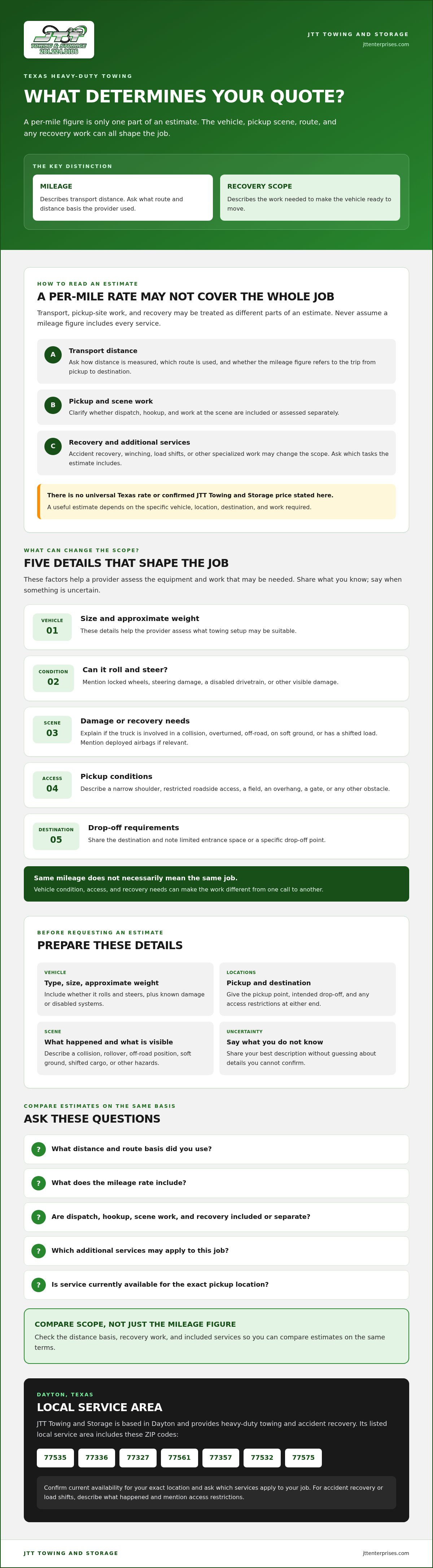
A per-mile rate is one possible part of a heavy-duty towing quote, not necessarily the price for the entire job. It may describe the transport distance, while pickup-site work or recovery may be estimated separately. That distinction matters when comparing the heavy duty towing cost per mile Texas providers discuss: the same mileage figure can cover different services depending on what the quote includes.
There is no universal Texas rate or confirmed JTT Towing and Storage price stated here. A useful estimate needs to reflect the specific vehicle, pickup location, destination, and work required. The type and capability of the tow truck used may also depend on the job.
Does a per-mile towing rate include the whole job?
Not necessarily. A mileage rate alone may not tell you whether dispatch, hookup, scene work, or additional services are included. Ask the provider to clarify each item rather than assuming the rate covers it. A routine transport quote may differ in scope from one that also involves accident recovery, winching, load shifts, or other specialized work.
Before authorizing a tow, ask what the estimate covers and which tasks, if any, are separate. Treat these as questions to confirm with the provider, not assumptions about any company’s billing practices.
Why Texas location and job details matter
The pickup point, destination, vehicle access, and proposed route all help define the job. A truck accessible beside a road and ready to move presents a different situation from one that needs off-road recovery or assistance after an accident. Ask which route and distance basis the provider used, such as the distance between pickup and destination, and how any scene work is reflected in the estimate.
JTT Towing and Storage is based in Dayton, Texas, and lists ZIP codes 77535, 77336, 77327, 77561, 77357, 77532, and 77575 in its local service area. Confirm current availability for your exact location and describe the truck’s position and condition so the provider can discuss the likely scope. For accident recovery or load shifts, explain what happened and mention any access restrictions. Don’t assume those tasks are included in a transport-only quote.
Mileage describes distance; recovery scope describes the work needed to make the vehicle ready to move.
Which Factors Change a Texas Heavy Duty Towing Quote?
Distance is only one part of an estimate. The vehicle’s size and approximate weight help the provider assess what kind of towing setup may be suitable, while its condition affects how it can be moved. A truck that rolls and steers may require different work from one with locked wheels, steering damage, or a disabled drivetrain. Share what you know, and say when a detail is uncertain rather than guessing.
The scene matters too. A collision, rollover, soft ground, restricted roadside access, or shifted load can require work before transport begins. Equipment needs depend on the vehicle and scene conditions, so don’t assume a particular truck or recovery method will suit every call. Ask what the provider expects the job to involve and whether the estimate separates recovery tasks from transport.
How truck condition and recovery complexity affect the estimate
Explain whether the vehicle is disabled, overturned, off-road, or involved in a collision. Note visible damage and whether it can roll or steer. If airbags have deployed or cargo has shifted, mention that early. Airbag recovery and load transfers are specialized services, not ordinary mileage. They may change the work needed to prepare the vehicle or load for transport. For more on accident scenes, see this tractor-trailer accident recovery guide.
For private-property tows initiated without the vehicle owner’s request, rules may differ from estimates for a tow the owner requests. The Texas Administrative Code on tow fees addresses private-property towing fees. Don’t assume those provisions describe the pricing of a requested heavy-duty tow. Ask the provider how they apply to your situation.
How distance, access, and destination shape the quote
Give the provider the pickup point and intended destination, along with any access restrictions. Mention whether the truck is on a narrow shoulder, in a field, beneath an overhang, or behind a gate. Describe destination requirements too, such as limited entrance space or a specific drop-off point. These details help the provider assess both the route and the work needed at either end.
Two calls with equal mileage can involve different work if one vehicle is ready to tow and the other needs recovery first. For a job-specific discussion, contact JTT about its heavy-duty towing and accident recovery, and confirm availability for your location and the services included in the estimate.
How to Compare Heavy Duty Towing Quotes Beyond the Per-Mile Rate
A lower mileage figure isn’t automatically the better quote. Providers may be estimating different distances, assuming different vehicle conditions, or including different amounts of recovery work. To compare the heavy duty towing cost per mile Texas providers quote, first make sure each estimate describes the same job.
Use a checklist or set up a table with one column for each provider. Record these details so differences in scope are easy to spot:
- Mileage basis: What route and distance are used to calculate transport?
- Vehicle assumptions: What vehicle type, approximate weight, and condition does the estimate describe?
- Pickup and destination: Are both locations and the intended drop-off point clearly identified?
- Recovery scope: Does the estimate cover towing only, or does it also describe separate recovery tasks?
- Included services: Which tasks are included, and what circumstances could change the scope?
What should a commercial towing quote clarify?
Ask for the vehicle description, pickup point, destination, and known condition to be reflected in the estimate. If the truck is damaged, difficult to access, or part of an accident scene, share that information before comparing quotes. Confirm what work is included and how the provider will handle a change in conditions or scope. Get the estimate terms clearly stated before authorizing service.
How to compare like with like
Give each provider the same description of the vehicle, incident, pickup location, destination, and access conditions. Then compare transport separately from accident recovery, off-road recovery, or load-shift assistance. These tasks may require work beyond moving a vehicle along a route, so a quote that includes them isn’t directly comparable to a towing-only estimate.
For example, two estimates for the same destination may differ because one assumes the vehicle can be loaded and moved, while the other accounts for a recovery step first. Ask each provider to identify that distinction instead of judging by the headline rate alone. JTT’s Dayton heavy-duty towing guide offers additional context on commercial recovery needs.
A clear comparison helps you understand what each provider is proposing, not just which number looks lower. If a detail is missing or unclear, ask for clarification before approving the work.
What Information Should You Prepare Before Requesting a Texas Towing Estimate?
A clear description helps a towing provider assess the vehicle, location, and likely work before preparing a job-specific estimate. You don’t need to know the technical solution. Share the details you can confirm and be upfront about anything you’re unsure of. This helps clarify what the estimate includes beyond the heavy duty towing cost per mile Texas figure.
What details help a towing provider assess the job?
Use this checklist when you call. Put personal safety first. Don’t enter a traffic lane, approach unstable equipment, or attempt to recover the vehicle yourself to gather information.
- Vehicle and load: Identify the truck, trailer, or equipment as accurately as you can. Describe whether it’s loaded, empty, or carrying a shifted load.
- Pickup location: Give the address, nearby landmark, or other precise location details. Mention gates, narrow access, soft ground, or a roadside position.
- Destination: Provide the intended drop-off location if known. Note access limits or specific destination requirements.
- Condition and movement: Explain whether the vehicle is damaged, disabled, overturned, or involved in a collision. Say whether it can roll, steer, or move under its own power.
- Visible hazards: Report traffic exposure, deployed airbags, leaking fluids, unstable cargo, or other hazards you can see from a safe place.
Photos may help explain the scene, but only take or send them if it’s safe and permitted. Never walk toward traffic or unstable equipment for a better view. A clear verbal description is better than risking injury.
What should you confirm before authorizing service?
Before approving the work, ask how the provider determines mileage and which services the estimate includes. Confirm whether the proposed scope covers towing only or also identifies separate recovery tasks. Ask how the provider will explain any change if the vehicle’s condition or scene differs from what you described. These questions help you understand the estimate without assuming a mileage figure covers every part of the job.
JTT Towing and Storage is based in Dayton, Texas, and offers heavy-duty towing, accident recovery, off-road recovery, and load shifts and transfers. Share the vehicle and scene details to discuss an estimate, and confirm current service availability for your exact location.
Contact JTT Towing and Storage to discuss the job and request current service information.
Choosing Heavy Duty Towing Near Dayton, Texas: From Quote to Service
A suitable provider should be able to discuss the vehicle, its location, and the work the job may involve. Consider whether the service matches the vehicle’s needs, whether the estimate distinguishes transport from recovery, and whether the provider has confirmed it can serve the pickup location. A clear explanation is more useful than a per-mile figure on its own.
JTT Towing and Storage is based in Dayton, Texas, and offers heavy-duty towing and accident recovery. Its stated local service area includes ZIP codes 77535, 77336, 77327, 77561, 77357, 77532, and 77575. Listed coverage is a starting point, not confirmation that service is currently available for a particular job. Ask about your exact location and describe the work needed.
When a tow becomes a recovery job
A collision, rollover, off-road position, or shifted load can mean the job involves recovery planning before the vehicle is ready for transport. That work differs from towing a vehicle along a route, so explain the scene when requesting an estimate and ask how the provider has accounted for it. For more context on off-road incidents, see JTT’s off-road heavy recovery guide.
How to take the next step with a Dayton-area provider
Before contacting a provider, gather the vehicle type, exact pickup location, condition, and intended destination. Mention visible damage, access restrictions, and whether the vehicle can roll or steer. These details help the provider discuss whether the job appears to involve heavy-duty towing, accident recovery, or another listed service. Share only what you can observe safely.
Ask JTT to confirm current service availability for your location and explain the estimate for your specific job, including what work it covers. That way, you can assess the proposed service and its scope rather than relying on a general idea of the heavy duty towing cost per mile Texas providers may quote.
Contact JTT about heavy-duty towing in Texas to discuss your vehicle and location and request current service information or a job-specific estimate.
Get a Clearer Estimate for Your Towing Needs
A per-mile figure is only one part of a heavy-duty towing estimate. The vehicle’s condition, pickup and destination, and any recovery work can all shape the job. Share those details with the provider, then confirm how mileage is calculated and which services the estimate includes before authorizing the work.
If you’re looking for heavy duty towing cost per mile Texas providers may quote, focus on understanding the full scope rather than comparing mileage figures alone. JTT Towing and Storage is a family-owned and operated provider based in Dayton, with more than 10 years of experience and heavy-duty towing and specialized recovery services. Confirm current availability for your exact location and ask for an estimate based on your situation.
Contact JTT Towing and Storage to discuss your heavy-duty towing needs and request current service information. With clear details and a direct conversation, you can take the next step with greater confidence.
Frequently Asked Questions
How much does heavy duty towing cost per mile in Texas?
There’s no single verified per-mile rate that applies to every heavy-duty tow in Texas, and JTT Towing and Storage’s rates aren’t specified here. A mileage charge may be only one component of an estimate. The total depends on the vehicle, route, and work required. Ask the provider for a job-specific estimate, and confirm how distance is measured and which services are included before authorizing a requested tow.
What affects the cost of heavy duty towing in Texas?
The estimate can depend on the vehicle type, approximate weight, condition, and whether it can roll or steer. Pickup access, destination, and the distance calculation matter too. A vehicle involved in a collision, positioned off-road, or carrying a shifted load may need work beyond transport. Give the provider a clear account of the vehicle and scene, then ask what factors could change the scope or estimate.
Does a heavy-duty towing quote include recovery work?
Not automatically. A quote may cover transport only or describe separate recovery work, depending on the job and provider. Ask whether the estimate includes tasks such as accident recovery, off-road recovery, airbag recovery, or load shifts and transfers. Confirm which services are included and how changes in vehicle condition or scene access will be addressed. Don’t assume a per-mile figure covers work before the vehicle is ready to move.
How is towing mileage calculated for a commercial truck?
Don’t assume every provider uses the same mileage calculation. Ask which pickup and destination points are being used, what route or distance basis the estimate follows, and whether the quoted mileage refers to transport distance. For example, confirm whether the provider is measuring between your exact pickup location and requested drop-off point. Clarifying this makes it easier to compare estimates based on the same assumptions.
Can accident recovery cost more than a standard heavy-duty tow?
Accident recovery can involve more work than a routine tow, but the effect on an estimate depends on the incident and recovery scope. A collision, rollover, difficult access, or shifted load may require assessment and work before transport can begin. Ask the provider to distinguish transport from recovery tasks and explain the estimate for each part. Don’t assume a specific recovery price without a job-specific estimate.
What information should I provide to get a heavy-duty towing estimate?
Share the truck or equipment type, approximate weight or load status if known, exact pickup location, intended destination, and vehicle condition. Explain whether it can roll, steer, or move under its own power, and describe the incident and visible hazards. Mention access restrictions such as a narrow entrance or roadside position. Provide photos only if safe and permitted. Don’t approach traffic or unstable equipment to gather details.
Does JTT Towing and Storage serve my Texas ZIP code?
JTT Towing and Storage lists ZIP codes 77535, 77336, 77327, 77561, 77357, 77532, and 77575 in its local service area around Dayton, Texas. Listed coverage doesn’t confirm current availability for a particular job. Contact JTT with your exact ZIP code and pickup location to confirm whether service is available and ask which services may suit your vehicle and circumstances.
What happens if the truck cannot be safely towed as-is?
If the truck can’t be safely moved in its current condition, describe what you can see and let the provider assess the situation before transport. Damage, a rollover, an off-road position, or shifted cargo may call for a recovery plan or another specialized service. Don’t attempt to move the vehicle or cargo yourself. JTT offers heavy-duty towing, accident recovery, off-road recovery, airbag recovery, and load shifts and transfers. Confirm which service fits your job.


