
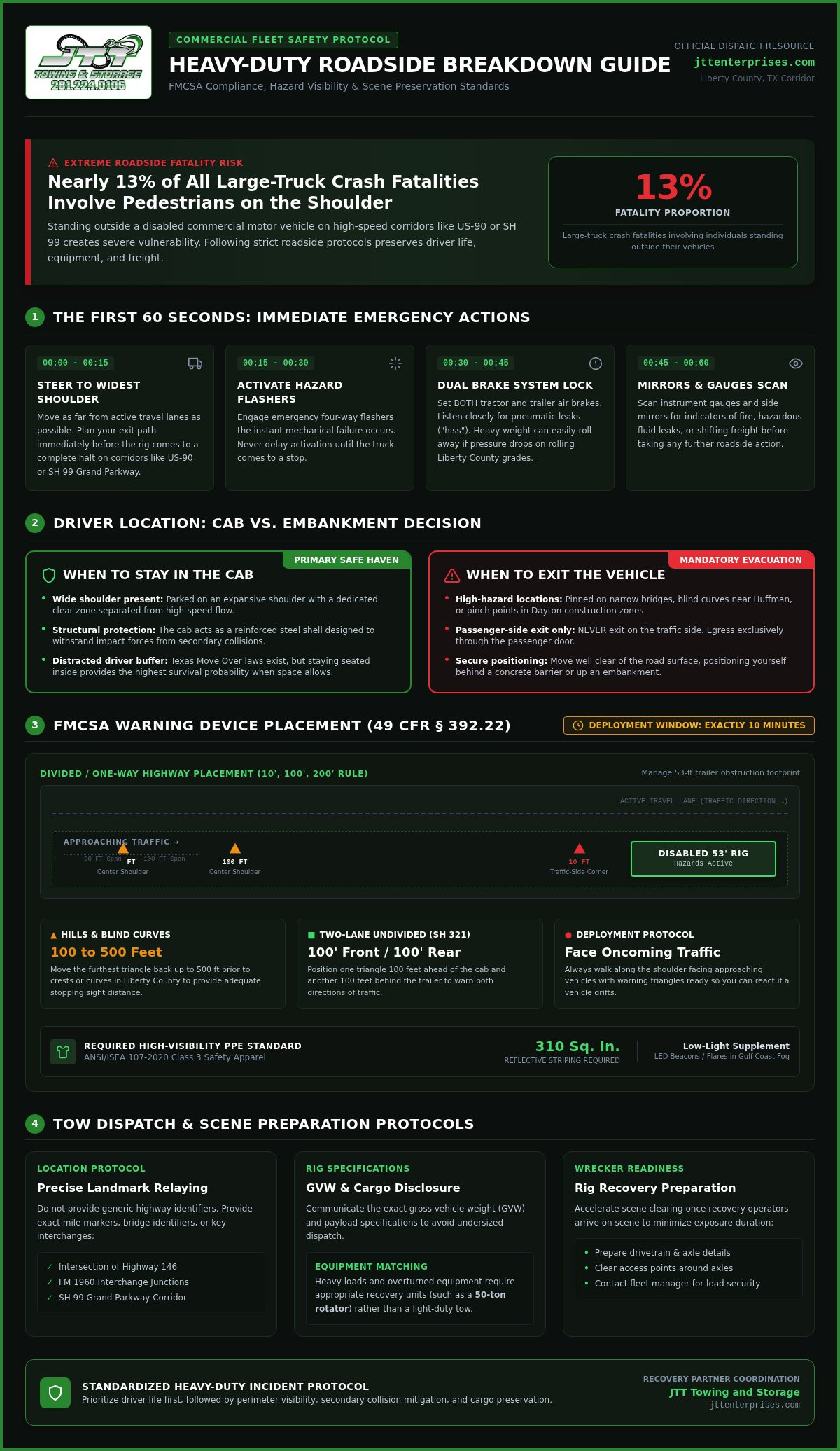
Did you know that nearly 13 percent of all large-truck crash fatalities involve people standing outside their vehicles on the roadside? When your rig loses power on a high-speed corridor like US-90 or SH 99, that sudden sense of vulnerability is completely justified. You aren't just managing a mechanical failure; you are managing the massive footprint of a disabled commercial vehicle in a high-risk environment. It is a stressful situation that requires a calm, methodical approach to ensure everyone goes home safely.
We understand that your priority is protecting your life, your equipment, and your cargo from secondary collisions or theft. Learning how to stay safe waiting for heavy duty tow is essential for every commercial driver navigating the busy freight lanes of Liberty County. This guide outlines the exact protocols you need, from precise FMCSA triangle placement for long trailers to deciding when it's safer to stay in the cab or move to the embankment. We will also cover how to prepare your driveline for recovery and safeguard temperature-sensitive loads against the intense Southeast Texas heat. By following these professional standards, you can maintain control of the scene until a reliable recovery partner arrives.
Key Takeaways
- Master the first 60 seconds of a breakdown by steering to the widest shoulder possible and activating high-visibility emergency flashers immediately.
- Learn how to stay safe waiting for heavy duty tow by implementing FMCSA-compliant triangle placement to manage your rig's massive footprint on busy Texas highways.
- Protect your cargo and equipment by identifying soft shoulder risks and securing high-value loads against potential theft in isolated roadside areas.
- Manage environmental hazards like extreme heat and humidity to prevent heat exhaustion while remaining alert for the arrival of the recovery team.
- Streamline the towing process by preparing drivetrain details and clearing access points around the rig's axles for the heavy-duty wrecker operator.
Immediate Critical Actions: Securing Your Rig and Yourself
The first 60 seconds after a mechanical failure are the most dangerous. You must immediately steer your rig toward the widest available shoulder, moving as far from the travel lanes as possible. If you are on a busy corridor like US-90 or the SH 99 Grand Parkway, don't wait for the truck to come to a full stop before planning your exit path. Engage your emergency flashers the moment you realize there's a problem. Once stopped, perform a quick but thorough scan of your mirrors and gauges for signs of fire, fluid leaks, or shifting hazardous materials.
Deciding whether to stay in the cab or exit the vehicle is a high-stakes choice. Generally, if you are parked on a wide shoulder with a clear zone, the cab is your safest haven. It provides a reinforced steel shell against secondary impacts. However, if you are stuck on a narrow bridge, a blind curve near Huffman, or a pinch point in the Dayton construction zones, you should exit through the passenger side. Move well away from the roadway, preferably behind a concrete barrier or up an embankment. While move over laws require Texas drivers to change lanes or slow down, distracted motorists remain a constant threat. Learning how to stay safe waiting for heavy duty tow means never assuming traffic will see you.
Securing the Air Brake System
Setting both the tractor and trailer air brakes is a non-negotiable step, especially on the rolling grades found in parts of Liberty County. A heavy-duty rig can easily overcome a single set of brakes if the air pressure begins to drop during a long wait. Listen closely for the "hiss" of an air leak that could lead to unintended movement. Heavy-duty braking systems require specific attention because their massive weight and pneumatic dependencies mean any loss of pressure can result in a catastrophic roll-away.
Initial Communication Protocols
Clear communication is your best tool for a fast, safe recovery. When you call for assistance, provide your exact location using specific landmarks like the intersection of Highway 146 or FM 1960. Don't just say you're "on the highway." Tell the dispatcher your gross vehicle weight and exactly what you're hauling. This ensures they send the right equipment, like a 50-ton rotator, instead of an undersized wrecker. After emergency services are notified, contact your fleet manager to coordinate load security and logistics. Understanding how to stay safe waiting for heavy duty tow includes ensuring the right help is on the way the first time.
Maximizing Visibility on Texas Highways: Managing the Footprint
Visibility isn't just about lights. It is about defining the boundaries of your disabled vehicle so that high-speed traffic has ample time to react. On a busy stretch like US-90, a 53-foot trailer creates a massive physical obstruction. Learning how to stay safe waiting for heavy duty tow involves more than just hitting the hazard switch. You must actively manage the "footprint" of your rig to prevent secondary collisions, which are often more devastating than the initial breakdown.
According to federal regulations for stopped commercial motor vehicles, you have exactly 10 minutes to deploy your emergency warning devices after stopping on the traveled way or shoulder. For divided highways, the standard is the 10, 100, and 200-foot rule. Place one triangle on the traffic side 10 feet from the rear, another 100 feet back, and a third 200 feet back. In low-light or foggy Gulf Coast conditions, supplement these with LED beacons or flares. Always wear ANSI/ISEA 107-2020 Class 3 safety apparel. This gear provides 310 square inches of reflective striping, making you visible to drivers at much greater distances than standard vests.
Triangle Placement for Long Rigs
Standard distances are a baseline, but Liberty County roads often require adjustments. If you are stopped near a curve or the crest of a hill, move your furthest triangle back between 100 and 500 feet to provide advance warning to oncoming drivers. Just as commercial drivers must adapt to local road conditions, anyone towing a trailer should be familiar with state-specific safety requirements; ProPride, Inc. offers a detailed guide to these laws to help keep the roads safer for everyone. On undivided two-lane roads, like parts of SH 321, place one triangle 100 feet ahead of the cab and another 100 feet behind the trailer. When deploying these, always walk along the shoulder while facing traffic. This allows you to keep an eye on approaching vehicles and jump clear if a motorist drifts toward your position.
Modern safety also includes digital visibility. Use your smartphone to send a GPS "drop pin" to your dispatcher or the heavy duty towing Dayton TX team. This ensures the recovery operator can locate your exact coordinates without confusion, especially in rural areas between Dayton and Huffman. Keep your phone line clear so the operator can reach you with an arrival update. Additionally, use your CB radio on channel 19 to alert other truckers. A simple "disabled rig on the eastbound shoulder of 1960" can prevent a dangerous surprise for a fellow driver hauling a heavy load. If you need immediate assistance, reaching out to a professional recovery partner ensures your scene is managed with expert precision.
Cargo Safety and Load Integrity While Awaiting Recovery
Your cargo is the lifeblood of your operation, and a roadside breakdown puts that investment at immediate risk. Protecting your freight involves more than just locking the trailer doors. You must account for physical shifts in the load, environmental factors, and potential security threats in isolated areas around Liberty County. Understanding how to stay safe waiting for heavy duty tow involves securing your freight as diligently as you secure your cab.
If your breakdown resulted from a sudden maneuver or hard braking, your cargo may have shifted. A shifted load changes the vehicle's center of gravity, which can cause a trailer to tip during the recovery process. While you are waiting, monitor your refrigerated units closely. The intense humidity in Southeast Texas can strain reefer motors. Log your temperature readings every hour to maintain a clear record for liability purposes. If the rig is deemed non-towable, you may need to coordinate a trailer load transfer Dayton TX to get the goods back on the move.
Security is another critical concern. Cargo theft rings often target stationary commercial vehicles, especially along freight corridors connecting Houston to the Trinity River basin. Keep your high-security bolt seals intact and never leave your bills of lading unattended on the dashboard. If you must exit the cab to inspect the trailer's exterior in the punishing sun, be mindful of your physical limits. Drivers should consult OSHA guidance on heat-related illnesses and first aid to recognize the early signs of heat exhaustion while performing these necessary checks.
Identifying Load Shift Risks
Look for subtle visual cues like bulging trailer walls or a noticeable lean to one side. These are red flags that the cargo securement has failed. Never attempt to open the rear doors or re-secure a shifted load while parked on a highway shoulder. The risk of the load falling on you or the trailer shifting into traffic is too high. Instead, rely on professional load shift correction services to stabilize the freight using specialized rigging and equipment. This keeps you out of harm's way and prevents further damage to the trailer structure.
Cargo Documentation and Insurance
Documentation is your best defense against insurance disputes. Use your phone to take clear photos of the trailer's position, the condition of the seals, and any visible damage. Do this only if it is safe to walk the perimeter of the rig. Keep your weight tickets and bill of lading organized and ready for the recovery team. Providing accurate weight data helps the wrecker operator calculate the necessary winching force. Maintaining these records ensures a smooth handoff and protects your professional reputation if a cargo claim arises later.
Environmental Hazards: Staying Safe in the Dayton, TX Climate
Dayton's environment presents unique challenges that can turn a routine breakdown into a complex emergency. The coastal flood basin between the Trinity River and the Houston Ship Channel is known for its saturated soil and unforgiving humidity. When considering how to stay safe waiting for heavy duty tow, you must account for the ground beneath your tires and the air around your cab. A heavy rig parked on a saturated shoulder is a recipe for a secondary disaster if you aren't vigilant.
Flash flooding is a persistent threat in Liberty County. Sudden torrential squalls can inundate low-lying ditches along FM 1960 or SH 146 in minutes. If you are forced to stop, avoid pulling into grassy swaths or deep ditches where water collects. Additionally, be mindful of local wildlife and pests. Rural East Texas breakdown spots are home to fire ants and snakes that often seek higher ground during rain. Stay alert when inspecting your perimeter and keep your cab doors closed to prevent unwanted visitors.
Managing Soft Shoulders and Mud
The soil composition in East Texas often includes heavy clay that loses its load-bearing capacity when wet. An 80,000-pound rig can sink to its axles in minutes on an unpaved FM road shoulder. To prevent a secondary semi truck rollover recovery Dayton TX, keep your wheels on the pavement or stabilized gravel whenever possible. Avoid making sharp steering adjustments once you've moved onto the shoulder, as the lateral force can pull the trailer into a soft ditch. If you lose traction, don't spin your tires; simply wait for a professional winch out service for semi trucks to pull you back to solid ground.
Extreme Heat Safety for Drivers
Heat is a silent killer for drivers stranded on Texas highways. With heat index values often exceeding 110°F, an uncooled cab becomes a furnace in less than an hour. If your engine is dead, maintain cabin ventilation by cracking the windows on the side away from traffic. Watch for signs of heatstroke, such as confusion, rapid pulse, or a lack of sweating, during your brief roadside inspections. Keep a gallon of water in your emergency kit to stay hydrated during long waits. While you need your emergency lights, manage your battery life by turning off non-essential electronics to ensure your visibility gear stays powered. If you find yourself in a dangerous situation, contact a heavy-duty recovery specialist in Dayton to secure your scene immediately.
Preparing for the Recovery Team: Facilitating a Safe Tow
Once you see the recovery lights on the horizon, your role shifts from passive observer to scene facilitator. Understanding how to stay safe waiting for heavy duty tow culminates in this final transition. Your goal is to provide the operator with a clear, unobstructed environment to work in. If it's safe to do so, clear any small debris or loose cargo from around the rig's axles and hitch points. This allows the operator to quickly identify attachment zones for the under-lift or tow chains without wasting precious time in the line of fire.
Accurate data is your best tool for preventing drivetrain damage during transport. You must inform the operator about the rig's specific drivetrain configuration and the current state of the air system. For example, mention if the driveshaft needs to be pulled or if the spring brakes require manual caging. If your rig is off-road or overturned, specialized equipment like an airbag recovery system or a rotator may be necessary to upright the vehicle without further structural damage. Perform a final walk-around to check for loose fairings, mirrors, or mudflaps that could fly off at highway speeds. This protects other motorists and reduces the liability for your fleet.
Communicating Rig Specifications
Identifying the best attachment points for heavy-duty under-lifts prevents unnecessary stress on the frame or suspension components. If your truck has custom modifications or sensitive aftermarket equipment near the front bumper, point these out immediately. A rotator is a heavy-duty recovery vehicle equipped with a 360-degree rotating crane boom that allows for precise lifting and uprighting of overturned rigs without requiring multiple lanes of traffic to be closed. Providing these details ensures the JTT Towing and Storage specialist can execute a surgical recovery that preserves the integrity of your equipment.
Transitioning to Secure Vehicle Storage
Before the rig is hooked and cleared, pack your essential personal items, electronics, and logbooks from the cab. You won't have immediate access to the interior once the vehicle enters a secure truck storage Liberty County facility. Understanding the intake process helps manage expectations regarding vehicle release and insurance inspections later. Finalize the hand-off by confirming the destination and obtaining the operator's contact information. This professional coordination ensures that your rig is moved from the dangerous roadside to a controlled environment with minimal delay. Learning how to stay safe waiting for heavy duty tow ends with a successful, damage-free delivery to a secure yard.
Securing Your Future on the Road After a Breakdown
Maintaining safety during a heavy-duty breakdown requires more than just patience. It demands active scene management and a thorough understanding of your vehicle's physical footprint. By prioritizing immediate visibility and preparing your drivetrain details for the recovery operator, you take control of a high-stress situation. Knowing how to stay safe waiting for heavy duty tow ensures that you, your cargo, and your equipment remain protected until professional help arrives.
When the unexpected happens on a Texas highway, you don't have to face the challenge alone. JTT Towing and Storage provides the professional assurance and specialized equipment needed to handle even the most complex recoveries. As a family-owned business with over 10 years of heavy-duty expertise in Liberty County, we utilize advanced tools like specialized rotators and airbag recovery systems to get you back on track safely.
Contact JTT Towing and Storage for 24/7 Heavy-Duty Recovery in Dayton and let our experienced team serve as your reliable guardian on the road. Stay safe, stay vigilant, and know that expert assistance is always within reach.
Frequently Asked Questions
Is it safer to stay in the cab or stand outside while waiting for a heavy-duty tow?
Staying inside the cab is generally the safest option if you are parked well off the roadway on a wide shoulder. The vehicle's reinforced structure provides a protective shell against secondary impacts. However, if your rig is stopped on a narrow bridge or blind curve near Dayton, you should exit through the passenger side and move behind a concrete barrier. Always evaluate the specific environment before deciding to leave the vehicle.
How far back should I place my safety triangles for a 53-foot trailer?
For a divided highway, place your first triangle 10 feet behind the trailer on the traffic side. The second goes 100 feet back, and the third 200 feet back. On two-lane undivided roads in Liberty County, place one 100 feet ahead and two behind at 10 and 100 feet. If you are near a hill or curve, move the furthest triangle back up to 500 feet to provide adequate warning.
What information does a heavy-duty towing dispatcher need from me?
A dispatcher requires your precise location, such as an intersection on FM 1960, and your Gross Vehicle Weight. You should also provide the cargo type and any specific drivetrain details, like whether it is an automated manual transmission. This information helps us determine if a standard wrecker or a specialized rotator is necessary. Learning how to stay safe waiting for heavy duty tow includes giving dispatch the right data to ensure a fast response.
Can I leave my rig unattended on the shoulder if I need to find help?
You should never leave your rig unattended on a highway shoulder. Stationary commercial vehicles are high-value targets for cargo theft rings operating between Houston and the Trinity River. Additionally, an abandoned truck creates a significant liability if a secondary collision occurs. Staying with the vehicle allows you to manage the scene and coordinate directly with the recovery team to protect your fleet's assets and reputation.
What should I do if my load shifts while I'm driving on a Texas highway?
If you suspect a load shift, pull over to the widest available shoulder immediately and set your air brakes. Do not attempt to open the trailer doors or adjust the straps yourself while on the roadside. Contact a professional recovery service for a load transfer or correction. Attempting to handle a shifted load on a busy highway is extremely dangerous and can result in the cargo falling or the trailer tipping.
How do I prevent my semi-truck from sinking into a soft shoulder while waiting?
To prevent sinking, keep your tires on the paved surface or stabilized gravel rather than pulling into the grass. East Texas soil becomes incredibly soft after heavy rain, and an 80,000-pound rig will sink rapidly. If you feel the truck beginning to settle, stop all movement immediately to prevent deeper entrapment. Knowing how to stay safe waiting for heavy duty tow means recognizing when you need a professional winch out before the frame hits the mud.
Does JTT Towing provide emergency jumpstarts for heavy-duty trucks in Dayton?
Yes, JTT Towing and Storage provides emergency jumpstarts for heavy-duty trucks and machinery throughout the Dayton and Huffman areas. We understand that a dead battery can leave you stranded in dangerous high-traffic zones. Our team arrives with the high-capacity equipment needed to restart large commercial engines quickly. This service is part of our commitment to providing comprehensive roadside assistance and mechanical support for local and long-haul drivers.
What is the difference between standard towing and airbag recovery for overturned rigs?
Standard towing involves lifting the front or rear of a disabled but upright vehicle for transport. Airbag recovery is a specialized technique used for overturned rigs or trailers. It involves placing heavy-duty pneumatic bags under the vehicle and inflating them to upright the load gently. This method is superior for protecting the structural integrity of the trailer and the cargo, especially when working in the restricted spaces common around Liberty County highways.


