
The nearest tow truck may not be the right one for the job. A passenger vehicle, a heavy truck, and a vehicle stuck off-road can each require different towing or recovery capabilities. If you’re searching for the best towing company in Dayton, TX, it’s reasonable to want clear answers before help is on the way.
The right choice starts with matching the provider’s services to your vehicle, location, and situation, not simply choosing the first listing you find. JTT Towing and Storage is a family-owned Dayton business established over 10 years ago, with light-, medium-, and heavy-duty towing, accident and off-road recovery, and vehicle storage among its services.
This practical checklist will help you compare a company’s towing and recovery capabilities, check whether its stated service area includes your location, and share the details needed to assess your request. You’ll also get a clearer sense of which local services may fit your incident, so you can ask focused questions and make a more informed choice.
Key Takeaways
- The best towing company for your situation should have capabilities suited to your vehicle’s size and the recovery involved.
- Before requesting service, be ready to describe the vehicle, incident, pickup location, and access conditions. Ask what details or images could help assess the job.
- Confirm that the company handles the specific service you need, and ask whether flatbed towing is suitable for your vehicle.
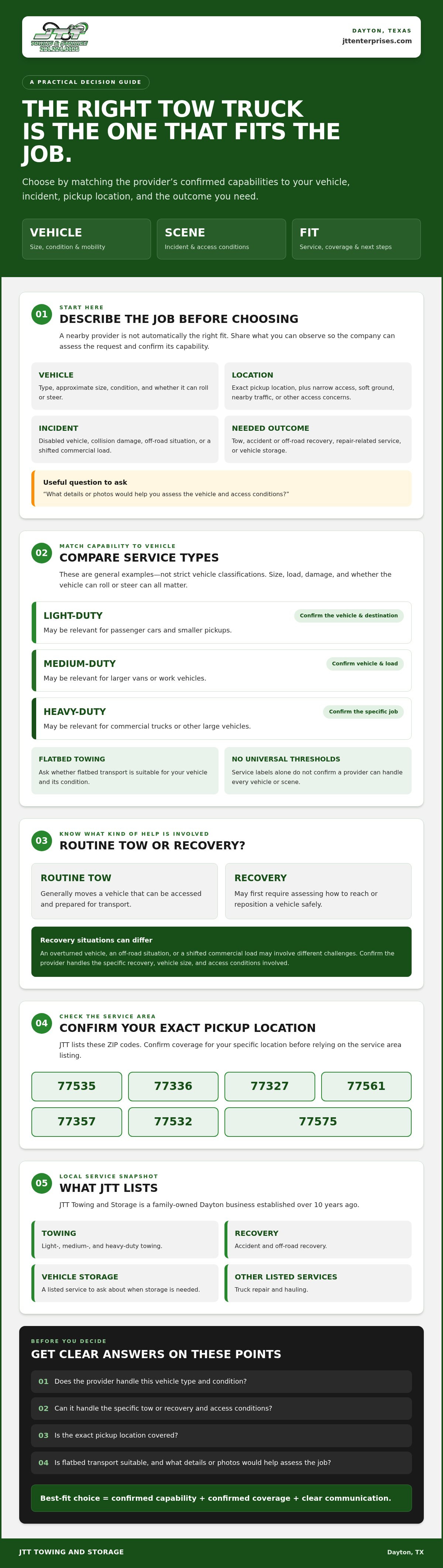
- Check whether your exact pickup location is covered. JTT lists ZIP codes 77535, 77336, 77327, 77561, 77357, 77532, and 77575; confirm coverage for your location.
- Learn how JTT’s towing, recovery, truck repair, hauling, and storage services may relate to different Dayton-area needs.
What Makes a Towing Company the Best Fit for Your Situation?
The best towing company isn’t necessarily the closest provider or the one with the broadest claims. It’s the company whose confirmed services match your vehicle, the incident, the pickup location, and the outcome you need. A provider equipped for a passenger car may not be prepared to assess a commercial truck recovery, so describe the job before deciding.
A suitable towing provider has the confirmed capability, coverage, and communication needed to handle your specific vehicle and situation. Clear answers about what the company can do and what happens next help you make an informed choice.
Which details determine whether a towing provider is a good fit?
Give the dispatcher practical details, even if you’re unsure how they affect the job. This helps the company assess the request and explain whether its services are a match.
- Vehicle: Share the type, approximate size, condition, and whether it can roll or steer.
- Location: Provide the pickup location and describe narrow access, soft ground, nearby traffic, or other conditions that may affect access.
- Incident: Explain whether the vehicle is disabled, damaged in a collision, stuck off-road, or involved in a load shift.
- Needed outcome: Clarify whether you need a tow, accident or off-road recovery, a repair-related service, or vehicle storage.
Ask what additional information or photos could help assess the vehicle and access conditions. Don’t guess about equipment or suitability; describe what you can observe and let the provider confirm its capability.
Why is specialized recovery different from a routine tow?
A routine tow generally involves moving a vehicle that can be accessed and prepared for transport. Recovery may first require assessing how to reach or reposition a vehicle safely. An overturned vehicle, an off-road situation, or a shifted commercial load can present different challenges, so not every towing provider will be equipped or offer the recovery service required.
Different types of tow trucks are designed for different towing tasks, but the vehicle and scene still determine what’s appropriate. Confirm that the provider handles the specific recovery, vehicle size, and access conditions involved. For complex commercial incidents, see this guide to Dayton tractor-trailer accident recovery.
Before requesting service, keep this checklist in mind: vehicle type, location, incident, access conditions, and needed outcome. Those details give a towing company a clearer basis to confirm fit and explain the next steps.
Compare Towing Services by Vehicle Type and Job Requirements
Towing service labels are a useful starting point, not a complete assessment of the job. The vehicle’s size, condition, and position can affect which service is appropriate. Vehicle size and condition help determine the towing or recovery service a provider should assess. Share those details and ask the company to confirm it can handle the request.
| Service category | May be relevant for | Confirm with the provider |
|---|---|---|
| Light-duty towing | Passenger cars and smaller pickups | Whether the vehicle’s condition and destination fit the service |
| Medium-duty towing | Larger vans or work vehicles | Whether the provider can accommodate the vehicle and its load |
| Heavy-duty towing | Commercial trucks or other large vehicles | Whether the specific vehicle and job conditions are within its capability |
These examples are general, not strict vehicle classifications. A vehicle’s exact size, load, damage, and ability to roll or steer can matter as much as the category name. If you’re comparing the best towing company for a particular job, describe the vehicle rather than relying on a label alone.
When should you ask about light-, medium-, or heavy-duty towing?
Ask which service level may fit, then provide the vehicle’s make and type, approximate size, condition, and whether it can move. Avoid assuming that a provider’s “heavy-duty” description covers every commercial vehicle or recovery situation. There are no universal thresholds to infer from the label here, so confirm the provider’s job-specific capability directly.
Flatbed towing is another service option, but the name alone doesn’t establish that it’s suitable for every vehicle. Describe the vehicle and its condition, then ask the provider to assess whether flatbed transport fits the request.
When might accident recovery or off-road recovery be needed?
A disabled vehicle after a collision may need accident recovery, while a vehicle stuck off-road may require a recovery assessment before it can be transported. An overturned vehicle or a shifted commercial load can introduce additional scene and access considerations. Recovery is about assessing and addressing the vehicle’s position; towing is the movement of a vehicle. Not every provider offers both, so confirm the specific service required.
For commercial vehicle context, read this guide to Dayton heavy-duty towing. If you’re considering a local provider, you can also review JTT’s towing and recovery services and confirm directly whether the service matches your vehicle and situation.
How to Evaluate a Towing Company Before You Request Service
A brief, organized conversation can help you determine whether a provider is equipped for the job and what to expect next. The best towing company for your situation should be able to explain its relevant service, confirm whether your pickup location is covered, and clarify the immediate arrangements without leaving you to guess.
Use this sequence when you call:
- Describe the incident. Explain what happened and the vehicle’s current condition. Mention anything that could complicate access or movement.
- Confirm service capability. Ask whether the company handles your vehicle type and the specific service you need, such as towing, accident recovery, or off-road recovery.
- Verify coverage. Give the exact pickup location, not just the nearest town, and ask whether the provider can serve that spot.
- Clarify next steps. Confirm the expected destination, any arrangements you need to make, and whether vehicle storage may be relevant.
What should you ask before choosing a towing provider?
Ask direct, job-specific questions: “Can you handle this vehicle and this type of request?” and “Where can it be taken?” If the recovery is complex, ask what further details could help the company assess it. Photos may help show vehicle position or access conditions, but check before sending them and follow the provider’s instructions. Clear answers help you understand the proposed service before arrangements are made.
How can you assess communication and service transparency?
Listen for a clear explanation of the service being discussed, what is confirmed, and what still needs assessment. Note the contact person, agreed destination, and any next steps. If details change, ask for the updated plan. Online reviews or a single testimonial can offer perspective, but they don’t verify that a company handles your particular vehicle or recovery. Confirm those capabilities directly.
Keep a short record of the call, especially if the vehicle may need storage or the destination depends on the recovery plan. If something is unclear, ask the provider to restate it before you proceed. You can also ask whether information about credentials or insurance is available, but don’t treat an unverified claim, rating, or response-time estimate as proof. Make your decision based on the service fit, coverage, and arrangements the provider confirms for your request.
Finding a Towing Company Serving Dayton and Nearby Communities
A company based in Dayton, Texas, may list nearby ZIP codes as part of its service area, but that doesn’t guarantee coverage for every address or every type of job within them. The exact pickup point, requested service, vehicle, and access conditions can all affect whether a provider can take the call. Confirm your location and towing or recovery needs directly rather than relying on a town name or ZIP code alone.
Which nearby ZIP codes should local customers ask about?
JTT Towing and Storage lists these ZIP codes in its stated service area: 77535, 77336, 77327, 77561, 77357, 77532, and 77575. If you’re in one of these areas, provide your specific address or roadside location and ask whether that pickup point and requested service are covered. A ZIP code by itself doesn’t confirm an arrival time, so ask the company about next steps for your particular request.
What information helps a local towing request move forward?
Give the dispatcher details that help identify the job and the pickup point. A precise location is more useful than a general reference such as “near Dayton.” Include the vehicle type and condition, whether it’s loaded or carrying cargo, and any access limits or hazards. For a recovery, describe the vehicle’s position and what makes it difficult to reach or move.
- Location: Share an address, road name, nearby landmark, or other precise location information you have.
- Vehicle: Identify the type, condition, and whether it’s carrying cargo or a load.
- Access: Explain narrow entrances, soft ground, traffic exposure, or other conditions that may affect access.
- Callback: Give a safe number and time or method for the company to reach you.
If you’re in an urgent roadside situation, move to a safer place if you can do so safely, and follow any emergency instructions. Don’t enter traffic or attempt to move a vehicle if doing so could put you at risk. Tell the provider about immediate hazards so the situation can be assessed.
Before confirming service, ask whether the job conditions fit the provider’s capabilities, where the vehicle may be taken, and whether storage is relevant. The best towing company for your needs is one that confirms the details for your actual location and situation, not one chosen by ZIP code alone. Contact JTT to confirm local coverage for your pickup point and requested service.
Why Consider JTT Towing and Storage for Dayton-Area Service?
JTT Towing and Storage is a family-owned and operated business based in Dayton, Texas, established over 10 years ago. Its service range includes several towing and recovery categories, along with vehicle storage. That may make JTT a local option to consider when you’re comparing providers, but the right fit still depends on your vehicle, pickup location, and the work needed.
The best towing company for one situation may not be the right match for another. A routine tow, a vehicle stuck off-road, and a commercial load shift call for different assessments. Confirm the specific service and job conditions with the company rather than assuming that a general service description covers every incident.
Which JTT services may fit your towing or recovery request?
JTT lists light-, medium-, and heavy-duty towing, as well as flatbed towing. Its recovery services include accident recovery and off-road recovery. The company also lists airbag recovery, load shifts and transfers, and vehicle storage. These categories can help you identify what to ask about based on your situation.
- Disabled vehicle: Ask whether light-, medium-, or heavy-duty towing fits the vehicle and its condition.
- Collision or off-road incident: Describe the vehicle’s position and access conditions, then ask about accident or off-road recovery.
- Load issue: Explain what has shifted and ask whether the request fits the listed load shift and transfer service.
- Storage need: Ask whether vehicle storage may be suitable and clarify the arrangements directly.
These service descriptions aren’t a guarantee that every vehicle or incident can be handled. JTT should confirm its capability for the specific request, including any unusual access or recovery conditions.
What should you have ready when contacting JTT?
A clear description helps the company assess whether its services fit your situation. Have the vehicle type, exact location, and current condition ready. Explain the problem in a few direct sentences. If the vehicle is carrying cargo or equipment, share what you know about the load, and mention narrow access, limited clearance, or other restrictions that could affect the job.
Use the conversation to confirm the service, coverage for your pickup point, possible destination, and next steps. If you’re uncertain whether the situation calls for towing or recovery, describe what happened and ask which listed service may apply.
To discuss your vehicle and situation with JTT Towing and Storage, contact JTT Towing and Storage and confirm whether its services fit the request.
Choose a Provider That Fits the Job
A confident towing decision starts with a clear match: the provider’s services should fit your vehicle and situation, and the company should confirm coverage for your exact pickup location. Share the key details, ask what service is appropriate, and clarify where the vehicle may be taken. Those straightforward steps can help you choose the best towing company for your needs without relying on assumptions.
For Dayton-area drivers, JTT Towing and Storage is a local option to consider. The family-owned and operated business has served the area for over 10 years and lists a seven-ZIP-code service area. Confirm directly whether your location and requested towing or recovery service are covered.
Contact JTT Towing and Storage to discuss your towing or recovery needs and get a clear conversation started. With the right details in hand, you can take the next step with greater confidence.
Frequently Asked Questions
What makes a towing company the best choice?
The best towing company for your situation is one that confirms it can handle your vehicle, the specific service, and your pickup location. Ask whether it offers routine towing, accident recovery, or off-road recovery as needed. Explain the vehicle’s condition and scene details rather than relying on a broad service claim. Clear communication about the proposed service and next steps can help you decide whether the provider is a suitable fit.
How do I know whether I need heavy-duty towing?
The vehicle and the job conditions help determine whether heavy-duty towing may be appropriate. Tell the provider what type of vehicle is involved, its approximate size and condition, whether it can move, and whether it’s carrying cargo. Then ask the company to confirm it can handle that particular request. A general towing listing doesn’t establish that a provider can accommodate every commercial vehicle or recovery situation.
Can a towing company handle accident recovery and regular towing?
Some companies offer both, but their services and capabilities vary. Regular towing generally involves transporting a vehicle, while accident recovery may require assessing its damage, position, and access to the scene. JTT Towing and Storage lists both towing and accident recovery among its services. Describe what happened, the vehicle involved, and any cargo or access concerns, then confirm directly whether the company can handle the specific recovery.
What information should I give a towing company when I call?
Start with your precise location, vehicle type, condition, and a brief account of what happened. Explain whether it can roll or steer, whether it carries cargo, and whether access is restricted by traffic, narrow space, or other hazards. Share a callback number and your preferred destination if known. This information helps the provider assess the request. Confirm service fit, location coverage, and the next steps directly.
Does JTT Towing and Storage serve areas near Dayton, Texas?
JTT Towing and Storage is based in Dayton, Texas, and lists ZIP codes 77535, 77336, 77327, 77561, 77357, 77532, and 77575 in its stated service area. A ZIP code alone doesn’t confirm coverage for every address or service request. Provide your exact pickup location and explain the towing or recovery needed, then contact JTT to verify whether it can assist at that location.
What is the difference between towing and vehicle recovery?
Towing generally means transporting a vehicle from one location to another. Recovery may involve assessing or repositioning a vehicle before transport, such as when it’s overturned, stuck off-road, or difficult to access. The work depends on the vehicle’s position and the conditions around it. Describe the scene clearly and ask the provider whether towing, accident recovery, or off-road recovery is the appropriate service for your situation.
Should I ask where my vehicle will be taken after a tow?
Yes. Confirm the intended destination before service proceeds, especially if the vehicle can’t go directly to a repair facility. If a vehicle has reached the end of its life or suffered irreparable damage, you might choose vehicle disposal instead; for instance, specialized car buyers like Oriental Car Removal help owners coordinate the pickup and removal of damaged or unwanted vehicles. Ask whether vehicle storage is available if that may be needed, and clarify how access or retrieval arrangements work. For an accident or commercial vehicle, identify who will coordinate the destination and any related logistics. Clear expectations can help prevent confusion after the vehicle has been moved.


