
A standard heavy-duty wrecker is a powerful tool, but it isn't always the right solution to protect your most valuable commercial assets during a recovery. If you manage a fleet in Dayton or Liberty County, you know that a loaded tractor-trailer overturned in a ditch is more than just a breakdown; it's a high-stakes engineering challenge. You likely worry about secondary damage caused by improper rigging or the mounting costs of extended downtime. It's a stressful situation where you need more than just a pull. You need specialized heavy lift towing services that prioritize precision and safety over raw force.
We understand the pressure of getting your equipment back on the road without making a bad situation worse. This guide explains the specialized technology and engineering behind high-capacity recovery. You'll discover the unique capabilities of rotator trucks and learn exactly when your commercial fleet needs a heavy lift response instead of a standard tow. We also provide a clear checklist on how to prepare your site so a recovery team can work efficiently to secure your cargo. By the end, you'll have the confidence to make the right call when every second and every asset counts.
Key Takeaways
- Differentiate between standard towing and heavy lift technology to ensure you choose the right equipment for vertical and rotational recovery needs.
- Identify high-stakes scenarios, such as overturned tractor-trailers, that necessitate specialized heavy lift towing services to protect your commercial assets.
- Master scene safety and communication protocols to minimize downtime and prevent secondary accidents on busy Texas highways.
- Understand how advanced hydraulic systems and outriggers maintain stability during complex recoveries on uneven or off-road terrain.
- Learn how Dayton-based expertise and 24/7 readiness provide a reliable bridge between industrial-scale power and community-focused care.
What is Heavy Lift Towing? Defining High-Capacity Recovery
Heavy lift towing isn't just about using a bigger truck; it's a fundamental shift in mechanical recovery physics. While standard towing focuses on pulling a vehicle behind a wrecker, heavy lift towing services involve specialized equipment designed to lift and move objects that exceed standard capacities. This process is essential when dealing with massive industrial assets that require more than just a horizontal pull to be recovered. In these high-stakes operations, weight distribution and the center of gravity become the primary concerns for the recovery team. If the center of gravity isn't properly calculated, the risk of a catastrophic tip-over or equipment failure increases. Precision rigging and careful planning ensure that the load remains stable throughout the entire movement.
Beyond simple recovery, heavy lift plays a vital role in minimizing environmental impact and secondary property damage. When a loaded trailer is dragged across the ground, it often causes significant soil disturbance or ruptures fuel lines. By lifting the asset vertically, operators can clear the scene without further damaging the surrounding terrain or the vehicle's own structural integrity. Most heavy-duty tow trucks are built for strength, but heavy lift adds the necessary element of control.
Heavy Duty vs. Heavy Lift: Knowing the Difference
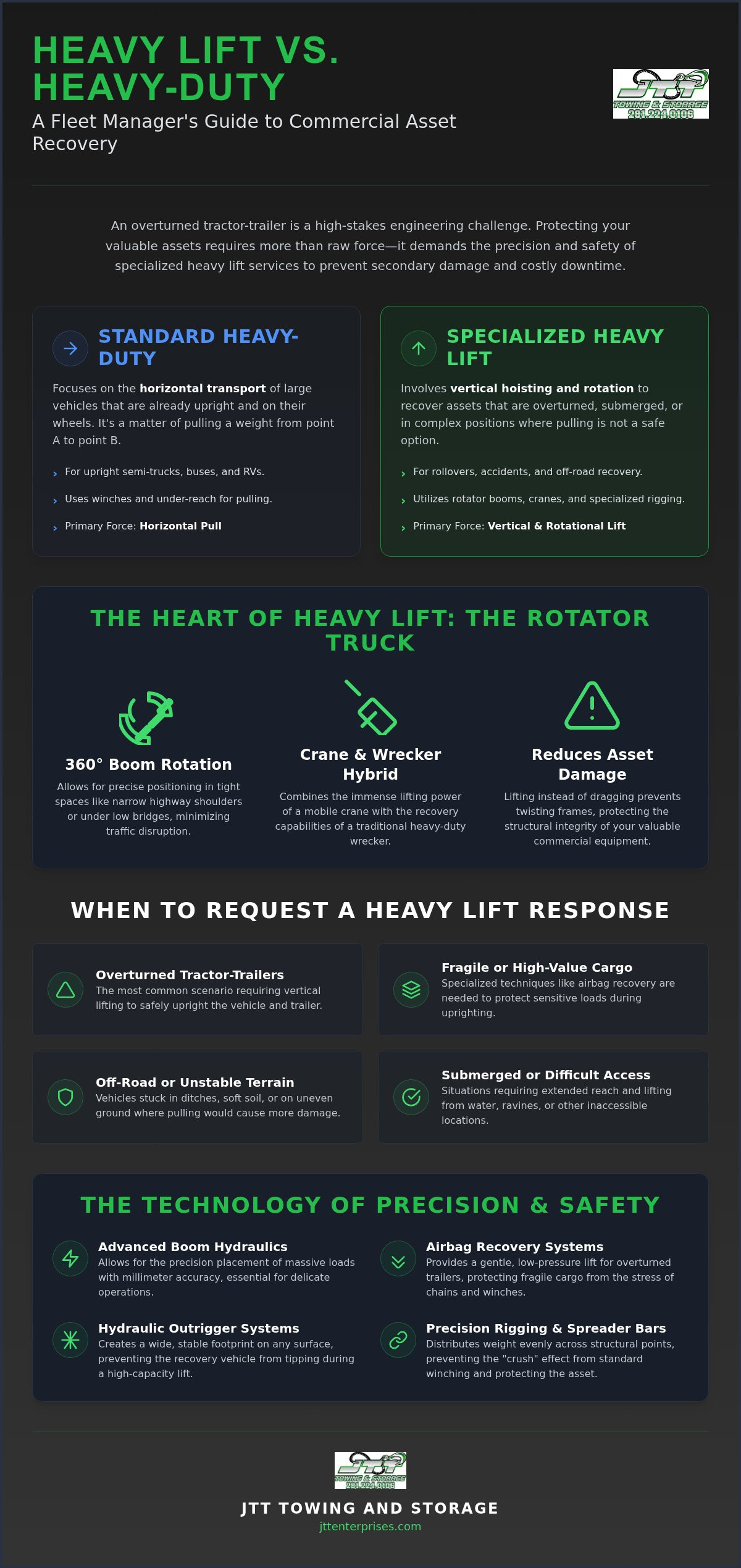
The distinction between these two services is often found in the direction of the force applied. Standard heavy-duty towing focuses on the horizontal transport of semi-trucks, buses, and other large vehicles that are already upright and on their wheels. It's a matter of moving a weight from point A to point B. In contrast, heavy lift introduces vertical hoisting capabilities. This is necessary for overturned or submerged assets that cannot be safely pulled. When a vehicle's orientation changes from upright to on its side or roof, a standard tow becomes a heavy lift scenario. Attempting to pull an overturned truck without lifting it first can twist the frame and result in a total loss of the asset.
The Essential Role of the Rotator Truck
The rotator is the most versatile tool in the heavy lift arsenal, acting as the "reliable guardian" for complex recovery scenes. Its 360-degree boom rotation changes the recovery landscape by allowing the truck to operate in extremely tight spaces. On narrow Texas highway shoulders or under low-clearance bridges, a rotator can position its boom exactly where it's needed without requiring multiple lanes of traffic to be closed. A rotator truck is a hybrid between a mobile crane and a traditional tow truck, combining the lifting power of a crane with the recovery features of a wrecker. This flexibility allows for the uprighting of trailers and the precise placement of heavy machinery in environments where a standard fixed-boom truck simply cannot reach.
The Technology Behind Heavy Lift Towing Services
Successful heavy lift towing services rely on advanced boom hydraulics that allow for the precision placement of massive loads with millimeter accuracy. In Dayton, where the ground is often soft or uneven, stability is maintained through complex outrigger systems. These hydraulic legs extend from the truck to create a much wider footprint, preventing the vehicle from tipping during a high-capacity lift. The Towing and Recovery Association of America sets the standard for how these systems should be deployed to ensure operator and public safety. Proper deployment means the truck becomes an unmovable anchor, even when lifting several tons at a full boom extension. This stability is what allows a recovery team to work safely in high-traffic or tight-clearance areas.
Rigging is another critical component that separates standard towing from specialized recovery. We use high-strength alloy chains and spreader bars to distribute weight evenly across an object's structural points. Spreader bars are especially important for protecting the integrity of the asset. They keep the lifting cables away from the sides of the vehicle, preventing the "crush" effect that often occurs when using standard winching methods. This technical approach ensures that your equipment is handled with the highest standards of care, reducing the risk of expensive repairs after the recovery is complete.
Airbag Recovery: Protecting the Cargo
Overturned trailers often carry fragile or expensive inventory that can't handle the stress of traditional chains. Using airbag recovery for semi trucks provides a much gentler solution. Low-pressure air cushions are placed strategically under the vehicle and slowly inflated to upright the trailer. This method spreads the lifting force over a large surface area, which prevents puncturing the trailer's thin aluminum skin. It's often the difference between saving a load and facing a total loss during a recovery operation. For logistics managers, the cost-benefit of this technology is clear; it preserves the cargo and keeps insurance claims to a minimum.
Winching and Off-Road Capabilities
Recovery in Texas mud or on steep embankments requires a deep understanding of physics and equipment limits. Heavy winch recovery isn't just about pulling; it's about calculating resistance and mechanical advantage. For construction and oil field machinery, we utilize multi-line pulls and wire ropes with high-load ratings. This ensures that even the heaviest equipment can be extracted from off-road sites without snapping lines or damaging the machinery's frame. If you're dealing with a complex recovery in challenging terrain, it's wise to consult with a professional team that has the right technical ratings for the job. Our equipment is built to handle the most demanding environments while maintaining total control over the asset.
When to Call for Heavy Lift: Common Commercial Scenarios
Standard towing is often enough for a simple mechanical breakdown, but complex logistical failures require a more sophisticated response. Knowing when to request heavy lift towing services can be the difference between a successful recovery and the total loss of an expensive asset. One of the most common scenarios involves overturned semi-trailers. In these cases, the trailer must be uprighted vertically before it can be safely transported. If you try to pull an overturned trailer horizontally, you risk twisting the chassis or causing the load to spill across the highway. Precision lifting prevents these secondary disasters.
Infrastructure incidents also demand high-capacity precision. When a vehicle is wedged under a bridge or stuck in a narrow construction zone, there isn't room for a traditional wrecker to maneuver. Specialized heavy lift equipment can reach over obstacles to hoist the vehicle straight up, clearing the scene without damaging public property. These operations are often governed by strict FMCSA safety regulations, requiring a team that understands both the physics of the lift and the legal requirements of the road. We also see a high demand for heavy lift when equipment ends up in deep ravines or submerged in water, where a vertical hoist is the only way to retrieve the asset without causing further environmental damage.
Industrial and Oil Field Equipment Hauling
The energy sector in Liberty County relies on massive, heavy components like generators, transformers, and oil field machinery. Moving these items across active job sites requires more than a simple flatbed; it requires the stability and reach of a heavy lift system. We provide the specialized support for heavy equipment hauling Texas operators depend on for their daily productivity. This also includes managing load shifts and transfers. If a load becomes unstable during transit, our team can secure the cargo and transfer it to a new trailer, preventing a dangerous rollover before it happens.
Bus and Large Vehicle Recovery
Buses present unique challenges due to their long wheelbases and extremely low ground clearance. Standard towing can easily scrape the undercarriage or damage the fragile fiberglass and composite bodies of modern coaches. Our bus towing services Dayton TX utilize heavy lift precision to ensure the coach is lifted from the correct structural frame points. This protects the aesthetic and structural integrity of the vehicle. Whether it's a municipal transit bus or a private tour coach, we treat these high-value assets with the professional care they deserve.
Safety First: What to Do While Waiting for Heavy Recovery
The moments following a major commercial incident are often the most dangerous. On high-speed corridors around Dayton, the risk of a secondary collision is high. Your primary responsibility is to secure the scene and protect human life while waiting for professional heavy lift towing services to arrive. This requires a calm, methodical approach to manage the immediate environment. Clear communication with your dispatcher is essential; they need to know the exact orientation of the vehicle and any immediate hazards that could complicate the recovery process.
When you call for assistance, provide specific details about the load and any fluid leaks. If hazardous materials are involved, notify the authorities immediately. Our specialized heavy lift towing services are designed to manage these complexities, but we rely on your initial report to prepare the recovery plan. Documenting the scene with photos from a safe distance provides critical evidence for insurance adjusters and logistical records. This preparation helps our team deploy the right equipment as soon as we arrive on-site. If you need immediate assistance with a complex recovery, you can contact our dispatch team for 24/7 support.
5 Critical Safety Steps for Drivers
- Move to a safe distance: Never stay inside the cab during a heavy recovery operation. The tension on winch lines and the weight of the lift make the immediate area extremely hazardous if a cable snaps or the load shifts.
- Deploy high-visibility markers: If it's safe to do so, set up flares or reflective triangles well behind the incident to alert oncoming traffic.
- Wear high-visibility gear: Always wear a safety vest to ensure you're seen by other motorists and arriving emergency responders.
- Establish a perimeter: Keep bystanders and unauthorized personnel away from the vehicle's "fall zone" to prevent injuries during the uprighting process.
- Verify capabilities: When searching for "towing near me," confirm the provider has the specific high-capacity equipment needed for heavy recovery rather than just a standard light-duty truck.
Site Preparation for the Heavy Lift Team
A heavy lift operation requires a stable and clear "footprint" for the truck's outriggers to deploy safely. Clear away any small debris or loose equipment that might obstruct the recovery path. It's also vital to inform the dispatcher about the soil conditions at the scene. In Dayton and Huffman, the ground can vary from solid pavement to soft, saturated mud. Knowing this allows the team to bring the necessary cribbing and support plates to prevent the recovery truck from sinking during the lift. Drivers must also identify any overhead obstructions like power lines or low-hanging tree branches that could interfere with the boom's vertical reach.
Choosing JTT Towing for Heavy Lift Services in Dayton, TX
When your commercial fleet faces a crisis, the provider you choose determines the speed and safety of the outcome. JTT Towing and Storage stands as a reliable guardian for the Dayton community, combining industrial-scale equipment with the accountability of a family-owned business. We've spent over 10 years perfecting our heavy lift towing services to meet the unique demands of Texas logistics. Our team doesn't just show up with a truck; we bring a decade of expertise and a commitment to integrity that only a local, community-rooted partner can provide. We understand that a breakdown or accident is a high-stakes situation, and we're here to provide a stable, calm response to get your operations back on track.
Our 24/7 availability means we're ready for emergency recovery in Dayton, Huffman, and throughout Liberty County whenever the need arises. We prioritize a damage-free recovery process by utilizing the latest rotator and airbag technology mentioned earlier in this guide. This precision-focused approach reduces the stress of the situation, giving you peace of mind that your assets are in professional hands. We don't rely on aggressive sales tactics; our reputation is built on years of dependable service and a neighborly reliability that larger, corporate firms often lack. We're a trusted partner that combines the efficiency of a large-scale operation with personal accountability.
Local Expertise in Dayton and Liberty County
Our deep roots in the region mean we don't need a map to find the fastest route to your scene. We have navigated local routes like Hwy 90 and Hwy 146 for years, understanding the specific traffic patterns and terrain challenges that out-of-town operators might miss. JTT has provided the heavy duty towing Dayton TX commercial drivers have relied on for over a decade. This local knowledge allows us to coordinate with law enforcement and clear scenes more efficiently. Beyond the recovery itself, we maintain a network of secure storage solutions and specialized hauling options to manage your cargo after the initial lift is complete.
Ready for Any Challenge: Our 'Can-Do' Philosophy
We believe that no task is too complex or demanding for our specialized fleet. Our heavy lift towing services are equipped to handle everything from submerged excavators in remote ravines to overturned log trucks on narrow county roads. This "can-do" attitude defines our personality; we possess the quiet confidence that comes from years of successful recoveries in the field. We treat your equipment with the same level of care and respect we would our own, ensuring that every strap, chain, and lift is executed with total precision. When you face a logistical failure that requires more than a standard wrecker, contact JTT for immediate, professional heavy lift support.
Secure Your Commercial Assets with Precision Recovery
Heavy lift towing services provide the critical engineering needed to manage complex recovery challenges without causing secondary damage to your fleet. By understanding the specialized technology of rotators and the precision of airbag systems, you can protect your equipment's value even in the most difficult circumstances. JTT Towing and Storage stands as a reliable guardian for businesses in Dayton and Liberty County, offering the calm competence required for high-stakes industrial recoveries. We've been family-owned and operated for over 10 years, and we treat every truck or piece of machinery as if it were our own.
Our team is available for 24/7 emergency heavy recovery, ensuring that help is always a phone call away. Whether you're dealing with an overturned trailer or submerged oil field equipment, we have the specialized rotator and airbag services to handle the job with total precision. Don't let improper equipment lead to costly downtime or permanent asset damage. Trust in our proven local experience to get your equipment back on the road safely.
Need Expert Heavy Lift Support? Call JTT Towing and Storage Now!
We look forward to serving as your trusted partner and keeping your commercial operations moving forward with confidence.
Frequently Asked Questions
What is the difference between a rotator and a standard heavy wrecker?
A rotator features a boom that can rotate 360 degrees, whereas a standard heavy wrecker has a fixed boom that only moves up and down or extends forward. This rotational capability allows the rotator to function like a mobile crane, hoisting vehicles vertically and swinging them into position. Standard wreckers rely on positioning the truck directly in line with the pull. Rotators are essential for tight spaces where there isn't room to maneuver a traditional truck.
How much weight can a heavy lift tow truck actually handle?
High-capacity recovery vehicles are engineered to handle loads ranging from 50 tons to over 75 tons depending on the specific equipment and boom extension. The actual lifting capacity varies based on the angle of the boom and the stability of the ground. These trucks are designed to manage fully loaded tractor-trailers, cement mixers, and heavy industrial machinery. Our team calculates the center of gravity and weight distribution before every lift to ensure the operation remains safe.
Is heavy lift towing more expensive than standard towing?
Heavy lift towing services typically involve higher operational costs due to the specialized nature of the equipment and the advanced training required for the operators. These services utilize multi-million dollar machines like rotators and specialized rigging that standard tows don't require. While the initial investment is higher, utilizing these precision services often saves money by preventing secondary damage to your vehicle and cargo. It's a strategic choice to protect high-value commercial assets during complex recovery scenarios.
Can you perform heavy lift recovery off-road or in the mud?
Yes, we specialize in off-road winch-outs and recoveries in challenging Texas terrain. Our heavy-duty trucks are equipped with advanced outrigger systems and high-traction tires to maintain stability on soft soil or steep embankments. We use specialized cribbing and support plates to distribute the truck's weight, preventing it from sinking while lifting a heavy load. This capability is vital for recovering construction equipment or oil field machinery that has veered off the road into saturated ground.
Do you provide heavy lift services for construction equipment in Dayton?
We provide comprehensive recovery and hauling for all types of construction machinery within the Dayton and Huffman areas. This includes excavators, dozers, and pavers that require high-capacity lifting due to their immense weight and awkward dimensions. Our local expertise allows us to navigate the specific job site conditions found in Liberty County. We treat every piece of industrial equipment with the care it deserves, ensuring it's moved safely to its destination or our secure storage facility.
What information do I need to provide when calling for a heavy lift tow?
When you call our dispatch team, please provide the vehicle's location, its orientation, and the type of cargo it's carrying. We also need to know about the surrounding terrain, such as whether the ground is paved or mud, and if there are overhead obstructions like power lines. Providing details about fluid leaks or hazardous materials is also critical. This information helps us deploy the correct rigging and equipment to manage the recovery process as efficiently as possible.
How do you ensure the cargo isn't damaged during a lift?
We use specialized tools like spreader bars and low-pressure airbag recovery systems to protect your cargo's integrity. Spreader bars keep lifting cables away from the sides of the trailer, preventing the "crush" effect common with standard winching. Airbags provide a gentle, even lift for overturned trailers, which is especially important for sensitive or fragile loads. Our operators are trained to prioritize the structural safety of your asset throughout every stage of the high-capacity recovery operation.
Are your heavy lift services available 24/7 in Liberty County?
Our heavy lift towing services are available 24 hours a day, 7 days a week, throughout Dayton and all of Liberty County. We understand that commercial accidents don't follow a schedule and often happen during late-night hours or in poor weather. Our "reliable guardian" philosophy means we're always prepared to deploy our specialized fleet at a moment's notice. You can count on a professional, steady response whenever a high-stakes situation threatens your fleet's productivity.


